Mobile Navigation

  • National
    • Policy
      • High Expectations
      • Quality Choices
      • Personalized Pathways
    • Research
    • Commentary
      • Gadfly Newsletter
      • Flypaper Blog
    • Events
    • Scholars Program
  • Ohio
    • Policy
      • Priorities
      • Media & Testimony
    • Research
    • Commentary
      • Ohio Education Gadfly Biweekly
      • Ohio Gadfly Daily
  • Charter Authorizing
    • Application
    • Sponsored Schools
    • Resources
  • About
    • Mission
    • Board
    • Staff
    • Career
Home
Home
Advancing Educational Excellence

Main Navigation

  • National
  • Ohio
  • Charter Authorizing
  • About

National Menu

  • Topics
    • Accountability & Testing
    • Advanced Education
    • Career & Technical Education
    • Charter Schools
    • Curriculum & Instruction
    • ESSA
    • Evidence-Based Learning
    • Facilities
    • Governance
    • Personalized Learning
    • Private School Choice
    • School Finance
    • Standards
    • Teachers & School Leaders
    • Think Again
  • Research
  • Commentary
    • Gadfly Newsletter
    • Flypaper Blog
    • Gadfly Podcast
  • Events
  • Scholars Program

The Education Gadfly Weekly

Sign Up to Receive Fordham Updates

We'll send you quality research, commentary, analysis, and news on the education issues you care about.
Thank you for signing up!
Please check your email to confirm the subscription.

The Education Gadfly Weekly, Volume 14, Number 35: Making teaching teachable

Volume 14, Number 35
8.27.2014
8.27.2014

The Education Gadfly Weekly, Volume 14, Number 35: Making teaching teachable

Volume 14, Number 35
view

Making teaching teachable

Many of our recent ed-reforms—e.g. Teach for America, alternative certification, the Hamilton Project, and various “new teacher” projects—implicitly subscribe to the idea that great teachers are born, not made. Ed schools, too, largely consider “training” teachers to be beneath their dignity. Hence the path to instructional excellence is to welcome all sorts of smart people into the classroom via all sorts of entry paths, then weed out those who don’t cut it.

Robert Pondiscio 8.27.2014
NationalFlypaper

Making teaching teachable

Robert Pondiscio
8.27.2014
Flypaper

An elder statesman speaks

Terry Ryan
8.27.2014
Flypaper

Arne pumps oxygen back into Common Core implementation

The Education Gadfly
8.27.2014
Blog

Hitting pause on testing, vouchers, and union solidarity

8.27.2014
Resource

What is Education Governance?

3.7.2013
Video

The Long Shadow: Family Background, Disadvantaged Urban Youth, and the Transition to Adulthood

8.27.2014
Blog

Pathways to Teacher Leadership: Emerging Models, Changing Roles

8.27.2014
Blog
view

An elder statesman speaks

Terry Ryan 8.27.2014
Flypaper
view

Arne pumps oxygen back into Common Core implementation

The Education Gadfly 8.27.2014
Blog

Hitting pause on testing, vouchers, and union solidarity

Robert Pondiscio, Amber M. Northern, Ph.D. 8.27.2014
Resource
view

What is Education Governance?

3.7.2013
Video
view

The Long Shadow: Family Background, Disadvantaged Urban Youth, and the Transition to Adulthood

8.27.2014
Blog
view

Pathways to Teacher Leadership: Emerging Models, Changing Roles

8.27.2014
Blog
view

Making teaching teachable

Robert Pondiscio
8.27.2014
Flypaper

photo credit: Night Owl City via photopin cc

Many of our recent ed-reforms—e.g. Teach for America, alternative certification, the Hamilton Project, and various “new teacher” projects—implicitly subscribe to the idea that great teachers are born, not made. Ed schools, too, largely consider “training” teachers to be beneath their dignity. Hence the path to instructional excellence is to welcome all sorts of smart people into the classroom via all sorts of entry paths, then weed out those who don’t cut it.

In her new book, Building a Better Teacher, veteran education journalist Elizabeth Green sets out to dismantle this notion.

If she’s right and the reformers are wrong it would be good news, for then we could devise purposeful strategies for improving classroom instruction at scale—and not subject kids to a trial-and-error process of teacher selection. This possibility makes Building a Better Teacher an important book. Alas, Green offers scant evidence to support the made-not-born thesis. Indeed, her biggest proof point—a lengthy examination of the teaching techniques pioneered by a small cadre of math teachers in Michigan—comes perilously close to undermining the case she sets out to build.

This narrative focuses on the work of Deborah Ball, currently dean of education at the University of Michigan. Back in the day, she was a gifted fifth-grade math teacher at Spartan Village Academy in East Lansing. While still a student at Michigan State (MSU), Ball and a colleague, an equally talented teacher named Magdalene Lampert, began collaborating on a project to describe and codify their math teaching methods.

These scenes are among the book’s best. Green, the founder and editor of Chalkbeat, is one of the best reporters and writers in the education field. She is in peak form offering play-by-play in classrooms as children grapple with fascinating explorations of odd and even numbers and fractions, guided by Lampert and Ball. “If two women in Michigan could teach this way,” Green asks, “people began to wonder, why couldn’t everyone?”

Why not? For starters, and in a curious bit of foreshadowing, Lampert and Ball struggle to name their work, let alone describe it. Not really progressive, not exactly constructivist, but clearly not traditional, it becomes simply “This Kind of Teaching” or TKOT. Nevertheless, Spartan Village becomes “a full-fledged teaching laboratory” devoted to the model’s proliferation.

The school fills up with teachers-in-training, grad students, and education professors. But teaching TKOT proves just as tricky as naming it. “Magdalene quickly found that her observers failed to see the subtlety of her methods. They saw only the least important details. After all, Magdalene’s most important work, her moment-to-moment decisions about what to do, lived only in her own head.”

TKOT is presented as a vast improvement over “dull, rote, blah” traditional math teaching, which Ball derides as “uninspiring at best, mentally and emotionally crushing at worst.” Yet, if there’s empirical proof of TKOT’s superiority, Green doesn’t offer it. We’re evidently to take it on faith. Of course, even if we accept the idea that Ball and Lampert discovered something transcendent, it’s not too useful unless, as the book’s subtitle puts it, we also learn “how to teach it to everyone.”

Enter Judith Lanier, who became dean of MSU’s ed school in 1980. Lanier gets a grant from the state legislature to create more “professional-development schools” like Spartan Village. By the end of the 1990s, “more than a dozen MSU professors had made home bases of local schools and embarked on new teaching research.” (But still no evidence is offered of student success.)

“It was hard not to feel like MSU was the center of a new universe, ground zero for a new national reform movement,” Green notes. The Michigan State team goes to California, only to be disappointed by teachers who eagerly embrace the idea of “teaching for understanding,” but don’t actually change their practice. “What stopped them from implementing the ideas more effectively wasn’t a lack of will, but a lack of clarity about what to do.”

Even back at Spartan Village, Green notes, “the work proved unsustainable.” Conflicts arose. Things fell apart. Key figures withdrew. Lanier resigned and moved to Flint, Michigan—where, after a few years, her reforms failed there, too. She finally left education altogether and “moved permanently to Beaver Island in Lake Michigan, the most remotely inhabited island in the Great Lakes,” Green reports. “She has lived there ever since.”

If a single school cannot sustain a method of teaching, even with the energetic efforts of a major research university behind it, what reason can there be to hope for an entire state to succeed, let alone the entire nation? Green, who’s too savvy a journalist not to understand the damage the Michigan denouement does to her argument, has an answer. Like aging major league baseball players, Spinal Tap, and David Hasselhoff, it turns out that cutting-edge math teaching techniques are huge in Japan, which took “a population of earnest but ordinary teachers and produced a country full of Magdalene Lamperts.” That nation has posted some of the best math scores in the world using techniques made in America, Green reports in both her book and a New York Times Magazine article. Yet this claim has since come under heavy fire.

Shortly after the magazine piece appeared, Brookings’s Tom Loveless wrote a withering critique, puncturing “six myths” offered by Green, and noting that Japan’s superiority in math long predates the reforms highlighted in Building a Better Teacher. “If Japan now outscores the U.S. because of superior teaching, how could it possibly have performed better on math tests in the 1960s?” Loveless asked. “And what about the decline in Japan’s math achievement since 1995? Is this really the nation we should look to for guidance on improving math instruction?”

Green makes much of Japan’s cultural commitment to craftsmanship and the practice of jugyokenkyu, or “lesson study,” to explain why reforms that failed here took root there. But another possibility—Japan’s national curriculum—is unexplored. (So, too, the country’s culture of hard work and education-obsessed parents.) It’s a potentially glaring omission. At one point, Green casually observes that, in a given week, “sixth-grade classrooms across Japan were introducing the concept of proportional relationships.” When every teacher is delivering the same content at the same time in a culturally homogeneous country, perhaps the conditions are ripe for jugyokenkyu to take root and spread. America—with its traditions of teacher autonomy, local control, and our aversion to established curriculum—offers less fertile soil.

Green has done outstanding reporting for several years on efforts to improve teacher education. A previous New York Times Magazine cover story on Doug Lemov in 2010 elevated him from a cult figure within the “no excuses” charter school movement to a full-on guru. Green returns to Lemov’s work in Building a Better Teacher, but now seems to have soured on it, suggesting that its principal power lay in behavior, classroom management, and discipline, more than academic instruction. She repeatedly describes his work and that of his colleagues as a product of “educational entrepreneurs,” a regrettable term redolent with false and misleading meanings.

Indeed, valorizing the work of Lampert and Ball over Lemov’s is Building a Better Teacher’s biggest problem. Lemov has succeeded where the Michigan State team failed—in replication. If Lampert’s best work “lived only her head,” Lemov’s exists in a series of extremely specific teaching methods that can be named, demonstrated, practiced, and mastered. Granted, they can be overdone and applied robotically—but Lemov’s “taxonomy” has become the standard practice in high-performing charters and beyond. Hundreds, perhaps thousands, of teachers flock to Lemov’s workshops each year to learn the techniques described in his book Teach Like a Champion, which has sold 750,000 copies and been translated into eight languages. Lemov’s techniques are as specific as TKOT is vague.

In the end, it is not enough to be innovative. The innovations must stick. We are many years from knowing whether Lemov’s work will put down deep roots beyond charter schools—and longer still from measuring the enduring effects on student achievement, if any, of LKOT—Lemov’s Kind of Teaching. But if teachers are to be made, after all, rather than born, then good instructional practice must be something that can be identified, named, practiced, and mastered by millions.

It is deeply odd for teachers to think that teaching itself is the one thing than cannot be taught. The singular strength of Green’s book is her willingness to tackle that myth—and it is a myth—head-on. But she undermines her argument by supporting it with a pedagogical preference instead of data.

Changing our view of teaching from art and alchemy to skill and craft is an essential shift in perspective, and is a worthy endeavor for researchers and journalists alike. Thus Building a Better Teacher is covering the right race but may be backing the wrong horse.


Register to attend next week’s Fordham event with Elizabeth Green and Robert Pondiscio, an extended talk on Green’s new book Building a Better Teacher.

view

An elder statesman speaks

Terry Ryan
8.27.2014
Flypaper

photo credit: Thomas Hawk via photopin cc

Being an education reformer is often frustrating. No matter how zealously we push an idea or how smart we think it is, sometimes nothing changes. Or—the Common Core is a recent example—we make fast, bold gains at the outset, only to see our efforts watered down, neutered, or repudiated outright. Sure, we take solace in education’s slow, steady improvement. But this, too, frustrates us because kids grow up fast and shouldn’t have to wait for the upgrades they needed yesterday.

The respected education innovator (and inaugural Charter School Hall of Famer) Ted Kolderie sums it up well in his provocative new book:

Trying endlessly to push change into an inert system makes no basic sense. A concept of education policy built on this theory of action does not work; is not practical…Nor does the effort to transform the system radically through political action succeed. It, too, is not practical. A political majority for radical change is almost a contradiction in terms.

Kolderie knows the reform struggles of the last thirty years as well as anybody, and The Split Screen Strategy: Improvement + Innovation does a fantastic job of showing the limitations of these faulty assumptions and naïve dreams.

Take charter schools, which have underperformed and proven unnecessarily contentious. Part of the problem is that their advocates early on lost sight of chartering’s original purpose: giving educators the freedom to do things differently.

This vision led even the AFT’s Al Shanker to back chartering at its debut. Today, however, proponents are lost in the orthodoxy of “closing achievement gaps” and pushing for replication and “scaling.” Success is now defined as outperforming district schools on standardized state tests. That strategy has led to some great results by high-flyers like KIPP—but it isn’t enough. Along the way, chartering has become irrelevant to rural and suburban America. And its narrow criteria for success stifle technological innovation and impede broader ideas of student achievement.

The solution, Kolderie argues, is a “split screen strategy” that supports worthy current reform efforts (like those of successful CMOs and open-minded school districts), but also makes room for open-source innovation. He calls for giving people across the K–12 sector, especially those at the school level, freedom to try new things. Specifically, Kolderie wants a number of charters and district schools to function as testing grounds, pilot sites, and R&D generators—a return to the original idea of chartering, but applied to “a modest sector” of K–12 schools.

These schools would serve as “skunk works” for America’s wider school-improvement efforts. They would experiment with pedagogy and alternate definitions of success, free from current accountability requirements. Teachers would “call the shots” and be treated as true professionals who own their schools. They would control the budget, design accountability systems, make employment decisions, shape curricula, handle school calendars, and manage technology.

In return, states and districts will hold them accountable for the results they promise. If they deliver, they’ll be encouraged to continue—and maybe even to expand—their efforts. If they fail, they’ll lose their innovator status and return to a more traditional model.

Can this actually work? Kolderie and his organization, Education/Evolving, studied current schools where the teachers run the show, like New Country in Minnesota and the IDEAL schools in Milwaukee, which are largely free from union rules, district constraints, and traditional accountability requirements. Early evidence from these teacher-operated schools suggests that they can work for students.

Is it fanciful? Something that can only work in the northern Midwest? Kolderie’s reform agenda is ambitious, maybe a tad wishful, but also rigorously reasoned and stimulating. Politically, it surely faces obstacles, including the reformers themselves. But, in the end, his proposal could lead to more gains and less frustration. At the very least—considering the costs, controversies, and marginal successes of so many of today’s top-down reforms—his vision is certainly worth serious consideration.


Terry Ryan is the president of the Idaho Charter School Network and was the vice president for Ohio programs and policy at the Thomas B. Fordham Institute for twelve years.

view

Arne pumps oxygen back into Common Core implementation

The Education Gadfly
8.27.2014
Blog

Last week, U.S. Secretary of Education Arne Duncan declared that states with NCLB waivers could wait until the 2015–16 school year to start tying test scores to teacher evaluations. It’s a very welcome bit of reasonableness, widely heralded, that grants overwhelmed states a reprieve and allows steadfast locales to stay the course. Effective implementation of the new Common Core standards is Job One—this is a time to support teachers as they stretch themselves and their students to meet the new, higher expectations. The Secretary’s decision will help.

On Thursday, a North Carolina trial court judge held unconstitutional a state voucher law that allowed public money to pay tuition at private and religious schools. The decision is frustrating for choice proponents—and not just because it leaves hundreds of families in last-minute limbo. Nevertheless, some light shines through. The ruling was based on the lack of regulation and accountability at these schools. Pass a provision requiring them to test kids and report the results, and the legal reasoning disappears. There’s also the imminent appeal.

New York City’s United Federation of Teachers supported a Saturday march against aggressive policing, pitting one city union against another and angering many teachers in the process. It also quite possibly injured their right to free speech. Teachers in NYC can choose not to be a member and avoid dues, but everyone still has to pay agency fees. This means that all teachers support union activities, including political speech with which they might disagree. Most states don’t require these payments. And the U.S. Supreme Court has recently opined on such fees (alas, the holding was narrow). Yet they still abound as absurd conditions of employment in some our nation’s schools.

RESEARCH ROUNDUP

Do higher math and science graduation requirements increase the number of dropouts? Researchers at Washington University in St. Louis have found that “many students ended up dropping out when school was made harder for them.” The American Academy of Pediatrics (AAP) recommends that middle schools and high schools delay the start of class to 8:30 a.m. or later “to align school schedules to the biological sleep rhythms of adolescents.” The cost of living isn’t the same in different parts of the U.S., but the federal poverty threshold is. A General Accounting Office study finds that “there would be significant shifts in eligibility and program costs” if school meal programs accounted for local differences in the cost of living. Four-year-old children’s ability to draw pictures of other children is an indicator of intelligence later in life, according to a study by the Institute of Psychiatry at King’s College London. So, when your mother put your pre-K drawing on the refrigerator, she was just rightfully recognizing your genius.

Hitting pause on testing, vouchers, and union solidarity

8.27.2014
Resource

Michelle and Robert applaud Secretary Duncan’s reasonableness, question a North Carolina trial judge (but have a solution), and disparage union agency fees. Amber tells us how classroom peers affect the achievement of students with special needs.

Amber's Research Minute

“Peer Effects in Early Childhood Education: Testing the Assumptions of Special-Education Inclusion,” by Laura M. Justice, et al., Psychological Science (2014): 1-8

Transcript

Michelle G:               Hello. This is your host Michelle Gininger of the Thomas B. Fordham Institute here at the Education Gadfly Show and online at EdExcellence.net. Now please join me in welcoming my co-host the Seth Meyers of education reform, Robert Pondiscio.

Robert P:                    I'm not even sure what that means and hello Michelle.

Michelle G:               Hello. I guess you unlike everyone else in America with not watching the Emmy's.

Robert P:                    No, no, I have a 16 year old daughter so of course my daughter.

Michelle G:               You know more about this than anyone.

Robert P:                    I describe this as the cultural equivalent of secondhand smoke, you're close it. You absorb some of it unintentionally but does that mean I'm focusing on it, no. Were you happy with who won?

Michelle G:               I've heard some of these reviews. I thought it was funny. I thought Seth Meyers did a pretty good job. There are some jokes that I laughed. I felt ...

Robert P:                    Okay. He's a funny guy.

Michelle G:               I felt like a real American. Usually I don't want all the award shows are doing any of that but I thought I was participating in what America does. Maybe I'll watch a football game this season.

Robert P:                    All I know is what I heard in the background blah, blah, blah, Game of Thrones, blah, blah, blah, Game of Thrones, blah, blah, blah, Game of Thrones.

Michelle G:               Isn't that all you need to know about TV?

Robert P:                    Pretty much.

Michelle G:               All right, with that we're going to play part in the Gadfly with our Com. Dev. intern Ellen. Ellen, take it away.

Ellen Alpaugh:          Last week Secretary of Education Arne Duncan declared that states with NCLB waivers could wait until the 2015 - 2016 school year to tie test scores to teacher evaluations. Is this just one year delay and nothing more or does this say something bigger about the testing over the long run?

Michelle G:               Both. Robert, you want to elaborate.

Robert P:                    Lordy, this is such a complicated question and no I don't think it goes away. I think it ... This delays it but I think a hard rain is going to fall on this. There was some polling data out last week that we talked about. A PDK poll on education next poll and you should never I suppose paint with two broader brush based on any particular finding. Look, let's be honest, testing is not popular. I was a teacher for several years and you can't blind yourself to the deleterious impact that testing is having on our classrooms.

                                    Curriculum narrowing, anxiety, lots of push back against testing. What's interesting when you look at the polling numbers is that testing itself is not necessarily unpopular. Something that jumped out to me ... At me in the ed next poll is that things like SAT testing, AP testing are really popular or as popular as a test is going to be. It's when you start looking at these accountability test in grade three through eight under whether there's no child left behind or common core.

                                    The people have lost track of why we do this. You have this kind of conundrum which is the ed reform movement is still largely popular. People like things like charter schools and choice and even vouchers but testing is really unpopular right now. Testing you could or it has created the momentum for these things at the same time it's almost threatening to turn on itself. Arne Duncan thanks for giving us a year off, buy us some time for common core and all these other good things but at some point we're going to have to decide what is exactly the role of testing in K-12 education and in ed reform.

Michelle G:               I completely agree. Yes, testing is no fun, it's awful, it's an imperfect measure, all of those things but if you look at what we support in education or what the public supports in education. A lot of it is because we have evidence that it work and we have evidence that it works because of test. Voucher programs even some school choice supporters don't like the independent evaluations that we've had on the DCPS program and the program in Milwaukee. Yet, those same folks are using those testing results to show that school choice work. You can see this across the issues. Why do we like charter schools? Probably because we're seeing some data that they are educating students better.

Robert P:                    When you say data, you mean?

Michelle G:               Results from test.

Robert P:                    There you go.

Michelle G:               It's sort of like dieting. It's not fun, no one likes eating rice cakes and celery and exercising but if you want to stay slim and fit you got to these things.

Robert P:                    Sure.

Michelle G:               It's just the way it is. It's not fun thing but guess what, it's life.

Robert P:                    Yeah, and I wrote a piece about this early this week and I describe this using Jefferson's quote from 1820's about slavery. Our relationship with testing is like holding a tiger or a wolf by the ears, you don't much like it but you can't let go.

Michelle G:               A lot of people on Twitter were liking your analogy there, bravo on that.

Robert P:                    Bravo Mr. Jefferson.

Michelle G:               All right, Ellen.

Robert P:                    A steal from the best.

Michelle G:               Question number two.

Ellen Alpaugh:          On Thursday a North Carolina trial court judge held unconstitutional a state voucher law that allowed public money to pay tuition at private and religious school. How big of blow is this for voucher proponents and how should they respond?

Michelle G:               All right, I'll say that this is a moderate blow to voucher proponents but a big blow to families in North Carolina.

Robert P:                    Especially when they're starting school and they got to write a tuition check.

Michelle G:               Yes, just over ... Almost 2,000 scholarships have been issued for this program and private schools started this week for a lot of student in North Carolina. That just puts a lot of upheaval in many families lives. That's what the first issue but the second is this is a program that was means tested. Families qualified if they were at or below 133% of the poverty level and according to the Alliance for School Choice which I worked for, full disclosure there.

                                    They hit seven of the eight accountability measures for voucher programs. It's very, very, very high on the accountability spectrum. In all intent and purposes this was a great program. Why it was ruled unconstitutional? I'm not a lawyer. The North Carolina does not have a blind amendment but this is a blow to families. I think they'll go back at it and they'll try to pass the program in the slightly different way. Perhaps changing the funding mechanism or whatever is needed but it's just a longer wait time.

Robert P:                    Sure. I'm reading for the decision here and it says that, "General assembly fails that children of North Carolina when they're sent with public tax payer money to private schools that have no legal obligation to teach them anything. I guess you could argue that but I'm not sure that's a credible argument. Look as Brandon Wright our colleague in Legal Expert says, "If that's the test, well then you just need to go back to the drawing board. Pass a law that says that private schools will give out the accountability measures, the test, etcetera and then problem solved.

Michelle G:               Yeah, and I think that proponent should have seen this coming. I looked back there's a great study that the Institute of Justice put out many years ago that I still go back to which looks at the ... State Constitutions in all 50 states and says whether school choice programs, whether vouchers or scholarship, text credit programs would be constitutional and it says yes, no depending on the program. For North Carolina it did say vouchers and scholarship text credit programs were constitutional but it did say that if a bill was to be ... Law was to be passed it should not draw from the public school funding stream which is basically what they did. No surprise in the long run.

Robert P:                    Of course there'll be an appeal.

Michelle G:               It's America, there you go. Ellen, question number three.

Ellen Alpaugh:          New York City's United Federation of Teachers supported a Saturday march against police brutality. Pitting one city union against another and angering many teacher union members. Teachers in NYC can choose not to be a member and avoid dues but all teachers still have to pay agency fees. What does such union activity say about these mandatory contributions?

Michelle G:               Mr. New Yorker?

Robert P:                    Man, the contributions is not withstanding. This is such a good old fashion New York City style food fights. Some of the stuff that's coming out with the police just the outrage from that the UFT would take this on and that Michael Mulgrew would participate in this protest is just amazing. I heard one teacher say, "Would we want cops protesting in our schools over low test scores?" The head of the PBA said something, I got it right here in front of me, "How would Mulgrew like it if police officers with the activist who oppose his efforts to shield bad teachers and undermine effective charter schools?" This is quite ... The fur is flying here.

Michelle G:               Only in New York it seems.

Robert P:                    Sure but you have to wonder what was Mulgrew thinking. This is ... Look, you can't make light with this, this is serious incident somebody died but if you're deciding where to spend your political capital and your members capital capital. I'm not sure this was the wisest decision.

Michelle G:               I think this is what happens when you work outside of your very narrow issue. On one hand you're building a strong coalition on the other hand when you go outside of your one issue for us education or for the unions education you're going to get people who's ... Your own members here are going to say, "I don't quite agree with that," and that just what happens. I think it's a decision that you have to make and in this case it looks like it was a messy one.

Robert P:                    Yeah, and Mulgrew ... Push back by saying, "Look, we have a history as a union of getting involved in these kinds of issues. You invoked union, activism around the freedom riders many, many years ago. Sure you can understand the process that got him from A to B but still the police are institution in New York City and as many police officers have been saying, "Look, you know, our sons and daughters and wives and husbands are teachers." It just feels this was a little bit of a third rail that did not need to be touched.

Michelle G:               Couldn't agree more. That's all the time we have for Pardon the Gadfly and now it's time for Amber's Research Minute. Welcome to the show Amber.

Amber Northern:      Thank you, Michelle.

Michelle G:               You were on Fox and Friends this weekend weighing in on this very issue [UFT police brutality protest]. What do you have to say about?

Amber Northern:      I was. I start out with it's outrageous. It's outrageous and teachers know ... Teachers always know, "Well, some of our donations, some of our fees go to politics," but wow this was right in their face. I loved it. I was like, "You know what, they finally get it." They finally get it because this was ... The zebra was showing it stripes, we just went off on Fox. They call me the next day and said, "You want to do it again tomorrow." My families called me like, "You are riled up," I'm like, "I know, like it just got me," and I dug into the contributions.

                                    Because Doug and I write a report about teacher union strength what seem hasn't been that long but it's ... I think it was two years ago. Anyway, and then when Doug back in the contributions and year after year after year they we giving donations to Al Sharpton's National Action Network along with plan parenthood and a host of other liberal leaning causes. Teachers need to dial like, "Hey, this is where some of our money goes to, like it or not."

Robert P:                    My money, $35 a paycheck for five years. Never joined the union but they got my money.

Amber Northern:      I think they knew this intuitively but then it was just out there blatant. I thought it was good that it happened. I didn't know how it works, you don't get a lot of time to go into the new ones. I didn't even get to talk about ...

Michelle G:               You don't get ... I can go in TV to go into new ones, I'm shocked.

Amber Northern:      I was, "I didn't get to take the agency fees," and all that stuff but anyway it was fun.

Michelle G:               You got riled up and you got your pay across.

Amber Northern:      I got riled up and I then I have a friend of mine taped it because I hadn't watched. My whole face was contorting. I was mad, I was, "Wow. It was really ugly doing that segment," but that what happens when you're riled up but anyway ...

Robert P:                    She's riled up again right now.

Amber Northern:      Riled up about our new study this week. It is a new study out in psychological science that's called peer effects in early childhood education, kind of a boring title but this is interesting study. It examines the performance of preschoolers both those without and with disabilities and how they are impacted by their peers when they're in a mainstream classroom. This is actually according to the authors and I think they're right. This is the first study of peer effects an inclusive classroom that serves preschoolers with disability.

                                    We've got a lot of peer effect research but never on the preschool level and never with kids in the mainstream classrooms. Anyway, they study the language skills of 670 preschoolers average age of four in multiple school districts in a single mid western over the course of a year about half of the kids had high EP's. Three key findings, number one there was indeed evidence of peer effects in the classroom have shown by the strong relationship between kids spring language scores and the language skills of their peers. Definitely a strong relationship between the two.

                                    Number two, the impact of peer effects varied based on whether the child had a disability. Specifically peer effects were stronger for kids with disabilities than those without. Preschoolers in classroom of kids with high language skills tended to have better language scores than preschoolers in classes of kids with lower skills. The lowest skilled kids, if you got that, made the greatest gains. This is what we've seen in other studies.

Robert P:                    Yeah, no surprise there.

Amber Northern:      Kids at the bottom make the greater gains. Kids with disabilities are more influenced by their classrooms language skills than children without. Last bottom line, children with the highest skills were not adversely impacted by the lower performing kids whether they had disabilities or not which is what everybody is always searching for, right? Like, "What about the kids on the other end of the spectrum.?" The study was correlational, it's not causal.

                                    It was one year, it's not a trend study and they also ... The instrument they use which I was kind of dug in. It was a teacher report instrument ... It's a dibble or something.

Robert P:                    It's squishy.

Amber Northern:      Which you typically have to do with young kids you have to deal one on one measure but it wasn't really standardized in a way. A little bit of clumsy there but I think it was encouraging because it showed us once again that peer effects matter and they matter greatly when we mainstream these kids. Which it's not an argument for against mainstreaming but it's interesting stuff.

Robert P:                    Persuasive because the kids at the high end so to speak no adverse effect.

Amber Northern:      They were harmed, right. Why do I want help? They weren't harmed either. They still scored at the end of the year higher than ... Their post test was still higher than a pretest. It wasn't a bad thing.

Michelle G:               Is your recommendation more research?

Amber Northern:      Wow. In my case I won't do it. Anyway, it was a needed area to do research. I think it's a neat idea because they're really striving for balance. On this half the kids with IP's. It's not like you've go 90% of the kids with Ip's you know what I mean. They're really striving to get what set up optimal affect and impact on kids. Half and half seems to be interesting, seems to be a positive outcome. I don't know if they change the percentages whether we would have see the same thing.

Michelle G:               Exciting stuff.

Robert P:                    Is it my imagination or we seeing a lot more pure effects research lately?

Michelle G:               I feel I've been reading more. It's also one of my sort of ... What do we call that, sew boxes if that's the word again. I tend to pay more intention to it just because he's interested in it. He wrote a lot about it in his book. Yeah, I don't know saying more as maybe just we just cover it more.

Robert P:                    You're paying attention. Fair enough.

Michelle G:               Either way both a good thing I think. All right. Thank you, Amber. That's all the time we have for the Education Gadfly Show till next week.

Robert P:                    I'm Robert Pondiscio.

Michelle G:               I'm Michelle Gininger for the Thomas B. Fordham Institute signing off.

view

What is Education Governance?

3.7.2013
Video

The greatest failing of education reformers in the U.S. this past quarter century has been their neglect of governance and structure—widely regarded either as politically impractical to touch or as too boring to get anyone interested. Yet the very structures and governance of our K–12 system often prevent other badly needed changes from taking place, enduring, or succeeding.

Recent months, however, have seen some cracks in the governance glacier with a spate of new books, articles, and conferences on the topic—meaning this set of reform challenges is no longer taboo to discuss or to tackle.

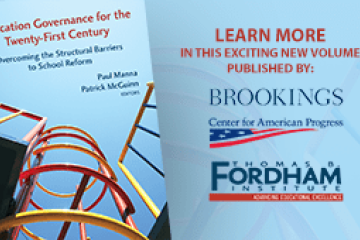
In an earnest effort to advance this crucial conversation, the Thomas B. Fordham Institute—in partnership with the Center for American Progress and the Brookings Institution Press—is pleased to present Education Governance for the Twenty-First Century: Overcoming the Structural Barriers to School Reform, edited by Paul Manna of the College of William and Mary and Patrick McGuinn of Drew University.

This important volume should be on the desk or bedside of every serious education reformer and policymaker in the land.

Featuring chapters by education scholars, analysts, and battle-scarred practitioners, it closely examines our present structures, identifies their failings, and offers some penetrating ideas for how governance might be done differently.

All serious reform victories begin with battles over ideas. In that spirit, we urge you to spend some quality time with this book. Overhauling our dysfunctional education-governance arrangements is a key priority for us at Fordham—and will inevitably loom among the hottest and most consequential issues for all serious reformers in the years to come.

view

The Long Shadow: Family Background, Disadvantaged Urban Youth, and the Transition to Adulthood

8.27.2014
Blog

Education-policy wonks should take a long look at The Long Shadow, a book based on a twenty-five-year study by Johns Hopkins University researchers. Following 790 Baltimore first-graders in 1982 until their late twenties, this book offers a rich research account of what policy analysts across fields have long tried to figure out: How can low-income children rise out of poverty and into the middle class? The sobering answer is they don’t. Kids born into poor families grew up to be poor themselves. Nearly half of the children in the study had the same income status as their parents; and only thirty-three children of families in the lowest-income bracket moved to a high-income bracket by their twenties. The education picture isn’t any sunnier. A mere 4 percent of those from low-income families had a college degree at twenty-eight (compared to 45 percent of their higher-income peers). The long shadow of poverty stretches further for African Americans: 40 percent of blacks who dropped out of high school were now working, compared to 89 percent of white high school dropouts. Women fared worse than men. Black and white women both earned less than their male counterparts, but white women tended to be better off financially with the benefit of marriage or a live-in partner. Black women earned less than white women and were less likely to be in stable relationships. The reading is sobering because the data is stark. Education reformers should take heed that family socio-economic status—at least today—matters more than educational attainment.

SOURCE: Karl K. Alexander, Doris Entwisle, and Linda Olson, The Long Shadow: Family Background, Disadvantaged Urban Youth, and the Transition to Adulthood. New York: Russell Sage Foundation, 2014.

view

Pathways to Teacher Leadership: Emerging Models, Changing Roles

8.27.2014
Blog

Nearly half of all new teachers will quit within five years, and countless studies demonstrate the detrimental financial and academic effects of such turnover. To retain high-quality teachers, schools need to build opportunities for educators to speak up and collaborate with peers. In Pathways to Teacher Leadership, former superintendent Marya Levenson proposes three avenues that make this possible. Road one is Instructional. Groups of teachers meet regularly to collaborate on curriculum and lesson plans, confidentially discuss frustrations and dilemmas, and ask questions both as individual teachers and as part of the school’s instructional community. The second is Institutional, in which teachers adopt administrative responsibilities, bridging the gap between principals and classrooms by facilitating school-wide reforms and discussion groups. Last is Policy. Teachers assume leadership roles and tackle ed-policy issues by joining networks or nonprofits, such as Teach Plus, that encourage educators to share their views. Teachers may choose one route over another based on time commitments, comfort with administrative duties, or desired outcomes. The important part is pushing past the “collective plateau,” a place where educators feel professionally stagnant. And this model, says Levenson, applies to early- and second-stage teachers alike. It’s a vision of teacher leadership that has the potential to mitigate the turnover crisis and shape passionate, constructively engaged, and effective educators.

SOURCE: Marya R. Levenson, Pathways to Teacher Leadership: Emerging Models, Changing Roles. Cambridge: Harvard Education Press, 2014.

Fordham Logo

© 2026 The Thomas B. Fordham Institute
Privacy Policy
Usage Agreement

National

P.O. Box 110
Burke, VA 22009

202.223.5452

[email protected]

Ohio

P.O. Box 82291
Columbus, OH 43202

614.223.1580

[email protected]

Sponsorship

130 West Second Street, Suite 410
Dayton, Ohio 45402

937.227.3368

[email protected]