Mobile Navigation

  • National
    • Policy
      • High Expectations
      • Quality Choices
      • Personalized Pathways
    • Research
    • Commentary
      • Gadfly Newsletter
      • Flypaper Blog
    • Events
    • Scholars Program
  • Ohio
    • Policy
      • Priorities
      • Media & Testimony
    • Research
    • Commentary
      • Ohio Education Gadfly Biweekly
      • Ohio Gadfly Daily
  • Charter Authorizing
    • Application
    • Sponsored Schools
    • Resources
  • About
    • Mission
    • Board
    • Staff
    • Career
Home
Home
Advancing Educational Excellence

Main Navigation

  • National
  • Ohio
  • Charter Authorizing
  • About

National Menu

  • Topics
    • Accountability & Testing
    • Advanced Education
    • Career & Technical Education
    • Charter Schools
    • Curriculum & Instruction
    • ESSA
    • Evidence-Based Learning
    • Facilities
    • Governance
    • Personalized Learning
    • Private School Choice
    • School Finance
    • Standards
    • Teachers & School Leaders
    • Think Again
  • Research
  • Commentary
    • Gadfly Newsletter
    • Flypaper Blog
    • Gadfly Podcast
  • Events
  • Scholars Program

The Education Gadfly Weekly

Sign Up to Receive Fordham Updates

We'll send you quality research, commentary, analysis, and news on the education issues you care about.
Thank you for signing up!
Please check your email to confirm the subscription.

The Education Gadfly Weekly, Volume 14, Number 33: The hidden half

Volume 14, Number 33
8.12.2014
8.12.2014

The Education Gadfly Weekly, Volume 14, Number 33: The hidden half

Volume 14, Number 33
view
High Expectations

The Hidden Half: School Employees Who Don't Teach

The number of non-teaching staff in the United States (those employed by school systems but not serving as classroom teachers) has grown by 130 percent since 1970. Non-teachers—more than three million strong—now comprise half of the public school workforce. Their salaries and benefits absorb one-quarter of current education expenditures. 

Matt Richmond 8.12.2014
NationalReport

The Hidden Half: School Employees Who Don't Teach

8.12.2014
Report

The hidden half: School employees who don't teach

Chester E. Finn, Jr.
8.13.2014
Flypaper

New York’s Common Core tests: Tough questions, curious choices

Robert Pondiscio
8.11.2014
Blog

Hail, hail to Michigan

The Education Gadfly
8.13.2014
Blog

Wonky but good

8.13.2014
Resource

Doing More with Less in K-12 Education: Cleveland State University

12.21.2012
Video

Does Student Attrition Explain KIPP's Success?

Robert Pondiscio
8.13.2014
Flypaper

A Compendium of Research on the Common Core State Standards

8.13.2014
Blog
view

The hidden half: School employees who don't teach

Chester E. Finn, Jr. 8.13.2014
Flypaper
view

New York’s Common Core tests: Tough questions, curious choices

Robert Pondiscio 8.11.2014
Blog
view

Hail, hail to Michigan

The Education Gadfly 8.13.2014
Blog

Wonky but good

Michael J. Petrilli, Kathleen Porter-Magee, Amber M. Northern, Ph.D., Pamela Tatz 8.13.2014
Resource
view

Doing More with Less in K-12 Education: Cleveland State University

12.21.2012
Video
view

Does Student Attrition Explain KIPP's Success?

Robert Pondiscio 8.13.2014
Flypaper
view

A Compendium of Research on the Common Core State Standards

8.13.2014
Blog
view

The Hidden Half: School Employees Who Don't Teach

8.12.2014
Report

The number of non-teaching staff in the United States (those employed by school systems but not serving as classroom teachers) has grown by 130 percent since 1970. Non-teachers—more than three million strong—now comprise half of the public school workforce. Their salaries and benefits absorb one-quarter of current education expenditures. 

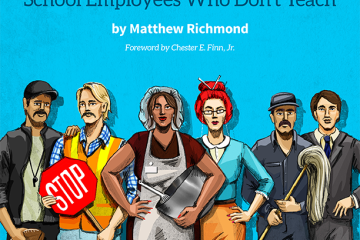
The Hidden Half: School Employees Who Don’t Teach analyzes how school staffing has changed over the last half-century, what might be driving the trends, and whether these developments are financially sustainable or educationally wise.

Click the image to view a larger version

SHARE THIS!

Right click and save the images to save to your computer. Please share on your networks.

____________

If you have questions about the book, please email Dara Zeehandelaar.

view

The hidden half: School employees who don't teach

Chester E. Finn, Jr.
8.13.2014
Flypaper

Why do American public schools spend more of their operating budgets on non-teachers than almost every other country in the world, including nations that are as prosperous and humane as ours? We can’t be certain. But we do know this:

  • The number of non-teachers on U.S. school payrolls has soared over the past fifty years, far more rapidly than the rise in teachers. And the amount of money in district budgets consumed by their salaries and benefits has grown apace for at least the last twenty years.
  • Underneath the averages and totals, states and districts vary enormously in how many non-teachers they employ. Why do Illinois taxpayers pay for forty staff per thousand pupils while Connecticut pays for eighty-nine? Why does Orange County (Orlando), Florida, employ eleven teacher aides per thousand students when Miami-Dade gets by with seven?

What accounts for such growth and such differences? We don’t know nearly as much as we’d like on this topic, but it’s not a total mystery. The advent and expansion of special education, for example, led to substantial demand for classroom aides and specialists to address the needs of youngsters with disabilities. Broadening school duties to include more food service, health care, and sundry other responsibilities accounts for still more.

But such additions to the obligations of schools are not peculiar to the United States, and they certainly cannot explain big staffing differences from place to place within our country.

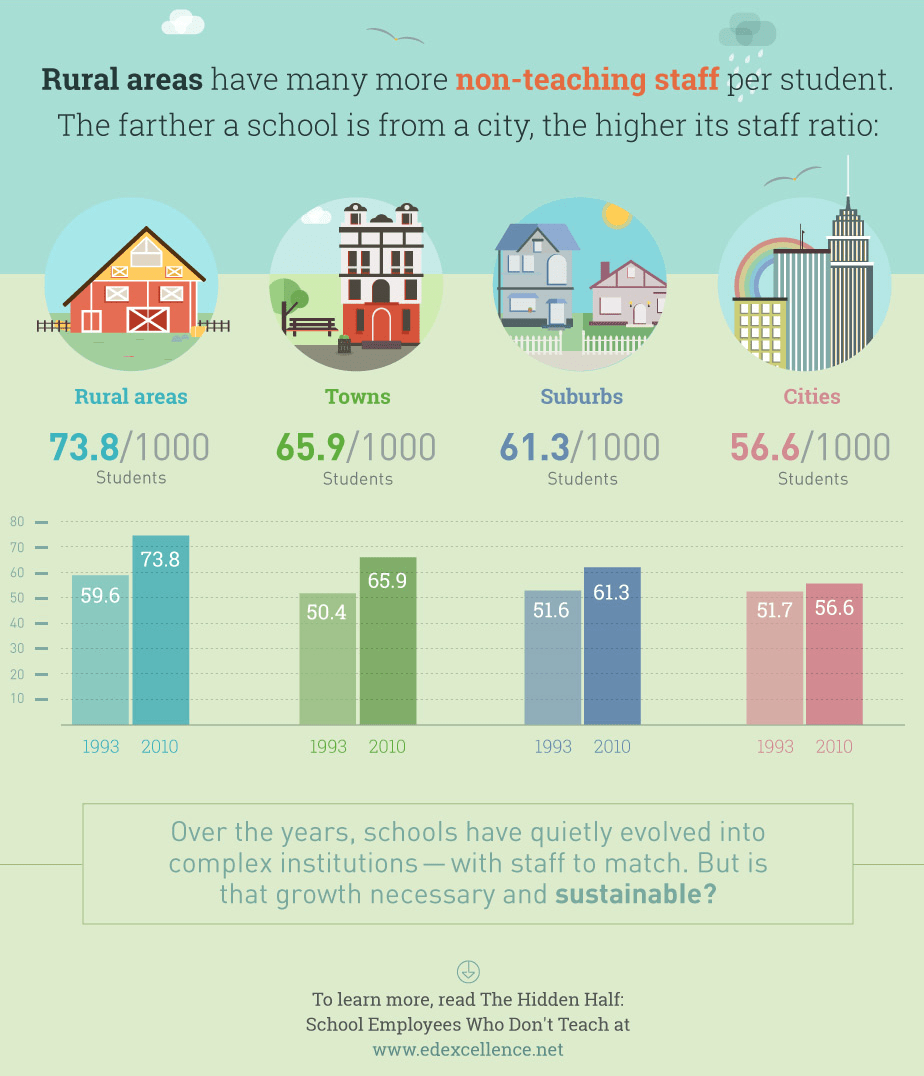
The Hidden Half: School Employees Who Don’t Teach, a new Fordham analysis, shines a bright light on how school staffing has been changing, both nationally and by state. It deconstructs the category of “non-teacher” as well as current data allow, shows which types have increased the most, and illustrates how states and districts vary in staffing levels. It also examines whether factors such as the number of students with special needs and a district’s size or “urbanicity” (rural districts tend to have more non-teaching personnel) are related to the number of non-teachers.

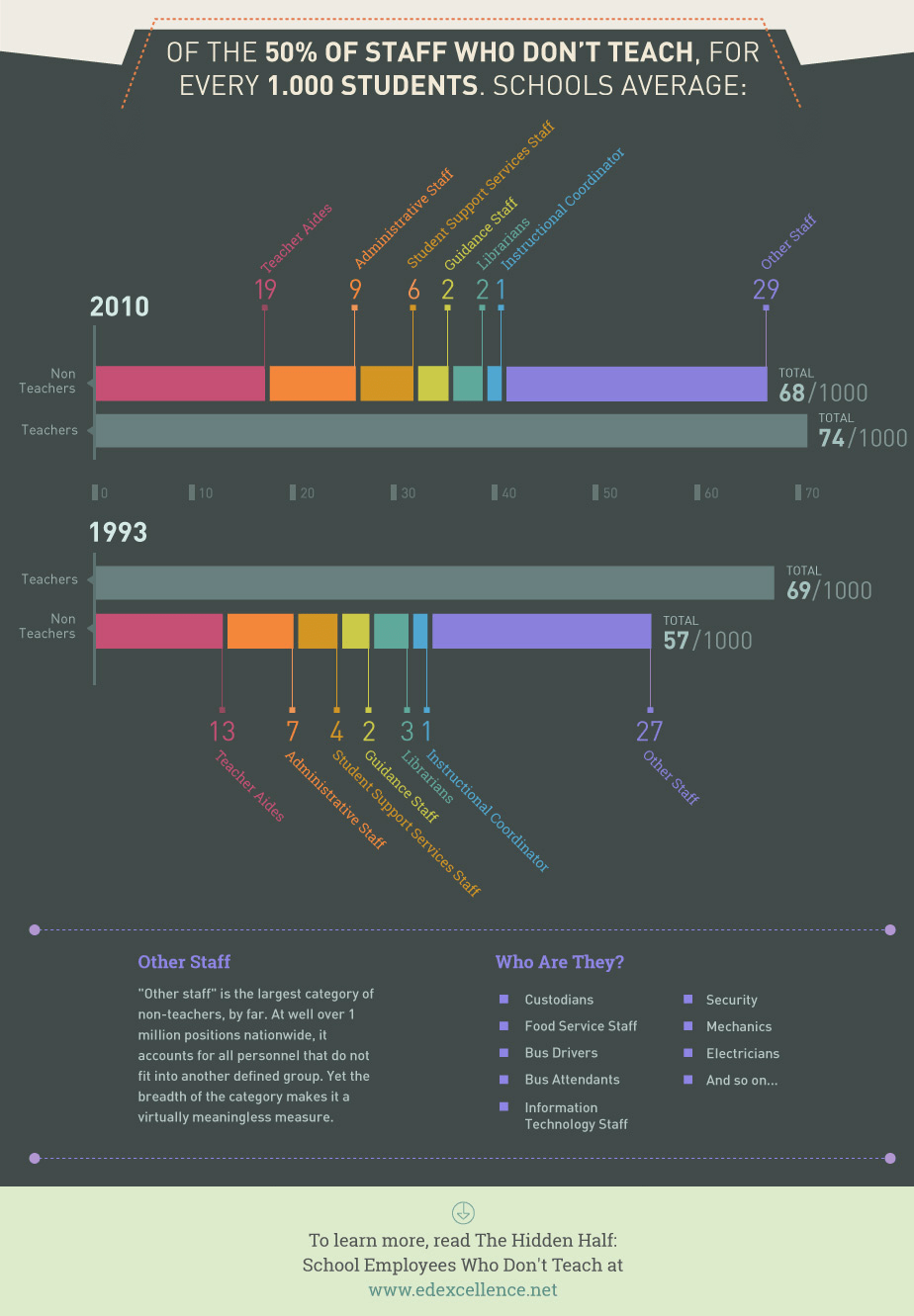
The greatest expansion is in the “teacher-aide” category, which went from virtually nonexistent in 1970 to the largest single staff position other than teachers. The ’70s witnessed much of this staff run-up relative to student enrollment. And this coincided with myriad federal legislation, including Section 504, Title IX, and the Education for All Handicapped Children Act, which shifted the paradigm for schools from “do your best to educate everyone” to “educate everyone or get sued.”

Though a study such as this does not fully explain why these patterns and variations have developed, it can highlight the dramatic numbers themselves and urge district and state decision makers to examine their own practices and ask tough questions about their priorities.

This isn’t the first Fordham report to encourage such self-scrutiny. Two years ago, for example, we published Nate Levenson’s pioneering look at special ed, Boosting the Quality and Efficiency of Special Education, which found that districts could improve the educational outcomes of youngsters with disabilities and save money by revising their staffing patterns (and making corollary changes). That report specifically encouraged school to employ—and deploy—better teachers, not more teachers or non-teachers.

Nor is Fordham alone in tugging at this important thread in the fabric of American education. For instance, a 2012 report from the Friedman Foundation found that in over six decades, starting in 1950, U.S. public schools increased their non-teaching positions by 702 percent (versus 96 percent for students and 252 percent for teachers).

Yet beyond a few isolated examples, non-teachers in our schools have largely avoided the attention of researchers, reformers, and policymakers. Why is that so? Education leaders at every level have been obsessed about the quality, effectiveness, and costs of classroom teachers. (For example, the federal Department of Education recently unveiled an elaborate, if dubious, set of new policies and programs intended to make the distribution of “quality” teachers more equitable.) Why does the other half of school personnel remain hidden? It’s unthinkable not to consider if personnel shifts might strengthen both performance and efficiency.

Part of the problem stems from today’s woefully inadequate data. National statistics from the U.S. Department of Education, for instance, are rich with information about schoolteachers and principals but crude and unhelpful when it comes to non-teaching personnel. For example, that agency’s Local Education Agency Universe Survey reports that “other” staff accounted for 41 percent of all non-teaching staff at the district level in 2010. That’s more than a million people. But what do they actually do? The federal definition for this huge but vague category of personnel is “all other staff who serve in a support capacity and are not included in the categories of central office administrative support, library support, or school administrative support.” Illustrations range from bus drivers to security personnel to cafeteria workers. (A variant of the same federal definition adds maintenance staff.) Using such a generic, catchall category may make it easier for district bean counters (non-teachers themselves) to enter data into federal forms and computer programs, but it also makes for opaque and uninformative data.

We dug into state and district sources, too, and could rarely find what we sought by way of useful and revealing categories, totals, comparisons, trend lines, and associated price tags. How can education policymakers, executives, and budgeteers make informed staffing decisions if this enormous cadre of school employees are not even recorded in discrete subsets that can be tracked over time—along with their costs—and compared with similar H.R. categories and expenditures in other districts and states?

This dysfunction attests to the longstanding heedlessness of education leaders (and analysts) regarding the costs and benefits of non-teaching personnel.

Our sense is that these millions of people have quietly accumulated over the years as districts simply added employees in response to sundry needs, demands, and pressures—including state and federal mandates and funding streams—without carefully examining the decisions they were making or considering possible tradeoffs and alternatives. This was the path of least resistance and, at a time of rising budgets, was viable even if imprudent.

But it’s no longer sustainable in the public sector any more than the private. Observe how private firms go about reducing costs, boosting productivity, enhancing organizational efficiency, and increasing profitability: they almost always start with staffing. The Pentagon is putting itself through similar self-scrutiny. So is the U.S. Postal Service.

One could list plenty more examples. Changing staff—and staff-related budgets—is never easy, especially in the public sector, due to politics, contracts, and civil-service rules. But that’s what leaders are for: to overcome obliviousness, work through politics, catalyze rethinking, and rearrange practices that no longer deliver the required results at an affordable cost.

Hence our recommendations for education leaders, based on the present analysis:

  1. Look at the practices of other districts, states, and countries to determine which ones might usefully be emulated or adapted in pursuit of better outcomes and efficiencies.
  2. Demand—and help gather—better data on the three million individuals who work for U.S. public schools but are not classroom teachers. Then scrutinize what they actually do to determine whether those functions are essential—and, if so, whether there might be a better way of performing them.
  3. Be creative when structuring one’s organization and deploying resources in response to obligations. Consider what can be done better (or less expensively) with the help of technology. Consider whether, for example, a behavioral specialist—or reading specialist—might better meet the educational needs of some youngsters than a platoon of aides.
  4. Each time you think of hiring (or replacing) someone, evaluate the necessity—and cost benefit—of that role. How vital is a given position to the school’s core mission? And is a full-time employee the best and most economical way to carry out a specific responsibility?
  5. Take maximum advantage of staffing flexibility already available within today’s contractual, programmatic, and regulatory constraints—and where that’s not sufficient to make needed tradeoffs and sound management decisions, push hard for additional leeway. When necessary, make a proper fuss at the state capital or in Washington. Waivers can be gotten, statutes amended, exceptions made, and alternatives approved.

Above all, make yourself and your team look under this hood. You are almost certain to be surprised by what you find there.

view

New York’s Common Core tests: Tough questions, curious choices

Robert Pondiscio
8.11.2014
Blog

With the release last week of half of the test questions from the most recent round of New York State Common Core ELA/Literacy and math tests, we can now begin to see if the tests are, as one New York principal insisted last spring, “confusing, developmentally inappropriate and not well aligned with the Common Core standards.”

Do the charges stick? After a quick analysis of the released items, on the charge of “confusing,” I find the tests (at least somewhat) guilty. Not well aligned with the Common Core standards? Not guilty. Developmentally inappropriate? That charge should never have been brought in the first place.

Calling Common Core “developmentally inappropriate” has become something of a blanket criticism, but it’s largely irrelevant. University of Virginia cognitive scientist Dan Willingham has repeatedly cautioned against invoking the idea of developmental stages to draw strong conclusions about what children are ready for. “Hard” and “developmentally inappropriate” are not synonyms.

Critics are on firmer footing describing some test items as confusing. The first passage on the fifth-grade reading test was “My Grandma Talley,” a short story by Nadine Oduor that makes frequent use of vernacular language. Unfamiliar words like “frettin’,” “lotta” (a lot of), and “doodlebug” and idiomatic language like “wet behind the ears” could easily trip up young readers. Dialect is not the same as the archaic language typically found in historical documents, which have been heavily signaled as important under Common Core.

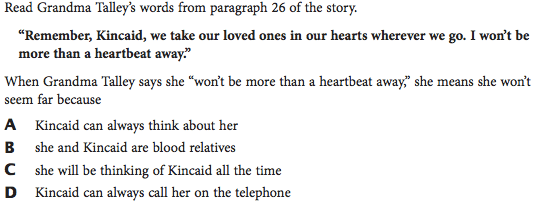
Following the passage, one question asks students to interpret what the narrator’s grandmother meant when she used a potentially unfamiliar expression:

The answer draws a subtle difference between A (correct) and C (incorrect). Frankly, if a fifth grader in a classroom discussion interpreted the phrase to mean they would be able to think about each other, I wouldn’t think to push for a more precise answer. Most of us also probably associate the phrase “a heartbeat away” with sudden death, as in “the vice president is a heartbeat away from the presidency.” This makes it a poor, confusing choice of expressions on which to base a test question.

Elsewhere on the same test is a passage about BMX bike racing and a section about a boy sailing around the world, which students are asked to evaluate and analyze through the lens of a companion piece about “smart risk-taking.” These are tasks that go far beyond mere recall or making inferences yet are well within what teachers have been led to expect under Common Core.

That said, it would be better—and far more fair—if test writers took care to choose reading passages about subjects children are more likely to have encountered in school.

The most important and powerful breakthrough in Common Core is the standards’ clear guidance that “by reading texts in history/social studies, science, and other disciplines, students build a foundation of knowledge in these fields that will also give them the background to be better readers in all content areas.” If this is what is expected, reading passages ought to encourage and validate good instructional choices.

A third-grade passage about turning tree sap into maple syrup, for example, is more likely to control for background knowledge and draw upon things children study in school (plants and trees) than a passage on the same test about snowshoeing.

It’s unfair and unnecessary to risk confusing children with topics—sailing, BMX racing, snowshoeing—that low-income urban children, in particular, are likely to know little about and have no out-of-school experience with.

Another curious choice: test writers surely do Common Core no favors with an eighth-grade passage asking students to evaluate claims on global warming. Why wave a red flag in front of those who already fear that CCSS means political indoctrination? Also, for those who have broadly misinterpreted Common Core to mean children must close read and cold read everything—no pre-reading for you!—note that one sixth-grade reading passage, a poem about “pit ponies,” explains at the outset that “Ponies and donkeys were once used in mines to pull carts of ore—in the United States as well as Great Britain.”

Math questions are challenging, often requiring multiple operations to answer a single question. A fourth-grade question asks, “In the number 344,586, how many times greater is the value represented by the 4 in the ten thousands place than the value represented by the 4 in the thousands place?” Where previous state tests might have simply asked for the value of a single digit, this requires knowing the value of both and the difference. You can calculate it or simply know that the same digit one place to the left is ten times greater. Either way, it’s far more challenging than simply knowing that the 5, for example, represents 500.

The tests are tough. Too tough? Recall that New York State was the poster child for the “proficiency illusion,” an alarming and dishonest dumbing down of state tests and lower cut scores. It got so bad that Diana Senechal demonstrated that random guessing could reliably earn a passing score. Forgive me if I do not share others’ enthusiasm for a return to those comforting, accomplishment-free days.

The bottom line: the tests are hard, as expected, but the choice of texts needs work. Test makers have an obligation to signal to the field the kind of instructional choices they want teachers to make—an obligation New York’s test makers, in rushing ahead rather than waiting for PARCC, appears not to have considered.

Under Common Core, text selection is critically important for teachers. It should matter even more on the tests.

view

Hail, hail to Michigan

The Education Gadfly
8.13.2014
Blog

Eleven of Michigan’s forty charter school authorizers are facing suspension due to deficient oversight of their schools’ accountability, transparency, fiscal governance, and academic improvement. Achievement was so dreadful across the board that each authorizer’s portfolio ranked in the bottom 10 percent of the state’s annual academic performance rankings of all schools. Offenders have until October 22 to shape up. While Gadfly hears that a handful of these entities were wrongly accused of shirking their responsibilities—Grand Valley State University, for example, is a well-respected and conscientious authorizer—the push for quality and accountability is welcome.

Teach For America is more diverse than ever, thanks to deliberate efforts by the organization. Half of TFA’s 5,300 new recruits identify as people of color, up from 39 percent a year ago. This coincides with the U.S. Department of Education’s new projection that, starting this school year, minority students will outnumber white students for the first time. More remarkably, this diversity is in sharp contrast to the nation’s teaching force as a whole: a mere 17 percent of U.S. teachers identify as people of color, a cohort that continues to suffer from lower ed-school enrollment, licensure-exam-score gaps, and disproportionate turnover.

Like clockwork, the School District of Philadelphia is once again short on funding for the upcoming school year—and, once more, the state has bailed them out, this time to the tune of $265 million. No one sees these bailouts as a good solution to this systemic, hard-to-fix problem (Ed Next has more on that). The governor, for example, recently tried and failed to plug the hole with a cigarette tax. Until all parties have the political courage to address the real problems—like the broken, costly pension system and a runaway teachers contract—we’re going to keep seeing Groundhog Day every August.

Wonky but good

8.13.2014
Resource

Mike and Kathleen Porter-Magee discuss New York State’s half-release of its half-good Common Core test, commend TFA’s diversity surge, and debate the debate about the AP U.S. History Framework. Amber shares a wonky study about teachers’ work hours.

Amber's Research Minute

"New Measures of Teachers' Work Hours and Implications for Wage Comparisons," by Kristine L. West, Education Finance and Policy, Vol. 9, No. 3 (Summer 2014).

Transcript

Mike Petrilli:             Hello. This is your host, Mike Petrilli of the Thomas B. Fordham Institute,here at The Education Gadlfy Show and on line at atexcellence.net and now please join me in welcoming my co-host, the Hillary Clinton of education policy, Kathleen Porter MaGee. 

Kathleen PM:            The Hillary Clinton.

Mike Petrilli:             Well I was looking for somebody who's on the rise and has been changing jobs and playing a lot of different roles.

Kathleen PM:            I see.  I don't think at Fordham I'm taking the Hillary Clinton of education policy as a compliment. 

Mike Petrilli:             Well look,  gee, I think among conservatives she's kind of having a moment right now.  

Kathleen PM:            All right.

Mike Petrilli:             She's distancing herself from President Obama.  Look, I think there are several conservatives out there who like her on some issues so I wasn't going for that.  I was going as a way of saying, Kathleen's here, she is on her way to her new job being superintendent and chief active officer of the partnership for ...

Kathleen PM:            ... inner city education.

Mike Petrilli:             ... inner city education.  Yeah. Can we talk about that name for a second? Didn't Paul Ryan get in trouble for using that term? Are we allowed to still say inner city?

Kathleen PM:            I didn't realize it was illegal.  No, so the partnership's been around for like 2 decades so I don't think they were about to change their name thanks to any political whims but I don't know if ...

Mike Petrilli:             Yes, I think a little asterisk in there ...

Kathleen PM:            Yeah.

Mike Petrilli:             ... that could say, just for clarification, we came up with this name back in the 90s when it was okay to still say inner city.  I'm confused, are we allowed ...

Kathleen PM:            Why is that not okay?

Mike Petrilli:             Do you remember this? 

Kathleen PM:            No.

Mike Petrilli:             Paul Ryan said that men in the inner city, their work ethic is not what it used to be or that their work participation is not what it used to be.  Anyways he got all this flak for people saying, "Oh that was race baiting," and ...

Kathleen PM:            Are we sure that the problem was that he used inner city or was that he said something offensive?

Mike Petrilli:             Yes. 

Kathleen PM:            Maybe.

Mike Petrilli:             People talked a lot about inner city, that was code word for ...

Kathleen PM:            I see.

Mike Petrilli:             Anyway, okay.  Here we are.  Many of us are feeling pretty sad this week of course about Robin Williams' memorable roles in many ... and many education related roles.  Of course Dead Poet's Society.

Kathleen PM:            Dead Poet's Society.

Mike Petrilli:             Right.  But he was also in Good Will Hunting and that had some education angles and other things but we will miss him dearly, but we must go on. The show will go on and we will talk education reform.  So Pamela in her last appearance on the Education Gadfly Show before moving to California ... Pamela, let's play Pardon the Gadfly.

Pamela Tatz:             New York State just released half of the test questions from the most recent round of the state's common core ELA and math tests.  What do you think?  Can the state do better? 

Kathleen PM:            Yeah, so I mean, let's just say first and foremost that New York State has become everybody's favorite whipping post when it comes to common core implementation, and ...

Mike Petrilli:             Its' my favorite one.

Kathleen PM:            Right, so there you go, exactly.  I think New York State deserves credit for working really hard to get things out there early and first, to get the curriculum resources out there, the teachers and to moving to a common core aligned assessment.  I think many states are going to have a real rude awakening next year when Park and Smarter Balanced come on line. I think they deserve credit for that for sure. 

Mike Petrilli:             Um hmm.

Kathleen PM:            Yes, but, there is certainly room for improvement.  I took a look at especially the ELA tests and it looks like some of the passages are pretty darn good actually.  The passage selection is getting better and better.  We're using authentic text which I think is great.  But some of the questions ...

Mike Petrilli:             And by authentic text, you mean actually things from literature.

Kathleen PM:            Things you would find in literature, exactly.

Mike Petrilli:             Right, not something some grad student wrote ...

Kathleen PM:            In order to confirm to ...

Mike Petrilli:             ... to meet a certain form.

Kathleen PM:            Yeah, the commissioned texts, which were the norm in most reading tests in the past.

Mike Petrilli:             Okay.

Kathleen PM:            I think they've shown that they're going to use real literary and informational text ...

Mike Petrilli:             Yeah.

Kathleen PM:            ... not self-created text.  As I read some of the questions, I just found myself feeling really disappointed.  It just seems like while we're trying to nudge in the right direction, too many of them seem like more of the same.  I agree that some of them were confusing.  I really didn't think they were pushing for the kind of evidence based literary analysis that we want our kids to be doing.  So, from a signaling perspective, I just don't think these questions are quite getting us where we want to be.

Mike Petrilli:             So I have been skeptical.  I mean you are hearing a lot of these horror stories from teachers and others about the test and my own view is I have yet to understand why New York decided to rush ahead with its own test right?  Here is Park and Smarter Balanced spending 3 or 4 years, hundreds of millions of dollars developing these tests.  We hope that's going to result in these great tests. We will be finding out soon.  It just seemed like, wow, New York, on an incredibly tight time line, incredibly tight budget, was going to do it by themselves.  It sounds like they've done, as you say, better.  They deserve credit for that, but I don't understand why they just didn't have the patience to say, let's just wait for Park. 

Kathleen PM:            You know, there's two sides to that though.  Waiting for Park, then you're asking your teachers to shift and teach to new standards but you're assessing old standards.

Mike Petrilli:             Yeah, I know.

Kathleen PM:            I mean, honestly there's no really good answer in this sort of middle ground implementation before the assessments come on line.

Mike Petrilli:             It is an awkward phase.  It's like there's no good answer to being a teenager.  I mean you just have to get through it.  

Kathleen PM:            Yes.

Mike Petrilli:             I will say in the states that have waited, if you look at California, look at Maryland, these other blue states that are similar politically to New York, they don't have a backlash to the common core.

Kathleen PM:            Yeah.

Mike Petrilli:             They're not on fire.  Look, I think you're right, we'll find out a year from now and we’ll talk about how it's going in those other states and whether ...

Kathleen PM:            Did they just delay the pain or did they avoid it?

Mike Petrilli:             Exactly.

Kathleen PM:            That remains to be seen.

Mike Petrilli:             Well said.  Okay, topic number 2 Pamela.

Pamela Tatz:             TFA is more diverse than ever.  Half of the 5,300 new recruits identify as people of color marrying the demographics of our school age population as opposed to a mere 17% of the nation's teaching force as a whole.  This is great for TFA, but how can we increase the diversity of US teachers in general?

Mike Petrilli:             Right, or put this a different way Kathleen.  Why can't Ed schools do this too?

Kathleen PM:            I don't know how much of an effort they're put ... TFA has made this a real central part of their mission and I think you have to be that deliberate about it.  There's no way diversity is going to magically increase.  It has to be a goal and it has to be one of your top priorities, otherwise I don't think it's going to happen; and I just don't know, have Ed schools made it as much of a priority as TFA? [crosstalk 06:32]

Mike Petrilli:             Other people say, look, bottom line is Ed schools don't recruit right?

Kathleen PM:            Right.

Mike Petrilli:             I mean they are just very passive, as ... look, as are most programs in colleges.  They get who they get and so they continue to get mostly white women from the suburbs and small towns, that's what they're getting except for a handful of programs in big cities.  What's your take on this though Kathleen, some people would argue why are we even focusing on race, why does it matter, why not just focus on teacher effectiveness?  What's your take on this?  Is it important to have a diverse teaching staff?

Kathleen PM:            I think so.  Yeah, definitely.  I think that especially because some of our neediest students are students of color and they're students from disadvantaged neighborhoods and I think if you only have white middle class women does a disservice to those communities.  People really do respond to role models and also it's hard for us to know our own blind spots.  It's important to have, not just diversity of color, but diversity of thought.  I think one way to get to that diversity of thought and idea is to have other kinds of diversity as well.

Mike Petrilli:             Yeah, there's been some interesting studies.  Education Next has published a few that show that look, all else being equal, kids do better, African American kids do better, with African American teachers. 

Kathleen PM:            You can understand, I mean it makes sense.  We even say that in white middle class communities, we want to see more male kindergarten teachers because we think boys respond to male role models.  Why would it be any different for students of color.

Mike Petrilli:             Yeah, yeah. I will say, my 4-year-old Leandro passed his first belt test in karate this last weekend ...

Kathleen PM:            Nice.

Mike Petrilli:             ... which involved breaking a board.  I'm pretty sure that this was some kind of trick board that had some kind of seam in it ...

Kathleen PM:            That's pretty bad.

Mike Petrilli:             ... because they just stomped on it and it broke and believe me, something was going on there with those boards because this was not a very strong stomp.  Anyway, the teacher is this man and I just see the way that he responds to that guy versus how he's responded to some of his female teachers.  It is different. 

Kathleen PM:            Yeah.

Mike Petrilli:             It’s ... all right so.

Kathleen PM:            Well even for actually girls.  When I see my oldest daughter, I would love for her to have role models, particularly in the early elementary age who are men as well, to see that ... to give a different impression of what sort of male gender roles are. 

Mike Petrilli:             Yes.

Kathleen PM:            I think it's important for everybody.

Mike Petrilli:             Yeah, okay.  Topic number three Pamela.

Pamela Tatz:             The RNC just piled on to the growing push back against the college boards AP US history framework and the college board has now promised to clarify the framework.  Will this response work?

Mike Petrilli:             So Kathleen, finishing up your tour of duty at the collage board.  I know you're ... I'm not asking you to speak on behalf of the college board, but wow, this quickly became a big controversy, got somewhat linked to the common core controversy, a lot of the same groups pushed back against this.  On this one though, we've looked at the AP history framework that came out in 2012, and I thought there were some legitimate concerns about it.  What's your take on all this?

Kathleen PM:            Yeah, so it's really interesting.  I was able to dive deep into the weeds and to work our head of AP and to work with David and to really understand because when this controversy started brewing, I hadn't been as involved in the development of this stuff so I didn't know as much about it, which was nice, I got to look at it with fresh eyes.  It's interesting, a couple things.  First of all the framework does not exist in a vacuum. 

Mike Petrilli:             Yeah.

Kathleen PM:            The framework is one piece of many that AP history teachers use and it's actually far more comprehensive than what they had in the past.  In the past there was I think a 4-page document that was literally a bullet list of a couple of things that included very few people.  This new document is trying to give a much more holistic picture of US history.  In addition, it's not the only thing.  It is paired with the US history assessment which AP US history teachers have always had access to. They use it to drive their instruction, they use it to drive their assessment.  I'm glad that the college board made the decision to release the assessment.

Mike Petrilli:             Um hmm.

Kathleen PM:            I think it is ... for me, when I read the framework, I thought, okay this is solid but what else, and when I read the assessment, I said this is exactly the kind of thing that I would want to use to drive teaching and learning in a US history classroom.

Mike Petrilli:             What were the complaints, that it was what ... that there wasn't enough focus on the founders, that there wasn't focus on heroes in American education, in US history?

Kathleen PM:            Yeah, I think that many of the critics felt that it was portraying a negative image of the United States and of American history and it didn't put enough focus on great leaders, again the founders and great leaders in American history.

Mike Petrilli:             Now there were a couple criticisms that I thought were totally unfair.  For one, they wanted to tie this to David Coleman ...

Kathleen PM:            Right.

Mike Petrilli:             ... who of course was one of the architects of the common core, but this was done before he got to the college board, so okay, that one doesn't work so well.  The second one was, I remember the American Principles Project saying something about how it wasn't appropriate for this ... who does the college board think they are to select which topics in history kids should learn?  Okay, they've been doing this for 50 years.  There's a test, you've got to figure out what's going to be on the test.  Unless you want to get rid of the AP program, you're going to have to do that. 

Kathleen PM:            Right, I mean you have to get specific if you're going to have a core set of tests aligned to it.  What I'll say, so the AP US history has been in development long before David took over, but what David has brought to the college board is a promise of transparency and I think that's what you're seeing now with the release of the AP US history test which has never ... I mean that's more transparency that we've seen from the college board in the past; and the promise of real clarification in the future.  I think he's making good on the promise of transparency and I think critics will be happy with what they see.

Mike Petrilli:             Yeah, that's good.  I think it's fair and people raise fair points and there was plenty.  I will say this, I would bet a lot of money that you will get a much more traditional view of American history from your US AP history course than if you took US History 101 on any college campus in America.

Kathleen PM:            Absolutely, yeah.  There's actually a lot of ... so AP US history teachers, they actually create their own curriculum that is aligned to the framework and there are some samples up on the college board website and there are more that teachers are developing all the time.  This is real opportunity here for AP US history teachers on the right to develop a framework that they think really embodies the principles of American history and to put that out there as exemplars.

Mike Petrilli:             All right, that is all the time we've got for Pardon the Gadfly.  Now it's time for everyone's favorite, Amber's research myth.  Amber, welcome back to the show.  Amber is sad, sad days here with the Robin Williams news. Was there a performance of his that you particularly liked.

Amber Northern:      Thank you Mike.

Mike Petrilli:             Amber is sad, sad days here with the Robin Williams news. Was there a performance of his that you particularly liked.

Amber Northern:      It had to be Mrs. Doubtfire.  [crosstalk 13:02]

Mike Petrilli:             Oh, I didn't see you go for that.

Amber Northern:      Come on, really.  He was just magnificent in that, and the outfit.  It still makes you smile when you see him in that getup.   Yeah.

Mike Petrilli:             It was a great movie. 

Amber Northern:      Oh, fantastic. 

Mike Petrilli:             All right.  Well Amber, what do you have for us this week?

Amber Northern:      We got a new paper out by Christine West.  She seeks to settle the question of exactly how many hours teachers work which seems like a simple question, but it's a little more complicated.  We often hear that teachers work late into the night grading papers, they stay late after school to help kids, they work weekends.  We recognize this as former teachers.  Then other people say, well yet, they have the summers off, so it all kind of balances out.  Anyway, the data hadn't been great to answer this question so far.  So, she uses a new data source, well new to answer this question.  It's called the American Time Use Survey, it collects data on how Americans spend their time via a time diary.  Individuals are periodically asked about all their activities over a 24-hour period beginning at 4 a.m. on the day prior to the survey, so the data don't rely on recall so they're more reliable.

Mike Petrilli:             Okay.

Amber Northern:      All right, she goes and uses the diary data for full time teachers and non teachers from 2003 to 2010.  Bottom line, teachers work an average of 34.5 hours per week annually, translates to 38 hours a week during the school year ...

Mike Petrilli:             Okay.

Amber Northern:      ... 21 hours during the summer.

Mike Petrilli:             Hmm.

Amber Northern:      Non teachers work 40 hours most of the year and 38 in the summer.  The summer by the way, that average includes teachers who may be working in year round districts, districts in which the school year stretches into June and starts in August and includes teachers taking PD in the summer or teaching summer school.  Okay?

Mike Petrilli:             Okay.

Amber Northern:      Second, West finds that when hours are properly accounted for, high school teachers earn 7-14% less than their demographically similar workers at other occupations.  That's in part because high school teachers are more likely to work in the summer, since more secondary kids attend summer school.  Yet, elementary, middle and special education teachers earn slightly higher wages than their demographically similar workers. Finally the report finds that teachers are more likely than most any other occupation; nurses, computer scientists, financial analysts, doctors, sales reps, like a ton of them; to over report work hours when diary data are compared to other report sources.

                                    Anyway, bottom line is she ends up talking ... a quite nice discussion at the that says, you know, this is yet another reason why we don't need the single salary schedule ...

Mike Petrilli:             Um hmm.

Amber Northern:      ... especially when secondary teachers have different work schedules, different responsibilities. 

Mike Petrilli:             Well, that's fascinating because isn't the history of why we have these master's degree pay bumps was because that was a way to get more money, more higher salaries to secondary school teachers.

Amber Northern:      Um hmm.

Mike Petrilli:             It was mostly high school teachers who were getting master's degrees.  Now, those were also mostly men so it was also a gender thing where we're going to pay the male teachers more than those female elementary school teachers, but it does sound like ... so you could say, well there is a differential, then. There is some evidence that those high school teachers should be getting paid more.

Amber Northern:      Now, you've got these 5-year master's programs where a lot of those elementary teachers go straight through and get their master's so we're not seeing a big difference between the master's degree holders. 

Mike Petrilli:             Interesting.  Is this ... do these numbers seem about right to you guys?  I mean those really sound low.

Amber Northern:      Yeah, the summers yeah.  [crosstalk 16:27].

Mike Petrilli:             [crosstalk 16:27] take this image of teacher's working 50-60 hours a week.

Amber Northern:      I guess the summer is quite of interesting because that's what they were saying.  Teachers, it's impossible to report ... consider your yearly work average when you've got to figure out the summer, so that's why I thought the report was fascinating.

Mike Petrilli:             Yeah.

Kathleen PM:            Yeah.

Amber Northern:      It tries to actually put a number on it.  If you really do work in the summer, it's just hard to figure out how much of that time is spent.

Kathleen PM:            I think it's a challenge to average any of this right?  You've got how many, 3 something million teachers and this is the average, so that means you have some teachers who really are slamming it the way people say, that teachers can; and you have others who probably are working, well obviously, are working less than the average. 

Mike Petrilli:             Also, this note that teachers have the summers off. I would suspect that those teachers who are parents would disagree with you that the summers aren't "off". 

Amber Northern:      Right.

Mike Petrilli:             They are home with their own kids all summer long.

Amber Northern:      Right. 

Mike Petrilli:             They may end up wanting to go back to school in the fall just like everybody else.

Amber Northern:      Yeah.  Another thing that's sort of hard about this is a lot of teachers get paid over the full year ...

Mike Petrilli:             Yeah.

Amber Northern:      ... so they may be reporting weeks that I'm paid, not weeks that I work.  I don't know.  [inaudible 17:32] all these reasons why this is really hard to figure out.  I don't know, it's kind of a wonky little study but it's a neat measure and I think it was kind of cool.

Kathleen PM:            And it provides new information.  It's interesting.

Amber Northern:      Yes, yes.

Mike Petrilli:             Lovely.  All right Amber, thank you for bringing wonky but cool.  That is all the time we've got for today.  Until next week.

Kathleen PM:            I'm Kathleen Porter Magee.

Mike Petrilli: And I'm Mike Petrilli at the Thomas B. Fordham Institute, signing off.  

view

Doing More with Less in K-12 Education: Cleveland State University

12.21.2012
Video

Hosted by the Nord Family Foundation, Thomas B. Fordham Institute, and Ohio Grantmakers Forum with additional support from the Edward A. Lozick Foundation, Martha Holden Jennings Foundation, Nordson Corporation Foundation, and Stocker Foundation.

The Buckeye State has been hit hard by the national recession and faces an estimated $8 billion biennial budget shortfall. This fiscal crisis will have a serious impact on K-12 education as 40 percent of state revenue goes toward public schools. While most Ohio district superintendents and local school boards have accepted the new reality of doing more with less, the fact remains that they have little experience when it comes to handling the level of funding reductions expected this year, and will need to be equipped to handle them in a way that will not decimate existing education reform initiatives or harm student achievement. For these reasons, we are assembling free public events to help local education, business, and community leaders identify ways to think smart about cuts to school spending while staying focused on student achievement.

view

Does Student Attrition Explain KIPP's Success?

Robert Pondiscio
8.13.2014
Flypaper

A new Mathematica study persuasively puts to rest a common charge leveled at KIPP charter schools: that their test score gains are largely attributable to the attrition of their lowest-performing students. The authors compare nineteen KIPP middle schools to district schools and find no meaningful difference among those who walk in the door of each type of school. Nor do they find any difference in student attrition rates on the way out. Students who enter KIPP in later grades do indeed tend to be higher performers, but “a large part of KIPP’s cumulative effect occurs in the first year of enrollment, before attrition and replacement could have any effect.” Thus, high-achieving “backfilled” students can account for no more than one-third of the cumulative KIPP effect. Analysts, however, couldn’t determine whether students and families attracted to KIPP and its intensity are more ambitious or motivated in the first place—a point Richard Kahlenberg highlights in a critique of the study on Education Next’s website. “When children hear about the rigorous regimen,” he notes—the extended school day and copious homework, for example—“particularly motivated families might be excited to sign up, while less motivated families could be scared away.” The careful and sober Mathematica scholars openly acknowledge that this is “a potentially important limitation of this study.” And so it is. Nevertheless, the criticism rankles. Do low-income children not deserve the opportunity to attend school with others who are motivated and whose parents are ambitious for their children? Some will no doubt continue to begrudge low-income black and Hispanic children their success, discounting it unless they overcome not just the disadvantage of poverty but classrooms filled with the disengaged and disruptive. But no matter. Perhaps a future study might explore why some are so determined to deny ambitious have-nots what affluent families give their kids by paying tuition or moving.

SOURCE: Ira Nichols-Barrer, Brian P. Gill, Philip Gleason, and Christina Clark Tuttle, “Does Student Attrition Explain KIPP’s Success?,” Education Next Vol. 14, No. 4 (Fall 2014).

view

A Compendium of Research on the Common Core State Standards

8.13.2014
Blog

Can’t get enough Common Core? The Center on Education Policy’s got you covered with this hefty compendium of over sixty CCSS-focused studies, including several from Fordham. CEP summarizes each, providing brief overviews of the focus, the findings, and the methodology (only methodologically sound studies were chosen). It’s handy one-stop shopping, covering a wide range of Common Core–related topics. Want to know whether the standards are likely to be effective? William Schmidt and Richard Houang’s study concluded that states with math standards most similar to the Common Core made greater gains on NAEP, and the Brown Center for Education Policy’s follow-up, which saw “no clear trends” in student achievement with regard to the adoption of standards, still found that “states with the strongest implementation of the CCSS had the highest achievement gains on NAEP between 2009 and 2013.” Curious whether students were college-and-career-ready before the standards? Check out the 2010 ACT study, which found that a measly one-third of students were ready for life after high school. Other topics addressed by the studies include Core-related teacher training, state and district implementation, and assessment adoption. The biggest take-way is that, so far, the Common Core holds up remarkably well to rigorous academic research.

SOURCE: A Compendium of Research on the Common Core State Standards (Washington, D.C.: Center for Education Policy, August 2014).

Fordham Logo

© 2026 The Thomas B. Fordham Institute
Privacy Policy
Usage Agreement

National

P.O. Box 110
Burke, VA 22009

202.223.5452

[email protected]

Ohio

P.O. Box 82291
Columbus, OH 43202

614.223.1580

[email protected]

Sponsorship

130 West Second Street, Suite 410
Dayton, Ohio 45402

937.227.3368

[email protected]