Mobile Navigation

  • National
    • Policy
      • High Expectations
      • Quality Choices
      • Personalized Pathways
    • Research
    • Commentary
      • Gadfly Newsletter
      • Flypaper Blog
    • Events
    • Scholars Program
  • Ohio
    • Policy
      • Priorities
      • Media & Testimony
    • Research
    • Commentary
      • Ohio Education Gadfly Biweekly
      • Ohio Gadfly Daily
  • Charter Authorizing
    • Application
    • Sponsored Schools
    • Resources
  • About
    • Mission
    • Board
    • Staff
    • Career
Home
Home
Advancing Educational Excellence

Main Navigation

  • National
  • Ohio
  • Charter Authorizing
  • About

National Menu

  • Topics
    • Accountability & Testing
    • Advanced Education
    • Career & Technical Education
    • Charter Schools
    • Curriculum & Instruction
    • ESSA
    • Evidence-Based Learning
    • Facilities
    • Governance
    • Personalized Learning
    • Private School Choice
    • School Finance
    • Standards
    • Teachers & School Leaders
    • Think Again
  • Research
  • Commentary
    • Gadfly Newsletter
    • Flypaper Blog
    • Gadfly Podcast
  • Events
  • Scholars Program

The Education Gadfly Weekly

Sign Up to Receive Fordham Updates

We'll send you quality research, commentary, analysis, and news on the education issues you care about.
Thank you for signing up!
Please check your email to confirm the subscription.

The Education Gadfly Weekly, Volume 14, Number 31: Education Reform in 2014

Volume 14, Number 31
6.3.2013
6.3.2013

The Education Gadfly Weekly, Volume 14, Number 31: Education Reform in 2014

Volume 14, Number 31
view
High Expectations

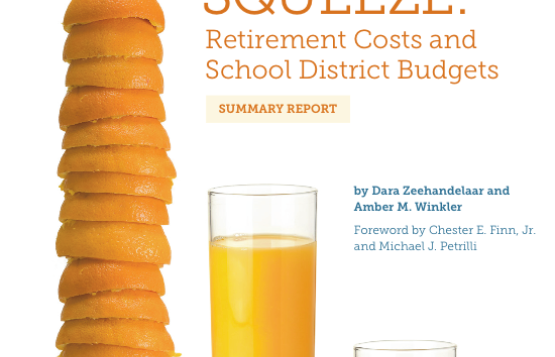
The Big Squeeze: Retirement Costs and School-District Budgets

When it comes to pension reform in the education realm, it’s hard to stay positive. Here, we’re saddled with a bona fide fiscal calamity (up to a trillion dollars in unfunded liabilities by some counts), and no consensus about how to rectify the situation. No matter how one slices and dices this problem, somebody ends up paying in ways they won’t like and perhaps shouldn’t have to bear. All we can say is that some options are less bad than others.

Dara Zeehandelaar Shaw, Ph.D., Amber M. Northern, Ph.D. 6.3.2013
NationalReport

The Big Squeeze: Retirement Costs and School-District Budgets

6.3.2013
Report

Education Reform in 2014

Chester E. Finn, Jr.
7.30.2014
Flypaper

Vergara: Going bicoastal

The Education Gadfly
7.30.2014
Blog

Justin Bieber, Orlando Bloom, and pop culture ineptness

7.30.2014
Resource

Don't jump the NGSS bandwagon yet

6.13.2013
Video

Renewing Head Start’s Promise: Invest in What Works for Disadvantaged Preschoolers

Chester E. Finn, Jr.
7.30.2014
Blog

Shortchanged: The Hidden Costs of Lockstep Teacher Pay

7.30.2014
Blog

Taking Immediate Steps to Provide Teachers with a Secure Retirement

Marie Dandie
7.30.2014
Blog
view

Education Reform in 2014

Chester E. Finn, Jr. 7.30.2014
Flypaper
view

Vergara: Going bicoastal

The Education Gadfly 7.30.2014
Blog

Justin Bieber, Orlando Bloom, and pop culture ineptness

Michael J. Petrilli, Dara Zeehandelaar Shaw, Ph.D., Brandon L. Wright 7.30.2014
Resource
view

Don't jump the NGSS bandwagon yet

6.13.2013
Video
view

Renewing Head Start’s Promise: Invest in What Works for Disadvantaged Preschoolers

Chester E. Finn, Jr. 7.30.2014
Blog
view

Shortchanged: The Hidden Costs of Lockstep Teacher Pay

7.30.2014
Blog
view

Taking Immediate Steps to Provide Teachers with a Secure Retirement

Marie Dandie 7.30.2014
Blog
view

The Big Squeeze: Retirement Costs and School-District Budgets

6.3.2013
Report

When it comes to pension reform in the education realm, it’s hard to stay positive. Here, we’re saddled with a bona fide fiscal calamity (up to a trillion dollars in unfunded liabilities by some counts), and no consensus about how to rectify the situation. No matter how one slices and dices this problem, somebody ends up paying in ways they won’t like and perhaps shouldn’t have to bear. All we can say is that some options are less bad than others.

In The Big Squeeze: Retirement Costs and School-District Budgets, we analyze and project how big an impact the pension and retiree health care obligations will have on the budgets of three school districts: Milwaukee Public Schools, Cleveland Metropolitan School District, and the School District of Philadelphia.

The Big Squeeze: Retirement Costs and School-District Budgets is a summary report by Dara Zeehandelaar and Amber M. Winkler, based on three technical analyses conducted by Robert Costrell and Larry Maloney to be released by the end of Summer 2013.

view

Education Reform in 2014

Chester E. Finn, Jr.
7.30.2014
Flypaper

On August 1, Chester E. “Checker” Finn, Jr., will step down from his role as founding president of the Thomas B. Fordham Institute, passing the baton to Michael J. Petrilli, Fordham’s longtime executive vice president. Finn will remain on staff as a distinguished senior fellow and president emeritus. Here is his “farewell address” as president.

This short essay cannot begin to say all that deserves to be said about the state of ed-reform in America in 2014, but it gives me an opportunity to do some stocktaking, recount a bit of history, and flag some challenges for the future.

Organizationally, the modern Thomas B. Fordham Institute and the Foundation that birthed it have been around for seventeen years, but the reformist zeal and philosophy that it inherited from the Educational Excellence Network carry us back to 1981. Two years before A Nation at Risk, Diane Ravitch and I—and a handful of fellow travelers—had concluded that American K–12 education needed a kick in the pants, a kick toward greater quality, primarily in the form of stronger student learning. (More of that tale can be found on our website here and here.)

That’s thirty-three years ago, before many of today’s ed reformers were even born, and, while Diane has obviously deviated from that path in recent years, I like to think I’ve continued to trudge down it, along with an ever-growing cadre of fellow reformers and—since 1997—with Fordham’s organizational and human resources pushing us onward.

What’s been accomplished?

I’ve reviewed some of this history before, citing as many as ten big, positive changes. Here, I’ll mention just the two that seem to me most profound:

  • We now judge schools by their results, not their inputs, intentions, or programs. The results we focus on deal, for the most part, with pupil achievement. And while we continue to struggle with the details, over the years we’ve developed academic standards that set forth the results we seek, we’ve created assessments and other measures to gauge how well they’re being achieved, we’ve built a trove of data that generally makes results (and progress toward them) transparent and comparable, and we’ve constructed accountability systems that reward, intervene in, and sometimes sanction schools, educators, and students according to how well they’re doing.
  • Choice among schools (and other education-delivery systems such as virtual learning, home schooling, and more) has become almost ubiquitous. Though too many choices are still unsatisfactory, and too many kids still don’t have access to enough good ones, we’re a very long way from the education system of 1981, which basically took for granted that children would attend the standard-issue, district-operated public school in their neighborhood unless, perhaps, they were Catholic (or very wealthy).

Plenty more accomplishments could be cited, including the serious entry of technology into classrooms, ambitious teacher-evaluation systems, networks of charter schools—virtual school systems, really—that do a bang-up job of educating poor and minority kids, some rewards for outstanding educators (and some softening of job protections for the other kind), and a host of “alternative” routes by which eager, talented individuals can make their way into classrooms and principals’ offices without passing through the traditional hoops.

The payoff to date is worth lauding: Student outcomes have strengthened, at least in fourth and eighth grades, mostly in math but somewhat in reading. High school graduation rates are starting to edge upward. Other “cultural” indicators are better, too: less teen pregnancy, less smoking, less drug abuse, and more.

We can’t claim that all of that is due to education reform but it has almost surely helped. We can honestly state that reformers have much to be proud of—and millions of American children (and the nation itself) now benefit from the fruits of their labors.

But we have so far still to go. The important changes that we’ve planted haven’t yet yielded enough of an achievement harvest, particularly at the end of high school, when it matters most, and we continue to wrestle with their implementation. We still have too many unforgivable gaps, too many “dropout factories,” too many kids left behind, too many without good options. Other countries continue to make faster gains than the U.S. And we haven’t yet worked our way down the agenda of essential reforms. Let me note (in no particular order) eight of the toughest and most consequential challenges ahead.

Governance

The basic structural and governance arrangements of American public education are obsolete. They’re okay at operating yesterday’s schools but almost hopeless when it comes to inventing tomorrow’s. We have too many layers, too many veto points, too much institutional inertia. “Local control” needs to be reinvented—to me it looks more like KIPP-Houston than the Houston Independent School District—and education needs to join the mayor’s (and governor’s) portfolio of other important human services. Alternatives are emerging—mayoral control in a dozen cities, recovery school districts in a few states, charter-management organizations, and more—but the vast majority of U.S. schools remain locked in structures that may have made sense around 1900 but not in 2014.

Finance. I dare you to track, count, and compare the dollars flowing into a given school or a given child’s education. I defy you to compare school budgets across districts or states. I challenge you to equalize and rationalize the financing of a district or state education system—and the accounting system that tracks it—in ways that target resources on places and people that need them and that enable those resources—all those resources—to follow kids to the schools they actually attend. What an unfiltered mess! (But please do watch Fordham try to make some sense out of it, at least in the DC metro area, a few weeks hence.)

Leaders

We’re beginning to draw principals, superintendents, chancellors, and state chiefs from nontraditional backgrounds, but we haven’t turned the corner on education leadership. We still view principals, for example, as chief teachers—and middle managers—rather than the CEOs they need to become if school-level authority is ever to keep up with school-level responsibility. Think of them—and those above them—as executives; prepare them as executives; empower them as executives; and compensate them as executives. We already hold them accountable as executives, but nothing else about their role has yet caught up.

Curriculum and instruction

“Structural” reformers—I plead guilty to having been one—don’t pay nearly enough attention to what’s happening in the classroom, in particular to what’s being taught (curriculum) and how it’s being taught (pedagogy). The fact is that content matters enormously—Don Hirsch is exactly right about this—and that some instructional methods work better in particular circumstances than others. Both standards-based and choice-based reform have remained largely indifferent about these matters, but that ought not continue. That’s why the folks at KIPP, for example, are finally developing network-wide curricula and why Amplify and the Core Knowledge Foundation have teamed up to build and distribute a Common Core–aligned language arts curriculum.

High-ability students

Smart kids deserve education tailored to their needs and capabilities every bit as much as youngsters with disabilities. (The individualized system of the future should tailor everybody’s education within a framework of common standards.) And the nation’s long-term competitiveness—not to mention the vitality of its culture, the strength of its civic life, and much more—hinges in no small part on educating to the max those girls and boys with “special gifts,” as Rick Hess puts it, who “may be those most likely to one day develop miraculous cures, produce inspiring works, invent technological marvels and improve the lives of all Americans.” But gifted education in America is patchy at best; at worst, our system is downright antagonistic to the needs of high-ability girls and boys.

Preparation of educators

How many times do people like Art Levine and organizations like the National Council on Teacher Quality have to document the failings of hundreds upon hundreds of teacher- and principal-preparation programs before this gets tackled as a top-priority reform? Once again, promising alternatives are emerging, and a smallish number of traditional programs do a fine job. But, once again, the typical case is grossly inadequate. And, once again, our governance system (or lack thereof) makes change hard to effect.

Complacency

Two forms of complacency alarm me. The old familiar one is the millions of parents who deplore the condition of American schools in general but are convinced that their own child’s school is just fine (“and that nice Ms. Randolph is so helpful to young Mortimer”). The new one, equally worrying, is reformers who think they’ve done their job when they get a law passed, an evaluation system created, a new program launched, then sit back on their haunches, give short shrift to implementation, but defy anyone who might suggest that their proud accomplishment isn’t actually working.

Greed

I hail the entry into the ed-reform camp of entrepreneurs with all their energy, imagination, and venture capital, but I’ve seen too many examples of them settling for making their venture profitable for investors or shareholders (or themselves) rather than educationally profitable for the kids it serves. That’s not so very different from traditional adult interests within the public and nonprofit sectors battling to ensure their own jobs, income, and comfort rather than giving their pupils top priority. A firm that’s just in it for the money is as reprehensible as a teacher union that’s in it just to look after its members’ pay, pensions, and job security.

You can count on the Fordham Institute to stay out front on these issues and others that arise, as well as its long-term emphases on standards-based reform (particularly the Common Core at present) and school choice in its myriad forms. We’ll be there with research, analysis, commentary, advocacy—and sometimes a bit of humor. As American ed reform’s leading gadfly, we’ll continue to nip at friends and allies when warranted—and almost always at defenders of the status quo and others who don’t put kids’ interests and the public interest at the top of their priorities. The Institute’s reins are passing into the exceptionally capable hands of Mike Petrilli and a stellar team of colleagues, and the place will inevitably continue to evolve, as it should. I get to move downstairs, cut back a little, and evolve a bit myself, as I should. But I’m not riding off into the sunset. In the months and years ahead, I’ll still be at Fordham (and Hoover), with fewer day-to-day responsibilities and thus more opportunity than ever to make trouble for those who deserve it.

view

Vergara: Going bicoastal

The Education Gadfly
7.30.2014
Blog

Seven families in Albany, backed by former news anchor Campbell Brown’s advocacy group, the Partnership for Educational Justice, filed the nation’s second Vergara-inspired lawsuit. (The first copycat suit was filed in New York City earlier this month by the New York City Parents Union.) The plaintiffs argue that New York State’s teacher-tenure and -seniority laws violate their children’s right to effective education. Meanwhile, recent New York City Department of Education data show that, of the 826 attempts to fire teachers over the last two years, only 40 resulted in termination; 330 are still pending.

In the upcoming school year, NYC charter schools will be allowed to offer pre-K for the first time; six schools are getting ready to do so. Many states, unfortunately, continue to make it all but impossible for charters to offer pre-school services. Ohio, for example, doesn’t provide charter funding for children under five. This is yet another form of underfunding of charter schools—and a situation that reform-minded lawmakers need to fix.

Teacher unions, fearing soured public opinion and wanting to make up ground lost in 2010, are set to play hardball in this year’s midterms. Politico reports that they’ll likely spend at least $70 million (or maybe much more) and are already sending out armies of teachers to go door-to-door—believing they’ll be more effective than the usual volunteer canvassers. Unions are also coaching their members to persuade their own spouses—mostly middle-aged white suburban and rural men, a demographic segment that the Democratic Party has recently had trouble reaching. Quipped union-watcher Mike Antonucci, “I’m going to go out on a limb here and assume these union strategists are not married, at least not successfully.”

Justin Bieber, Orlando Bloom, and pop culture ineptness

7.30.2014
Resource

Mike and Michelle talk teacher-tenure lawsuits, charter schools offering pre-K, and teacher-union midterm politics. Dara ups the stakes with a study on high-stakes testing of voucher students.

Amber's Research Minute

"High-Stakes Choice Achievement and Accountability in the Nation’s Oldest Urban Voucher Program," by John F. Witte, et al., Educational Evaluation and Policy Analysis (June 9, 2014).

Transcript

Mike Petrilli:             Hello. This is your host, Mike Petrilli, at the Thomas B. Fordham Institute, here at The Education Gadfly Show and online at edexcellence.net. Now, please join me in welcoming my co-host, the Orlando Bloom of education reform, Michelle Gininger.

Michelle G:               I'll take that.

Mike Petrilli:             You know why we say that [crosstalk 00:00:36]? Orlando Bloom, who I'm not sure I know who that is, but I like him because supposedly he punched Justin Bieber this week.

Michelle G:               What do you have against Justin Bieber? Are you on the anti-Bieber chain?

Mike Petrilli:             Look, I don't know the Justin Bieb- ... the Biebster, what do we call him? The Bieber? Biebster? [Biebalicious 00:00:54]? I don't know. What do we call him? I don't know him all that well. But I will say this. [crosstalk 00:00:58] He does look pretty annoying. It sounds like he was what, hitting on Orlando Bloom's wife?

Michelle G:               Ex-wife, I believe.

Mike Petrilli:             Ex-wife? All right, then why'd he hit him?

Michelle G:               We probably should have had more information before we went [crosstalk 00:01:11] down this.

Mike Petrilli:             Folks, listeners, listen. There are many, many hundreds of you out there. Sometimes I need help with pop culture references, so send them my way at Michael Petrilli.

Michelle G:               But we do know education policy.

Mike Petrilli:             We know education policy and that's what we're going to get to. Michelle, let's do it. Brandon is here to help us. Brandon, let's play, Pardon the Gadfly.

Brandon Wright:       7 families in Albany have filed the nation's 2nd Vergara-inspired lawsuit, arguing that New York State's teacher tenure and teacher seniority laws violate their children's right to effective education. Are these New York versions of Vergara a good idea?

Mike Petrilli:             So, what do you think, Michelle? This is the Campbell Brown suit. Campbell Brown. Do you support this? Are you happy?

Michelle G:               I'm pretty excited because we're going to disagree. I know you're not a big fan of the other states following suit. I am. Yes, it's a total mess when you bring in the courts. It's going to blow everything up, but teacher tenure is not good in any instance. I am against teacher tenure.

Mike Petrilli:             Okay. Let's [head 00:02:10] back this a little bit here. All right? Yes, there is a huge problem with getting the courts involved in this kind of education policy [crosstalk 00:02:17].

Michelle G:               On that, we agree.

Mike Petrilli:             All right. But, that's a huge issue. That's what this is. It's a court case, Michelle, okay? If the question is, should we be pushing in the New York legislature to reform tenure? Fine. I'm fine with that. I'm particularly interested in any kind of reform that gets at LIFO, that says that school districts have to consider seniority when making termination decisions. But here's the thing about New York versus California, right? In California, it was what, a 2 year probationary period for teachers. New York is 3. That makes a difference. Look, you've got 2 years, 2 cycles of teacher evaluations, 2 cycles of value-added scores, when you are trying to decide if somebody should get tenure.

                                    What we see in New York City is when Joel Klein came in and said, "Look, we're going to take this seriously. We're going to actually make real decisions at this point of determining tenure and we're not going to just automatically give tenure to teachers because they reached that period," guess what? It worked. They were able to push a lot of teachers out of the system. Why not focus on that, do that statewide, instead of filing a new lawsuit?

Michelle G:               I mean, I agree that doing things by the court is a really messy, not great way of doing it, but how long [crosstalk 00:03:23]. How long have we been trying, have ed reformers been out there trying to reform tenure in states? How long?

Mike Petrilli:             Yeah. Yeah.

Michelle G:               Right. A very, very long time.

Mike Petrilli:             That depends. We got some real reform in the last few years. We've seen a lot of movement.

Michelle G:               But then, and you know ... Bloomberg did a really great job of not just giving tenure to everybody, but that depends on who your leader is. Is Bill de Blasio going to be holding this up right and doing the right thing and not just handing out tenure to every teacher? I don't think so. I think that 3 years, 5 years, like in Ohio, isn't enough time to earn tenure. If you're not doing your job, you're not performing, it shouldn't be impossible to fire someone. You're going to be Fordham's incoming president later this week. If you're not doing your job, you're not bought in.

Mike Petrilli:             I didn't think you were going to go there, Michelle. I thought you were saying that I should have the authority to fire the staff at the Thomas B. Fordham Institute.

Michelle G:               You do have that authority.

Mike Petrilli:             I do have that authority. Okay.

Michelle G:               Which is why we all do our jobs.

Mike Petrilli:             Which is why, in the end, you agree with me.

Michelle G:               Oh, yes, I do. Mike was right. Mike was right.

Mike Petrilli:             That's very well done. I'm just teasing about that. All right. Topic number 2, Brandon.

Brandon Wright:       In the upcoming school year, New York City charter schools will be allowed to offer pre-K for the 1st time, but many other states continue to make it all but impossible for charters to offer preschool services. Should they?

Mike Petrilli:             Well, yeah. Michelle, we have a study in the works on this question by [Sara Meech 00:04:48], who is doing the study for us and for the National Alliance for Public Charter Schools, looking at what that landscape is out there across the states, in terms of charters getting access to preschool funding and policies. This is a no-brainer, right?

Michelle G:               This is a no-brainer and this is crazy that we're even in this situation, especially since some of these folks who are against charters want universal pre-K. How are they going to do that without including, say, charter schools? That's a huge sector that can educate a lot of pre-K kids.

Mike Petrilli:             Yup. There's certainly plenty of states, like our home state of Ohio, where there simply is not much state money for pre-K. Okay? It's basically, there's the federal funds for Head Start and not much more than that. Look, I'm ready to say that's a problem, okay? I do think pre-K investment makes sense if you do high quality and all the rest. In states though that do provide some kind of funding to traditional public schools, they should absolutely make sure that funding goes to charter schools. We see here in D.C. what happens. When a charter school can start at age 3 with kids, they got an incredible impact, and particularly the high-performing charter schools. These 2 sectors, the charters and the preschool worlds, they need to come together.

Michelle G:               Yes. On this question, we agree 1000%.

Mike Petrilli:             It's like, what, peanut butter ... It's like, what, peanut butter and chocolate?

Michelle G:               Yeah. I thought you were going to say jelly, and then I was going to say, well, what kind of jelly do you like, and then that could bring us down a whole other path.

Mike Petrilli:             No, no.

Michelle G:               Because grape jelly is no good.

Mike Petrilli:             I prefer the Reese's peanut butter cup analogy.

Michelle G:               Yeah.

Mike Petrilli:             You can't beat peanut butter and chocolate. It's as good as it gets. That is what charter schools and pre-K ...

Michelle G:               Could be.

Mike Petrilli:             Yes, thank you. Very good. Okay, Brandon, topic number 3.

Brandon Wright:       Teacher unions are set to play hardball in this year's midterms and Politico reports that they'll likely spend at least $70 million and are encouraging female teachers to try to convince their husbands to vote Democrat. Is this likely to work?

Michelle G:               Mike, I have a question for you.

Mike Petrilli:             Yes, Michelle?

Michelle G:               Does [Megan 00:06:44] dictate your vote?

Mike Petrilli:             She does not. She has, at times, dictated where I live, and that is how I ...

Michelle G:               That seems fair.

Mike Petrilli:             ... and how I turned up to be the only Bush administration appointee living in Takoma Park, Maryland, the Berkeley of the D.C. area. Look, this is funny. Mike Antonucci, who follows the unions better than anybody, of course he quipped that he is pretty sure that whoever devised this plan is not married, at least not successfully.

Michelle G:               Yes, I mean, there's a great ... What's the advertising show called?

Mike Petrilli:             Mad Men?

Michelle G:               There's a great Mad Men episode where they're talking about the Kennedy election, the wives are, and one of the woman says, "Well, I'm going to have to ask my husband how I'll vote." We have come a long way. Now, women are dictating how their husbands are going to vote. This is a win.

Mike Petrilli:             No, we'll see. It is interesting. There's a huge gender divide in our politics right now. Women, much, much more likely to vote for the Democrats, although it's really single women that are much more likely. Married women, it's not quite as pronounced, but still, unions are saying, in a lot of these swing states, in the South or in the Midwest, you've got ... The Democrats have a hard time getting the votes of white men, especially in suburbs, exurbs, small towns, but plenty of those men are married to teachers. So, we'll see. You know what I say to this, to the NEA? Thank God for the secret vote, for the secret ballot. I'm really excited that generally you are not expected to go into the voting booth with your spouse.

Michelle G:               So you think, will we have a case of many husbands voting for Republicans but telling their wives and just being shocked when the election results come in?

Mike Petrilli:             Exactly.

Michelle G:               I have no idea how this happened.

Mike Petrilli:             Exactly. You can tell that to Nate Silver. The exit polls on this one are not going to be accurate.

Michelle G:               And we can thank the union.

Mike Petrilli:             Exactly. All right. That's all the time we got for Pardon the Gadfly. Thanks for helping us play, Brandon. You may notice a new voice there, Brandon Wright, taking over from the eminently talented Pamela Tatz, who is heading briefly to the West Coast, leaving us here at Fordham. We will miss her. We'll have her on the show 1 more time before we go and give her a hard time about this terrible career choice that she's making.

Michelle G:               And we do it every single day.

Mike Petrilli:             As we do. All right. Now it's time for everyone's favorite, Amber's Research Minute. Dara Zeehandelaar, welcome back to the show.

Dara Z:                       Thank you, thank you.

Mike Petrilli:             You are pitching in for Amber, who is on a well-deserved vacation. This means that you get to answer the question of the day, what do you think about Justin Bieber, and would you like to punch him?

Dara Z:                       I wanted to high-five Orlando Bloom when I heard about this story. I'm pretty sure that it has something to do with somebody's girlfriend or I didn't read that far enough into the story. I think it's about girls and not out of just general spite, but I don't care about the backstory. I think I speak for everyone ...

Michelle G:               We're unclear on the facts too.

Mike Petrilli:             But already, no, the fact that Dara had seen this headline. She knew what we were talking about. We had to just like Google pop culture and see what popped up, but you had actually [crosstalk 00:09:49].

Michelle G:               You're not supposed to tell people we do that.

Mike Petrilli:             I know. Is that what we do? Is that how we do it?

Dara Z:                       Oh my gosh. I wish that ...

Mike Petrilli:             Should we go to the trashy magazines? Anyways, very impressive, Dara, that you are in the loop even though you sit over there in that office doing research all day.

Dara Z:                       Oh my gosh. Could I take that back? I'd like to pretend like I didn't know what you were talking about.

Mike Petrilli:             Okay.

Michelle G:               Too late. [crosstalk 00:10:07]

Mike Petrilli:             Dara, not a Bieber fan. Okay, Dara, what do you have for us this week?

Dara Z:                       I've got a study from this month's Educational Evaluation and Policy Analysis journal from John Witte, Patrick Wolf, Joshua Cowen, Deven Carlson, and David Fleming, all stars. It's called "High-Stakes Choice, Achievement and Accountability in the Nation’s Oldest Urban Voucher Program." It's a unique look at 1 very interesting aspect of the Milwaukee parental choice program. Now, we very well know that voucher programs, writ large, have little, if any, accountability mechanisms. We've talked about this before.

Mike Petrilli:             Mechanisms beyond parental choice itself.

Dara Z:                       Right.

Mike Petrilli:             I mean, test-based accountability.

Dara Z:                       Right.

Mike Petrilli:             Great.

Dara Z:                       But, in Milwaukee, as of the 2010-11 school year, private schools participating in the voucher program are required to test students who receive the vouchers with the reading and math portions of the state test, and to report the results for public consumption. Now, the researchers had that data, but they also, for a group of students, had pre-reform test scores, because this group was already doing an evaluation of the voucher program. This gave the authors the opportunity to estimate the impact of the accountability policy on student achievement outcomes.

                                    What they found is that high stakes testing has a positive impact on the achievement scores of voucher students, in the 1st year after private schools were required to test those students. They determined this by looking at the test scores of voucher students over a 3 year period, 2 years before the change and 1 year after. They had a fairly limited sample of 437, mostly 7th and 8th graders participating in the program, compared this group to a similar group of Milwaukee public school students.

                                    The voucher students saw a significant growth in their test scores during the 1st year of the accountability policy, with particularly positive results for students who were already at the high end in math and at the low end in reading. The policy had a positive impact on African American students in both reading and math, and for Hispanic, white, and Asian students, in math only. The authors did a number of tests of this result, and they fairly convincingly argue that the positive impact of the policy was a result of the policy, and not because of other factors.

                                    But, of course, a few caveats. It's hard to generalize to students in other grades, and it's very hard to generalize to students in other cities and other voucher programs, because of the scope of the Milwaukee program. It's also possible that the public reporting requirement motivated private schools to do better, period, and it had nothing to do with voucher students. Finally, because the researchers could only look at 1 year of data post-reform, it could be that this is a 1 year bump in scores, rather than a sign of sustained improvement.

Mike Petrilli:             [Woof 00:12:54]. Wow. That is very exciting, Dara, and this is in fact 1 argument we make when we argue for more test-based accountability for voucher programs. It was our hope that this would, in fact, raise student achievement. There were some indications from Milwaukee that that might have been the case, and this sounds like this is a much more in-depth, sophisticated analysis that says, "Yes, indeed, that's exactly what happened."

Michelle G:               Yes. This is really exciting news. I think there's been a lot of debate within the choice movement about accountability and maybe Orlando Bloom and Justin Bieber can work it out, just like the 2 sides of the voucher argument can work it out too. Can we be optimistic here?

Mike Petrilli:             Beautiful. Beautifully said, Michelle. I love it. I do suspect that it could be a 1 year bump or at least a bump that is not sustained forever. We've seen that in the traditional public schools. That, you look at the nation as a whole, we got a big 1 time bump in the late 90s or early 2000s, when states embraced test-based accountability. The improvements eventually faded out. They hit a plateau. Now we maintain that higher level of performance. We didn't get back down.

                                    You may see something here. [Lookit 00:14:04], when you suddenly know, as a school, that somebody's looking over your shoulder and they're going to look at the student achievement results, it makes sense. Any bit of little more focus, a little more focus on what's on the test, and you can see these kinds of results. Look, people on the other side of this issue, it doesn't take away from their argument, which is that, look, that might have led to teaching to the test. It might have forced schools to do something that ... to stop doing things that made them unique and made them special and made them in effect private. It's not that it answers these questions about trade-offs, but it's pretty compelling that this policy seems to be pretty good when it comes to student learning.

Dara Z:                       When it comes to student testing. When it comes to student learning, again, not to keep beating this drum, but we also need high standards and good tests.

Mike Petrilli:             Yeah, no, that's absolutely right. This is using whatever standardized test they were using for the evaluation or the state test?

Dara Z:                       It's the state test.

Mike Petrilli:             It's the state test. This is a big question. We finally, with our friends in the voucher world, came to say, you know, if we would prefer you to use the state tests for the voucher schools, including common core tests, if that's what you're moving to, but we understand the sensitivities around that and if it's just some kind of reputable standardized test, we are okay with that. That might be the best that we can do, because again, the trade-offs. We don't want private schools to lose their distinctiveness and feel like they all have to look like everyone else.

Dara Z:                       Right, although it does put some people into kind of a catch-22, because these researchers were able to say that the voucher students saw improvement, because they were using the same test, the state test, as the Milwaukee public school students. You can't make that conclusion robustly if you're not using the same test.

Mike Petrilli:             I see. I see. So if they'd used the Stanford 9 instead, we just don't know if they would have seen the same results.

Dara Z:                       Right.

Michelle G:               Right, and I think that was our inclination to using the common yardstick, as it being a tool for parents too. If you can see how a private school is performing on 1 test, and the public school on the same test, you get an understanding of where they are, even though, of course, tests aren't the perfect measure.

Dara Z:                       Right, but, like I said, it puts some people into a tough position because they want to be able to prove that the voucher system is effective, but they also don't want to sacrifice the flexibility of being forced to use the state test or not, in order to prove that it works.

Mike Petrilli:             Gotcha. The big question, where is Justin Bieber on this question? Do you think he's pro-accountability or no?

Michelle G:               Why don't you tweet him and ask?

Dara Z:                       I don't think that he would pass the 7th grade Wisconsin state test.

Mike Petrilli:             Ouch. Ouch. Throwing it. Loving it.

Michelle G:               Oh, man, I could actually, because [crosstalk 00:16:43].

Dara Z:                       Whatever. Bring it. I could take him.

Mike Petrilli:             You could bring it.

Dara Z:                       I could take him.

Mike Petrilli:             Well, yeah, that.

Michelle G:               But could you take Orlando Bloom?

Dara Z:                       Why would I want to?

Mike Petrilli:             Well said. Okay, gang. That's all the time we've got for this week. Until next week.

Michelle G:               I'm Michelle Gininger.

Mike Petrilli:             And I'm Mike Petrilli at the Thomas B. Fordham Institute, signing off.

view

Don't jump the NGSS bandwagon yet

6.13.2013
Video

Chester E. Finn, Jr. breaks down why Fordham does not support implementation of the NGSS.

view

Renewing Head Start’s Promise: Invest in What Works for Disadvantaged Preschoolers

Chester E. Finn, Jr.
7.30.2014
Blog

The estimable Sara Mead is, as we’ve come to expect, perceptive about what ails today’s preschool options and advocacy campaigns, even as she strives to support (and repair) programs and policies that she knows are flawed. So it is with Head Start, by far the largest early-childhood program in the land, the only really big one that the federal government runs, and one that been in the news lately in part because it’s among the categorical programs that reform-minded Republicans like Congressman Paul Ryan would like to turn over to the states via block-grant funding. Mead wants to change Head Start in major ways but not take it away from Uncle Sam. She remains confident that he’s capable of fixing it and doesn’t have great confidence in the states, though she acknowledges that some state- (and district-) operated preschool programs have stronger results than Head Start and says she would welcome a “pilot program” whereby a few states (after meeting multiple federal requirements!) would gain greater say over their programs.

Setting aside the federalism question and recognizing Mead’s earnest desire to fix Head Start rather than damn its failings, this report still amounts to a devastating critique of those failings in 2014 and of Uncle Sam’s inability so far to set them right.

Mead correctly recalls that Head Start began under LBJ as part of the “war on poverty,” not as a pre-K education program per se. She accurately reports that it was intended to “deliver services” to needy three- and four-year-olds, not just to prep them for school. Hence its thousands of local operators were judged not on any outcomes, let alone education outcomes, but on their compliance with myriad requirements related to the services they delivered and how they went about it. And despite a couple of Congressional- and executive-branch repair efforts (all of them opposed vigorously by Head Start’s feisty lobby and weakened by the program’s iconic stature), that’s still pretty much how it operates. Yet, as Mead declares, “the world has changed” and so must Head Start.

Here are its four “fundamental challenges” as she sees them:

  1. “Lack of Clear Performance Measures.” This immense federal program, fifty years on, has no outcomes gauges by which to know how much, if at all, participating children (or their families) are gaining or which operators are more effective than others.
  2. “Overemphasis on Compliance.” Not only does Head Start have no outcome measures, but its 1,600 local grantees are judged on their fulfillment of “2,400 detailed requirements on everything from potty-emptying to dental care to accounting.”
  3. “Lack of Focus.” In Mead’s words, “Head Start’s emphasis on comprehensive services reflects the integrated nature of child development and the complex, interrelated challenges that face poor families….The problem is that, when you’re trying to do everything, it’s hard to do anything well….Ultimately, Head Start’s mission should be to even the playing field for our poorest children by preparing them for school and life—which means addressing all domains of school readiness.” OK, I added the emphasis. But isn’t Mead here describing what most Americans believe the program already does?
  4. “Ignoring curriculum.” It turns out that the commercial curriculum used by two-thirds of Head Start operators “is not particularly effective.” Worse, the What Works Clearinghouse found that it has “no discernible effects on oral language, print knowledge, phonological processing, or math for preschool children.” In short, not a head start at all.

Mead believes that these enormous problems can be solved in Washington. I don’t share her optimism. But she’s done a valuable service by illuminating them and suggesting remedies that, in principle, would do Head Start—and America’s neediest preschoolers—a world of good.

SOURCE: Sara Mead, Renewing Head Start’s Promise: Invest in What Works for Disadvantaged Preschoolers (Washington, DC: Bellwether Education Partners and Results for America, July 2014).

view

Shortchanged: The Hidden Costs of Lockstep Teacher Pay

7.30.2014
Blog

A new report by TNTP outlines the main pitfalls of the current teacher-pay system and offers some insightful solutions. The authors explain that teachers’ starting salaries are 25 percent less than in other comparable fields and are stagnant during the first decade of a teacher’s career. What’s more, teachers only receive pay raises in two ways: by climbing another “step” on the salary scale or by earning a more advanced degree. High-performing teachers earn their raises the same way as everyone else: by letting time pass. Since the system encourages mediocrity and there is no incentive to perform well, schools end up retaining vast numbers of average teachers and losing their high performers. The report’s suggested remedy: higher entry-level salaries, raises for performance, and incentives to teach in high-need schools—all while maintaining salaries at 65 percent of per-pupil revenue—and ending automatic raises for advanced degrees and enhanced credentials that have not been shown to improve student outcomes. (Yes, that sounds a lot like D.C.’s IMPACT system, a model that TNTP lauds.) Schools spent an estimated $8.5 billion on raises for teachers due to their obtaining master’s degrees and $250 million on automatic pay increases for ineffective teachers, the report notes. If these funds were redistributed along the lines suggested here, the teacher profession could become more competitive and a more attractive option for high-performing teachers.

SOURCE: TNTP, Shortchanged: The Hidden Costs of Lockstep Teacher Pay (Brooklyn, NY: TNTP, July 2014).

view

Taking Immediate Steps to Provide Teachers with a Secure Retirement

Marie Dandie
7.30.2014
Blog

According to this brief from Third Way, our current teacher pension system is a “rip-off”; furthermore, “no private plan would be allowed to behave this way.” Under federal guidelines set by the Employee Retirement Income Security Act, private-sector employees are partially vested in their pensions in three years and fully vested in six years. By contrast, states have the authority to determine their own teacher vesting periods—which can last up to twenty years. Nineteen states “require their teachers to spend at least 10 years in the classroom before they can even vest at the minimum level of their retirement.” With 40 to 50 percent of teachers leaving the profession within five years, most teachers never reap their employers’ contributions, leaving states to eagerly inhale what’s left behind. Another big problem: teachers in twelve states (over 40 percent of the teaching force) work outside of the Social Security system, and no feasible guidelines exist for transferring one pension to another or a pension to Social Security coverage. To reboot the public pension system, the authors propose a mobile “cash-balance” system that would “allow cash flow to be uninterrupted for current and future retirees.”

SOURCE: Tamara Hiler and Lanae Herickson Hatalsky, “Taking Immediate Steps to Provide Teachers with a Secure Retirement,” Social Policy & Politics Program (Washington, DC: Third Way, July 2014).

Fordham Logo

© 2026 The Thomas B. Fordham Institute
Privacy Policy
Usage Agreement

National

P.O. Box 110
Burke, VA 22009

202.223.5452

[email protected]

Ohio

P.O. Box 82291
Columbus, OH 43202

614.223.1580

[email protected]

Sponsorship

130 West Second Street, Suite 410
Dayton, Ohio 45402

937.227.3368

[email protected]