Mobile Navigation

  • National
    • Policy
      • High Expectations
      • Quality Choices
      • Personalized Pathways
    • Research
    • Commentary
      • Gadfly Newsletter
      • Flypaper Blog
    • Events
    • Scholars Program
  • Ohio
    • Policy
      • Priorities
      • Media & Testimony
    • Research
    • Commentary
      • Ohio Education Gadfly Biweekly
      • Ohio Gadfly Daily
  • Charter Authorizing
    • Application
    • Sponsored Schools
    • Resources
  • About
    • Mission
    • Board
    • Staff
    • Career
Home
Home
Advancing Educational Excellence

Main Navigation

  • National
  • Ohio
  • Charter Authorizing
  • About

National Menu

  • Topics
    • Accountability & Testing
    • Advanced Education
    • Career & Technical Education
    • Charter Schools
    • Curriculum & Instruction
    • ESSA
    • Evidence-Based Learning
    • Facilities
    • Governance
    • Personalized Learning
    • Private School Choice
    • School Finance
    • Standards
    • Teachers & School Leaders
    • Think Again
  • Research
  • Commentary
    • Gadfly Newsletter
    • Flypaper Blog
    • Gadfly Podcast
  • Events
  • Scholars Program

The Education Gadfly Weekly

Sign Up to Receive Fordham Updates

We'll send you quality research, commentary, analysis, and news on the education issues you care about.
Thank you for signing up!
Please check your email to confirm the subscription.

The Education Gadfly Weekly: Transgender policies’ utter contempt for parents

Volume 23, Number 34
8.24.2023
8.24.2023

The Education Gadfly Weekly: Transgender policies’ utter contempt for parents

Volume 23, Number 34
view
High Expectations

The hill that public education dies on: Transgender policies’ utter contempt for parents

Enshrining into policy and practice ideological views on student gender to which a majority of Americans do not subscribe could easily be fatal to support for public education. Indeed, there are no words adequate to capture this level of hubris.

Robert Pondiscio 8.24.2023
NationalFlypaper

The hill that public education dies on: Transgender policies’ utter contempt for parents

Robert Pondiscio
8.24.2023
Flypaper

How districts are gaming graduation rates by letting students cheat

Jeremy Noonan
8.24.2023
Flypaper

Seven ways state leaders can rigorously implement the science of reading

Aaron Churchill
8.24.2023
Flypaper

Long term outcomes of a home- and community-based literacy program

Jeff Murray
8.24.2023
Flypaper

Cheers and Jeers: August 24, 2023

The Education Gadfly
8.24.2023
Flypaper

What we're reading this week: August 24, 2023

The Education Gadfly
8.24.2023
Flypaper
view

How districts are gaming graduation rates by letting students cheat

Jeremy Noonan 8.24.2023
Flypaper
view

Seven ways state leaders can rigorously implement the science of reading

Aaron Churchill 8.24.2023
Flypaper
view

Long term outcomes of a home- and community-based literacy program

Jeff Murray 8.24.2023
Flypaper

view

Cheers and Jeers: August 24, 2023

The Education Gadfly 8.24.2023
Flypaper
view

What we're reading this week: August 24, 2023

The Education Gadfly 8.24.2023
Flypaper
view

The hill that public education dies on: Transgender policies’ utter contempt for parents

Robert Pondiscio
8.24.2023
Flypaper

An unmistakable fault line is emerging between much of public education and many of those it serves, particularly parents, on transgender issues. Put bluntly, a strong majority of Americans—57 percent in a recent poll conducted by the Washington Post and Kaiser Family Foundation—simply don’t buy the idea that a person can be a gender other than the one “assigned at birth.” The fissures grow even wider on related issues that schools must contend with. Sixty-nine percent oppose transgender females competing against biological females in youth sports. And overwhelming majorities, more than three-fourths of those polled, believe it’s “inappropriate for teachers to discuss trans identity in elementary schools.” Other polls have found strong majorities of parents think transgender students should use bathrooms and locker rooms to match their sex rather than their chosen gender identity.

Big swaths of public education are moving aggressively against these sentiments. The most egregious examples are policies that say school district personnel can or should keep a student’s transgender status hidden from parents. The advocacy group Parents Defending Education counts over 1,000 school districts, which collectively educate more than 10 million children, that encourage teachers and staff to allow students to “socially transition”—change their name, pronouns, or gender expression—without parental consent or notification.

It is not possible to overstate the level of distrust, even contempt, reflected in the practice of excluding parents from discussions about their child’s gender preference, even deceiving them if students claim their parents are unsupportive. Moreover, such policies, typically justified as protecting students from harm, are wholly unnecessary. Teachers are “mandated reporters” in every U.S. state. If they have reason to believe children are unsafe at home, they are required by law to alert local child protective services. In no other conceivable instances is there any justification for excluding parents from profoundly life-altering decisions about their own children. If schools insist on inserting themselves between parents and their children, they do so not because they are compelled to, but because they choose to. The Supreme Court has recognized for over a century, going back to Pierce v. Society of Sisters, that “the child is not the mere creature of the state.” Keeping a child’s gender switch a secret from parents as a “best practice” is the state saying, in effect, “Oh, yes he (or she) is.”

It is not news that Americans’ trust in major institutions has been in freefall for some time. In the case of public education, it’s a two-way street. A December 2021 poll conducted for EdChoice showed that only about a third of teachers (36 percent) say they trust parents, a level below their confidence in their principals, union leaders, and the U.S. Department of Education. This level of institutional disregard creates ripe conditions for public school personnel to assume that their judgment is superior to a child’s parents. And that’s exactly what appears to be happening. Coming at a time when Americans have more opportunities to educate their children outside of traditional public schools and a growing inclination to do so, the consequences of aggressive anti-parent policies could easily become public schools’ undoing. The increased tempo of debates over masking during the pandemic and current issues with ideologically-tinged curricula and activism have already alienated a significant number of parents. Enshrining into policy and practice ideological notions about student gender to which a majority of Americans do not subscribe could easily be fatal to support for public education at large.

It will be argued that these policies are rarely enacted, but that’s beside the point. A government-run institution granting itself permission to withhold life-changing information from parents about their own children is both profoundly alarming and a massive overreach. These policies effectively demolish parental authority and allow the state to assume a role for which it has no rightful or reasonable claim. There is simply no credible evidence to support the belief that parents do not have in mind the best interest of their transgender children. Moreover, keeping such information from parents almost certainly violates the Family Educational Rights and Privacy Act (FERPA), which gives parents virtually unlimited rights to review their child’s school records. By circumventing this law in spirit, if not in practice, schools not only undermine parental rights, but also risk legal consequences. Today there are some twenty active court challenges to these policies, and as Luke Berg, a lawyer at the Wisconsin Institute for Law & Liberty, who is litigating three of these cases, describes the situation, “It’s hard to imagine a faster way to destroy the public education system than to tell parents that one of the conditions of sending their children to public school is ceding their parental role to teachers.”

Indeed, there are no words adequate to capture this level of institutional hubris. If teachers in our nation’s public schools wish to restore and maintain Americans’ trust in education, they must be willing to acknowledge a simple fact about their profession: They’re not free agents, not activists or ideologues, but government employees with no reason or right to usurp parental authority.

A public education system that ignores or overrules the fundamental role of parents, placing the state in a position of superior authority over children will not be accepted for long. If this is the hill public education chooses to die on, don’t be surprised if it gets its wish.

view

How districts are gaming graduation rates by letting students cheat

Jeremy Noonan
8.24.2023
Flypaper

For at least a decade, schools have been using online credit-recovery (OCR) courses to award bogus credits that satisfy graduation requirements, and thus inflating graduation rates. In spite of well documented abuses and comprehensive research studies showing negative outcomes associated with OCR use, schools persist in using them to push students—often the most disadvantaged—across the finish line.

The pandemic made this worse by ushering in a practice that is ripe for cheating: schools allowing students to take OCR courses entirely at home. Worse, some school systems have continued the practice post-pandemic, including three of the largest school systems in my home state of Georgia: Atlanta, Fulton, and Gwinnett.

I recently undertook substantial efforts to confront the problem in my own district (documented in this video), the Paulding County School District, which revealed a massive failure of accountability that may have implications outside of Georgia.

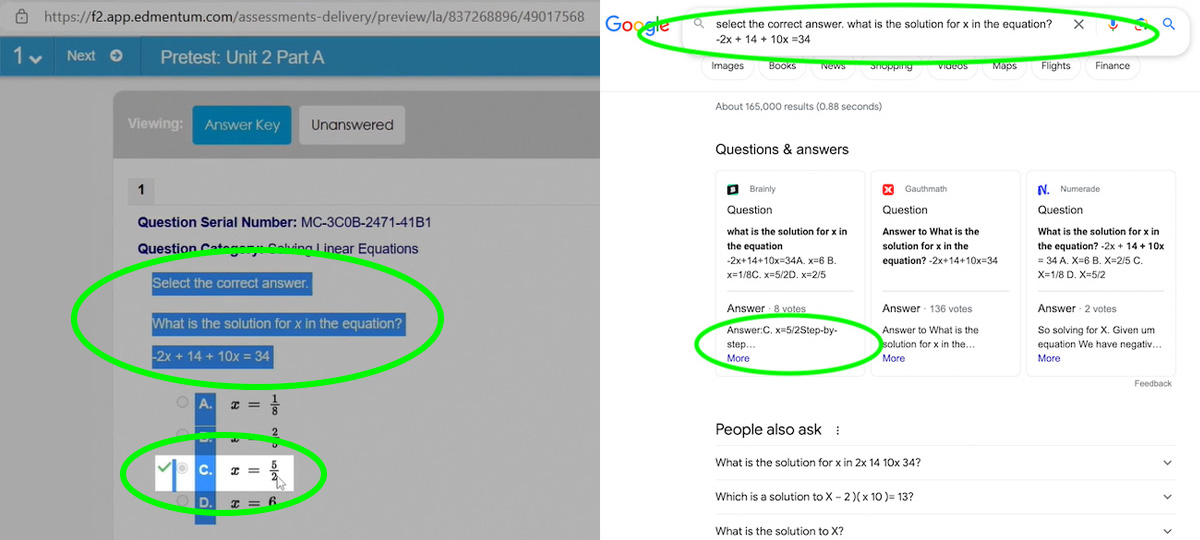
My experience began when I was unexpectedly assigned mid-year to oversee online credit recovery courses. I soon discovered that a few seniors assigned to me never showed up for class and were taking their course at home so they could graduate on time. I was expected to give them access to their assessments by unlocking them on Edmentum’s (the course provider) teacher platform. Knowing that the answers to the test bank were posted on third-party websites in a massive crowd-sourced cheating effort (see Figure 1), I refused to supervise these students and commenced my mission to rid the district of this ill-advised and harmful practice.

Figure 1. An example of how easy it is to cheat on Edmentum’s online credit-recovery courses
1

I first appealed to my school principal, urging that OCR exams be supervised on campus. But he rejected my proposal on grounds that the practice was a district norm. My first dead end.

Next I contacted my district administrators, but they sanctioned the practice and would not require exams to be proctored. A second dead end.

Realizing that this wasn’t going to be fixed internally, I made a video documenting the cheating and followed my own ethical obligations to report it to outside authorities.

I began by calling the U.S. Department of Education’s fraud, waste, and abuse hotline. For the agency to have jurisdiction, the program must be federally funded. I had reason to believe that Covid relief funds may have been used, but could not verify this. The U.S. DoE declined to get involved, but referred me to Georgia’s state education agency. A third dead end.

I contacted the state DoE’s Accountability Division, whose mission is “to provide all stakeholders with important information on the performance and progress of Georgia schools,” which it does mainly in the form of a school rating system in which graduation rates comprise 10 percent. Since the division’s mandate is limited to measurable outcomes, and not the means by which a school attains them, staff demurred and referred me to the agency’s External Affairs division. There I got some traction, bringing the matter to the attention of officials at the highest levels, but no action was taken. This may have been because, under Georgia’s “Strategic Waiver Initiative,” the DoE has permitted local school boards to waive all sorts of state regulations, provided that they attain certain annual increases in their district’s ratings. Either way, it was my fourth dead end.

I then turned to the Governor’s Office of Student Achievement, which exists to support “accountability and transparency through strategic data use to advance student success.” Since it has a legal mandate to “inspect academic records” to ensure that schools are “faithful to performance accountability requirements,” I requested an academic audit of the Paulding County School District’s credit recovery program. But their mandate extends only to standardized assessments required by the state. Lacking the authority to investigate local assessments, they also declined to get involved. A fifth dead end.

My next step was Cognia, the non-governmental accreditors that are supposed to ensure that accredited online courses are effective and credible, which would include verifying that the assessments are valid, i.e., not gameable. Cognia’s current president distinguishes the purpose of accreditation from that of government accountability: “unlike compliance measures, accreditation identifies what graduation rates, test scores, and other indicators cannot tell on their own—what takes place in the school that leads to its results.” In other words, accreditation focuses on the means by which an increased metric is attained. Since enabling online cheating betrays public trust and obliterates the credibility of academic credits, I assumed Cognia would get involved, so I filed a complaint supported by extensive documentation.

But Cognia sent an email to the Paulding County School District about my complaint, explaining that the accreditor was declining to investigate due to “insufficient evidence.” This was surprising, considering that I was a first-hand source who gave them email evidence of the district’s approval of unsupervised testing, as well as multiple assessment-provider records showing how students aced tests in impossibly low amounts of time.

Cognia, it seems, has been enabling schools to engage in such practices for over a decade by giving OCR courses its stamp of approval, in spite of the various ways they fall short of basic accreditation standards. Accrediting ineffective and easily gameable courses should damage Cognia’s credibility. But that doesn’t seem to have happened. A sixth dead end.

The last institution I could think of that may have the power and will to bring some accountability was Georgia’s Professional Standards Commission (PSC). The PSC oversees teacher certification, and is charged with enforcing the state’s ethics code.

Of the ten standards that comprise the code, two seemed germane to this scheme: honesty and professional conduct. Honesty is violated when schools misrepresent student achievement. Professional conduct is a catch-all category for any number of behaviors that are detrimental to education and to the “welfare or morals of students.” (There is a third standard on test integrity, but this is only limited to state-mandated assessments. When it comes to the integrity of local assessments in Georgia, anything goes.) Enabling students to earn graduation credits fraudulently certainly misrepresents student achievement and harms the profession while damaging students’ consciences.

Alas, the PSC complaint form is focused on discrete violations by specific individuals and is not set up for reporting systemic cheating where administrators are complicit for creating a permission structure, and guidance counselors and teachers are complicit for carrying out the scam by unlocking tests knowing that students had access to the answers. My seventh and final dead end.

—

One of the largest cheating scandals in U.S. history unfolded from 2009–2011 in Atlanta Public Schools, when over 100 educators were implicated in changing students’ wrong answers on state-mandated assessments A few were sentenced to prison. (The Fulton County District Attorney who indicted Trump last week was the lead prosecutor!) There were severe consequences because there are definitive regulations for state-mandated assessments and clear sanctions for cheating. Educators thus take great pains to administer these tests with integrity.

Yet when it comes to increasing graduation rates, rightly called the most “fungible statistic in education,” educators can practice—or allow their students to practice—all sorts of gaming behaviors with impunity because they are held accountable by the state only for the outcome. Online-credit recovery is a prime example of this.

To deter this behavior, we need a better system that also holds everyone—education departments, accreditors, administrators, principals, and educators—accountable for the means, as well. Yes, it’s vital that more high school students earn diplomas. But those diplomas will become worthless unless they mean that graduates are prepared for college and career.

Some of Georgia’s largest school systems fall short of this standard—and that’s very likely true of many more across the country. The biggest victims are the students themselves, failed by their schools and thrust into adulthood with false promises and a lack of skills. It’s high time for our leaders to put these young people first.

Editor’s note: Jeremy Noonan resigned his teaching position in Paulding County after the district refused to address the problem. In response to an Atlanta Journal-Constitution article and video based on his experience, he was put on paid administrative leave in order for the district to conduct their own ethics investigation into his use of student data.


view

Seven ways state leaders can rigorously implement the science of reading

Aaron Churchill
8.24.2023
Flypaper

Ohio recently passed a historic state budget that includes, among other components, ambitious literacy reforms that require schools to follow the science of reading—an instructional approach that emphasizes phonics for building foundational literacy skills and knowledge-rich curricula to support vocabulary and comprehension. These are much-needed changes, and similar movements are also spreading across the country. But effective implementation of legislative reforms will be a crucial next step. If Ohio leaders—and officials in other locales working to execute science of reading laws—successfully follow through on implementation, these promising literacy reforms will have a much better chance of boosting reading proficiency.

To recap, the legislation requires Ohio districts and charter schools to adopt curricula that aligns to the science of reading starting in fall 2024. Backed by a large body of research, this approach emphasizes explicit and systematic phonics instruction, as well as knowledge-rich curricula that builds vocabulary and comprehension. To support the transition, lawmakers set aside some $170 million to replace outdated curricula and provide professional development for teachers. The overarching goal is to ensure that all children are taught to read via proven methods by well-trained teachers, ultimately leading to stronger reading proficiency statewide. 

Under the new policy, schools that have previously embraced popular but debunked approaches such as “three-cueing” or “balanced literacy” will need to change course. Doing so is crucial, but it could also invite pushback from those wedded to the status quo. Some schools may openly defy state requirements. More likely, however, resisters will seek to undermine state policy in subtler ways, such as claiming to follow scientifically based instruction but continuing to use disproven methods behind closed doors.

If state leaders aren’t attentive and hard-nosed about implementation, Ohio’s promising literacy efforts could turn into mush. How can they ensure rigorous implementation? Let’s take a look at seven ways.

1. Ensure a complete and thorough system-wide survey of curricula materials. While weak curricula are assuredly in use across Ohio, there is no systemic data on how many schools use them. This leaves us uncertain about the heft of the implementation. It’s going to be much heavier lift if three-quarters of Ohio schools are using disproven methods than if only half of schools are doing so. Fortunately, the budget bill requires the Ohio Department of Education (ODE) to field a reading curricula survey, with districts and charters required to respond. Recognizing the urgency of collecting these data, ODE, to its credit, sent out the survey this week. The agency should now make certain that schools respond promptly and completely. On the latter count, ODE should ensure that school-level information is obtained, as curricula may differ across schools within a larger district. And, as recommended in this piece, it should also insist on specificity, making sure to collect not only the title of the material, but also publisher and year, as older editions may be of differing quality.

2. Keep the bad stuff off the high-quality instructional materials lists. The budget bill tasks ODE with creating two lists of high-quality instructional materials: one for core curricula and the other for intervention programs. All districts and charter schools must select curricula and programs from these state-approved lists (with one exception, discussed in #5 below). Curating carefully vetted lists of materials is a crucial implementation step, as the whole effort could be undermined if state officials—perhaps under lobbying pressure from publishers—include low-quality programs such as Fountas & Pinnell’s Classroom, Lucy Calkins’ Units of Study, or Reading Recovery. Timeliness is also key, as schools need to know this year which materials have the green light. The good news is that EdReports, a well-regarded national organization, has conducted detailed evaluations of reading curricula that Ohio policymakers can rely on. States such as Colorado, Louisiana, and Massachusetts have also developed solid lists of high-quality materials.

3. Smartly allocate instructional materials funding. Lawmakers set aside $64 million to subsidize schools’ purchase of high-quality materials. These funds are critical, but the bill doesn’t provide any direction to ODE about how to allot them. Moreover, while the overall set-aside is significant, it may not cover curricula upgrades in all Ohio schools. What this means is that ODE will likely need to develop an allocation method that prioritizes funds. At the front of the line should be the districts and charters that absolutely need to change curricula because their current ones do not make the state-approved lists. If there is a sufficiently large number of schools that must change curricula, ODE may need to further prioritize dollars, perhaps by providing subsidies to higher-poverty schools first. (In this event, it should also request additional funding from the legislature.)[1] One final issue that ODE may need to iron out is whether to provide a per-pupil subsidy up front or reimburse districts after purchase. A per-pupil amount might be more sensible, as reimbursement could end up incentivizing unduly expensive purchases.

4. Bolster teacher professional development (PD) requirements. Retraining teachers who are accustomed to using debunked teaching methods is essential to the science of reading effort, as they’ll be the ones shifting to a different approach and using the new materials. To build the knowledge and skills of Ohio’s teaching force, the budget bill sets aside $86 million over the biennium to pay teacher stipends for completing PD.[2] Implementation details are left to ODE, so the agency will need to sort out several issues:

  • Who must participate: The bill requires all administrators and teachers, regardless of grade or subject, to complete a whole “course” in the science of reading. But it also provides an exemption to those who have “previously completed similar training, as determined by the Department.” Thus, ODE will need to set criteria for the exemption, and it should set a high bar to qualify—perhaps exempting only those who have taken one of the state-approved PD courses before. One aim of the initiative is to get Ohio educators on the same page around effective methods, and a more inclusive statewide PD initiative would better achieve that goal.

  • Who may provide PD: The bill requires ODE to identify vendors that provide PD to educators. Much like the vetting of instructional materials, ODE should carefully screen prospective vendors. It might be wise to approve just a handful of vendors—Colorado approves a half-dozen, for example—rather than a long list of variable quality.

  • What counts as “course completion”: Teacher PD is notorious for being more of a box-checking activity than rigorous, skills-building work. ODE should put some meat on the “completion” bones and require PD vendors—as a condition of approval—to include an end-of-course assessment that educators must pass to complete the course and receive their stipend. If an educator falls short, he or she should have an opportunity for a retake; failing that, they should have to redo the course.

5. Scrutinize waiver requests. While the legislation requires schools to use state approved curricula and includes an explicit proscription on “three-cueing,” it also includes a loophole that could allow a school to use three-cueing in two circumstances: (a) if it receives a waiver from ODE to use it for a particular student[3] or (b) if a student’s IEP calls for the use of this method. To guard against abuse, ODE should carefully review waiver requests and likely reject most, if not all, of them. If it doesn’t, it runs the risk of becoming a rubber stamp that allows schools to circumvent the state’s science of reading requirements. ODE should also publicly report the number of waiver requests from each district and school, as well as how many were approved. The sunlight will also provide another safeguard against abuse.

6. Publicly report schools’ reading curricula on an ongoing basis. Beyond the survey mentioned above, Ohio’s new literacy laws require districts and charter schools to report core reading curricula and intervention programs on an ongoing, annual basis to ODE. While the legislation doesn’t explicitly require public reporting after data are sent to ODE, the agency can and should make them public à la Colorado’s curriculum transparency dashboard. This tool would provide communities a check on whether their local schools are following state law, and it would clearly flag any obvious cases of non-compliance. It may also allow communities and parents to advocate for changes if their schools are using programs that, while state-approved, are not up to their exacting standards. Lastly, public reporting could allow for analyses that link schools’ reading performance to their curricula selections, potentially shedding light on which are associated with the strongest learning gains.

7. Strictly enforce state literacy requirements. State officials shouldn’t turn a blind eye if schools are ignoring state law. As agencies in other states have done, ODE should step in and take corrective action if a district or school is using disapproved programs. The agency may also need to periodically conduct curricula reviews of schools (perhaps randomly selecting a small percentage each year) to verify implementation of high-quality curricula. All students deserve to learn via effective reading methods, and ODE should honor the intent of the literacy law through strong enforcement.

* * *

Led by Governor DeWine, the state budget bill greatly improves Ohio’s early literacy laws by requiring schools to follow the science of reading. For the effort to succeed and benefit Ohio students, implementation will be key. As this piece indicates, there’s a lot on the plate of state officials. But if Ohio can get the details right and rigorously implement its new policies, the payoff will be great: a better educated, more literate next generation of Ohioans.


[1] It’s also possible that fewer schools than expected will need to change curricula, allowing the $64 million set-aside to go further. If that’s the case, the state might consider creating another tier of instructional materials—“exceptionally high-quality”—and subsidize schools that seek to upgrade from a state-approved curricula to a top-tier curricula.  

[2] All teachers in grades K–5; English teachers in grades 6–12; and intervention specialists, English learner teachers, reading specialists, and instructional coaches in grades pre-K–12 are eligible for $1,200 stipends upon course completion. Grades 6–12 teachers in other subjects (e.g., math or science) are eligible for $400 stipends. Though required to take PD, administrators are not eligible for a stipend.

[3] Provided he or she is not on a state-required reading improvement and monitoring plan.

view

Long term outcomes of a home- and community-based literacy program

Jeff Murray
8.24.2023
Flypaper

Future Forward began in Milwaukee in 2005 as SPARK—a small-scale, local effort to combine family engagement with intensive tutoring to help low-income elementary-age students improve their literacy skills. It has since expanded significantly, rebranded, and moved under the aegis of national nonprofit Education Analytics, Inc. The SPARK pilot has been studied extensively, and a new report, from researchers at the University of Wisconsin-Milwaukee, gives us the most comprehensive analysis yet.

This analysis extends previously-published research, following 576 students who were entering kindergarten, first grade, and second grade in seven Milwaukee Public Schools in fall 2013. The children, nearly all of them Black or Latino, were randomly assigned to receive either two years of Future Forward literacy intervention along with traditional business-as-usual reading instruction, or simply business-as-usual instruction. Students with IEPs were excluded from the analysis (except for one child with a speech-language plan), as were English learner students. Those in the treatment group were offered thirty minutes of phonics-focused, one-on-one tutoring from a paraprofessional or trained volunteer three times each week via pullouts from noncore classes. Informal learning opportunities were also included in afterschool programming provided by the Boys and Girls Clubs of Greater Milwaukee. But the program’s most innovative aspect was family engagement, which included regular communication from an engagement coordinator (typically another school parent) about the child’s progress, home visits where parents were provided with “development opportunities” that could help their child’s literacy growth during the school year and in the summer, plus monthly community events that included learning opportunities, as well as fun activities to attract families.

The prior research study found that, after two years of active participation—comprising an average of thirty hours of in-school tutoring actually attended per student per year, sustained communication to parents, dozens of community events, hundreds of home visits, and two years of afterschool opportunities—treatment group students saw positive impacts on foundational literacy, reading achievement,, and school attendance. The impacts were greatest for students starting at the lowest levels of reading skills. So far so good.

The new analysis follows the original participants for five years beyond the end of the active treatment, through winter 2020 when children were in middle school. Attrition occurred in both treatment and control groups due to students moving out of state or switching to private schools, but the researchers note that the percentages are within the norms set by the What Works Clearinghouse to avoid attrition bias. Data are provided using the same sources as previously, although the district did change its reading assessment vendor beginning in 2015–16. The nationally-normed scores were converted to grade level equivalents to allow direct comparison to previous scores.

Treatment students continued to notch higher test scores than their control group peers through middle school. However, positive impacts were now concentrated around students who had started SPARK at the highest levels of reading skills, reversing the trends observed during active treatment and providing solid evidence of a fading out of effects, at least for certain students. Furthermore, one year after active treatment, Future Forward students were almost exactly at grade level in reading (0.03 years below), while control group students were 0.29 years below. However, five years after active treatment, the typical Future Forward student was reading 2.03 years below grade level, and even those who had started at a higher skill level were reading 1.17 years below. The situation was even more dire for control group students, with the worst performers reading more than three years below grade level. Neither is desirable, but at least participants did not fare as poorly as their non-participant peers.

Another tiny bright spot: The average Fast Forward student whose attendance data could be reliably tracked across all years under study recorded 5.9 fewer absences than the average control student. However, the researchers suggest that the incomplete data for a large number of students could be skewing those results. These positive effects were also concentrated among students who started at the higher end of the literacy skills distribution. No discussion is provided about possible mechanisms at work here.

These findings accord with similar analyses over the years of HeadStart, Success for All, and kindred interventions for disadvantaged young children: early positive impacts that begin fading out in one or two years. And if the educational systems in which students spend the rest of their primary and secondary education are underperforming, no amount of early boost will get them—and keep them—on par with their more-advantaged peers. The authors conclude here that it is unreasonable “to expect time- and resource-limited programs to fundamentally transform the educational terrain,” and that their findings “highlight the need for systemic change.” Programs like Future Forward are part of the solution, but are not sufficient on their own, even with the addition of home- and community-based efforts.

SOURCE: Curtis J. Jones et. al, “What Is the Sustained Impact of Future Forward on Reading Achievement, Attendance, and Special Education Placement 5 Years After Participation?” Educational Evaluation and Policy Analysis (July 2023).

view

Cheers and Jeers: August 24, 2023

The Education Gadfly
8.24.2023
Flypaper

Cheers

  • “Teens need to start school later. No more excuses, experts say.” —Education Week
  • In recent years, sixteen states have passed laws that will hold back third-grade students who cannot read. —Wall Street Journal
  • Where other states have seen declines in Catholic school enrollment, Florida’s school choice scholarships have allowed enrollment to grow. —Wall Street Journal
  • While many science of reading laws overlook the importance of background knowledge, more policy-makers are starting to recognize its importance. —Matt Barnum (Chalkbeat)
  • “Chinese parents around the country are launching programs and schools to defend traditional values like hard work and meritocracy.” —City Journal

Jeers

  • The poorest schools in New York City already have smaller-than-average class sizes, so affluent schools will likely benefit most from a new class-size law. —Chalkbeat
  • Los Angeles and New York City are limiting co-location, the practice of housing traditional public and charter schools in the same building. —The 74
view

What we're reading this week: August 24, 2023

The Education Gadfly
8.24.2023
Flypaper

What we’re reading this week

  • School choice legislation has allowed more businesses to offer and more families to use hybrid school options, mixing home- and micro-school models. —Washington Post
  • Many schools are finding success with various initiatives such as tutoring, extended school years, expanded mental health services, and better data tracking. —McKinsey
  • The Pacific Legal Foundation asked the Supreme Court to weigh in on a prestigious high school’s revamped admissions policies that purportedly discriminate against Asian-American students. —National Review
  • Despite the rising skepticism of college credentialing, degrees maintain a positive return on investment. —Ben Wildavsky
Fordham Logo

© 2026 The Thomas B. Fordham Institute
Privacy Policy
Usage Agreement

National

P.O. Box 110
Burke, VA 22009

202.223.5452

[email protected]

Ohio

P.O. Box 82291
Columbus, OH 43202

614.223.1580

[email protected]

Sponsorship

130 West Second Street, Suite 410
Dayton, Ohio 45402

937.227.3368

[email protected]