Mobile Navigation

  • National
    • Policy
      • High Expectations
      • Quality Choices
      • Personalized Pathways
    • Research
    • Commentary
      • Gadfly Newsletter
      • Flypaper Blog
    • Events
    • Scholars Program
  • Ohio
    • Policy
      • Priorities
      • Media & Testimony
    • Research
    • Commentary
      • Ohio Education Gadfly Biweekly
      • Ohio Gadfly Daily
  • Charter Authorizing
    • Application
    • Sponsored Schools
    • Resources
  • About
    • Mission
    • Board
    • Staff
    • Career
Home
Home
Advancing Educational Excellence

Main Navigation

  • National
  • Ohio
  • Charter Authorizing
  • About

National Menu

  • Topics
    • Accountability & Testing
    • Advanced Education
    • Career & Technical Education
    • Charter Schools
    • Curriculum & Instruction
    • ESSA
    • Evidence-Based Learning
    • Facilities
    • Governance
    • Personalized Learning
    • Private School Choice
    • School Finance
    • Standards
    • Teachers & School Leaders
    • Think Again
  • Research
  • Commentary
    • Gadfly Newsletter
    • Flypaper Blog
    • Gadfly Podcast
  • Events
  • Scholars Program

The Education Gadfly Weekly

Sign Up to Receive Fordham Updates

We'll send you quality research, commentary, analysis, and news on the education issues you care about.
Thank you for signing up!
Please check your email to confirm the subscription.

The Education Gadfly Weekly: Society is exploiting teen vulnerability and undermining education

Volume 26, Number 10
3.12.2026
3.12.2026

The Education Gadfly Weekly: Society is exploiting teen vulnerability and undermining education

Volume 26, Number 10
view
Walt Whitman High School in Bethesda, Maryland
High Expectations

Are public schools part of the government, civil society, or both?

Please don’t call a local public school a “government school.” It is part of the community, and it and its peers are worth celebrating, conserving, and cherishing, now and for years to come.

Michael J. Petrilli 3.12.2026
NationalFlypaper

Are public schools part of the government, civil society, or both?

Michael J. Petrilli
3.12.2026
Flypaper

Society is exploiting teen vulnerability and undermining education

Brandon L. Wright
3.12.2026
Flypaper

High-quality instruction starts in educator preparation programs

Julia Hayes
3.12.2026
Flypaper

Why do teachers quit?

Daniel Buck
3.12.2026
Flypaper

What do boys think about gambling?

Alicia Anderson
3.12.2026
Flypaper

Can schools keep up with AI? | Episode 1009 of The Education Gadfly Show

3.11.2026
Podcast
view
Teenagers on phones

Society is exploiting teen vulnerability and undermining education

Brandon L. Wright 3.12.2026
Flypaper
view
Teacher teaching in a classroom

High-quality instruction starts in educator preparation programs

Julia Hayes 3.12.2026
Flypaper
view
Empty classrooms

Why do teachers quit?

Daniel Buck 3.12.2026
Flypaper
view
Watching football on phone

What do boys think about gambling?

Alicia Anderson 3.12.2026
Flypaper
view

Can schools keep up with AI? | Episode 1009 of The Education Gadfly Show

Robin Lake, Michael J. Petrilli, David Griffith, Ph.D., Amber M. Northern, Ph.D. 3.11.2026
Podcast
view
Walt Whitman High School in Bethesda, Maryland

Are public schools part of the government, civil society, or both?

Michael J. Petrilli
3.12.2026
Flypaper

Recent events—some near, some far—have made me wonder whether traditional public schools should be seen as part of the government or as civil society institutions—Hobbesian Leviathans or Burkean “little platoons”?

As an education reformer, my impulse is to bemoan the impersonal, bureaucratic, sclerotic nature of the American education system, especially the traditional, district-operated K–12 version that remains dominant today. Nobody who has spent time around local, state, or federal education policy could deny the Kafkaesque nature of the myriad, overlapping, and often non-sensical rules—many of them embedded in teachers union contracts—that govern the daily lives of educators and thus the educational experience of their pupils.

As a supporter of school choice, I’m eager to see school district monopolies face competition from charter and private schools—non-profit entities that surely qualify as exemplars of civil society in action, sitting as they do between the public sector and the private sphere of home and family.

But I’m finding it harder these days to argue that traditional public schools aren’t also civil society institutions.

Let’s start with the school closest to me, Walt Whitman High School in Bethesda, Maryland, and in particular with its principal, Greg Miller. (My two sons attend the school; Whitman is part of the Montgomery County Public Schools or MCPS.)

Mr. Miller is in his second year in this role, after serving as assistant principal for four years before that. And he has had quite a start to 2026.

First, someone spray-painted an Islamophobic statement on the side of the school.

Then a group of underclassmen were frog-marched out of a vacant house, in handcuffs, literally across the street from the school, with hundreds of students watching from inside the atrium, after the teens were busted for trespassing and doing drugs, all during lunchtime.

Next, a math teacher (and coach of the wrestling team) watched his house burn down due to a faulty battery in the garage, with the school community rallying to support him and his family.

Finally, a junior on the girls’ wrestling team died suddenly a few days later.

Through this string of challenges and tragedies, there was Mr. Miller—writing to parents, consoling students, coordinating responses, even speaking at the girl’s funeral.

Along the way, I’m sure he also did his “day job.” But after all this, it’s hard for me to see him as a “government bureaucrat.” No, he’s more like the mayor of a small town. He’s a community leader—like a minister or rabbi. And I’m sure he’s not the only public school principal worthy of the moniker.

This is further reason to reject the temptation to call public schools “government schools.” Walt Whitman doesn’t feel like part of the government to me, especially not now. It’s part of the community.

I’m hardly the first to notice this. Almost a decade ago, Andy Smarick wrote in National Affairs that:

…although some conservatives derisively refer to the district system of “government schools,” this veils the vast array of civil-society activity associated with these state bodies. Though their schools are publicly governed, regulated, and funded, districts are intertwined with countless voluntary associations, including PTAs, booster clubs, alumni associations, service organizations, sports teams, bands, tutoring groups, and much more. These district schools host community plays in their auditoriums, craft fairs in their cafeterias, junior sports leagues on their fields, and so on. The government is undeniably a part of this landscape, but the web of involved civil-society actors isn’t merely scenic; it’s indispensable to the health of the ecosystem.

Civil society in Minneapolis

I’m also thinking about public schools as civil society because of what has been happening in Minnesota. I’ve been moved by what I’ve learned, not so much about the protests and the so-called “resistance” (though much of that is inspiring, too), but about the acts of community action that have sprung up to assist affected families—neighbors helping neighbors in their time of need. And guess which institution was often in the middle of it? The public schools. Here’s how the Washington Post described it:

Over the weeks, Columbia Academy, like the district’s four other schools, had taken on an entirely new identity. It was still a place of learning, even if 210 of its 700 students were now studying at home. But now it was also a food bank, a counseling hotline, a missing persons task force, an immigration resource center and a refuge.

“We are the first call,” said Sherk, a first-year principal who has worked in the district for two decades. “They don’t call the police. They don’t even sometimes call their neighbors or different organizations. They call the school.”

Notably, it tended to be small school districts and charter schools that were the heart of the action. Friends tell me that the Minneapolis Public Schools—a large, lumbering bureaucracy—was much less responsive.

Maybe this can teach us something, too. Maybe public-school systems—especially the large ones in big cities, like Minneapolis, or the huge countywide ones like MCPS—can rightly be thought of as “the government.” But individual public schools themselves may be some of the strongest civil society institutions we’ve got left.

So, call them government school systems if you must. But please don’t call my local public school a “government school.” It is part of the community, and it and its peers are worth celebrating, conserving, and cherishing, now and for years to come.

view
Teenagers on phones

Society is exploiting teen vulnerability and undermining education

Brandon L. Wright
3.12.2026
Flypaper

The simplest, most effective policy for improving U.S. schools and student outcomes might not be an “education policy” at all—but stronger government protections for young people from addictive products and services that now routinely reach adolescents.

Schools, as everyone knows, can only do so much. K–12 students are only in them for perhaps one-sixth of their waking lives. And data have long shown that socioeconomic factors are far more predictive of student and adult outcomes than what happens in kids’ classrooms. But softening the effects of wealth and privilege is enormously difficult. The protections I’m talking about are simpler and, I think, achievable. And they’re something that we education policy types should promote.

Recent coverage of how legalized gambling and marijuana are affecting young people is illustrative. Phone-based gambling on sports is now legal in 32 states, after a 2018 Supreme Court decision paved the way. Prediction markets, which let users speculate on a wide range of outcomes, including sports, have also expanded rapidly since 2025 and are now available almost everywhere. A recent essay in The Free Press by a high school sophomore argued that boys like himself need protection from this industry because his “generation is finding the lure of betting irresistible”—but they aren’t getting it. “The fact that these sites are technically restricted to those over 18, 19, or 21 years of age (depending on the state) is laughable,” he writes. “Enter the name and identifying info of a parent or sibling over the age requirement, and you’re in.”

A Common Sense Media report published in late January shows how right he is. It reports that 36 percent of boys ages 11–17 gambled in the past year. It rises to 49 percent among 17-year-olds. This connects to the wider digital world in which today’s young people live. Nearly half of boys who gamble see online advertisements promoting the activity, and most say the ads “just started showing up.” And peer culture compounds the problem, suggesting it’s poised to get worse, with 84 percent of boys reporting gambling if their friends do.

Marijuana shows a similar pattern. Colorado and Washington passed the first laws permitting adult recreational use in 2012. Now most Americans live in states where recreational marijuana is legal, and most live in a county with at least one dispensary. The Wall Street Journal reported last week that high schools are struggling with student use during school hours. The blame falls, at least in part, on the way that “legalization has made marijuana culturally acceptable and easy to get.” A California high school felt compelled to install vape sensors in the restrooms. A New York school implemented food restrictions because students were bringing in THC edibles. A principal in Vermont said “It’s just everywhere in the community. That’s really, really hard for schools.”

Like gambling, none of this is legal for high schoolers, but “students said it is relatively easy to get from older siblings, friends, and acquaintances,” reports the Journal. And like gambling, we’ve let profit-hungry firms shape public perception in a manner that is affecting young people. The same article continues:

Cannabis companies now market their wares as treatments for anxiety, pain and sleep problems. Edibles in cute packaging and THC vapes in flavors like “strawberry cough” and “Zkittles” (a play on the candy) can make marijuana seem safe, stylish and fun.

Weed is “seen as organic. It’s all-natural,” said Will Trimua, a 17-year-old Liberty High senior, about many of his peers’ views. And unlike nicotine, doctors sometimes recommend it, “so why should it be bad then?” added Trimua…

The problem is that these activities that our country has embraced, mostly in the name of freedom and money, are often very harmful, especially for teens. A 2024 poll found that 68 percent of those who say they bet on sports online report at least one harmful gambling behavior, such as borrowing money to bet or experiencing emotional distress from losses. And 17 percent met the criteria for problematic gambling. The rates are worst for young people and males. Meanwhile, research increasingly shows that THC is very dangerous for the teenage brain, linking it to attention and memory deficits, poor performance in schools, a 37 percent increase in the risk of depression, a 50 percent increase in the odds of suicidal ideation, and a three-fold increase in suicide attempts. Worth noting, too, is that the marijuana sold commercially today is significantly stronger than what was used illicitly in decades past.

Similar dynamics are present with social media, video games built around heavily incentivized microtransactions, pornography, nicotine vapes, AI assistants, short-form video, high-caffeine energy drinks, online shopping paired with easy consumer credit, and more. Every one of these domains, plus gambling and marijuana, has its own defenders, its own claims about harmless fun or individual choice. But the deeper problem is not any single vice, product, or service. It is the environment they collectively create for adolescents, one saturated with immediate gratification and organized around avoiding discomfort. Teenagers are still learning how to cope with boredom and manage indulgence, and still coming to understand the value of sustained effort and sacrifice. Those skills and habits, and their importance, are learned through repeated exposure and experience. As I argued in a recent piece on moral formation, character develops through daily habituation, modeled behavior, consistent consequences, and the peer cultures that form around them. A child’s formation is inseparable from the environments where that child spends the most time. And that environment is increasingly toxic and predatory.

* * *

In short, America’s young people are in serious trouble and at risk of significant harm at the hands of a system that is driven by greed and a worldview that confuses choice for freedom. Left unchecked, this will be calamitous for education.

Last month I outlined the difficult choice schools face: whether to give in and accommodate a student culture increasingly shaped by constant digital stimulation, or to resist it by insisting on traditional education—whole texts, sustained problem-solving, teacher-led discussion and writing, and the kind of work that requires students to push through boredom and confusion, with tech kept genuinely supplementary.

My preference is the more traditional path because it better builds the habits serious learning requires. But it is only worth pursuing if it’s viable—if it can possibly educate U.S. students well and at scale. My contention is that the environment described in this essay, which adults are allowing to develop around teens, will soon make that approach to education all but impossible. In other words, schooling as we have long known it, and as many still want it, may not survive intact.

The habits that serious, traditional learning requires are formed through repetition, and repetition is shaped by environment. When a teenager spends evenings in a cycle of short videos, algorithmic content feeds, monetized games, gambling parlays, AI shortcuts, and chemical escape, he is rehearsing a posture toward life that he then brings to school every morning. When more and more students do this, the combined effect changes what a classroom feels like, how teachers must approach instruction, and what students are capable of doing. All of it is antithetical to the traditional, effective classroom.

Hence one way, I think perhaps the best way, to facilitate this kind of learning is to press policymakers to create tools that genuinely protect young people from these forces. Age verification should be designed to actually work, particularly for gambling products and pornography. Advertising and promotion for addictive products should be treated as child-exposure problems when minors are plainly part of the audience. Platforms that push such content to minors through recommendation systems should face sharper accountability. Consumer protections in games that feature chance-based monetization and heavily promote microtransactions should take adolescent vulnerability as a central fact. Marijuana policy should reckon with products, such as edibles and vapes, that are easy to conceal and easy to normalize in teen culture. And if such a piecemeal approach cannot work, we should consider sweeping laws that effectively restrict young people’s access to broad categories of risky services.

Some will reject such government protections as paternalism and argue that parents need to do their jobs rather than asking Uncle Sam to do it for them. That is only true if moms and dads can do so reliably at scale. Sadly, that is not realistic. These forces are too powerful, too profitable, too widespread, and too optimized for attention and engagement, and too many parents are already stretched too thin in their time, energy, and finances. Parents have been unable to prevent adolescents from using the internet for harmful and illicit purposes for 30 years. Expecting them to succeed now, when the challenge is harder than ever, is fanciful.

Such protections are, instead, pragmatic and prudent. Governments are the only entities that can accomplish this at scale. Modern societies already restrict young people’s access to products and practices that predictably harm them—alcohol, tobacco, firearms, driving—and sometimes even strengthen those safeguards with universal bans, as with clove cigarettes and the Joe Camel cartoon character. We recognize that kids are developing and not equipped to navigate certain risky environments. The same logic should apply to markets and technologies built to monetize compulsion and weakness.

None of this says that schools are powerless. For one, they can implement tough phone policies and send an important message—one they can even state explicitly—that phones are dangerous for children. Moreover, strong education systems improve student outcomes far more than weak ones. They adopt strong curricula, train teachers better, hold schools accountable for learning, broaden choice, and foster cultures that build character and lasting habits. Effective education policies still matter enormously.

But if we want to create a world in which these policies have any shot at sustained success, we need to widen the frame and advocate for reforming environments that shape adolescents outside school. A society that tolerates—even encourages—markets that profit from obsession, addiction, and escapism should not be surprised when classrooms become harder to run and outcomes become harder to improve. Few actions would do more to improve education than protecting young people from this increasingly predatory world.


view
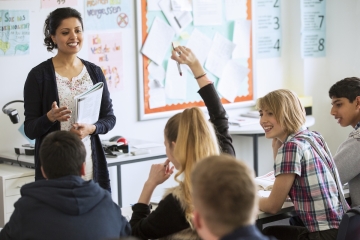
Teacher teaching in a classroom

High-quality instruction starts in educator preparation programs

Julia Hayes
3.12.2026
Flypaper

Like many other teachers, I took the traditional route into the profession, pursuing an undergraduate degree in education. But during my teacher training between 2019 and 2023—by which point the adoption of high-quality instructional materials (HQIM) had become a growing priority—I never had the chance to practice identifying or implementing HQIM or, for that matter, any curriculum at all. Instead, I spent most of my time writing lengthy lesson plans from scratch.

During my first week teaching second-grade special education in an elementary school, I was expected to start targeted small-group instruction to address my students’ learning needs. Without any curricular materials from my school or district, I found myself developing lessons that were not aligned with any differentiated curriculum, high-quality or otherwise. A few weeks into the school year, after asking for curricular materials, I received resources from the special education team—but I still lacked the experience to implement them effectively. This led me to feel frustrated, less confident, and in need of support that was not always accessible.

My experience as a beginning teacher is far from unique. As of 2024, only about 10 percent of U.S. teachers report that their preparation program emphasized helping them use curricular materials. When programs fail to prioritize HQIM, new teachers scramble to interpret pacing guidelines, adapt lessons, and reverse-engineer learning targets. Instead of refining their instructional delivery, they are simply trying to stay afloat.

So why aren’t educator prep programs (EPPs) ensuring that new teachers are prepared to use HQIM effectively? Let’s consider the central problem. Although states are increasingly encouraging the selection of HQIM, districts ultimately decide on curricula. EPPs typically send teachers to dozens of different districts—each of which is making its own choices around instructional materials. So it’s not realistic to expect EPPs to instruct future teachers on a particular HQIM.

What EPPs can do is intentionally build teachers’ capacity to recognize features of HQIM, while also practicing adapting and implementing HQIM across contexts. These are related but distinct skills. Recognizing the hallmarks of HQIM requires analytical preparation, while implementing them with fidelity requires structured practice. Most EPPs neglect both.

Teaching candidates to identify HQIM is not about training them to shop for curriculum. In districts with loose curriculum guidance, this skill helps teachers avoid patching together ineffective materials. In districts with strict guidance, it deepens their understanding of the curriculum’s design so that, when adaptations are necessary, they strengthen rather than diminish its core components.

On the other hand, implementation is a separate challenge. Even when HQIM are present in schools, new teachers have rarely been taught how to interpret pacing guides, differentiate without weakening coherence, or implement materials with fidelity. Without this preparation, teachers spend more time learning to decode the curriculum and less time responding effectively to students’ needs.

Currently, three states—Louisiana, Tennessee, and Texas—are going even further, taking concrete steps to integrate HQIM into EPPs.

1. Louisiana has prioritized selecting evidence-backed HQIM to improve teacher support and student achievement. Although the Pelican State’s educational progress can be attributed to several factors, its evidence-backed curricula and investment in teacher training aligned to those curricula serve as key principles. In 2024, the state began investing in high-quality preparation as a long-term strategy to retain teachers. To reinforce this approach, the HQIM requirement for school districts is aligned with efforts to support EPPs, encouraging them to shift from training aspiring teachers to design their own lessons toward preparing them to implement structured, research-based lessons. It surely helps that Eureka Math is used by approximately 90 percent of Louisiana public-school teachers and that the ELA curriculum Louisiana Guidebooks is used by over 80 percent, making it likely that teachers will see these programs in their own future schools.

2. Tennessee EPPs have partnered with three school districts through the Lead in Literacy network to support strong early literacy preparation for educators. Together, they work to construct a shared vision for literacy instruction, build candidate knowledge and skills grounded in research on reading and HQIM, and ensure best practices from these efforts translate into improved support for diverse learners. The goal is to ensure that new teachers enter classrooms prepared to deliver effective literacy instruction on day one.

3. In Texas, efforts to strengthen educator preparation include integrating HQIM into coursework. For example, Dallas College—one of Texas’s largest community college systems—has embedded HQIM directly into its educator preparation coursework. These instructional materials include Eureka Math and Amplify Reading, which are widely used across the country. Teacher candidates gain valuable insights into maximizing the use of these curricula through research-based instructional strategies, strategic partnerships, and faculty training facilitated by TNTP.

Other states and EPPs can learn from these efforts. In places like Louisiana and Dallas College, alignment is made easier by the widespread use of specific HQIM, which allows EPPs to ground coursework in materials candidates are likely to encounter in the field. But even in states without that level of consistency, EPPs can still ensure candidates enter the profession able to identify and implement HQIM with fidelity across contexts. That skillset is transferable, regardless of where a candidate teaches.

To ensure that this shift is successful, stronger partnerships between EPPs and school districts are needed. Student teaching placements already connect the two systems, but coursework and on-the-ground experiences are not always intentionally aligned. In practice, that means candidates may complete their training in schools that do not utilize HQIM. Without widespread adoption of HQIM across districts, efforts to better align EPPs with curriculum reform will have limited impact. Programs and districts should move beyond informal coordination and intentionally work to ensure that aspiring teachers have meaningful opportunities to practice identifying and implementing HQIM.

If states and districts are serious about improving instruction, teacher preparation cannot remain disconnected from curriculum reform. HQIM alone will not drive results. Teachers must be prepared to identify and use them effectively from day one. That preparation begins in EPPs, and it should be treated as a priority effort to prepare teachers to teach students effectively.

view
Empty classrooms

Why do teachers quit?

Daniel Buck
3.12.2026
Flypaper

I’ve worked at some rough schools. At one, as summer approached, my colleague and I reviewed the staff picture from September and counted that a third of the teachers who began in the fall had quit before the year’s end. We didn’t hold it against them.

The story was always the same. A student did something outlandish (picked a fight in class, threatened or cussed out the teacher, brought a weapon), administration returned the kid without a consequence, and the next morning everyone found a classroom with the lights off and keys on the desk.

We never heard from the teacher again.

In a new report, the Badger Institute’s Patrick McIlheran investigated this dynamic further by doing something rather simple: He asked teachers why they quit. He and his team used public data to find the districts in Wisconsin with the highest teacher turnover rate, collated email addresses, sent around a survey, and where possible, scheduled extended interviews to figure out precisely why teachers up and left.

The report makes for harrowing reading:

  • A student tipping bookcases and assaulting a teacher.
  • A school shifting from consistent consequences to teachers assuming a “buddy role.”
  • Principals afraid of students.
  • A student running down the hall, screaming “f---ing b---h” at the top of her lungs.
  • A young man pummeling a young woman on the playground.
  • Students throwing chairs.
  • Students with free rein in the halls during class.
  • A teacher asking for a student’s phone (they’re banned) and being told “f--- your mother” in response.
  • A teacher needing 66-stiches and foot surgery from breaking up a fight.
  • Refusals to follow the most basic directions like abiding by a seating chart.
  • A teacher bit and punched.
  • Teachers arriving early for meetings, giving up their preps to sub in classrooms, and then staying late into the afternoon to catch up.
  • A principal who spent staff meetings reading a 200-page book out loud, blaming teachers as the cause for education’s failures.
  • Districts messing up even the simplest of responsibilities like buying enough textbooks.
  • Parents who gave no support because “the idea of giving your time…because it’s the right thing to do for your kid” was just “unheard of.”

One teacher’s quote summarizes well the conclusion of the report: “I need to get the hell out of this.”

Why did he quit? It wasn’t behavior, workload, pay, or a single nasty email. It was all of “this.” To ask why teachers quit is to ask why anyone would run out of a burning building. Well, there’s the fire and the crumbling supports and the falling debris and what do you mean “why am I evacuating?!”

When I’ve written on this topic before, I’ve fallen into the same error of my more progressive counterparts, providing a monocausal explanation. Where they blame pay, I point to student misbehavior.

Picking through this report, however, the reader comes away with a broader sense of complete administrative and systemic breakdown. The schools with the most attrition ceased to operate as institutions that take learning seriously, and the dysfunction manifested in communication breakdowns, chaos, stress, and behavior.

I think back to the school where a third of my colleagues quit. The breakdown began even before students entered the building. On our staff onboarding day, no one could access their computers because the instructional coach running the meeting didn’t have the right generic password. No one knew who did, so we couldn’t access curriculum, email, or anything else that we needed to prep. We all went home and began the year unprepared.

The year proceeded likewise. Curriculum files were in the wrong place, school entry and exit routines were poorly thought through and thereby chaotic, the lunchroom ran out of food because someone ordered the wrong amount, we all got mixed messages on this, that, and the other thing—you get the point.

The dean of students spent his time scrambling to get food or fix the copier instead of dealing with behaviors. The first teacher quit. Now a grade-level lost its TA, who now assumed the role of a long-term substitute, and every other teacher had more work. The second quit. More simple tasks and procedures dropped. Emails grew curt and the administration started to micromanage what they could control—teacher dress or needless observables—in desperate hopes that it would fix everything else.

Every teacher who quit complained about behavior, but really it was all of “this.”

That’s not a totally satisfying conclusion. Behavior and pay are both clear problems with clear solutions. Complete administrative breakdown has countless problems and no one, obvious fix (other than shuttering the school, which is most feasible in the charter sector, but hard even there), but I’ll draw attention to one often overlooked fix: school leadership training.

At these districts, significant superintendent and principal turnover preceded the chaos. Replacements were either bureaucrats looking for higher positions or newbies who had no clue how to run a school. Leaders were scared of difficult conversations, had no idea how to manage behavior, implemented illogical policies and routines, and pushed fads for a quick fix instead of tried and true management.

But ultimately, the report suggests that teachers quit “when they’re prevented from doing the work they chose.” Teaching is an honorable profession and can be a wonderful career. When classrooms run well, they’re invigorating, energetic, lively places, and nothing beats teaching in such environments. If we want to stop having to ask “why did you quit?” policymakers and administrators need to create the conditions for teachers do to what they love to do: teach children well.

view
Watching football on phone

What do boys think about gambling?

Alicia Anderson
3.12.2026
Flypaper

March brings my favorite family pastime. Soon, the fanatics and ambivalent among us will fill out NCAA basketball brackets and tape them to the kitchen wall. My teen son will carefully analyze rankings for each team and stats for key players. His sisters will pick teams based on mascots and vibes (we saw your 2022 run, Saint Peter’s Peacocks). Dad’s picks will be based on a combination of 90’s glory and a quick glance at late-season records. For me? It’s UVA all the way, always. My son might do everything right, but it’s March Madness, baby, and anything can happen. Thank goodness bragging rights are on the line, not cold hard cash. 

In July 2025, Common Sense Media surveyed 1017 boys ages 11 to 17. Using a nationally representative sample, they set out “to understand boys’ exposure to gambling activities,” and asked questions about different types of gambling: online gaming, “traditional” betting like on poker or lottery tickets, and sports betting. Common Sense Media has been a trusted resource for me for years. I often rely on its website to inform my decisions about screen-time or as backup with movie night selections when “everyone else is watching!” Its Betting on Boys report doesn’t give clear guidance for concerned parents like the site’s age ratings for books, shows and movies, but it does help connect the dots between common teen behavior and more troubling habits.

According to the survey, 36 percent of the boys reported gambling in the past year, rising to nearly half (49 percent) of 17-year-old boys. The survey results indicate a strong social pull: 84 percent of boys reported gambling if they had friends who participate. Offline gambling often starts as a social activity with relatives, including things like buying lottery scratch-off tickets at the gas station or, perhaps, NCAA bracket wagers. 

Against the backdrop of international social media bans and U.S. court cases about the addictive nature of certain online platforms, 59 percent of the Common Sense survey respondents said that online gambling content “just started showing up”—that is, it’s delivered to them via complex algorithms designed to keep users online and spending money. Boys who see online gambling content—even if they don’t seek it out—spend more than twice as much as those who don’t ($72 compared to $33 annually).

Gambling related to video games is the most prevalent on-ramp, an area few parents and boys even connect with gambling. These boys aren’t sneaking into casinos; they’re dropping a few dollars here and there for random chances to win something in an online game from home or from the lunch table at school. They describe spending money on in-game boosts or potential rewards—like randomized “loot boxes”—as fun and exciting. This may mask the addictive nature of the practice. Once boys start spending, and especially once they start losing money, many move on to more betting, for more money, and tend to lose more.

The survey’s insights on sports gambling came out right before this year’s Super Bowl. They report that about six in ten boys see gambling ads during sports broadcasts. In my house, every single Super Bowl ad block included promotions for sites like DraftKings and FanDuel. If you watch sports, online gambling ads are unavoidable and make it seem like betting is a natural extension of the game. I’m sure that’s the goal.

Adults are monetizing boys’ interests—games, sports, and their social interactions with each other—into something highly profitable, and with serious consequences for young men. Common Sense found that as boys lost more money, they became more likely to say that the purpose of gambling is to “win money” rather than provide them with a source of fun or a social activity. The report authors refer to escalation via “pathways” rather than “alarms.” A boy is unlikely to quickly develop a gambling habit that spirals out of control. Instead, exposure to gaming, algorithm-driven content, and peer behavior inches boys away from a harmless hobby to a disruptive addiction. In the survey, 27 percent of boys who gamble report negative consequences like stress and conflict with their parents. The boys are also using their parents’ money—nearly a quarter who gamble use a parent’s card with permission. More than one in five of the higher-loss gamblers use a parent’s card without permission. 

Like many of the boys surveyed, my teen son doesn’t share my sense of urgency about boys being led by algorithms down a path to future doom. He told me that gambling is dumb because it’s a waste of money. But when I mentioned a $5 bracket contest with some adults, he begged to make my selections in exchange for a share of the inevitable winnings. This disconnect may explain the draw of the in-game rewards that so many of his peers bet on, just a few dollars or even cents at a time. It doesn’t seem like betting—they aren’t sticking coins in a slot machine—but the effect is essentially the same.

The Common Sense findings made me second-guess our family bracket challenge, but come Selection Sunday we will still be scribbling out our picks. In our house, watching the tournament offers an opportunity to connect over our shared interest in sports (or, for my oldest daughter, the chance to explain who would win in an actual wolfpack vs. wolverine situation). I can’t block the algorithms or the ads, but at least I have a better sense of what my son is up against.

SOURCE: Michael B. Robb and Supreet Mann, “Betting on boys: Understanding gambling among adolescent boys,” Common Sense Media, 2026.

view

Can schools keep up with AI? | Episode 1009 of The Education Gadfly Show

3.11.2026
Podcast
 

Robin Lake, director of the Center on Reinventing Public Education, joins the Education Gadfly Show to discuss the rapid evolution of artificial intelligence and what it could mean for schools. As AI tools grow more powerful, do schools need to fundamentally rethink how they prepare students for the future of work?

Then on the Research Minute, Amber Northern looks at evidence from New Jersey on whether raising teacher salaries improves student outcomes, highlighting research that links salary increases to gains in test scores, graduation rates, and college enrollment.

Recommended content:

  • Agentic AI and the Future of Work —Robin Lake, Think Forward: Learning with AI, The Center on Reinventing Public Education
  • AI-assisted learning stumbles on the evidence —Daniel Buck and Anna Low, Thomas B. Fordham Institute
  • What Happens When We Pay Our Teachers More? Evidence from New Jersey Public Schools —Prasiddha Shakya, Institute of Education Sciences, EdWorking Papers (2024)
  • Raising the Floor: Teacher Retention Effects of a Statewide Minimum Salary Increase —Gema Zamarro, Andrew M. Camp, Josh McGee, Taylor Wilson, and Miranda Vernon, CALDER (2026)

Feedback Welcome: Have ideas for improving our show? We would love to hear them. Send them to [email protected]

Fordham Logo

© 2026 The Thomas B. Fordham Institute
Privacy Policy
Usage Agreement

National

P.O. Box 110
Burke, VA 22009

202.223.5452

[email protected]

Ohio

P.O. Box 82291
Columbus, OH 43202

614.223.1580

[email protected]

Sponsorship

130 West Second Street, Suite 410
Dayton, Ohio 45402

937.227.3368

[email protected]