Mobile Navigation

  • National
    • Policy
      • High Expectations
      • Quality Choices
      • Personalized Pathways
    • Research
    • Commentary
      • Gadfly Newsletter
      • Flypaper Blog
    • Events
    • Scholars Program
  • Ohio
    • Policy
      • Priorities
      • Media & Testimony
    • Research
    • Commentary
      • Ohio Education Gadfly Biweekly
      • Ohio Gadfly Daily
  • Charter Authorizing
    • Application
    • Sponsored Schools
    • Resources
  • About
    • Mission
    • Board
    • Staff
    • Career
Home
Home
Advancing Educational Excellence

Main Navigation

  • National
  • Ohio
  • Charter Authorizing
  • About

National Menu

  • Topics
    • Accountability & Testing
    • Advanced Education
    • Career & Technical Education
    • Charter Schools
    • Curriculum & Instruction
    • ESSA
    • Evidence-Based Learning
    • Facilities
    • Governance
    • Personalized Learning
    • Private School Choice
    • School Finance
    • Standards
    • Teachers & School Leaders
    • Think Again
  • Research
  • Commentary
    • Gadfly Newsletter
    • Flypaper Blog
    • Gadfly Podcast
  • Events
  • Scholars Program

The Education Gadfly Weekly

Sign Up to Receive Fordham Updates

We'll send you quality research, commentary, analysis, and news on the education issues you care about.
Thank you for signing up!
Please check your email to confirm the subscription.

The Education Gadfly Weekly: School choice isn’t killing traditional public schools. It’s making them better.

Volume 23, Number 45
11.9.2023
11.9.2023

The Education Gadfly Weekly: School choice isn’t killing traditional public schools. It’s making them better.

Volume 23, Number 45
view
High Expectations

School choice isn’t killing traditional public schools. It’s making them better.

The impact of school choice on traditional school districts, what scholars call its “competitive effects,” is an area in which there is much high-quality research. A new book critical of choice fails to wrestle with this fact.

Michael J. Petrilli 11.9.2023
NationalFlypaper

School choice isn’t killing traditional public schools. It’s making them better.

Michael J. Petrilli
11.9.2023
Flypaper

Schools aren’t up to the task of teaching students about the Israel-Hamas War

Robert Pondiscio
11.9.2023
Flypaper

State education departments are cheerleading mediocrity

Dale Chu
11.9.2023
Flypaper

Grading standards and student effort: Short-run versus long-run effects

Adam Tyner, Ph.D.
11.9.2023
Flypaper

Cheers and Jeers: November 9, 2023

The Education Gadfly
11.9.2023
Flypaper

What we're reading this week: November 9, 2023

The Education Gadfly
11.9.2023
Flypaper
view

Schools aren’t up to the task of teaching students about the Israel-Hamas War

Robert Pondiscio 11.9.2023
Flypaper
view

State education departments are cheerleading mediocrity

Dale Chu 11.9.2023
Flypaper
view

Grading standards and student effort: Short-run versus long-run effects

Adam Tyner, Ph.D. 11.9.2023
Flypaper

view

Cheers and Jeers: November 9, 2023

The Education Gadfly 11.9.2023
Flypaper
view

What we're reading this week: November 9, 2023

The Education Gadfly 11.9.2023
Flypaper
view

School choice isn’t killing traditional public schools. It’s making them better.

Michael J. Petrilli
11.9.2023
Flypaper

Considering that Cara Fitzpatrick’s new history of the school choice movement is titled The Death of Public Schools, you might assume that the book provides an in-depth examination of the (supposedly) deleterious impact of vouchers and charter schools on traditional public schools. That is certainly the impression one might get from the many news articles and reviews about the volume, such as “Is School Choice Destroying Public Education?” (in the New York Times) and “Is public school as we know it ending?” (in Vox).

Yet such an examination is almost nowhere to be found. The book dedicates exactly three sentences to the question. And when journalists asked Fitzpatrick about the issue, including Vox’s Rachel Cohen, Chalkbeat’s Matt Barnum, and The 74’s Kevin Mahnken, she had very little to say, even when pressed.

That’s a shame because the impact of choice on traditional school districts, what scholars refer to as its “competitive effects,” is an area in which there is much high-quality research. For good reason: In a country where most students have long attended their neighborhood public schools, all of us should want to know what happens when some of those students leave for new options. Advocates have forever argued that competition could work its magic in education, just as it does in other sectors, lifting all boats. Detractors wring their hands, however, because of the expectation that the most motivated or advantaged students will leave, and those who remain will be more disadvantaged—and they’ll be remaining in schools with fewer resources to serve them well.

Those fears are not without some basis in history. When school choice as we know it started to take off in the early 1990s, it was on the heels of two devastating decades of White flight and middle-class Black flight out of American cities and their public school systems. This had a terrible impact on the schools and their students, leaving both of them poorer and stuck with myriad challenges. So it was not crazy for public school proponents to worry that charters and vouchers would exacerbate the exodus out of urban public schools, leaving the children left behind in even worse straits.

This concern is also salient politically, as this allegation—that school choice will harm or even destroy the public schools—is one of the few lines of attack that tends to soften support for charter schools and vouchers.

So what does the research say? Is school choice “the death of public schools”?

Um, nope.

Here’s Fitzpatrick’s three sentences on the question:

Contrary to what some critics claim, traditional public schools have seen some positive effects from competition. One recent study found that the presence of charter schools resulted in improvements for students in district-run schools. (Part of the overall improvement came from low-performing district-run schools closing.)

She’s right—and could have said much more. Most of the effects that charter schools have on the traditional public schools in their vicinity appear positive. To wit, a recent Mathematica review of the literature on this question identified nine studies that found positive effects, three that found negative effects, two that found mixed effects, and ten that found no effects whatsoever. As that summary suggests, evidence that charter competition has salutary effects on district-run schools has now been detected in a wide variety of settings, from the dense urban cores of Milwaukee and New York City to the sprawling suburbs of Florida, North Carolina, and Texas.

The research on competition from private-school choice is even more positive. Patrick Wolf at the University of Arkansas has painstakingly aggregated all relevant studies. At last count, twenty-five of twenty-seven studies show positive effects on public schools, with the other two finding null effects. (See Table 5 here.) As Wolf writes, “no empirical study of the competitive effects of private school choice programs concludes that the effects are negative.”

It’s worth noting that several of these studies, including recent ones from Ohio, Indiana, and Louisiana, find disappointing results for the students participating in the school choice programs—while at the same time finding benefits for the public school students “left behind.” It’s hard to argue that the authors of such studies are putting their thumbs on the scale.

One of the most compelling recent studies, by David Figlio, Cassandra M. D. Hart, and Krzysztof Karbownik, examined Florida’s massive tax-credit scholarship program over the course of fifteen years and found positive competitive effects on both academic outcomes and student behavior. The more competition that schools faced, the greater the impacts. The impacts overall were modest: less than 1 percent of a standard deviation each year. But year after year, those impacts added up, especially for the most disadvantaged students in the schools facing the most competitive pressure.

So why did Fitzpatrick choose a title for her book that implied that school choice was the death of public schools (besides the publisher’s certain desire to boost book sales with something provocative)? In an email interview, she told me that “the title is alluding to the competing visions of Democrats and Republicans. Democrats generally want the ‘one best system,’ while Republicans want public education to include any education paid for with public dollars. Given the crucial court victories (Zelman, Espinoza, Carson, etc.) and the incredible spread of school choice programs, my view is that Republicans have won on that front.”

Furthermore, she explained, even if school choice hasn’t negatively impacted traditional public schools so far, that doesn’t mean the dynamic might not change in the future.

Based on the last thirty-plus years, it certainly seems that school choice programs can co-exist with the traditional system, but those were smaller, targeted programs. We don't really know yet what the effects of universal programs will be.

Except, of course, urban charter schools are hardly “smaller, targeted programs.” Washington, D.C., is a fifty-fifty city, with charter schools and D.C. Public Schools each serving about half of the District’s student population. Several other major cities are within striking distance of that mark. If school choice were to kill off the public schools, one would think we’d have seen that by now.

And the new, universal private-school choice programs—most of them structured as education savings accounts—are likely to have even less of an impact on public schools because (to date at least) they aren’t leading many kids to leave their school districts. Instead, they tend to subsidize families who already had their kids in private schools or home schools—one reason I’m not crazy about them. We can question this use of taxpayer dollars, but it’s unlikely to result in less money, or many fewer students, for traditional public schools.

All of this is great news. School choice is a rare win-win policy, one that’s generally good for families taking advantage of greater options, while also helping to improve traditional public schools, as well. We should root for all these sectors in American education to succeed. And we should root for the myth about the “death of public schools” to die.


view

Schools aren’t up to the task of teaching students about the Israel-Hamas War

Robert Pondiscio
11.9.2023
Flypaper

Campus radicalism is easy to spot—and condemn. Attempts to justify the atrocities committed by Hamas, and in some cases to celebrate it, have caused crises at dozens of universities, prompting deep-pocketed donors to publicly withdraw philanthropic support and threaten not to hire graduates. Even some stalwart liberals have been shocked by the depth and virulence of campus anti-Semitism.

Such scenes might be fewer and farther between in K–12, but that doesn’t mean there’s not cause for concern about how the Israel-Hamas war is being taught and discussed in public-school settings. The blunt truth is that America’s K–12 education system is uniquely ill-suited to help students make sense of complicated world events and navigate contentious issues, let alone achieve some level of moral clarity about them.

When major news breaks, social media and education news sites fill up with well-intended advice for teachers on “how to talk to students” about traumatic events. As often as not, that advice is aimed at reassuring children that distant events do not place them physically at risk or fostering “tolerance and empathy,” not teaching history. “When approached by children with questions about the Israel-Hamas war, parents and teachers should center conversations on empathy rather than politics,” advised Harvard “global health” lecturer Claude Bruderlein in the Boston Globe. New York City schools chancellor David Banks tweeted that New York City would be “providing resources to our schools to facilitate discussions about the conflict and supporting our students in being compassionate global citizens.” A fine impulse as far as it goes, but surely it’s of equal public interest to encourage students to become well-informed global citizens. 

Readers of a certain age might remember doing “current events” as students, which typically consisted of giving an oral report in homeroom or during morning announcements about world, national, and local news culled from the newspaper. That public school warhorse rested on two assumptions, neither of which is reliably true today: that every student’s family took a daily newspaper (or watched the likes of Walter Cronkite the previous evening) and that public education at least tacitly viewed preparation for engaged citizenship as a core part of a school’s mission. Nor is it helpful that the credibility, neutrality, and trust in mainstream media, already low, has suffered repeated blows since October 7, potentially complicating classroom use of articles from major newspapers.

The College, Career, and Civic Life (C3) Framework, a big deal in social studies circles, emphasizes the importance of “developing active and responsible citizens” who “vote, serve on juries when called, follow news and current events, and participate in voluntary and group efforts.” To the degree that any attention at all to contemporary events is part of the typical American student’s experience, it falls under social studies, the most neglected field in American education. Scores of eighth graders on the National Assessment of Educational Progress’s civics and history exams are by far the lowest of any tested subject. Only 22 percent of eighth-graders scored at or above the NAEP “proficient” level in civics. Just 13 percent in U.S. history. The student survey that accompanies the NAEP exam shows less than half (45 percent) of U.S. students report getting “quite a bit” or “a lot” of opportunity to discuss current political and social events.

Perhaps we should be grateful for that. The group Parents Defending Education reports receiving several complaints from parents in the past month pertaining to inappropriate classroom materials and displays, including a California teacher displaying an image in class showing a fist destroying a Star of David. A Massachusetts school superintendent circulated “resources” from the Saudi-backed Middle East Policy Council, which said, in part, “Israeli terrorism has been significantly worse than that of the Palestinians.” As Fordham’s Daniel Buck reported in National Review, the Zinn Education Project, which develops history curricula used by 155,000 teachers, declared that Hamas’s terrorist attack “is the direct result of decades of Israeli occupation.”

Such episodes illustrate an aspect of classroom life that is too dimly understood, even by education policymakers and otherwise well-informed observers, who fail to grasp how little control is exercised over the curriculum and materials put in front of students on any given day. Studies by the RAND Corporation have long shown that nearly every U.S. teacher draws regularly upon “materials I developed and/or selected myself” in preparing lessons. Only half of elementary principals surveyed by RAND reported that their schools had adopted published curriculum materials to support kindergarten through grade five (K–5) social studies instruction.

But the standard practice of teachers scouring the Internet for materials takes on a very different feel when it comes to hot-button political or social issues. Teachers who are on shaky ground in their own understanding of world events are a ripe target of opportunity for curriculum materials and lesson resources published by organizations that promote particular points of view.

A good illustration of the phenomenon is the New York Times’ “1619 Project.” The Pulitzer Center produced classroom material based on the controversial series. Only five school districts in the U.S. are known to have officially adopted it for classroom use, including Chicago, Washington, D.C., and Buffalo. Yet the Pulitzer Center’s website claims that its materials have been used in 4,500 classrooms across the county. So which is correct? Almost certainly, it’s both. The simple fact is that a prodigious amount of material ends up in front of children in classrooms all across America with little or no oversight or official vetting.

In an ideal world (and perhaps in a different era), teaching current events would encourage debate, deliberation, and discussion. It would also suggest to students that part of becoming a well-educated citizen is paying attention, beyond one’s personal interests, to the world outside the classroom window and developing informed opinions. The neglect of history as a discipline, inattention to current events, the collapse of trust in the media—and the normalization of teachers culling their classroom materials from untrustworthy sources—adds up to a kind of pedagogical perfect storm that is likely to result in students either misinformed or in the dark entirely on events that are likely to have far-reaching impact on their lives for many years.

view

State education departments are cheerleading mediocrity

Dale Chu
11.9.2023
Flypaper

Post-pandemic learning loss is a lot like the national deficit. It is huge, it is exacerbated by political divisions, and nothing that’s currently being done about it will come close to solving the problem. Indeed, there’s no sugarcoating the setbacks that students have suffered. Along with plunging test scores, powerful forces—including poor student mental health, record-setting absenteeism (among students and teachers), and staffing shortages concentrated in high-poverty districts and positions—have conspired against any impactful academic recovery effort. Taken together, they paint a grim picture of the education sector in the years ahead.

But don’t tell that to the public relations mandarins working in state education offices. Based on a scan of press releases that they’ve issued thus far that have characterized their 2023 state assessment results, one could be forgiven for thinking that everything’s just fine. U.S. Secretary of Education Miguel Cardona’s eagerness to disappear the pandemic far into the rearview mirror notwithstanding, consider the rosy spin coming from some of these states:

  • California: “Given the ongoing drops in achievement appearing on many national tests and the relationship between student advantage and achievement, California’s statewide scores are particularly promising; the proportion of high-need students has also increased in California.”

  • Connecticut: “The data show that for the first time since the pandemic, attendance improved, and chronic absenteeism rates declined from 23.7 percent in 2021–22 to 20.0 percent in 2022–23 resulting in approximately 18,000 more students attending school regularly in 2022–23. Improvements were evidenced in all grades and in all student groups.”

  • Delaware: “Despite the challenges schools face, the state is seeing promise when disaggregating the data to look more closely at the district and school level. [One school district] saw gains in both ELA and math. At [an elementary school in this district] the gains were significant; 65 percent of students scoring proficient or higher in ELA, a 15 percentage point increase from last year. In math, 67 percent of students scored proficient or higher, up 13 percentage points from 2022. [The district’s high school] saw SAT growth in reading and math as well with 2023 proficiency higher than pre-pandemic levels in both subjects.”

  • Georgia: “‘I am pleased to see continued evidence of Georgia’s academic recovery in this year’s [state test] results,’ State School Superintendent Richard Woods said. ‘Even for this year’s third graders, whose entire academic career has been impacted by the pandemic, we can see evidence of growth.’”

  • Massachusetts: “The Department of Elementary and Secondary Education (DESE) released 2023 Massachusetts Comprehensive Assessment System (MCAS) results today, showing continued academic recovery from the pandemic… ‘Pandemic learning loss is a national problem, but these results show signs of recovery thanks to the hard work of educators, students, families, and staff,’ said Education Secretary Patrick A. Tutwiler.”

  • Michigan: “‘We continue to be encouraged by the gradual improvements in student achievement,’ said State Superintendent Dr. Michael Rice. ‘Though the 2022–23 school year was far from normal…it was the most stable school year of the last four. Michigan’s educators worked hard to help students continue to rebound and to increase their learning.’”

  • Oregon: “This year’s state summative test results show that our education system is stabilizing. Some student groups have achieved pre-pandemic levels in English language arts, mathematics, and science in Oregon districts.”

  • Washington: “Today, the Office of Superintendent of Public Instruction (OSPI) released data from the spring 2023 state assessments, which are one indicator of continued pandemic learning recovery. Overall, the data indicate accelerated learning recovery in math in nearly all grades assessed, as well as in English language arts at the elementary level.”

Never mind the compelling evidence to the contrary. These state officials seem to be inclined to say, “There’s got to be a pony in here somewhere!” Just as schools and districts have gotten into the bad habit of withholding honest feedback from students and parents—through rampant grade inflation and social promotion among other academic gimmicks—state education departments are doing a disservice to local communities when they downplay the bad news and cheerlead mediocrity. At best, the rah-rah is premature until these states demonstrate real progress on the next NAEP.

This is not to say state leaders must be dour in their outlook, but they should be interested in conveying urgency about the long and difficult road ahead. The resistance to being forthright is frustrating because standardized testing is the best tool we currently have to ascertain a student’s trajectory and predict future performance. To be sure, remaining clear-eyed and sober in the face of adversity can be tricky, but it’s not impossible. For example, Colorado’s new education commissioner, Susana Cordova, appropriately laments the achievement gaps that continue to persist in her home state:

Unfortunately, large gaps remain between student groups, which reaffirms my commitment to continue the hard work of eradicating the long-standing disparities in opportunity and achievement. I see these scores as a continued call to action to ensure our students and educators have the support they need to meet our state standards.

Indiana education secretary Katie Jenner adopts a similar posture:

English language arts is an area where many students continue to need additional support, particularly our English learner and middle school students. We knew that experts were projecting years in recovery time, and yet, the urgency is real and requires us all to keep our foot on the gas pedal.

But the best of the bunch so far appears to be Arkansas, which led with the headline, “[State assessment] results show little to no rebound from pre-pandemic levels.” Unlike the syrupy notes struck by many of his colleagues, the serious tone imparted by education secretary Jacob Oliva is worth emulating:

These results are a wake-up call, and we must stop the red-light, green-light tug of war with implementation and act with urgency. It’s time we move forward and focus on evidence-based approaches outlined in [recent legislation] that will result in increased student learning. Our students deserve nothing less.

Despite Uncle Sam’s poor example, states should not be in the business of burnishing the subpar academic results caused by the nation’s lackluster response to Covid. If students are to stand a chance of getting back on track, it must start with our elected officials and their appointed officers in state education agencies insisting upon academic excellence, and not whitewashing what the data are trying to tell us.

view

Grading standards and student effort: Short-run versus long-run effects

Adam Tyner, Ph.D.
11.9.2023
Flypaper

A simple observation: In the U.S., high school graduation rates have increased while other measures of academic achievement—from college entrance exam scores to high school NAEP scores to college enrollment—have stagnated at best. Taking this observation as the foundation, a new working paper from researchers at the University of Pennsylvania and the University of Texas at San Antonio argues that this pattern suggests “a decline in academic standards,” and then builds on that foundation to examine the consequences of changes to grading standards upon student behavior, academic effort, and learning.

The paper begins by investigating the theoretical connection between academic standards and student effort using mathematical models. Theirs is not the first attempt to do this. Going back to the 1980s, economists have shown through such formal models that, when academic standards change, students are likely to react. For example, rising standards may make some students expend greater effort to meet the new standard while inducing some lower-performing students to just give up. The present paper develops a model suited to the more nuanced effects of grading policies, and its authors’ model shows that, in theory, lenient grading could have either positive or negative effects on student effort. After all, while a lower bar may put an academic goal, such as passing a course, within reach of students who expend a bit more effort to reach it, other students may decide to take it easy when they are graded more leniently.

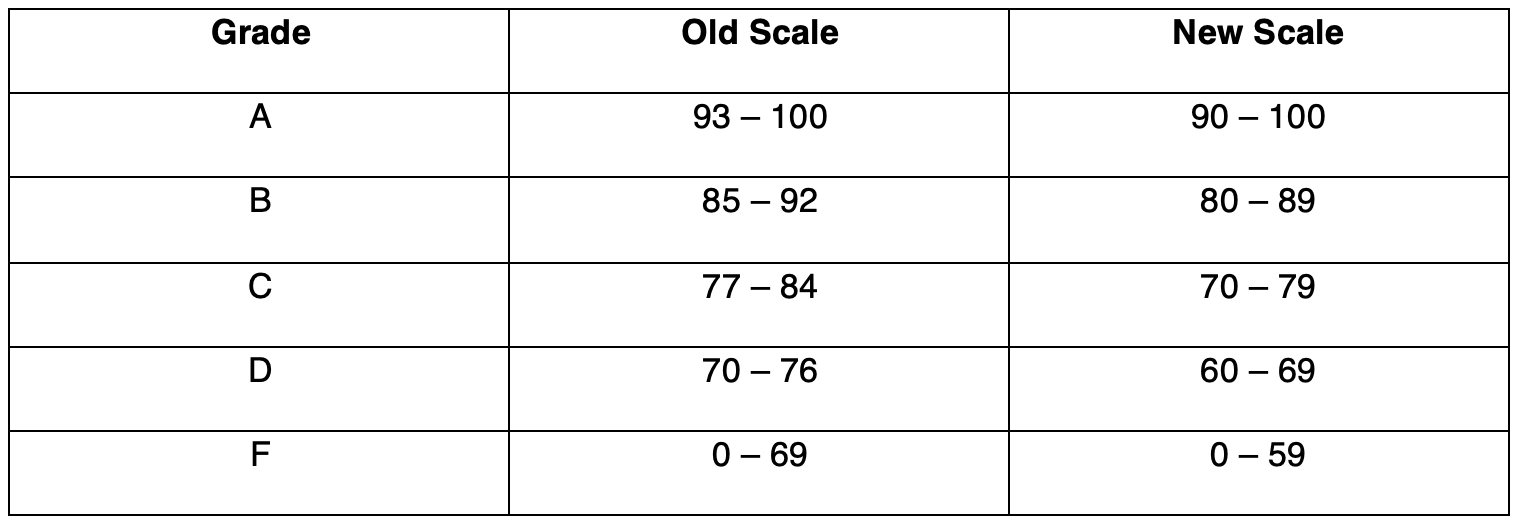
To test their model’s predictions, the researchers use grades, end-of-course test scores, ACT scores, and graduation data from North Carolina and leverage the fact that the state implemented a one-time change to grading policy that led to a drop in standards. In 2016, the state of North Carolina implemented a statewide change to the correspondence between number grades (0 to 100) and letter grades (A to F), and the result was more lenient grading (Table 1). For example, the minimum grade needed for an A dropped from 93 to 90, while the minimum passing grade (a D) dropped from 70 to 60. To identify the effects of this more lenient grading policy, they compare the outcomes of ninth grade students in the last cohort with the old grading policy to those of their counterparts in the first year of the new, more lenient policy.

Table 1: Grading scale changes in North Carolina

1

Note: Adapted from A. Brooks Bowden et al., 2023.

What their analysis finds is troubling. First, more lenient grading led to an average GPA increase of 0.27 points, while scores on North Carolina’s end-of-course exams stayed flat. In other words, the policy led to instant grade inflation. Even more troublingly, it also led to measurable declines in student attendance. That means that the more lenient grading policy not only inflated grades, but it also helped cultivate the culture of chronic absenteeism that later accelerated during the Covid-19 pandemic.

It gets worse. The grade inflation accrued only to students who were already higher achieving, while it was lower-performing students who missed class more. You can see where this is going: Higher-achieving students are fine; they are self-motivated, or they have pressures from family and peers that keep them going. Lower-achieving kids, for whom school more often provides the only source of accountability for their academic work, show up less and learn less. Academic leniency is promoted by people who think they’re doing disadvantaged students a favor. As it turns out, lenient grading in North Carolina did those students no favors at all.

The harm to lower-performing students does not end after the first year. The researchers find that academic disengagement (measured by absences) persisted as these students continued through high school, while achievement gaps (measured by later ACT scores) eventually widened. Although the effect was small and not statistically significant, there was suggestive evidence that lower-ability students were slightly more likely to graduate high school after the reduction in standards, which of course previews the enduring observation with which we started, a pattern that’s even more of a problem in the post-pandemic era: As chronic absenteeism reaches an all-time high, graduation rates keep going up. Keeping young people off the streets and in school is a worthy goal, and lowering certain standards might be justified in some cases if it leads many students to stay in school and learn more. In the North Carolina case examined in this paper, however, it seems hard to justify the lower attendance, decreased effort, and larger test-score gaps based on the statistically insignificant—yet slightly positive—effects on high school graduation.

This is far from the only research showing that soft grading standards reduce student learning. Studies from Florida to Norway, as well as a 2020 Fordham report that also used data from North Carolina, all show that students tend to learn less when assigned to teachers with lower grading standards. At a time when academic achievement has plummeted, this is yet another reason we ought to beware of the new wave of policies that lower standards and expectations further, such as “no zero” policies and prohibitions on penalizing student grades for turning in work late or even for cheating.

In the moment, lowering standards seems like an act of charity, giving grace to a struggling, needy student. What this research helps show is that, in the longer run, falling standards mean lowered expectations and diminished learning. The researchers of the present study put it this way: “The short-run gains of artificially raising high school completion rates may result in a permanent widening of long-run” disparities.

SOURCE: A. Brooks Bowden, Viviana Rodriguez, and Zach Weingarten. “The Unintended Consequences of Academic Leniency,” retrieved from Annenberg Institute at Brown University (2023).

view

Cheers and Jeers: November 9, 2023

The Education Gadfly
11.9.2023
Flypaper

Cheers

  •  School board candidates in Kansas made low test scores a main talking point in their campaigns. —NPR
  • Some states are experimenting with auto-enrollment policies, where top students are automatically placed in advanced classes. —Brenda Berg & Jonathan Plucker, The 74

Jeers

  • Wisconsin’s supreme court could overturn school choice in the state. —Wall Street Journal
  • Portland teachers went on strike last week over pay, depriving the city’s 45,000 public school students of an education. —AP News
  • A suburban St. Louis school district has conducted thousands of invasive investigations and home visits to bar non-resident students from its schools. —NPR
view

What we're reading this week: November 9, 2023

The Education Gadfly
11.9.2023
Flypaper
  • Some schools and districts are trying to better align college credits earned in high school with the potential majors of their students. —Education Week
  • Microschooling founders who want to create safe, effective schools for Black children need vouchers to be sustainable. —The Texas Tribune
  • Debates continue over whether teacher licensure exams are racially biased, effective, and/or necessary. —Emma Green, The New Yorker
Fordham Logo

© 2026 The Thomas B. Fordham Institute
Privacy Policy
Usage Agreement

National

P.O. Box 110
Burke, VA 22009

202.223.5452

[email protected]

Ohio

P.O. Box 82291
Columbus, OH 43202

614.223.1580

[email protected]

Sponsorship

130 West Second Street, Suite 410
Dayton, Ohio 45402

937.227.3368

[email protected]