Mobile Navigation

  • National
    • Policy
      • High Expectations
      • Quality Choices
      • Personalized Pathways
    • Research
    • Commentary
      • Gadfly Newsletter
      • Flypaper Blog
    • Events
    • Scholars Program
  • Ohio
    • Policy
      • Priorities
      • Media & Testimony
    • Research
    • Commentary
      • Ohio Education Gadfly Biweekly
      • Ohio Gadfly Daily
  • Charter Authorizing
    • Application
    • Sponsored Schools
    • Resources
  • About
    • Mission
    • Board
    • Staff
    • Career
Home
Home
Advancing Educational Excellence

Main Navigation

  • National
  • Ohio
  • Charter Authorizing
  • About

National Menu

  • Topics
    • Accountability & Testing
    • Advanced Education
    • Career & Technical Education
    • Charter Schools
    • Curriculum & Instruction
    • ESSA
    • Evidence-Based Learning
    • Facilities
    • Governance
    • Personalized Learning
    • Private School Choice
    • School Finance
    • Standards
    • Teachers & School Leaders
    • Think Again
  • Research
  • Commentary
    • Gadfly Newsletter
    • Flypaper Blog
    • Gadfly Podcast
  • Events
  • Scholars Program

The Education Gadfly Weekly

Sign Up to Receive Fordham Updates

We'll send you quality research, commentary, analysis, and news on the education issues you care about.
Thank you for signing up!
Please check your email to confirm the subscription.

The Education Gadfly Weekly: Patriotism, American identity, civics ed—and Independence Day

Volume 25, Number 26
7.3.2025
7.3.2025

The Education Gadfly Weekly: Patriotism, American identity, civics ed—and Independence Day

Volume 25, Number 26
view
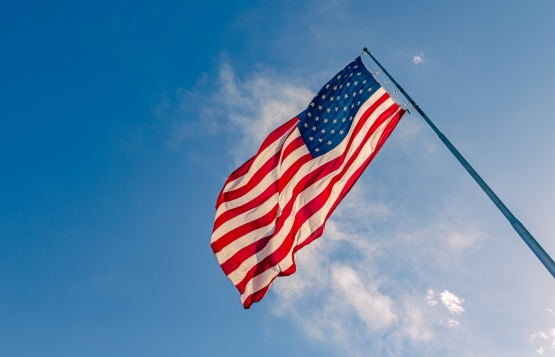
American flag
High Expectations

Patriotism, American identity, civics ed—and Independence Day

The Fourth of July this year—tomorrow, remember?—is far more than a one-shot holiday with fireworks and hot dogs. It’s the kickoff of a year in which many Americans will focus on the origins, meaning, and mission of the Declaration of Independence, as we prepare to observe its 250th anniversary—its semiquincentennial, if you insist—twelve months from tomorrow.

Chester E. Finn, Jr. 7.3.2025
NationalFlypaper

Patriotism, American identity, civics ed—and Independence Day

Chester E. Finn, Jr.
7.3.2025
Flypaper

The Supreme Court is right on religious liberty, but “curriculum” is complicated

Robert Pondiscio
7.3.2025
Flypaper

In education, the Democrats lack a vision—the GOP, restraint

Dale Chu
7.3.2025
Flypaper

Modeling education trends by race and gender in college graduation

Jeff Murray
7.3.2025
Flypaper
view
children reading

The Supreme Court is right on religious liberty, but “curriculum” is complicated

Robert Pondiscio 7.3.2025
Flypaper
view
Sign with red and blue arrows

In education, the Democrats lack a vision—the GOP, restraint

Dale Chu 7.3.2025
Flypaper
view
Image of graduates

Modeling education trends by race and gender in college graduation

Jeff Murray 7.3.2025
Flypaper
view
American flag

Patriotism, American identity, civics ed—and Independence Day

Chester E. Finn, Jr.
7.3.2025
Flypaper

The Fourth of July this year—tomorrow, remember?—is far more than a one-shot holiday with fireworks and hot dogs. It’s the kickoff of a year in which many Americans will focus on the origins, meaning, and mission of the Declaration of Independence, as we prepare to observe its 250th anniversary—its semiquincentennial, if you insist—twelve months from tomorrow.

This has produced a lot of reflection, some excellent writing, at least one important new project announcement, and—underscored by the turmoil and discord around us, both domestic and global—renewed attention to what Tocqueville called “reflective patriotism.”

As you doubtless know, that’s the kind of patriotism—devotion to one’s country—that’s grounded in thoughtful appreciation of the benefits of living in a constitutional democracy that honors life, liberty, and the pursuit of happiness, along with reflection on what’s been achieved and what’s not yet right. Tocqueville contrasted it with the forms of patriotism he had seen in Europe, based mostly on tradition, blood (and tribal) ties, and one’s rootedness in the land itself.

Joanne Jacobs’s recent posting wraps together several recent writings on reflective patriotism that connect it with the civic mission of schools. Even more comprehensive is my colleague Bruno Manno’s tour-de-force Forbes essay, which emphasizes the urgency of stepped-up civic education while recognizing many of the groups and organizations that are doing important work in this realm (including some that I’m proudly associated with).

This week also brought an important new entry, as the Progressive Policy Institute announced a major initiative to strengthen “American identity,” led by my friend Richard (Rick) Kahlenberg. Advised by a stellar group that includes the likes of David Brooks, Danielle Allen, Larry Summers, and Linda Chavez, it kicks off with a worthy report by Kahlenberg and promises much more to come.

The PPI team stakes out a four-theme agenda that’s both ambitious and much needed: reflective patriotism for sure, but also social cohesion, deeper understanding of “what it means to be an American,” and a menu of policies and actions for the K–12 realm.

Put it together and—for me at least—in a moment when there’s plenty to worry and grumble about, a note of optimism can be detected in the ether, a well-timed challenge to do something about the tribulations that beset us, not to despair. May it last—and energize and focus us—for 366 more days and then years to follow. The 250th anniversary, after all, isn’t just a moment in time, a day of celebration. It also carries hope of rekindling. But now is when we have to collect the fuel.

view
children reading

The Supreme Court is right on religious liberty, but “curriculum” is complicated

Robert Pondiscio
7.3.2025
Flypaper

The Supreme Court’s decision last week in Mahmoud v. Taylor was cheered by conservatives and religious liberty advocates. The 6-3 ruling found that a Maryland public school district violated the First Amendment’s Free Exercise Clause by refusing to let parents opt their elementary school children out of lessons featuring LGBTQ-themed storybooks. The Court reaffirmed a bedrock principle going back a century to Pierce v. Society of Sisters: Parents cannot be forced to have their children exposed to material that conflicts with their religious beliefs, certainly not without notice and the opportunity to opt out.

But don’t be surprised if Mahmoud proves to be less than the last word. Not because SCOTUS’s legal reasoning is muddled—it’s not—but because of the way reading is taught in many elementary classrooms. The gap between how courts think “curriculum” works and how it’s actually implemented in elementary classrooms is vast. And that means schools will likely keep finding themselves on the receiving end of angry phone calls, and possibly lawsuits, from parents blindsided by what their children bring home in their backpacks.

In Mahmoud, the books in question weren’t part of the Montgomery County school district’s core curriculum. A few years ago, the MCPS school board “determined that the books used in its existing [English language arts] curriculum were not representative of many students and families in Montgomery County because they did not include LGBTQ characters,” according to the majority opinion written by Justice Alito. The board decided to introduce “LGBTQ+-inclusive texts.” Five books for younger students were at issue in Mahmoud: Intersection Allies, Prince & Knight, Love, Violet, Born Ready: The True Story of a Boy Named Penelope, and Uncle Bobby’s Wedding.

As described in the majority decision, the school board suggested “that teachers incorporate the new texts into the curriculum in the same way that other books are used, namely, to put them on a shelf for students to find on their own; to recommend a book to a student who would enjoy it; to offer the books as an option for literature circles, book clubs, or paired reading groups; or to use them as a read aloud.” This is easily recognizable as the “reader’s workshop” model, which relies on students self-selecting books from a “classroom library” (not to be confused with a larger, stand-alone school library) – bins filled with dozens of books, even hundreds of them, on shelves in a child’s classroom, sorted by reading levels, genres, or themes, and providing time for both independent and guided practice. In the workshop model, teachers lead “mini-lessons” on a reading “skill” or “strategy” from a common text. But students typically practice on books they choose themselves—on the theory that this generates kids’ interest and engagement.

The workshop model also relies heavily on whole-class read-alouds, which is the principal source of the conflict in Mahmoud. The Court looked askance, for example, at a 2022 professional development session that advised teachers to correct students who make “hurtful comments” on transgender issues. “When we’re born, people make a guess about our gender and label us ‘boy’ or ‘girl’ based on our body parts,” they were advised by the district to explain. “Sometimes they’re right and sometimes they’re wrong.” A guidance document also encouraged teachers to “disrupt the either/or thinking” of their students about biological sex. Initially, MCPS allowed parents to opt out of read-alouds featuring the controversial books, but later rescinded that option. It was this shift—the loss of notice and opt-out rights—that the Court found constitutionally unsupportable: Parents were denied the opportunity to withhold consent on religious grounds.

What counts as “instruction”?

“The books are unmistakably normative,” SCOTUS ruled. “They are designed to present certain values and beliefs as things to be celebrated, and certain contrary values and beliefs as things to be rejected.” Neither did the Justices accept Montgomery County’s argument that its “LGBTQ+-inclusive” instruction was mere “exposure to objectionable ideas” or as lessons in “mutual respect.” The storybooks “unmistakably convey a particular viewpoint about same-sex marriage and gender. And the Board has specifically encouraged teachers to reinforce this viewpoint and to reprimand any children who disagree. That goes beyond mere ‘exposure.’” 

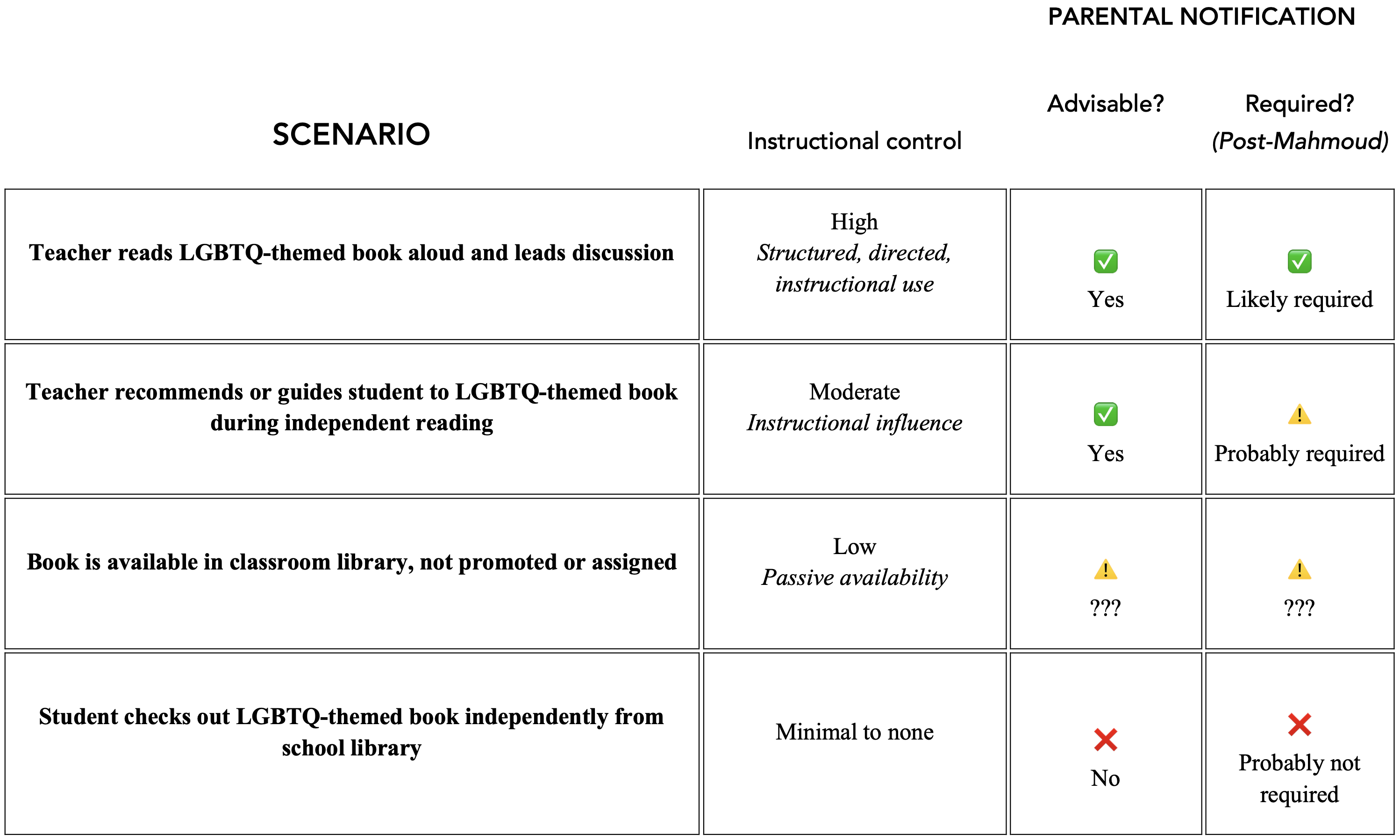
The line the Court drew seems bright: If schools use contested materials instructionally—especially in ways that make exposure unavoidable—parents have a right to know and a right to say no. Montgomery County’s approach and guidance seems heavy-handed and didactic. But in common practice, the line between “instructional” and “not instructional” is far from clear. Many elementary classrooms today don’t assign novels or shared texts; the teacher teaches literacy skills, not books. A question surely on the minds of teachers, administrators, and school board members who’ve read the decision is one the Court left unaddressed and may not even be aware of: is the line crossed only when controversial books are read aloud? Or is their mere presence in a classroom library enough to require parental notification, since students might choose them as part of their ELA instruction? No consideration in either the majority decision or the dissent authored by Justice Sotomayor seems to have been given to the difference between a classroom library or a school’s main library, or (apart from a whole-class read aloud) how a controversial book might end up in a child’s hands.

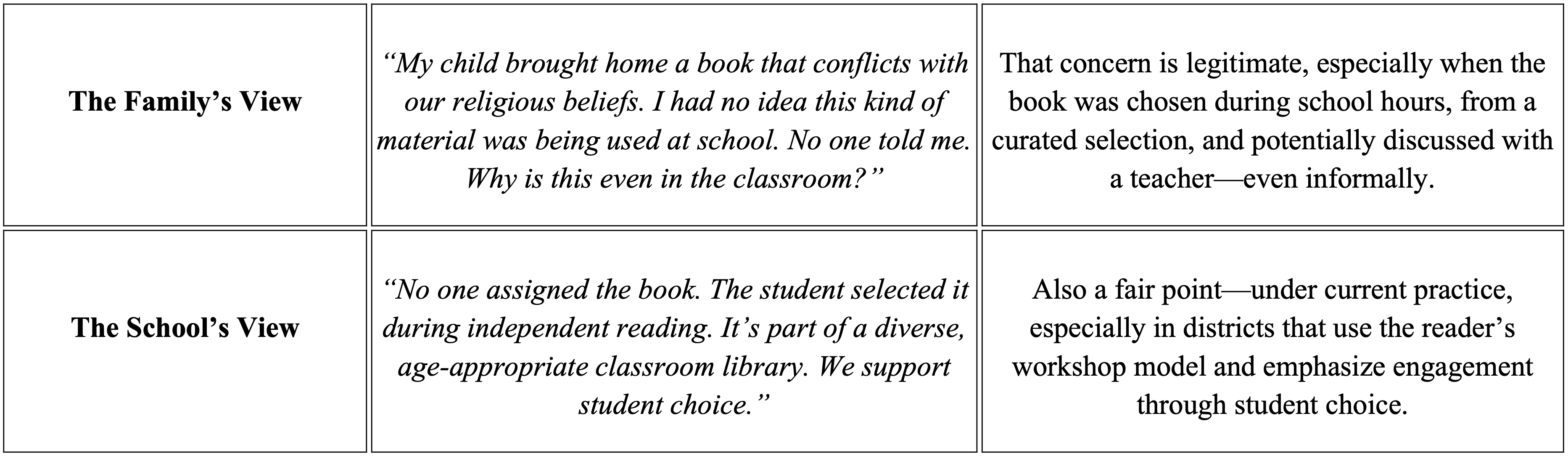
From a judicial perspective, it might matter whether a book is “assigned” and exposure compelled. But from a parent’s perspective, it probably doesn’t. If a first grader comes home with It’s Okay to Be Different or I Am Jazz, parents are unlikely to distinguish between something their child picked up on her own and something their teacher handed them. Nor should we assume that the difference is meaningful. The classroom library didn’t build itself. Teachers or other school district personnel chose what went on those shelves. And students made their selections during instructional time, under adult supervision, as part of a structured literacy program. In other words, “We didn’t assign it” may not be much of a defense.

Most non-educators—including parents, policymakers, and judges—think of “curriculum” as a list of books that every child reads. Something on the syllabus. A shared text. Yet that’s not how ELA works in many classrooms anymore. Although the workshop model has come under fire in recent years, it’s still a common, even dominant approach to elementary reading instruction across the country.
Parent vs school chart

When a child chooses a book that contradicts the family’s religious or moral beliefs, it may not have been “assigned” per se but that doesn’t mean it’s neutral. It was placed there for a reason. And when it’s chosen during class time, under the implicit encouragement of an adult, it becomes part of the instructional environment. But does Mahmoud require parental notification of its simple existence in that environment? SCOTUS appears not to have weighed this possibility, which is far more likely than a controversial book being chosen for a whole-class read aloud.

This is where Mahmoud and classroom practice potentially—and predictably—collide. The Court treated the issue as one of compelled exposure. But in an ELA class built on student choice, what counts as “compelled”? If you make available a limited, curated set of books is that choice free or coerced?
Pondiscio chart

In the final analysis, there is a foreseeable mismatch between the expanded, ambient definition of curriculum inside schools and the traditional, content-focused definition held by the public. The Court didn’t resolve that mismatch. It barely acknowledged it and, indeed, might not be entirely cognizant of it. But it will almost certainly keep generating friction.

view
Sign with red and blue arrows

In education, the Democrats lack a vision—the GOP, restraint

Dale Chu
7.3.2025
Flypaper

New York Times opinion columnist David French recently offered a tidy framework for understanding Donald Trump’s political durability: many voters support Trump’s objectives, but reject his methods. That asymmetry—popular ends coupled with polarizing means—helps explain both his staying power and his ceiling. In contrast, French observed, Democrats often have the opposite problem: they benefit from opposing Trump’s methods, but struggle to rally support for their own policy aims. Nowhere is this dynamic more vivid—or more consequential—than in education policy, where Republicans often undercut themselves with overreach, and Democrats suffer from failure to persuade, either due to unclear positions or a disconnect with the concerns of the broader public.

Consider the ongoing firestorm surrounding Harvard. The Trump administration, through Secretary of Education Linda McMahon, has taken aim at elite universities over their handling of antisemitism—a concern shared by many across the political spectrum. A sharply worded letter from the U.S. Department of Education to Harvard, later disavowed by the department, transformed what might have been a principled investigation into campus discrimination into a muddled episode of heavy-handedness and backpedaling. The pattern is familiar: a popular objective, holding higher ed accountable, undermined by inconsistent and improvisational methods. Democrats were quick to seize the moment, but their standing is weakened by their own record of using federal levers—Title VI, Title IX, and student lending—to pressure colleges in ideologically charged ways. The result is a credibility gap on both sides: a legitimate issue that neither party is positioned to address effectively.

A similar pattern has emerged in K–12. The Trump administration’s approach to federal education research has been anything but strategic. Rather than rethink the mission of the Institute of Education Sciences (IES), it was haphazardly reduced to rubble. The National Assessment of Educational Progress (NAEP), the cornerstone of education transparency and comparability, has been caught in the crossfire. To its credit, the administration is now turning its attention to the task of reforming the agency. But the episode underscores a familiar tension: It’s one thing to criticize federal bloat or take aim at long-standing norms, quite another to replace them with something better. What could have been a thoughtful push for modernization risks becoming a case study in ideological self-sabotage.

This is the Trump team’s education dilemma in miniature. They’re on strongest footing when spotlighting outrageous excesses; think DEI bureaucracies run amok, activist professors defending Hamas, or elementary schoolers exposed to fringe ideologies. These are the education equivalents of protesters waving foreign flags atop burning cars in American streets—visually charged, politically effective, and tailor-made for outrage. But when the administration pivots from symbolic targets to clumsy execution, like floating visa cancellations for students over old op-eds or botching major federal functions, they lose the thread. They shift from exposing overreach to embodying it. The White House seems quite okay with this asymmetry and continues to embrace the theater of grievance, even when the policy backend is incoherent or constitutionally suspect.

If Republicans suffer from a surplus of zeal and a deficit of execution, Democrats face the opposite challenge: a crisis not of tactics but of vision. They remain effective at pouncing on GOP missteps, as when Trump’s ham-handed intervention at Harvard managed to cast the school as an object of sympathy, allowing Democrats to deflect attention from the underlying problem. These reactive wins, however, mask a deeper vacuum. Since Hillary Clinton’s 2016 campaign marked a clear break from the education reform priorities of previous Democratic administrations, the party has largely outsourced its K–12 agenda to the teachers unions.

The result has been a platform that closely mirrors union orthodoxy: more money, less work, less testing, and no accountability. During the pandemic, this dynamic was laid bare as union leaders—Randi Weingarten chief among them—successfully pressured Democratic officials to keep schools closed far longer than public health data supported. In her case, the party’s entanglement with organized labor was literal: she simultaneously served as union boss and DNC member. Today, many of the same voices are working to rewrite history, insisting that they fought to reopen schools. But the damage wasn’t just educational. It was also political. By handing the policy reins to adult interests, Democrats have struggled to offer families, especially in working-class communities, a compelling vision of educational excellence.

Last month’s announcement that Weingarten is stepping down from her role on the Democratic National Committee offers a moment rich in symbolism—and perhaps opportunity. For years, her dual identity as union boss and party insider has exemplified the Democrats’ education dilemma: an approach more attuned to the interests of the adults in the system than to the needs of families or students. Her exit could create space for a course correction, especially at a time when parental frustration and student learning loss remain politically potent. But unless Democrats reclaim an education agenda rooted in outcomes, rigor, and real opportunity—and unless Republicans can pair their instincts with institutional competence—the nation’s schools will remain trapped between two parties that each get something right, but neither gets it all the way.

view
Image of graduates

Modeling education trends by race and gender in college graduation

Jeff Murray
7.3.2025
Flypaper

College graduation rates have been steadily increasing among White, Black, and Hispanic populations for the last five decades, although both Black and Hispanic students lag far behind their White counterparts. Additionally, the graduation rates for men in all three groups have been on a much slower growth trajectory than for women. That began around 1970, effectively reversing the gender gap in favor of men that had existed for generations before that. In fact, Hispanic women in the 1990 birth cohort are poised to notch higher college graduation rates than Black males. What is behind these shifting patterns and what does the future hold? A new working paper aims to find out.

A trio of researchers extend their previous work, which analyzed the career and family decisions of women born between 1935 and 1975, by adding the education component, now also including males in their modeling, and stretching the timeline. Data in both studies come from the Current Population Survey (CPS) of the U.S. Census Bureau.

The new study starts by creating a model of individual and family decision-making for students born between 1960 and 1980 (as well as fitting a broad range of other demographic and labor market outcomes over the same period), with groups of students broken out in ten-year cohorts. The model assumes that White, Black, and Hispanic individuals have common preferences for school, work, marriage, and fertility/family size. These preferences are assumed to differ by gender, but are held fixed over cohorts. The three factors that do differ across cohorts (and by gender/race) are parental background, consisting of mothers’ education, parent’s marital status, and parent’s immigration status; labor market conditions, specifically, job offers and wage levels; and what are termed “marriage market conditions,” or the frequency and quality of marriage offers.[1] By adjusting the various components and running several robustness checks, they are confident that the model describes the college graduation patterns observed…and more labor, education, and family-related outcomes besides. They conclude that changes in parental background factors account for one quarter of the observed growth in women’s college graduation from the ’60 to ’80 cohort. Marriage market factors account for another one-fifth and labor market factors explain the rest.

The researchers then use their model to project outcomes forward for the student cohorts born in 1990, 2000, and 2010. They predict that White women’s graduation rates will plateau, while that of Hispanic and Black women will grow rapidly. But the aggregate graduation rate for women will grow very slowly due to the combination of these trends. For just a few specifics: Since the college graduation rate of White mothers increased from 38 percent in the 1990 cohort to 51 percent in the 2010 cohort, the graduation rates of their daughters are predicted to hit a peak and flatten out (at around 53 percent) because the remainder of the cohort consists of women whose mothers did not graduate. The college graduation rate of White men (married or not) is predicted to grow slightly faster than for White women, narrowing but not closing the gap between them. For Black women, the college graduation rate of mothers increased from 13 percent in the 1980 cohort to 19 percent in the 1990 cohort and 28 percent in 2010. This will result in a predicted boost of the graduation rate of their daughters from 24 percent (1980 cohort) to 28 percent (1990) to 33 percent (2010). For Black men, the graduation rate is predicted to rise modestly over time, increasing the gap between them and Black women. The pattern for Hispanic individuals—both men and women—is similar to that of Black individuals, for the same reasons.

We must consider that these projections are models only and are built on trend data from decades earlier. More on this in a moment. But it is interesting that, in their conclusion, the authors discuss some more prosaic reasons underlying both the observed and predicted gender gap outcomes. For example: Women’s rate of return on the investment required to earn a college degree has increased faster than men’s in recent years—in both the labor and marriage markets (corny and misogynistic as it may sound, they’re talking about meeting and marrying college-educated men as a measure of marriage prospect “quality”). And while the labor market returns for men are still higher, women’s returns have increased quickly as more and more enter and remain in the workforce.[2]

And in the end, that is the moral of the story: Despite being able to show mathematically—and empirically—that the college graduation rate’s gender gap has strongly reversed in favor of women in the last fifty years across the racial and ethnic groups studied, men still fare better in the labor market due to a combination of longstanding societal and structural factors. At the same time, modern-day and near-future externalities will likely shake the foundation of both the statistical model and the real world outcomes. To name just a few items: There is evidence that the long-rising “college wage premium” may have plateaued overall (and even begun shrinking) for graduates versus their non-degreed peers, there are fast-moving economic changes today that might impact college degree holders more strongly than others, and the marriage and fertility rate declines are real and likely accelerating. It all combines to feel like a perfect storm of headwinds threatening to cause women—along with all non-White college graduates—to slip further back down the economic ladder in the future despite their degrees.

SOURCE: Zvi Eckstein, Michael P. Keane, Osnat Lifshitz, “What Explains Growing Gender and Racial Education Gaps?” NBER Working Papers (June 2025).


[1] There’s a lengthy Appendix describing how all of these factors are defined and quantified; they are all too complex to be summarized here.

[2] A recent Pew Research report finds that, in 2023, 87 percent of college-educated women were in the labor force, the highest estimate on record.

Fordham Logo

© 2026 The Thomas B. Fordham Institute
Privacy Policy
Usage Agreement

National

P.O. Box 110
Burke, VA 22009

202.223.5452

[email protected]

Ohio

P.O. Box 82291
Columbus, OH 43202

614.223.1580

[email protected]

Sponsorship

130 West Second Street, Suite 410
Dayton, Ohio 45402

937.227.3368

[email protected]