Mobile Navigation

  • National
    • Policy
      • High Expectations
      • Quality Choices
      • Personalized Pathways
    • Research
    • Commentary
      • Gadfly Newsletter
      • Flypaper Blog
    • Events
    • Scholars Program
  • Ohio
    • Policy
      • Priorities
      • Media & Testimony
    • Research
    • Commentary
      • Ohio Education Gadfly Biweekly
      • Ohio Gadfly Daily
  • Charter Authorizing
    • Application
    • Sponsored Schools
    • Resources
  • About
    • Mission
    • Board
    • Staff
    • Career
Home
Home
Advancing Educational Excellence

Main Navigation

  • National
  • Ohio
  • Charter Authorizing
  • About

National Menu

  • Topics
    • Accountability & Testing
    • Advanced Education
    • Career & Technical Education
    • Charter Schools
    • Curriculum & Instruction
    • ESSA
    • Evidence-Based Learning
    • Facilities
    • Governance
    • Personalized Learning
    • Private School Choice
    • School Finance
    • Standards
    • Teachers & School Leaders
    • Think Again
  • Research
  • Commentary
    • Gadfly Newsletter
    • Flypaper Blog
    • Gadfly Podcast
  • Events
  • Scholars Program

The Education Gadfly Weekly

Sign Up to Receive Fordham Updates

We'll send you quality research, commentary, analysis, and news on the education issues you care about.
Thank you for signing up!
Please check your email to confirm the subscription.

The Education Gadfly Weekly: In memory of George Floyd

Volume 20, Number 22
6.3.2020
6.3.2020

The Education Gadfly Weekly: In memory of George Floyd

Volume 20, Number 22
view
High Expectations

With his remarks on the murder of George Floyd, Joe Biden showed us how to teach empathy and American history

America’s schools could learn a lot about how to handle two hot-button issues from Joe Biden’s comments in response to George Floyd’s horrific murder: how to model and cultivate empathy for our fellow citizens, and how to teach an inclusive version of history. He carved a middle path between right and left that is anything but the mushy middle.

Michael J. Petrilli 6.3.2020
NationalFlypaper

With his remarks on the murder of George Floyd, Joe Biden showed us how to teach empathy and American history

Michael J. Petrilli
6.3.2020
Flypaper

Scrapping admissions tests won’t cure what ails education

Chester E. Finn, Jr.
6.3.2020
Flypaper

The failure of virus experts and their models—and what it means for K–12

Mike Goldstein
6.3.2020
Flypaper

Broadening CTE to include middle schools

Jessica Poiner
6.2.2020
Ohio Gadfly Daily

The different ways charter and district schools are doing distance learning

6.3.2020
Flypaper

The Education Gadfly Show: The crisis’s outsized impacts on Catholic schools

6.3.2020
Podcast
view

Scrapping admissions tests won’t cure what ails education

Chester E. Finn, Jr. 6.3.2020
Flypaper
view

The failure of virus experts and their models—and what it means for K–12

Mike Goldstein 6.3.2020
Flypaper
view
Design principles for MS CTE SR image

Broadening CTE to include middle schools

Jessica Poiner 6.2.2020
Ohio Gadfly Daily
view

The different ways charter and district schools are doing distance learning

6.3.2020
Flypaper
view

The Education Gadfly Show: The crisis’s outsized impacts on Catholic schools

Michael J. Petrilli, David Griffith, Ph.D., Amber M. Northern, Ph.D., Mike McShane 6.3.2020
Podcast
view

With his remarks on the murder of George Floyd, Joe Biden showed us how to teach empathy and American history

Michael J. Petrilli
6.3.2020
Flypaper

“I wish I could say this hate began with Donald Trump and will end with him,” former Vice President Joe Biden said on Tuesday. “It didn’t and it won’t.”

It’s true, of course, that racism and hate are nothing new, and the same surely goes for the partisanship and polarization gripping our nation. The culture wars are generations old, and the current season of attack and outrage opened with the dawn of social media platforms, not in 2016. We all abhor it and yet cannot seem to escape it, except in fleeting moments.

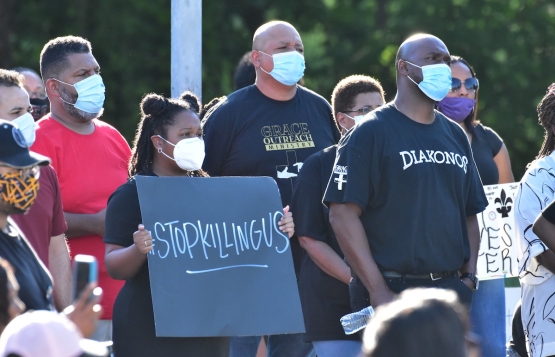
Moments like the early days of the pandemic, when “we’re all in it together” felt like more than an empty slogan, when signs sprouted up and evening applause erupted to thank essential workers—the doctors and nurses, but also the truck drivers and grocery store clerks. And yes, in the aftermath of the awful murder of George Floyd, a black man suffocated to death by an “officer of the peace,” a man whose cries for help went unheeded by four policemen, sickeningly unmoved by his distress.

For maybe a day or two, the nation, consumed with grief and anger, was pulled together by a common understanding that Floyd’s murder was an abomination. That coming on the heels of Amy Cooper, Breonna Taylor, and Ahmaud Arbery, and in the context of a COVID-19 crisis ravaging the black community, this was no time to revert to our old arguments about race in America. As Trevor Noah said so eloquently, the dominos are falling. Perhaps this is a chance for something new—especially if the inexcusable violence and looting stops and the peaceful protests continue.

—

Back in our little corner of the world, in the domain of education reform, I’ve been thinking a lot about the culture war. Mostly that’s because of the recent publication of How to Educate an American: The Conservative Vision for Tomorrow’s Schools, which I co-edited with my colleague, friend, and mentor Chester E. Finn, Jr. As the subtitle makes clear, it’s not a book about finding common ground but about clarifying ideological divisions. Here’s how Yuval Levin, the editor-in-chief of National Affairs and the Director of Social, Cultural, and Constitutional Studies at the American Enterprise Institute, explains the rationale in his brilliant chapter:

The era of the reform coalition also exacted some real costs. Above all, it made American education policy awfully clinical and technocratic, at times blinding some of those involved in education debates to the deepest human questions at stake—social, moral, cultural, and political questions that cannot be separated from how we think about teaching and learning. This has meant less of a focus on public schooling as a source of solidarity in American life, which was once a powerful theme on the left in particular. And it has meant less of an emphasis on character formation and civic education, which were once fundamental to the right’s way of thinking about schooling…

Frustrated by the collapse of the reform coalition but also liberated from its constraints, the right and left will probably take somewhat different directions in education-policy thinking in the coming years. For that reason, it remains useful to consider education policy and politics in terms of left and right. In fact, it may be that the deepest differences between the most intellectually coherent forms of the American left and right actually emerge most clearly around questions of education, and not by coincidence. And for each camp, the concerns that were put aside for the sake of working together in the reform coalition seem likely to be those that now come to the fore.

Alas, Levin is not wrong. Yet I find myself more than a little depressed by the idea of shoring up an agenda for conservatives, even in the principled cause of bringing “viewpoint diversity” to our issue, as Princeton professor Robby George puts it in his essay.

Truth to tell, I liked the bipartisan age of welfare reform, balanced budgets, and No Child Left Behind—especially since poor kids and kids of color made so much progress at that time. I am much more comfortable fighting the good fight for charter schools and testing and accountability than slugging it out in the culture wars per se.

Still, given the political leanings of most teachers, administrators, and education officials, if conservatives don’t engage in debates about how to handle these issues right, we will cede our public schools to the left just as we have ceded our elite universities to the left. That’s akin to ceding our nation’s future as well.

So it’s essential for conservatives to offer answers to cultural questions. Eliot Cohen, Dean of Johns Hopkins University’s School of Advanced International Studies, advocates an approach to teaching American history that is both “patriotic” and “critical"—a sharp distinction from the approach of Howard Zinn or the 1619 Project. Peter Wehner, a senior fellow at the Ethics and Public Policy Center (EPPC) and contributor to The Atlantic and The New York Times, calls for a renewal of character education, one that is not afraid of “inculcating virtue in the young through moral precept, through example and habit, through rewards and punishment, through conversations and stories.” Mona Charen, a syndicated columnist and also a senior fellow at EPPC, urges schools to teach teenagers that their decisions around parenting and marriage will have at least as much consequence for their lives as whether they choose to go to college.

The goal of these arguments isn’t so much to envision a school system imbued with conservative values, but instead to help pull our public schools back to the center.

Which brings me back to today’s crisis.

—

While Joe Biden continues to be a gaffe-machine, including on the sensitive issue of race, America’s schools could learn a lot from his speech about how to handle two hot-button issues: the teaching of American history, and the development of “social and emotional” skills, or what we conservatives more comfortably call “character.” He carved a middle path between right and left that is anything but the mushy middle (despite what the Wall Street Journal might say).

First, history. As several of us discussed at an AEI event last week, nobody should want a Blue American History for kids in Blue America, and a Red American History for kids in Red America. We should all strive for a Purple History, one that doesn’t whitewash the many times our nation has failed to live up to its ideals, especially with respect to the treatment of African Americans, but also doesn’t leave out the many inspiring times that it did. Biden shows how it’s done:

The history of this nation teaches us that it’s in some of our darkest moments of despair that we’ve made some of our greatest progress.

The Thirteenth and Fourteenth and Fifteenth Amendments followed the Civil War. The greatest economy in the history of the world grew out of the Great Depression. The Civil Rights Act of 1964 and Voting Rights Act of 1965 came in the tracks of Bull Connor’s vicious dogs.

And:

It’s been reported that on the day John F. Kennedy was assassinated, little Yolanda King came home from school in Atlanta and jumped in her father’s arms.

“Oh, Daddy,” she said, “now we will never get our freedom.”

Her daddy was reassuring, strong, and brave.

“Now don’t you worry, baby,” said Martin Luther King, Jr. “It’s going to be all right.”

Amid violence and fear, Dr. King persevered.

He was driven by his dream of a nation where “justice runs down like water and righteousness like a mighty stream.”

Then, in 1968, hate would cut him down in Memphis.

A few days before Dr. King was murdered, he gave a final Sunday sermon in Washington.

He told us that though the arc of a moral universe is long, it bends toward justice.

And we know we can bend it—because we have. We have to believe that still. That is our purpose. It’s been our purpose from the beginning.

To become the nation where all men and women are not only created equal—but treated equally.

To become the nation defined—in Dr. King’s words—not only by the absence of tension, but by the presence of justice.

And:

American history isn’t a fairytale with a guaranteed happy ending.

The battle for the soul of this nation has been a constant push-and-pull for more than 240 years.

A tug of war between the American ideal that we are all created equal and the harsh reality that racism has long torn us apart. The honest truth is both elements are part of the American character.

At our best, the American ideal wins out.

It’s never a rout. It’s always a fight. And the battle is never finally won.

So, too, when it comes to the mission of schools beyond the academic, vocational, and civic. In the Venn diagram displaying the overlap between “SEL” and “character education,” surely there is space for empathy, one of the loftiest of virtues, particularly essential at a time like this. And Biden models it beautifully:

I know so many Americans are suffering. Suffering the loss of a loved one. Suffering economic hardships. Suffering under the weight of generation after generation after generation of hurt inflicted on people of color—and on black and Native communities in particular.

I know what it means to grieve. My losses are not the same as the losses felt by so many. But I know what it is to feel like you cannot go on.

I know what it means to have a black hole of grief sucking at your chest.

Just a few days ago marked the fifth anniversary of my son Beau’s passing from cancer. There are still moments when the pain is so great it feels no different from the day he died. But I also know that the best way to bear loss and pain is to turn all that anger and anguish to purpose.

All of this gives me hope. If someone running for president can find a way to reach out to black and white, to left, right, and center, and can address our history, our values, and our complicated relationship with race in a way that promotes unity rather than division, so can our schools. And maybe that will help our moments of common cause, of civic friendship, last more than a day or two at a time.

view

Scrapping admissions tests won’t cure what ails education

Chester E. Finn, Jr.
6.3.2020
Flypaper

On May 21, driven by exquisitely progressive intentions, the regents of the University of California made the worst policy decision in the recent history of American higher education: to eliminate SAT and ACT admissions testing for in-state applicants to all nine of their undergraduate campuses, which comprise one of the country’s biggest and historically most prestigious state systems.

Naturally, this was done in the name of equity, in pursuit of a more diverse student body, one that “looks like California,” and on the assumption, as regent Jonathan Sures asserted, that the SAT (and presumably the ACT) is “inherently racist.”

In abolishing the future use of those tests, the regents went notably farther than a number of colleges that have made admissions “test optional,” meaning that students could submit their scores for consideration if they wish. Although the UC system will function that way for the next two years, the regents stated that, when the time comes to consider admission for young Californians now finishing the eighth and ninth grades, no test scores will be considered. (It’s unclear as yet how the campuses will handle out-of-state applicants, who represent a sizable fraction of enrollees, particularly at high-status Berkeley and UCLA—and who also pay much larger tuitions.)

Meanwhile, the university will look into developing a new and ostensibly “fairer” test to deploy starting in 2025, but with no commitment that this will actually happen. Says president Janet Napolitano—a former Democratic governor of Arizona and longtime liberal stalwart—“Generally the right test is better than no test, but a flawed test should not continue to be required.” Or now, apparently, even considered.

What’s cockeyed and ultimately unfair here is that it’s not the SAT and ACT that are “flawed.” There’s no denying that their scores tend to correlate with test-takers’ socio-economic circumstances and often with their race, but that’s not because the tests are biased, a hoary allegation that the test-makers have long since addressed. No, it’s because in California, as elsewhere in the United States, the K–12 education system has shown itself incapable of producing remotely equitable academic outcomes among racially and socio-economically diverse students. Consider, for example, that on the National Assessment of Educational Progress, among Golden State eighth graders in 2019, an overall 30 percent were “proficient” (or better) in reading, somewhat worse than 33 percent for the nation as a whole. But when we look at group performance, we find that 45 percent of California’s white youngsters and 57 percent of Asian students made it to that level, but just 10 percent of black pupils and 19 percent of Hispanics did so. Which is to say, fewer than one in five youngsters in those two huge minority groups was truly literate when they entered high school. Is it any wonder that their SAT and ACT scores, a few years later, average far below those of their white and Asian classmates?

Like most universities, leaders and faculty at the University of California—and legislators who furnish much of its budget, not to mention progressive thinkers and civil rights advocates all over the place—want its undergraduate demographics to be far more “representative” than today, when Latino students have actually come to outnumber whites, but both are dwarfed by Asian enrollments, and just four percent of undergrads are African American. Because a referendum back in 1996 barred the use of racial preferences in California public colleges, UC admissions officers have striven to diversify their entering classes, and in fact have succeeded better at this than kindred institutions in other states. But not well enough for equity hawks and social justice impresarios, who comprise large fractions of the university’s professoriate and leadership.

Not all, though. There was huge dissent across the campuses over this issue, and the regents’ decision flies in the face of a faculty task force that—just a few weeks earlier—urged that admissions testing be brought back after the current COVID-19-forced testing hiatus.

Most professors want academically-prepared students in their classrooms, young people ready to succeed in bona fide “college level” academics, which means “proficient” (or more) in all the core skills one should possess at the end of high school and with a solid knowledge base in subjects they will pursue further. Yet the regents chose to shoot the test messenger rather than push hard on the unwelcome message: that California’s schools are failing to educate their students of color well enough to place them on a level playing field when the time comes for college.

By doing away with admissions testing, however, the university is bringing a host of new problems upon itself, its faculty, its academic reputation, and ultimately its state. Four such problems will prove especially vexing.

First, huge added pressure will now be placed on the other forms of evidence that applicants supply to admissions offices of these highly selective campuses: course grades, teacher recommendations, student essays, extracurricular activities, and all the rest. Perhaps imaginative new indicators will be devised and deployed. Far more likely, however, is worsening grade inflation, teacher favoritism, padded student resumes, and new advantages for privileged kids whose parents will now arrange for essay coaches and soccer coaches and all manner of rarefied out-of-school activities. The test-prep firms may take a hit, but what a bonanza awaits those who coach fencing and conduct summer study tours to exotic places. In the end, hard-pressed campus admissions teams, lacking truly comparable and objective metrics across applicants and high schools, will substitute subjective judgments based on hasty reading of individual portfolios, tucked into which are clues as to kids’ ethnicity.

Second, as at Harvard and elsewhere, there will be backlash among angry Asian American families and their well-educated daughters and sons, whose rejection by UC will in fact constitute a form of reverse discrimination.

Third, the universities’ classrooms will contain more ill-prepared students, which will force instructors to simplify what they teach. It won’t be termed “remedial,” yet a larger portion of it will consist of what should have been learned in high school. This is apt to lead to gradual lowering of academic standards, resentment by better-prepared students, more drop-outs by discouraged kids whose admission to UC did not, in fact, signal their readiness for college work, and eventual trouble with graduate-school admission and employment, if it becomes clear that a UC bachelor’s degree does not mean what it once did.

Fourth—perhaps obvious but worth emphasis—state policymakers and education leaders will feel even less pressure to fix what ails California’s schools. The pushback against true education reform was already powerful, much of it coming from the state’s powerful teacher union. The drive by many families to prepare their children satisfactorily for UC’s competitive, test-linked admissions process was a valuable countervailing force. Now that force will weaken, to be replaced by pressure to elevate kids’ grades and ingratiate themselves with reference-writing teachers.

It’s ironic that on the same day the regents voted to make UC admissions more subjective—and inevitably more vulnerable to favoritism and influence peddling—Californians Lori Loughlin and Mossimo Giannulli agreed to plead guilty to fraud conspiracy charges in connection with their involvement in the college admissions cheating scandal known as Varsity Blues. Though the University of Southern California, to which their daughters were applying, is a private institution, hence not directly touched by the regents’ vote, it doesn’t take much imagination to see how UCLA and Berkeley and their fellow campuses will be even more vulnerable to kindred forms of chicanery and mischief in the future.

This doesn’t just bid fair to tarnish one of our biggest and most respected university systems. By its example and influence, it diminishes all of American higher education.

Editor’s note: A different version of this essay was first published by The Dispatch.

view

The failure of virus experts and their models—and what it means for K–12

Mike Goldstein
6.3.2020
Flypaper

1. Problems with models

Nobel Physicist Richard Feynman wrote about models:

[Physicists have] learned to realize that whether they like a theory or they don’t like a theory is not the essential question.

Rather, it is whether or not the theory gives predictions that agree with experiment.

It is not a question of whether a theory is philosophically delightful, or easy to understand, or perfectly reasonable from the point of view of common sense.

But we’re human. We like simple: “Let’s raise standards or spend more on schools.” We like common sense: “Reduce class sizes.” We like delight: “Hooray for project based learning.” So these human reactions continue even when such K–12 policies don’t typically perform well in experimental settings.

2. COVID-19 medical models have not performed well

Joseph Epstein writes in the Wall Street Journal:

Some specialize in epidemiology, in immunology, in virology, in public health. On television they flood us with information, more, it sometimes seems, than we can handle. They talk about models, curves, numbers, percentages.

They tell us everything except what we want to know: how the coronavirus began, where it is headed, and when it will end.

The reason they cannot help, I gather, is that they do not really know. Epidemiology, immunology, public health, one begins to sense, may be in the same state—they know everything but what is crucial.

Thus far little predicted by the various scientific experts has come to pass. Not the number of deaths nor the duration of the virus, nor the time of a return to normal life. Yet when the talk turns to reopening the economy, many people, governors and mayors among them, say they await the word of science.

...One major casualty of the coronavirus may turn out to be to the prestige of science.

This failure of experts prompted Edward Dougherty, the chair of electrical engineering at Texas A&M, to explain this is a common problem with models:

Today, scientists are grappling with the problem of model uncertainty, as seen in areas like climate and medicine. These questions are increasingly challenging the basis of modern scientific knowledge itself, which is defined by a combination of mathematics and observation.

Modern scientific knowledge, while rejecting commonsense conceptual models, has always depended upon mathematically expressed theories that could be validated by prediction and observation.

But this approach is now under pressure from multiple sides, suggesting a deep crisis of scientific epistemology that has not been fully confronted. At the same time, political leaders find themselves increasingly impotent when faced with scientific issues.

As we move further into the twenty-first century, humankind is presented with an existential paradox: Man’s destiny is irrevocably tied to science, and yet knowledge of nature increasingly lies not only outside ordinary language but also outside the foundational epistemology of science itself.

So, folks, we K–12 people are in good company! We tend to admire epidemiologists and climatologists. But they’re bad at modeling, just like us.

Epidemiology, for example, is perhaps one-fourth science and three-fourths psychology of crowds. K–12 is perhaps one-fourth the idea, policy, or intervention and three-fourths human execution, with all its variance. (Also see here, here, here for other takes on the problems of experts in creating—and communicating about—their models). 

3. Does K–12 have many, or few, evidence-proven practices?

Many of my K–12 friends stipulate that there are lots of anti-data dummies in our sector. “Not us but other people,” they say. Dummies advocate intervention where most of the evidence is actually negative.

However, these smart friends believe there are many other interventions that are backed by evidence. Why do these friends believe this? Jon Baron at Arnold Foundation nails it:

Someone reading academic journals or looking at web-based clearinghouses of evidence-based interventions might get the impression that there are actually a large number of social interventions shown effective through rigorous evaluations. As we have discussed in previous Straight Talk reports, however, most of these “evidence-based” interventions are backed by only preliminary or flawed findings, which, based on the long history of rigorous evaluations, are often reversed when a more definitive evaluation is subsequently carried out. (Emphasis added.)

Importantly, this problem is not just us in K–12. Baron says it appears in many disciplines:

Business: Of 13,000 RCTs conducted by Google and Microsoft to evaluate new products or strategies in recent years, 80 to 90 percent have reportedly found no significant effects.

Medicine: Reviews in different fields of medicine have found that 50 to 80 percent of positive results in initial clinical studies are overturned in subsequent, more definitive RCTs. Thus, even in cases where initial studies—such as comparison-group designs or small RCTs—show promise, the findings usually do not hold up in more rigorous testing.

Education: Of the 90 educational interventions (all with “good preliminary evidence”) evaluated in RCTs commissioned by the Institute of Education Sciences and reporting findings between 2002 and 2013, close to 90 percent were found to produce weak or no positive effects.

Employment/training: In Department of Labor-commissioned RCTs that reported findings between 1992 and 2013, about 75 percent of tested interventions were found to have found weak or no positive effects.

“Aha!” you say. “Well if 90 percent of K–12 interventions don’t work when tested in RCTs, that means 10 percent do! And so let’s do that 10 percent.”

Sadly, no. Because education is complex, there are two problems. One is that replication of RCTs often doesn’t work in new settings—early childhood education, for example, or high-dosage tutoring. The second problem is timing: Sometimes early gains on a proxy measure, like test scores, don’t translate to later gains on things we care more about, like college graduation rate or escaping poverty with higher earnings; this may be the case with no excuses charter schools, a topic I will explore in a future column.

I offer those particular three examples—early childhood education, high-dosage tutoring, and no excuses charters—because Randi Weingarten likes the first, Betsy Devos likes the third, and both are sort of lukewarm on the second. I’m trying to show that this evidence/model problem is true across the preferences of our political tribes, whether blue or red or purple, and that it’s true across disciplines, not just education.

4. So then what do we do about models?  

Texas A&M’s Dougherty offers this:

Confronting the problems of complexity, validation, and model uncertainty, I have previously identified four options for moving ahead:

(1) dispense with modeling complex systems that cannot be validated;

(2) model complex systems and pretend they are validated;

(3) model complex systems, admit that the models are not validated, use them pragmatically where possible, and be extremely cautious when interpreting them;

(4) strive to develop a new and perhaps weaker scientific epistemology.

I think it’s safe to say that our ed policy sector does #2 mostly. We pretend! Pretending will continue.

Jon Baron encourages #3. I am in his tribe. But it does not appear to be a growing tribe, as best as I can tell. Humility doesn’t scale well.

Feynman nailed what people really want: policies that are delightful, simple, or common sense. And politicians give people what they want.

So now what? I will examine that in a Part 2. Stay tuned!

view
Design principles for MS CTE SR image

Broadening CTE to include middle schools

Jessica Poiner
6.2.2020
Ohio Gadfly Daily

High-quality career and technical education (CTE), which teaches students both the academic and technical skills needed for a variety of in-demand careers, is a promising pathway for millions of young people. Perhaps understandably, the majority of the nation’s CTE programs happen at the high school and postsecondary levels. However, many CTE experts and advocates warn that waiting until high school to educate students on their career options is a mistake.

There isn’t a broad consensus about what CTE and career awareness programs should look like in middle school. So Advance CTE, with support from the Association for Career and Technical Education, gathered a workgroup of national, state, and local leaders to pinpoint the key aspects of a quality CTE experience in the middle grades. The end result—a paper titled Broadening the Path: Design Principles for Middle Grades CTE—offers state and local leaders suggestions on how to design new programs and policies, as well as how to improve existing initiatives.

The paper covers three main areas: student outcomes, design principles, and core program elements. In terms of student outcomes, it’s critical for leaders to establish clear goals that are firmly rooted in student learning and incorporate rigorous standards and curricula. An effectively implemented middle school CTE program would accomplish several important outcomes, including awareness of and exposure to a wide variety of careers; the development of employable skills, such as problem solving, time management, and self-advocacy; the development of foundational technical skills, like understanding industry-specific terminology; and an actionable next-steps plan for a student’s transition to high school. This last outcome is particularly important, as it can help middle schoolers identify which courses to take.

To achieve these learning outcomes, state and local leaders must design and implement effective programs and policies. This paper offers several principles for doing so, though they are not intended to be prescriptive. First and foremost, programs must be equitable and inclusive. To have maximum impact, CTE programs in the middle grades should not be limited to a single elective course, even though carving out dedicated instructional time might affect master schedules and teacher availability. The paper also warns against tracking students into certain courses based on their gender, race, or ethnicity, and against making CTE courses a “dumping ground” for certain students.

It is also vital for programs to be anchored in careers. Students should be able to explore a vast range of occupations, the knowledge and skills needed to pursue them, and associated labor market information. They should also have access to hands-on experiences, like project-based and work-based learning. Effective programs should strike a careful balance between breadth (exposing students to many careers) and depth (allowing students to explore their unique interests). Employers should be included in intentional and meaningful ways. Aligning middle school offerings to high school, college, and career advising and clearly communicating CTE options to students and their families are also crucial. Finally, to gauge student success, the paper recommends focusing on growth validated by educators and employers. Coursework, work-based learning, and competitions for career and technical student organizations (CTSOs) would give students an opportunity to demonstrate their learning.

The final section explores six core elements of CTE programs: standards, curricula, and assessments; course and activity structure and scheduling; career advisement; experiential learning; teachers and leaders; and data and measurement. Implementing these elements effectively will determine a program’s overall quality. For example, the majority of information collected on CTE programs and students occurs at the high school and postsecondary level. To build effective CTE programming in the middle grades, state and local leaders will need to determine how and when to measure whether middle school students have achieved learning outcomes.

Overall, this paper is an informative look at how to extend the benefits of CTE into the middle grades. State and local leaders looking to expand CTE programming would be wise to use this roadmap as a guide.

Source: “Broadening the Path: Design Principles for Middle Grades CTE,” Advance CTE and the Association for Career and Technical Education (March 2020).

view

The different ways charter and district schools are doing distance learning

6.3.2020
Flypaper

The pandemic forced schools across the country to close and institute some form of remote learning, but their methods varied widely. To see just how much, analysts at the American Enterprise Institute and the Center on Reinventing Public Education have been examining how different public school districts and charter school networks have responded. The team at AEI, led by Nat Malkus, have looked at traditional district schools, while CRPE’s research, led by Robin Lake, has been tracking both traditional district schools and charters.

Malkus et al. developed the COVID-19 Education Response Longitudinal Survey (C-ERLS), which began sampling 250 public school districts on March 26 and 27, comprising 10,289 schools. The team has gathered data entirely from district websites, and checked back every seven to ten days to monitor changes to proposed plans. The most recent report covers the changes that occurred between April 24 and May 8.

AEI found that all the sampled schools were closed by March 27, with many shuttered by March 18. They all remain closed through May 8, and as the end of the school year approaches, none have plans to reopen before summer. Many have removed previous tentative plans to reopen, which had been posted on their district websites. By March 27, 43 percent were already offering some form of remote instruction for students, 30 percent had plans to implement remote options in the near future, and the remaining 27 percent made no mention of any plans for distance learning. However, by May 8, 97 percent of schools were providing some form of remote instruction for their students.

Of those 97 percent, 62 percent expected some level of participation from students, with 30 percent taking attendance. Nine percent of schools expressly stated that participation was not required and attendance would not be taken, while the remaining 29 percent did not have clear expectations for participation from students.

CRPE, meanwhile, compared the remote learning plans of eighty-two traditional public school districts with those of eighteen charter school management organizations (CMOs), all of which are part of the Charter School Growth Fund portfolio and oversee at least ten schools. CRPE reviewed district and CMO websites and open-access online learning materials to determine which had educational resources available for distance learning, and their strategies for providing remote instruction.

By April 21, 100 percent of the eighty-two traditional districts reviewed by CRPE were providing educational resources for their students—with 96 percent having formal curriculum provisions. Yet as of May 6, 33 percent still didn’t have consistent expectations for their teachers on how to provide meaningful remote instruction, and almost half of these didn’t require teachers to provide feedback for students. Much of the instruction consists of a combination of online assignments, paper packets, and lessons from public-access television broadcasts. But there is a lack of engagement between students and teachers, as well as a lack of expectation for learning; only 16 districts were tracking student attendance by April 21, with states varying in expectations and requirements of their districts as well.

As for the CMOs that CRPE examined, by April 10, nine of the eighteen provided some form of online instruction with formal curricula, instruction, and progress monitoring, while only two had no education resources for their students to access; the other seven fell somewhere in between. When Lake and her team compared the charter networks to districts, they found that the CMOs were more likely to monitor the progress of their students in some form and advance towards synchronous online instruction. Several charter schools also have their teachers serve as advisors, building relationships and checking in with the students to monitor their progress, even if the charter school network has not required remote instruction. This was in contrast to public school districts, which did not specifically require their teachers to serve as advisors for their students.

The reports from AEI and CRPE were limited to information that was offered by district websites, meaning it did not account for plans that were disseminated through school websites, email, direct contact, or other forms of communication. CRPE’s analysis also had additional limitations: It did not randomly select CMOs and districts to review, and the number they reviewed is not large enough to make any general comparisons between school districts and charter school networks.

It is crucial to track how school districts and charter schools are responding to COVID-19. Educators are being driven to enhance, and often create from scratch, their remote learning systems, and find ways to support their students academically and emotionally. While the initial priority of schools is to ensure that students have access to remote instruction and continue learning, these analyses and differences in governance structures suggest that charter schools may have more flexibility in experimenting with different strategies than traditional districts. Yet schools have a responsibility and opportunity to learn from each other to create strong systems that educate and support the students they serve, especially as we look towards the coming school year.

SOURCES: Nat Malkus, Cody Christensen, and Lexi West, “School District Responses to the COVID-19 Pandemic: Round 1, Districts’ Initial Responses,” American Enterprise Institute (April 2020); Nat Malkus and Cody Christensen, “School district responses to the COVID-19 pandemic: Round 5, plateauing services in America’s schools,” American Enterprise Institute (May 2020); Robin Lake and Bree Dusseault, “Analysis: How 18 Top Charter School Networks Are Adapting to Online Education, and What Other Schools Can Learn From Them,” The 74 (April 2020); Bree Dusseault and Travis Pillow, “Still No Consistent Plan for Remote Learning for Hundreds of Thousands of Students at Some of America’s Biggest School Districts,” Center on Reinventing Public Education (May 2020); Robin Lake and Bree Dusseault, “Remote Classes Are in Session for More School Districts, But Attendance Plans Are Still Absent,” Center on Reinventing Public Education (April 2020); and Robin Lake and Bree Dusseault, “Districts and CMOs Are Making Progress on Instruction and Monitoring, But Lag in Grading and Attendance,” Center on Reinventing Public Education (April 2020).

view

The Education Gadfly Show: The crisis’s outsized impacts on Catholic schools

6.3.2020
Podcast

On this week’s podcast, Michael McShane, the director of national research at EdChoice, joins Mike Petrilli to discuss how Catholic schools are weathering the pandemic and economic downturn and what public policy can do to help. On the Research Minute, Amber Northern examines the effects of a quarter century of school finance reforms.

Amber's Research Minute

Kenneth A. Shores, Christopher A. Candelaria, and Sarah E. Kabourek, “Spending More on the Poor? A Comprehensive Summary of State-Specific Responses to Finance Reforms from 1990-2014,” retrieved from Annenberg Institute at Brown University (May 2020).

The Education Gadfly Show is available on Google Podcasts, Libsyn, Spotify, iHeartRadio, Apple Podcasts, TuneIn, The Podcast App, PodBean, Podbay, Chartable, Castbox, and myTuner Radio.

Fordham Logo

© 2026 The Thomas B. Fordham Institute
Privacy Policy
Usage Agreement

National

P.O. Box 110
Burke, VA 22009

202.223.5452

[email protected]

Ohio

P.O. Box 82291
Columbus, OH 43202

614.223.1580

[email protected]

Sponsorship

130 West Second Street, Suite 410
Dayton, Ohio 45402

937.227.3368

[email protected]