Mobile Navigation

  • National
    • Policy
      • High Expectations
      • Quality Choices
      • Personalized Pathways
    • Research
    • Commentary
      • Gadfly Newsletter
      • Flypaper Blog
    • Events
    • Scholars Program
  • Ohio
    • Policy
      • Priorities
      • Media & Testimony
    • Research
    • Commentary
      • Ohio Education Gadfly Biweekly
      • Ohio Gadfly Daily
  • Charter Authorizing
    • Application
    • Sponsored Schools
    • Resources
  • About
    • Mission
    • Board
    • Staff
    • Career
Home
Home
Advancing Educational Excellence

Main Navigation

  • National
  • Ohio
  • Charter Authorizing
  • About

National Menu

  • Topics
    • Accountability & Testing
    • Advanced Education
    • Career & Technical Education
    • Charter Schools
    • Curriculum & Instruction
    • ESSA
    • Evidence-Based Learning
    • Facilities
    • Governance
    • Personalized Learning
    • Private School Choice
    • School Finance
    • Standards
    • Teachers & School Leaders
    • Think Again
  • Research
  • Commentary
    • Gadfly Newsletter
    • Flypaper Blog
    • Gadfly Podcast
  • Events
  • Scholars Program

The Education Gadfly Weekly

Sign Up to Receive Fordham Updates

We'll send you quality research, commentary, analysis, and news on the education issues you care about.
Thank you for signing up!
Please check your email to confirm the subscription.

The Education Gadfly Weekly: Doing educational equity right: Advanced education

Volume 24, Number 4
1.25.2024
1.25.2024

The Education Gadfly Weekly: Doing educational equity right: Advanced education

Volume 24, Number 4
view
Quality Choices

The right to school choice is also about the right to stay put

Fordham’s latest report, "New Home, Same School," analyses the relationships among residential mobility, school mobility, and charter school enrollment. It finds, among other things, that changing schools is associated with a small decline in academic progress in math and a slight increase in suspensions—and that residentially mobile students in charter schools are less likely to change schools than their counterparts in traditional public schools.

David Griffith, Ph.D., Amber M. Northern, Ph.D. 1.25.2024
NationalFlypaper

The right to school choice is also about the right to stay put

David Griffith, Ph.D. | Amber M. Northern, Ph.D.
1.25.2024
Flypaper

Doing educational equity right: Advanced education

Michael J. Petrilli
1.25.2024
Flypaper

If Trump returns...

Chester E. Finn, Jr.
1.25.2024
Flypaper

Testing multiple measures of school economic disadvantage

Jeff Murray
1.25.2024
Flypaper

Cheers and Jeers: January 25, 2024

The Education Gadfly
1.25.2024
Flypaper

What we're reading this week: January 25, 2024

The Education Gadfly
1.25.2024
Flypaper
view
Students working together

Doing educational equity right: Advanced education

Michael J. Petrilli 1.25.2024
Flypaper
view

If Trump returns...

Chester E. Finn, Jr. 1.25.2024
Flypaper
view

Testing multiple measures of school economic disadvantage

Jeff Murray 1.25.2024
Flypaper

view

Cheers and Jeers: January 25, 2024

The Education Gadfly 1.25.2024
Flypaper
view

What we're reading this week: January 25, 2024

The Education Gadfly 1.25.2024
Flypaper
view

The right to school choice is also about the right to stay put

David Griffith, Ph.D. | Amber M. Northern, Ph.D.
1.25.2024
Flypaper

Every now and then, the cracks that form at the intersection of housing and education policy become visible to a casual observer. An overcrowded school building. A desperate family that commits “residency fraud” so its kids can learn. A homeless parent who struggles to enroll her children in a local school.

Yet too often such fissures are undetectable to all, save the case workers and educators who do their best to patch them (with mixed results). One day Johnny is scraping out a D-minus in English. The next day he’s gone, carried away by circumstances beyond his control—social, economic, familial—to unfamiliar streets and classrooms unseen.

Alas, Johnny’s experience is far from unique. Roughly one in five poor families in the United States changes residences each year, often involuntarily. Worse, because the housing and education markets are linked, involuntary changes in residence often force already-vulnerable students to change schools, at least when their new address is sufficiently distant that they wind up in another attendance zone.

It follows that, insofar as school choice weakens the link between housing and education, it may hold particular benefits for students who experience “residential instability.” Families would surely benefit from being able to change homes while keeping their children at the same school. Yet, to our knowledge, this potential benefit has never been studied, perhaps because doing so requires a dataset with detailed information on students’ home addresses.

That’s why we were excited to learn of the dataset that the University of North Carolina’s Douglas Lee Lauen and his research assistants have painstakingly assembled. Professor Lauen is well-known for his prior work on charter schools and educational accountability and, like us, was eager to shine a bright light on this neglected dimension of school choice. In addition to information on student demographics, achievement, attendance, and discipline, his database includes the home addresses of every student who enrolled in a North Carolina public school between 2016–17 and 2018–19. This unusually rich dataset, which includes information on more than four million students, enables analysis of the relationships among residential mobility, school mobility, and charter school enrollment.

Fordham’s resulting report—titled New Home, Same School: Charters and residentially mobile students and authored by Lauen—is worth reading in full. But here are its four key findings.

First, about one in seven students experiences a change in residence or school in a given school year. Moreover, there is a strong link between residential and school mobility. It’s hard to say how many of these moves are “involuntary,” but they’re more frequent among low-income families.

Second, Black and Hispanic students are more mobile than White students. For example, Black students are about twice as likely to change schools as White students (and about two-thirds of those moves are accompanied by changes in residence). In other words, racial disparities in school mobility are effectively baked into a system in which housing and schooling stay linked.

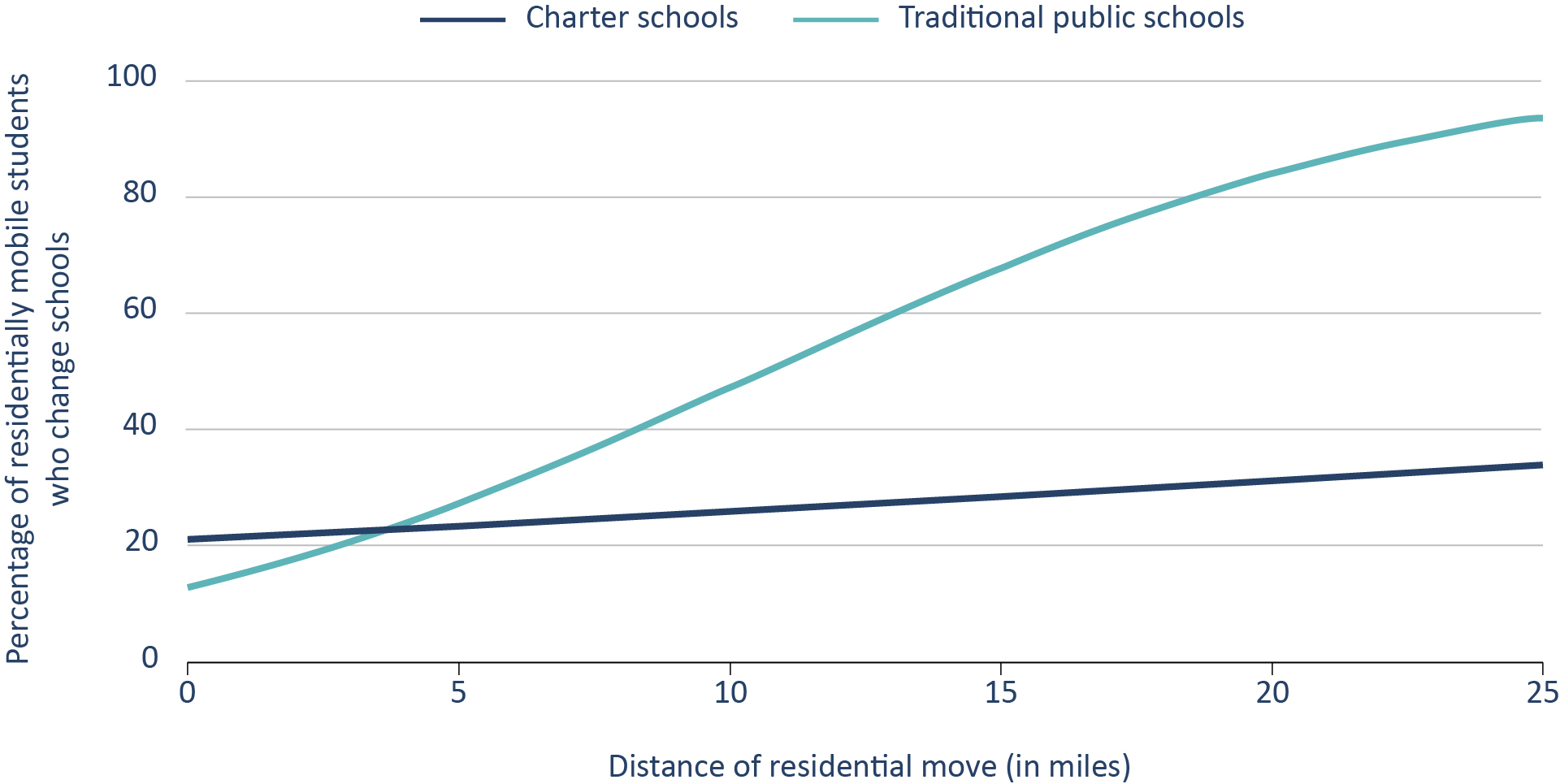
Third, residentially mobile students in charter schools are less likely to change schools than their counterparts in traditional public schools. More specifically, the former become less likely to change schools relative to students in traditional public schools as the distance of the residential move increases (Figure 1).

If you think about it, this makes sense: The further a family moves, the more likely its kids are to wind up in the catchment zone of a different traditional public school or an entirely different district. But most charter schools don’t have catchment zones so as long as any transportation barriers are surmountable, nothing prevents their students from remaining enrolled in the same school should where they live change.

Figure 1: As the distance of the residential move increases, students in charter schools become less likely to change schools than those in traditional public schools.

1

Notes: This figure shows how the probability of school mobility increases for residentially mobile students as the distance of the residential move increases. The sample includes only students who made a residential move of twenty-five miles or less. Traditional public school and charter school status are defined before the residential move. Estimates were generated using a probit model with distance of a residential move as the predictor and school move as the outcome.

Finally, residential mobility, school mobility, and “compound” mobility are all associated with a small decline in academic progress in math and a slight increase in suspensions. In other words, the results suggest that needlessly high mobility rates have real costs for students (and of course there could be other costs that we do not observe).

Isolating these adverse effects is challenging, as is generalizing about the various scenarios that can result in a student changing schools. (Consider the difference between a student who is expelled and a student whose parent takes a higher-paying job in a better-resourced community.) Still, if there’s no reason to believe that a student’s new school will be better than their old one, it’s hard to endorse a regime that forces families to change schools when they change homes.

—

“Freeing” students in low-income neighborhoods from low-performing schools remains a key benefit of school choice. But another, albeit less obvious, benefit is reducing the educational disruption and personal stress that often come with a change in residence, especially for students in those same neighborhoods.

Every year, about 3 million children in the United States are evicted. As of 2022, about 1.2 million students were considered homeless by the U.S. Department of Education (though the true number is almost certainly higher). And in the past year, a combination of rising rents and the expiration of pandemic-era protections has created a housing crisis that has disproportionately affected students of color. Right now, in New York City alone, at least 100,000 kids are in temporary housing.

Obviously, school choice can’t address all of the factors underlying such tragic statistics or completely quell their consequences. But more robust and equitable open enrollment policies would be one step. More charter schools (which are legally prohibited from giving preference to students from “good” neighborhoods) would be another. And, regardless of how we attack the problem, the burden of proof should fall on those who insist that students who are already perilously close to falling through the cracks must change classes, teachers, curricula, and peer groups if and when they find a new home.

In short, the right to school choice is also about the right to stay put.

view
Students working together

Doing educational equity right: Advanced education

Michael J. Petrilli
1.25.2024
Flypaper

This is the fourth in a series on doing educational equity right. See the introductory post, as well as ones on school finance, student discipline, school closures, homework, grading, effective teachers, and a concluding post on doing educational equity wrong.

On my more optimistic days, I think that finding a durable consensus around advanced education—gifted-and-talented programs in elementary schools, advanced courses in middle and high schools, etc.—should be relatively easy. It even fits on a (mega) bumper sticker. “Advanced education: Don’t end it, mend it, and extend it to many more students.”

In other words, if the problem is that gifted-and-talented programs and access to advanced courses have been inequitable in the past—as they surely have been in most places—the solution is not to get rid of them, as some on the far left propose, but to open them up to many more students, especially those from underrepresented groups. Indeed, that’s a decent summary of the recommendations from the National Working Group on Advanced Education, which those of us at the Thomas B. Fordham Institute were honored to convene last year.

But I know that the ideological battles are much sharper than this obvious compromise might let on. Indeed, advanced education is at the heart of the culture wars still raging around DEI, “wokeism,” and the very nature of “merit” in our knowledge-based capitalist economy.

The view from the left

Among many progressives we can detect much skepticism about the very nature of academic “giftedness.” Partly that’s because of the problematic history of the gifted-and-talented movement, linked as it was with some terrible ideologues, including people espousing eugenics and white supremacy. Nor does it help that in some communities, White parents used entrance into gifted-and-talented programs as a way to shield their children from school desegregation efforts.

But even if we’ve moved past all that, it remains a fact that Black, Hispanic, and low-income students are significantly underrepresented in gifted-and-talented programs and advanced courses. If “talent is equally distributed, but opportunity is not,” as a favored slogan goes, clearly these programs must be at odds with opportunity. High achievement is not about “merit,” then, so much as it’s about privilege.

The view from the right

Meanwhile, many of us conservatives tend to take an absolutist position when it comes to merit and achievement. We insist that considering someone’s racial or class identity is (or certainly should be) irrelevant whether we’re talking about selection into gifted-and-talented programs at age five or entrance to selective universities at age eighteen. Everyone should be judged as individuals, and if we see disparities by race or class, that’s just the way the cookie crumbles. We shouldn’t be surprised that children with two well-educated parents do better in school and on achievement tests than those growing up in unstable single-parent homes. Furthermore, it’s not schools’ job to level the economic playing field, but to help every student fulfill their God-given potential. The more kids learn, the more our future economy will grow, and the more secure our nation will be.

Bridging the divide

It’s looking as if the two extremes are quite far apart. Is high academic achievement a sign of merit or privilege? Are kids of color underrepresented in gifted programs and advanced courses because of differences in wealth and family structure or because of exclusion and discrimination?

Let’s see if the three rules that have guided our discussion during this series are helpful here, too:

  1. When aiming for equity, we should level up instead of leveling down.

  2. We should focus on closing gaps between affluent students and their disadvantaged peers, not between high-achieving students and their lower-achieving peers.

  3. We should focus equity initiatives primarily on class, not race.

Rule number one is easy to apply here. Eliminating gifted-and-talented programs, advanced courses, and other forms of “tracking” is clearly an example of leveling down. It’s the Harrison Bergeron strategy of kneecapping talented kids, supposedly for the good of the whole. It’s not only morally repugnant, but politically unsustainable.

To level up instead of down, we need to embrace acceleration for kids who are well over on the right side of the achievement distribution, while also erring on the side of inclusion. One of the best ways of doing so is using so-called “local norms.” That means selecting, say, the top 10 percent of students in every elementary school and inviting them into gifted-and-talented programs and acceleration opportunities, rather than the top 10 percent of students in the whole district or the whole state. That would ensure that students at every school in America, including high-poverty schools, would gain access to such opportunities—and boost the number of low-income kids and kids of color who end up participating. Schools and districts should also avoid selection factors that can introduce racial or socioeconomic bias, such as mandatory recommendations from teachers or parents. Instead, “universal screening” should identify all students who could benefit from greater challenge, who should be placed into advanced learning as the default.

Rules number one and two also mean making sure that the students who don’t get into gifted-and-talented programs or advanced courses are also held to reasonably high standards. The detracking people weren’t wrong that the old remedial tracks were tracks to nowhere and hotbeds of the “soft bigotry of low expectations.” We surely don’t want to go back to that. Nor should placement into a track or ability group be set in stone; the spirit of “universal screening” for advanced learning opportunities only works if we keep doing it rather than think of it as “one and done.”

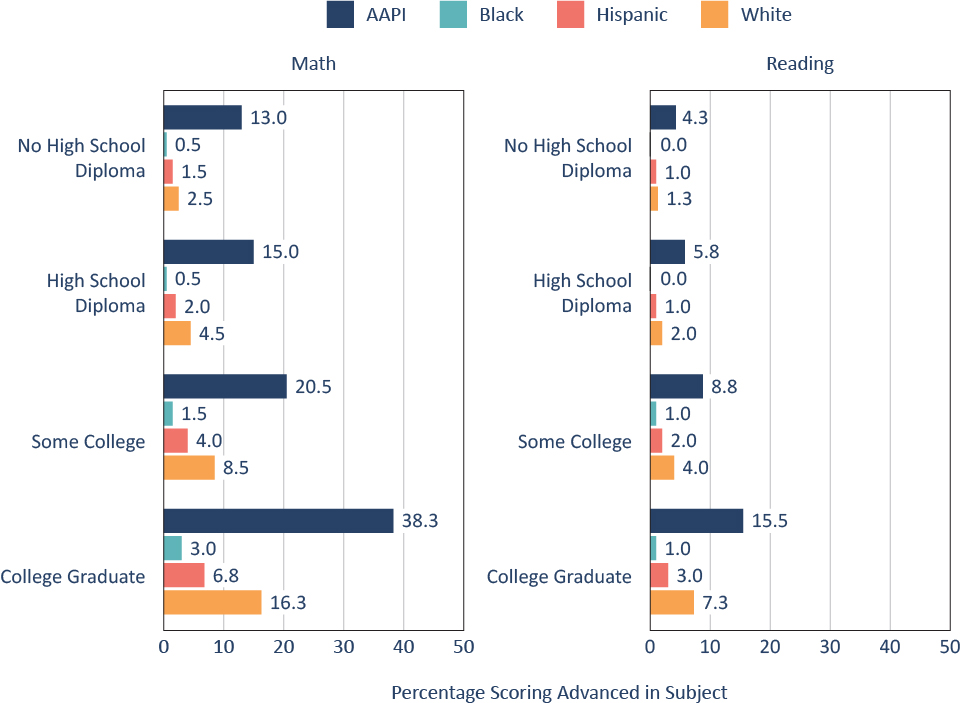
Our rule number three—focus primarily on class instead of race when seeking to do educational equity right—is probably the most challenging here. While it’s true that controlling for socioeconomic factors significantly reduces the “excellence gaps” among races, it doesn’t completely eliminate them. That was one finding of a recent study by my colleagues Adam Tyner and Meredith Coffey. What’s particularly perplexing is the low percentage of Black students who are achieving at the highest levels on standardized tests—even Black students from high-SES families.

Figure 1. Excellence gaps by race/ethnicity persist within student socioeconomic groups, as measured by the mother’s education level.
1

We’re not the first ones to uncover this finding—far from it. Indeed, decades of scholarship have examined the relative underperformance of Black students in affluent communities, such as Shaker Heights, Ohio, outside Cleveland. This was also the subject of a recent book by the Washington Post’s Laura Meckler. Perhaps it’s a statistical artifact—maybe Black students in such neighborhoods are more disadvantaged economically than they appear via rudimentary data. But there’s reason to suspect that it goes deeper. One prominent theory—which, no, hasn’t been debunked—is the “acting White” phenomenon, born out of the aftermath of desegregation, in which some Black students fear paying a social price for excelling academically. Creating a “culture of high achievement,” as many of the best charter schools do, may be the most promising way to meet the challenge, though in integrated schools, it might be hard to do so entirely via race-neutral means.

—

I think it’s fair to say that the right is naturally more comfortable with meritocracy in general, and advanced education in particular, than the left is. If we conservatives want our fellow citizens across the ideological spectrum to embrace advanced learning, too, we need to take their equity concerns seriously. That means working harder and smarter than we have in the past to ensure that gifted-and-talented programs and advanced courses are not the exclusive province of affluent students, most of them White or Asian. We don’t have to embrace the whole DEI ideology or eliminate entrance standards to gifted programs or advanced courses to acknowledge that our advanced learning opportunities could and should be more diverse, equitable, and inclusive. Say it with me: Don’t end it, mend it, and extend it!


view

If Trump returns...

Chester E. Finn, Jr.
1.25.2024
Flypaper

Now that President Trump has soundly defeated Governor Haley in New Hampshire and thus appears to have sewn up the GOP nomination, it’s time to consider what a second Trump term may mean for education. I’ve examined the question before, but that was based on campaign literature and at the 30,000-foot level. A much more detailed and closer-to-the-ground agenda for education policy under Trump II can be found in a forty-three-page chapter by Lindsey Burke within the Heritage Foundation’s latest Mandate for Leadership volume. This exhaustive—thirty chapters, almost 900 pages—handbook for reshaping the federal government and its policies and programs is intended to guide the next conservative administration. (As I write, we can assume that means Trump, never mind his patchwork version of conservatism.)

This doorstop of a tome, the ninth in a quadrennial series of bulky “what to do when elected” manuals brought forth for every presidential election, is serious and angry. (Though it often invokes Reagan, it displays none of his sunny optimism.) Subtitled “The Conservative Promise,” it’s part of an ambitious undertaking called “Project 2025,” which (says Wikipedia) “envisions widespread changes across the entire government, particularly with regard to economic and social policy and the role of the federal government and federal agencies.” Established in 2022, the project also seeks to recruit lots of eager conservatives to come to Washington to replace all those appointed officials and civil servants that sometimes get termed the “deep state.”

While nobody can be certain that the unpredictable Trump will follow this (or any) blueprint, serious observers expect it. A trio of veteran Washington Post reporters wrote in November that:

Much of the planning for a second term has been unofficially outsourced to a partnership of right-wing think tanks in Washington. Dubbed “Project 2025,” the group is developing a plan, to include draft executive orders, that would deploy the military domestically under the Insurrection Act, according to a person involved in those conversations and internal communications reviewed by The Washington Post.

The Heritage book sets forth, often in minute detail, what the Trump team is supposed to change, and its chapters were written by people who have considerable experience with these issues. Lindsey Burke, for example, has been working at Heritage since 2008 and has headed up the organization’s ed-policy team for the past seven years.

Predictably, she’d like to abolish the U.S. Department of Education and asserts that the federal role in K–12 “should follow the path outlined by Milton Friedman in 1955, wherein education is publicly funded but education decisions are made by families.” But she’s well aware that many missions, programs, billions, and interests are entangled here, and knows better than simply to cry “down with it all.”

So many of her prescriptions take the form of dismantling, relocating, and block-granting. Many of ED’s programs—including the big Title I and IDEA programs—she would move to the Department of Health and Human Services (while also converting them to “formula block grants”), in effect recreating the old Department of Health, Education, and Welfare (HEW). I admit to not quite grasping how shifting such responsibilities to an even larger federal bureaucracy is viewed as progress—I guess because HHS is thought to be less vulnerable to the influence of teachers unions and other education interest groups. In similar fashion, she would dispatch Indian education to the Interior Department, vocational and career education to the Labor Department, statistics to the Census Bureau, and “impact aid” to the Pentagon.

Yet there’s more going on in these pages than outsourcing. Page after page admonishes the next administration to repeal or rescind a host of Biden-era regulations, from those putting limits on charter schools to those advancing “disparate impact” in civil rights and school discipline to those (more than I knew!) requiring government attention or protection to nonbinary students.

More pages take on procedural challenges that Burke wants made, such as reforming ED’s “negotiated rulemaking” process and—as urged by AEI’s (and Fordham’s) Ian Rowe—adding “family structure” to the categories by which NAEP data are disaggregated.

Even as she would stop (or outsource) much of what the department does, she doesn’t shy away from adding. Half the chapter addresses “new policy priorities for 2025 and beyond.” These range from “prohibiting compelled speech” to passing a federal “Parents’ Bill of Rights” to equipping parents and students (over eighteen) with a “private right of action to seek injunctive and declaratory relief” if denied access to various forms of data. Of course she also urges Congress to create multiple forms of school choice, such as a “federal scholarship tax credit that would incentivize donors to contribute to nonprofit scholarship granting organizations” and creating ESAs for students enrolled in Bureau of Indian Education schools.

Some recommendations display the schizophrenia that affect many conservatives torn between wanting Uncle Sam to advance their favorite themes and causes and wanting Washington simply to get out of the way. Thus, for example, Title I dollars would be entrusted to parents to “help pay for private learning options” but then “the federal spending should be phased out....”

I resonate with a fair portion of what’s in these pages even as I view much of it as fantasyland. But my personal preferences aren’t nearly so consequential as recognizing that Trump II is quite likely to treat the entire volume as a serious playbook, a “mandate” for their own singular form of “leadership.” Particularly if they find themselves working with a likeminded (and functional?) Congress, lots of this could well come to pass.

view

Testing multiple measures of school economic disadvantage

Jeff Murray
1.25.2024
Flypaper

Equitably funding education in America means providing more resources to students who need additional support. Youngsters from economically-disadvantaged families are typically among those determined to need additional help, and have traditionally been identified by asking families to self-report their financial status and having a third party then verify their eligibility for services such as free or reduced-price lunch. But is direct certification really the right method for identifying family need? It has been criticized for being intrusive to families and burdensome to schools, but other methods regularly generate concerns in regard to their accuracy. New research out of Oregon compares various methods for identifying students in need, looking for the most accurate.

A group of researchers led by Stanford University’s Michelle Spiegel uses student-level administrative records from a sample of 1,060 public schools in the Beaver State from 2009–10 through 2016–17. These records are linked with U.S. Census Bureau data, Oregon Supplemental Nutrition Assistance Program (SNAP) program enrollment, and IRS data to construct two novel benchmark measures of student economic disadvantage—one based solely on IRS data, the other based on a combination of SNAP/IRS information. The researchers’ constructed measures are then aggregated to the school-by-year level to aid comparison over time and across schools versus five other measures actively used to report poverty levels in Oregon schools. These include student-specific measures, like free or reduced-price lunch (FRPL) and SNAP eligibility (without the addition of IRS data), and community-centric measures, like the Urban Institute’s Model Estimates of Poverty in Schools (MEPS) and the Census Bureau’s household income-to-poverty ratio.

Each measure includes various income cutoff levels, and thus they predictably yield different percentages of students defined as economically disadvantaged. However, the trend lines over successive school years do tend to correlate reasonably well. In other words, if one measure indicates an improvement in economic circumstances (fewer disadvantaged students) from year to year, most of the others indicate similarly.

There is, however, one exception: the Oregon Department of Education’s Economic Disadvantage rate, a widely-used measure which includes schools that take advantage of the Community Eligibility Provision (CEP) allowing them to designate all students as economically disadvantaged. That measure showed the least correlation with the others and typically overestimated the number of economically-disadvantaged students, and indicated a relatively-stable percentage of economically disadvantaged students from year to year without reflecting the economic changes clearly shown in all the others. More on the implications of that in a moment.

Further comparison of trend data indicates that SNAP-based direct certification measures correlate most directly with the researchers’ own method, whose IRS-sourced data are not readily available to school leaders and policymakers. Thus, SNAP-based direct certification is likely the best and most accurate existing means by which to determine true economic disadvantage rates in schools, both over time and across schools.

CEP, which launched in the 2014–15 school year, likely achieved its aims of expanding access to nutritious food, reducing paperwork, and eliminating school lunch debt. But it also began skewing the Oregon poverty data almost immediately. The same pattern was seen by Fordham’s own analysis in our home state of Ohio, which went on to show that levels of other aid for economically disadvantaged students were likely impacted by the designation of 100 percent of students in a growing number of districts as eligible for free lunches.

Spiegel and her team don’t go that far in their analysis, but the implications of their findings are the same: To the extent that other financial supports for low-income students are allotted on a per pupil basis, it is inevitable that a poverty measure that includes all students without regard to actual need will sweep in families of far higher means, risking a misdirection of finite funding. In short, although community eligibility is a commendable school meals initiative, mounting evidence shows that its impact on school poverty measures has negative implications for equitable education funding writ large.

SOURCE: Michelle Spiegel et al., “Measuring School Economic Disadvantage,” Educational Evaluation and Policy Analysis (January 2024).

view

Cheers and Jeers: January 25, 2024

The Education Gadfly
1.25.2024
Flypaper

Cheers

  • As pandemic-era funds reach a spending deadline, the White House is urging schools to double down on tutoring, extra learning time, and attendance policies. —Chalkbeat
  • Former Governor of Indiana Mitch Daniels highlights five great books on education. —Wall Street Journal
  • After one school banned phones, there were more meaningful interactions between students, fewer disruptions, and less time spent on screens. —The Guardian

Jeers

  • Bureaucracies and administrative bloat cost Americans trillions in economic output and sap sectors of initiative and creativity. —David Brooks, New York Times
  • “What functional illiteracy feels like for teenagers.” —Boston Globe
  • Tennessee Democrats called on the state’s education commissioner, Lizzette Reynolds, to resign because she doesn’t meet the state’s legal requirements for the job. —Chalkbeat
view

What we're reading this week: January 25, 2024

The Education Gadfly
1.25.2024
Flypaper
  • Black families disproportionately attend schools of choice and so are caught in the middle of the school choice debate in Chicago. —Chicago Sun-Times
  • Student debt, underemployed degree-holders, and political intolerance are causing Americans to lose faith in the value of college. —Douglas Belkin, Wall Street Journal
  • Classroom rewards can improve behavior and don’t quash intrinsic motivation, but proper implementation matters. —Emily Oster, Parent Data
  • “DEI is worth saving from its excesses. Companies should root out discrimination and hostile training sessions and focus on optimizing talent.” —Roland Fryer, Wall Street Journal
  • The latest issue of the journal for state boards of education covers best practices for implementing high quality curricula. —State Education Standard
Fordham Logo

© 2026 The Thomas B. Fordham Institute
Privacy Policy
Usage Agreement

National

P.O. Box 110
Burke, VA 22009

202.223.5452

[email protected]

Ohio

P.O. Box 82291
Columbus, OH 43202

614.223.1580

[email protected]

Sponsorship

130 West Second Street, Suite 410
Dayton, Ohio 45402

937.227.3368

[email protected]