Mobile Navigation

  • National
    • Policy
      • High Expectations
      • Quality Choices
      • Personalized Pathways
    • Research
    • Commentary
      • Gadfly Newsletter
      • Flypaper Blog
    • Events
    • Scholars Program
  • Ohio
    • Policy
      • Priorities
      • Media & Testimony
    • Research
    • Commentary
      • Ohio Education Gadfly Biweekly
      • Ohio Gadfly Daily
  • Charter Authorizing
    • Application
    • Sponsored Schools
    • Resources
  • About
    • Mission
    • Board
    • Staff
    • Career
Home
Home
Advancing Educational Excellence

Main Navigation

  • National
  • Ohio
  • Charter Authorizing
  • About

National Menu

  • Topics
    • Accountability & Testing
    • Advanced Education
    • Career & Technical Education
    • Charter Schools
    • Curriculum & Instruction
    • ESSA
    • Evidence-Based Learning
    • Facilities
    • Governance
    • Personalized Learning
    • Private School Choice
    • School Finance
    • Standards
    • Teachers & School Leaders
    • Think Again
  • Research
  • Commentary
    • Gadfly Newsletter
    • Flypaper Blog
    • Gadfly Podcast
  • Events
  • Scholars Program

The Education Gadfly Weekly

Sign Up to Receive Fordham Updates

We'll send you quality research, commentary, analysis, and news on the education issues you care about.
Thank you for signing up!
Please check your email to confirm the subscription.

The Education Gadfly Weekly: Civic engagement versus civics education

Volume 18, Number 47
11.28.2018
11.28.2018

The Education Gadfly Weekly: Civic engagement versus civics education

Volume 18, Number 47
view

"Lord knows I love my kids": Poverty, family formation, and the future of education reform

“They already made up in their mind that they’re not going to give [my children] back. I feel as though they want me to say, ‘F**k it, let me just sign, take ’em.’ I get to that point. I get there. That’s why I’ve been late. I can be on time. But when I’m at home getting ready, I don’t see an end to this tunnel, I don’t see a light, it’s just pitch black.

Ian Rowe 11.28.2018
NationalFlypaper

"Lord knows I love my kids": Poverty, family formation, and the future of education reform

Ian Rowe
11.28.2018
Flypaper

Civic engagement versus civics education

Chester E. Finn, Jr.
11.28.2018
Flypaper

Poor curriculums are disastrous, but schools can help teachers avoid them

11.28.2018
Flypaper

Improving student motivation and engagement

Robert Pondiscio
11.28.2018
Flypaper

Proposed solutions for revitalizing working-class communities

Sophie Sussman
11.28.2018
Flypaper

The Education Gadfly Show: How to separate the wheat from the chaff on technical credentials

11.28.2018
Podcast
view

Civic engagement versus civics education

Chester E. Finn, Jr. 11.28.2018
Flypaper
view

Poor curriculums are disastrous, but schools can help teachers avoid them

By Kari Patrick 11.28.2018
Flypaper
view

Improving student motivation and engagement

Robert Pondiscio 11.28.2018
Flypaper
view

Proposed solutions for revitalizing working-class communities

Sophie Sussman 11.28.2018
Flypaper
view

The Education Gadfly Show: How to separate the wheat from the chaff on technical credentials

Michael J. Petrilli, David Griffith, Ph.D., Amber M. Northern, Ph.D. 11.28.2018
Podcast
view

"Lord knows I love my kids": Poverty, family formation, and the future of education reform

Ian Rowe
11.28.2018
Flypaper

“They already made up in their mind that they’re not going to give [my children] back. I feel as though they want me to say, ‘F**k it, let me just sign, take ’em.’ I get to that point. I get there. That’s why I’ve been late. I can be on time. But when I’m at home getting ready, I don’t see an end to this tunnel, I don’t see a light, it’s just pitch black. This is a frickin’ routine that is never going to f**king end, and I feel like I’m drowning all the time. Lord knows I love my kids. But at the end of the day, it’s only so much one person is willing to take.”

—Mercedes, single mother of four children

In the grueling world of education reform, we are inundated with mind-numbing statistics about the generational academic failure suffered by millions of students, many of whom are “of color or living in poverty.” Yet rarely do we have the opportunity to go beyond these nameless, faceless identity groupings of race and class to understand the human story of the individual souls in our classrooms. Rarer still is empathy for the circumstances of the adult caregivers of the students we serve, who despite their own life tragedies are seeking better outcomes for their children.

One such story is that of Mercedes and her four children, Amaya, Camron, Leslie, and Tiana. Mercedes is twenty-five, has never been married, and has spent eight years fighting with the Bronx Family Court trying to gain and regain custody of Camron, Leslie, and Tiana. A recent New Yorker article titled “When Should a Child Be Taken from His Parents” chronicles Mercedes’s harrowing saga of homelessness and single parenthood, while she struggles to raise children who have their own mental health issues and special education needs. Given their boomeranging in and out of foster care, Mercedes provided pseudonyms for each child to protect their privacy and lessen the chances of another forced removal of her children from her home. The despair Mercedes expresses above is truly heartbreaking and highlights her frustration with a beleaguered child welfare system that overwhelms even the most well-intended professionals trying to protect the interests of traumatized children.

There is no way to absorb Mercedes’s story without acknowledging that the tragedy her life has become was partially caused by factors beyond her control: a drunk, physically-abusive father; even more violent relationships with men; entrenched poverty; and a host of systemic barriers. Yet simultaneously, Mercedes’s multiple non-marital births to different long-gone men, her drug addiction, and a series of other self-inflicted wounds means that her individual choices, and those of the men who abandoned her and their children, also make them partially responsible for the predicament she and her kids are suffering through.

There is lots of blame to go around.

Understanding the complexities of Mercedes’s life helps educators develop deep empathy for her, her children, and the students in our own classrooms, many of whom also struggle through the burden of family dysfunction. But with that empathy comes an equally important and urgent responsibility: Be brave. Have the courage to name what Mercedes’s story reveals, that structural barriers around race and poverty, as well as individual choices around family structure and timing of family formation, are causal factors that deeply damage the life prospects for her children.

The challenges that Amaya, Camron, Leslie, and Tiana will face are extraordinary, and were unfairly caused by conditions created by the adults in their lives. Unfortunately for them and millions of children like them, their adverse start in life is tragically ordinary.

***

“According to Census Bureau data, a two-parent black household is more likely to be poor than is a two-parent white household, but both are far less likely to be poor than is a mother-only household of either race. In other words, if you are a baby about to be born, your best odds are to choose married black parents over unmarried white ones.”

—Jonathan Rauch

In May 2001, when journalist Jonathan Rauch wrote these controversial words in The National Review, he was calling attention to the fact that, in economic terms, a parent’s marital status had displaced race and class as a primary driver of child poverty. His data proved that “the long-term presence of two parents—in other words, marriage—is a better predictor of a child's life chances than is race or income, and that illegitimacy and single parenthood are risky no matter what your race or income.”

Nearly two decades later, the issue has only grown more acute as social mobility in America has declined. Indeed, in April 2018, the Pew Research Center reported that “the share of U.S. children living with an unmarried parent has more than doubled since 1968, jumping from 13 percent to 32 percent in 2017. That trend has been accompanied by a drop in the share of children living with two married parents, down from 85 percent in 1968 to 65 percent.”
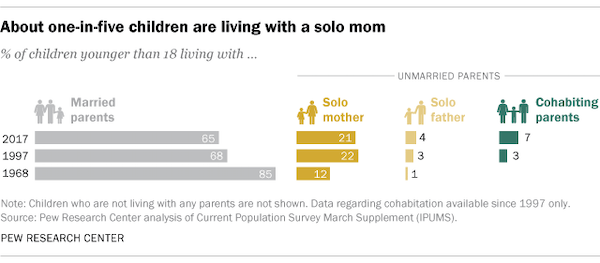
Source: Gretchen Livingston, “About one-third of U.S. children are living with an unmarried parent,” Pew Research Center (April 27, 2018).

This trend is likely to continue, given the decline in marital childbearing among young men and women. Indeed, in each of the National Center for Health Statistics’s Final Birth Data Reports for 2017, 2016, 2015, 2014, and 2013, it found that the non-marital birth rate to women of all races aged twenty-four and under held steady at an astronomical 71 percent for the last five years. Similarly, for each of the last five years, more than 41 percent of women who gave birth were already unmarried mothers at or under the age of twenty-four. And these already unwed, young mothers were giving birth to their second through eighth child.

In raw numbers, this means that in each of the last five years, unmarried young women who had given birth during that time are raising an estimated 1.1 million or more children. And what of the men? In “How Family Background Influences Student Achievement,” researcher Anna Egalite notes that, “In the case of nonmarital births, estimates say that 56 percent of fathers will be living away from their child by his or her third birthday.”

We probably all know stories of heroic, unmarried young parents who have defied the statistics and created a great future for their kids. But like Mercedes, who gave birth serially as an unmarried mother, this vulnerable population of young adult caregivers is much more likely than their less vulnerable peers to be undereducated, poor, and suffer mental health issues that lead to chronic stress and poor academic outcomes in their children.

Indeed, according to the Annie E. Casey Foundation, children of young unwed mothers will be nearly five times as likely to be raised in poverty, as compared to children raised in two-parent homes. And five decades ago, the landmark “Equality of Educational Opportunity” study, better known as the Coleman Report, established the primacy of family background versus in-school factors as far more determinative of student achievement outcomes.

For Mercedes’s children and the millions like them growing up in communities in which non-marital births are the norm, they need to learn the pathways that give them the best chance to break the hamster wheel of family instability and poverty for their own lives.

***

The challenge is that, when it comes to the topic of family structure, many education reformers seem to invoke Reinhold Niebuhr’s Serenity Prayer: “God grant me the serenity to accept the things I cannot change; the courage to change the things I can; and the wisdom to know the difference.”

Educators typically resign themselves to assuming that improving the home environment of their students is in the domain of “things I cannot change.” In the parlance of Teach For America corps members, it is outside of their “locus of control.” But what matters is not what is in the locus of control of educators. What matters is that we teach each student about his or her own individual locus of control, and thus the personal decision-making power they have to control their own destiny.

In fact, there is a sequence of personal life decisions—completing at least a high school degree, working full-time, and marrying before bearing children—that gives low-income students of all races the greatest probability to enter the middle class or beyond. As Wendy Wang and Brad Wilcox found in their recent research, 94 percent of young adults from lower-income families manage to avoid poverty if they followed all three steps of this “Success Sequence.” How can we in good conscience deprive our students of this information about the different pathways into adulthood that have very different rewards and consequences? Shouldn’t we teach them about what they can do to have a better chance at success in life?

Indeed, philanthropists, policymakers, and education reformers would be wise to spur innovation and fund pilots for middle and high schools to teach data associated with the Success Sequence. Schools have the unique responsibility to empower their graduates to develop the personal agency over the forces they do control, and to give them the best shot to withstand the pressures of the forces they don't control, such as life's adversities and the effects of systemic racism, sexism, and poverty.

***

Regardless of the decisions Mercedes may have made in her own life, or those that were forced upon her, parents like her are counting on educators to ensure her children know the series of choices within their power that will likely lead them to realize their human potential.

Each day, Mercedes sends Amaya, Camron, Leslie, and Tiana to their local school, where they seek and deserve an education that will empower them to lead lives vastly different from their mother and respective fathers.

For our own serenity, I pray that we have the courage and the wisdom to know we can make that difference.


view

Civic engagement versus civics education

Chester E. Finn, Jr.
11.28.2018
Flypaper

There’s much about Montgomery County, Maryland, that I appreciate—starting with the fact that it’s been a fine home for me and my family for forty-plus years. There’s also much that I respect about the Montgomery County Public Schools (MCPS) and several of its current initiatives, including greater attention to the education of gifted kids, particularly those from poor and minority backgrounds.

Yet I take strong issue with a new policy that the school board is expected to ratify in early January that, according to the Washington Post, will “allow public high school students to take as many as three excused absences a year to participate in political protests and other forms of ‘civic engagement’ during the school day.”

This, added Post reporter Joe Heim, will make my county’s school system “one of very few in the country that would formally let students take an excused day off to join marches, lead protests, lobby leaders, campaign for candidates, or otherwise partake in civic action.”

Welcome to civics education circa 2019—and welcome to the left’s encouragement of protest in Donald Trump’s America circa 2019. Take my word for the fact that the MCPS school board—like most of the county that elects it—is well to the left, in addition to being well-compensated: $25,000 annually for each member, plus sundry perks.

In the aftermath of the awful Parkland high school shooting, my colleague Robert Pondiscio wrote brilliantly about the understandable impulse of many young people to join in protests against gun violence and in support of various gun-control measures. He acknowledged and praised their wish to engage this issue and join in civil disobedience on behalf of a worthy cause. But then he added this essential qualifier:

Student civic engagement is to be encouraged, even celebrated, but that doesn’t mean it must meet with official approval. Indeed, it is essential that it does not. If students have permission to walk out, it’s no longer student activism at all. It’s a field trip. And that’s part of the teachable moment, too. The message to students should be clear: If this issue is important to you, then it’s worth the consequence. Otherwise, you’re not protesting gun violence, you’re boycotting chemistry class. By its very nature, an act of civil disobedience means the protester refuses to comply with rule, norms, and expectations. Permission, by definition, restores the element of compliance, robbing the protest of any meaning.

What MCPS is on the verge of doing is turning civil disobedience into civic engagement, placing thereon its official stamp of approval, removing all “consequence” from such actions—and getting a bunch of teenagers out of chemistry class. It’s shaving three days off their school year and leaving kids free to define almost anything they wish as civic engagement, including partisan activity. MCPS principals didn’t want to be cast in the role of deciding what is and isn’t acceptable off-campus action, or even to be responsible for determining whether participation would be safe. Nor did sundry organizations want to be bothered with giving permission to students wishing to participate. Now—assuming the revised policy gets approved in January, as expected—all students need do is notify the principal of their plans. (Their parents are also supposed to assent.)

This hands-off stance toward “civic engagement” on the part of the school system is in marked contrast to that same system’s hyper-regulatory handling of “service learning,” seventy-five hours of which is required of all students, beginning after fifth grade. There we find innumerable rules, procedures, mandates, and restrictions, such as, “All service-learning activities must be secular in nature, occur in a public place and be supervised by a nonprofit organization adult representative.”

Not so with civic engagement, the nature of which seems to be entirely up to the kids. Veteran school board member Patricia O’Neill declared—of course—that, “We want students to be prepared to be active citizens” and, in precise contradiction of Pondiscio’s key caution, argued that it’s important they not be penalized for engaging in such actions.

Once this policy goes into effect, apparently fifteen-year-olds will decide for themselves what to protest, what to demand, what to march or testify or scream in support of or opposition to. They can take on actual public policy decisions—such as hearings before the county council, the state legislature, Congress, even the MCPS school board. Or they can jump and yell at people or stores they dislike. (Sneakers and iPhones are far too expensive!) They can picket polling places and moon the cops.

It’s hard to believe it will all be serious, as these three days off might be termed “engagement” but actually morph into other things that teenagers like to do, especially when unsupervised. If the Redskins win the Super Bowl, one imagines that half the MCPS high-school enrollment will take the day off to attend the team’s victory parade, which would, after all, be a grand, unifying civic event. (They may have to claim, however, that they cut school to protest the team’s politically incorrect nickname.) Some of their engagement choices may prove risky or unsafe, as may their means of getting to and fro. And in some they will surely be exploited by others. But all will be done with impunity—and immunity—as the school system will have given carte blanche and then averted its gaze.

Meanwhile, young Marylanders are faring none too well when it comes to civic education. State policy requires that high school students take a course in American government—and also take a state-developed test in that subject. That “end of course” exam is getting revised, but when the old version was administered from 2003 through 2013, passing rates (for all test-takers in the state) ranged from 40 to 74 percent. That means a great many kids are emerging from high school in the Old Line State with very weak understanding of how government actually works.

It’s hard to believe that letting them cut high school for three days a year to do whatever they like—or whatever someone inveigles them into doing—in the name of civic engagement is going to improve their understanding of civics.

One must also weigh the possibility that adults with agendas of their own will coopt some—or perhaps a great deal—of this free adolescent labor for purposes and causes selected by the adults. Kids may innocently be drawn into projects they have little or no capacity to evaluate—but “it sounds like a fun way to spend Thursday”—and into some that may be at odds with their parents’ values. This, too, is certain eventually to lead to trouble, the more so if participation causes kids to get into trouble. (Picture them cutting school to join an Antifa riot.) Don’t be surprised if more policy changes await. In the meantime, expect goodly numbers of MCPS high schoolers—the giant district contains 45,000 of them!—to enlist, or be enlisted, in innumerable causes. Some, surely, will be left-tilting “resistance” work and political campaigns. But not all. A worried mother of Montgomery County teenagers says she’s “more concerned that these kids will be rallying around kooky ideas, fringe movements, conspiracies, etc.—just random things that they hear about and don't know much about but that sound like fun and maybe offer free food.”

The more one considers such possibilities, the better chemistry class sounds—at least to me.

view

Poor curriculums are disastrous, but schools can help teachers avoid them

11.28.2018
Flypaper

Lately, I’ve seen a meme that keeps popping up on social media: “Telling a teacher to use a boxed curriculum is like forcing a chef to cook hamburger helper.”

I was tempted to like it at first; it seems catchy and does hint at an issue that teachers face regularly: maintaining autonomy and creativity, while using materials that are aligned to academic standards and include challenging activities and content for students. But the meme boils down (pun intended) an important topic—aligned instruction and teachers’ access to high-quality materials—into an “either, or” situation. But, of course, it’s actually more complicated than that.

Indeed, the material we teachers use, and the way we deliver it inside classroom walls, is critically important to our students learning, and the use of low-quality, uninspired materials is, well, a recipe for disaster.

The RAND Corporation recently published a report titled “Changes in What Teachers Know and Do in the Common Core Era.” Using responses from their annual American Teacher Panel survey, they looked at changes in teacher instruction and materials from 2015–17 to find out whether the materials teachers are using in the classroom are aligned to higher standards.

Some of the highlights may seem surprising, and include:

  • Teachers are finding and using more standards-aligned, content-focused materials from online sources.
  • Teacherspayteachers.com and Pinterest are the top two sites “drawn upon regularly” by both math and English language arts teachers for “instructional resources.”
  • Teachers are not using many published textbooks aligned to the newer standards.

This made me reflect on the materials I use, and I began to wonder just how many teachers really felt the need to seek out their own materials. All teachers receive a curriculum, but how many of them actually find the materials that accompany it to be aligned, high-quality and useful?

Curious, I reached out to Educators for High Standards’ network of teachers. In addition to Pinterest and Teacherspayteachers.com, they shared that they regularly use resources from Student Achievement Partners on the AchievetheCore.org site, which I was glad to see because they have a huge library of aligned resources and plans. Teachers also mentioned other online resources, such as Newsela, PBS, NASA, and Readworks.

The message was loud and clear: Just like the teachers in the RAND study, our network of teachers rely more on external sources than their current textbooks and materials. Only 56 percent of our teachers think the materials they are provided definitely or somewhat include engaging materials and plans for students. And only 44 percent of them state that a majority of their lessons are developed with aligned resources from the district.

Teachers in our network are experiencing the same trends from the RAND report, and yet, at the same time, they expressed how crucial aligned resources are in the instructional process:

Aligned curriculum ensures that there are no continuity gaps, that coherence occurs across grade levels…It also helps reduce the amount of time teachers need to spend researching and creating aligned resources.

One teacher shared that, before her district purchased an aligned math series, she and her colleagues “had to find our own, or create our own, math resources. This was a tremendous undertaking and required hours and hours of research.”

When teachers are given access to adequate training and aligned resources and curriculum, they are more supported and better equipped to deliver high-quality aligned instruction. They’re able to focus on measuring and reflecting on student performance and building relationships. But, unfortunately, it seems that all too often, teachers are spending time seeking out standards-aligned resources and materials, which is discouraging.

The RAND report shows us that teachers are looking for online resources, which means the materials being adopted in many districts may not be up to par. While RAND’s report indicates that these materials teachers are seeking out are more aligned than in past years, results of this search for materials can often be detrimental to how standards are being implemented and the instruction itself.

But I do have hope. Districts no longer have to buy “hamburger helper” curriculum. There are tools and resources they can use to purchase top-shelf “ingredients” for teachers to work with. Edreports.org is an example. This resource provides free reviews of instructional materials to districts, so they can ensure the textbooks and curriculum they are adopting are high quality, aligned, and what teachers are looking for.

Teachers will and should always bring their own ideas, creativity, and lessons into their classrooms. But when districts are lacking the foundational aligned materials teachers need, we begin to look to other resources, which may or may not be truly aligned.

If we want high standards to be implemented faithfully and to ensure students are given the best opportunity to succeed, states and districts need to make sure teachers are given every support possible. Teachers deserve a “buffet” of high-quality materials to choose from so that we aren’t burdened with hunting and foraging for aligned materials on top of everything else we already do.

Only when districts and schools are truly focused on carefully reviewing and selecting high quality, aligned materials will teachers be able to focus on the art of teaching.

Kari Patrick teaches high school English at STEAM Academy in Lexington, Kentucky. She also serves as Senior Advisor of Teacher Outreach for the Collaborative for Student Success.

Editor’s note: This article was first published by Education Post.

view

Improving student motivation and engagement

Robert Pondiscio
11.28.2018
Flypaper

There’s a terrific story about the late Frank McCourt, who became famous as the author of Angela’s Ashes and other books, but who was Mr. McCourt the English teacher to a generation of students at Stuyvesant High and other New York City schools. One day a student asked what possible use a particular work of literature he assigned would have in his life. “You will read it for the same reason your parents waste their money on your piano lessons,” McCourt replied. “So you won’t be a boring little shite the rest of your life.”

Of course, merely suggesting that a student might become a boring little shite would be enough today to get a teacher Twitter shamed by sundown and fired the next day. But McCourt’s barb was well-aimed: The point of a good education is to expose children to the best of what has been learned, spoken, or thought over the past ten thousand years of human civilization. It’s their intellectual paycheck. Enjoy it and spend some today. Invest the rest where it can mature and pay dividends forever. Not everything should or will be immediately or obviously useful or relevant.

So with the caveat that a rich and complete education must include introductions to unfamiliar and challenging ideas, people, and events, we recommend this new report from our friends at the Education Trust, Motivation and Engagement in Student Assignments: The Role of Choice and Relevancy by Joan Dabrowski and Tanji Reed Marshall. It follows up on previous Ed Trust analyses of over 6,800 middle school assignments, which “yielded disappointing results” in terms of student motivation and engagement. As you likely know, Ed Trust advocates fiercely and effectively on behalf of students of color and low-income children. For those students to achieve at high levels, the authors say, “they must be interested and emotionally invested in their learning.” However, only 10 percent of the 6800 assignments reviewed by Ed Trust in English language arts, science, and social studies “offered students authentic choices in content, process, or product.” In math, only 3 percent hit the mark. The authors determined “relevance” by focusing on three questions (channeling McCourt’s student long ago): Is the content useful? Does it interest us? Is it presented by someone we know and trust? By these somewhat vague criteria, only 12 percent of ELA, science and social studies assignments were deemed “relevant”; just 2 percent in math.

“Students should be given choice in their learning and tasks should be relevant, using real-world experiences and examples for students to make connections with their goals, interests, and values,” Dabrowski and Marshall insist. Providing choice within an assignment “promotes the healthy development of student autonomy,” they add. “Affording students opportunities in which they are ‘in charge of their lives’ is central to their academic achievement and emotional adjustment. When students make decisions about their work they are empowered to own it. Moreover, their ownership of a task leads to self-direction and self-discipline because they are personally invested in the outcomes.”

Well, sure. Choice and relevancy are two arrows in the teacher’s quiver to engage and push children to academic heights. But there are lots of others. Interest and engagement may result in rigor, but it can also be a way of encouraging students merely to fall back on the familiar. As Dan Willingham reminds us in Why Don’t Students Like School, the mind is not designed for thinking, but for avoiding it. “Unless the cognitive conditions are right, we will avoid thinking,” he wrote. Those cognitive conditions might be enhanced by “choice and relevancy,” but it might also involve presenting material in a way that sparks student interest in the form of a narrative or a puzzle to be solved that is in students’ cognitive sweet spot. Moreover, you can’t be interested or engaged by what you’ve never heard of. In sum, there are lots of ways to push students to “thrive and achieve at high levels.” Not every assignment must include student choice or relevancy; assignments that don’t aren’t necessarily lacking. (It’s worth knowing, by the way, that the book McCourt assigned to his mostly white students in the anecdote above, which prompted his student’s impertinent question, was Things Fall Apart by the Nigerian novelist Chinua Achebe.)

To their great credit, the authors anticipate many of these criticisms, taking pains to include three important caveats about “relevancy” and cautioning that teachers “must (1) be cautious about gimmicks and artificial techniques with unproven results, (2) be thoughtful about the content of the assignment, and (3) recognize the important role of knowledge acquisition.” Hear, hear. Especially the third point.

In sum, none of what Dabrowski and Marshall offer is bad advice. Quite the opposite. Choice and relevance can be powerful motivators, but not to the exclusion of all other teaching strategies. There’s not a lot of upside in being the martinet who insists kids eat their peas. But every good idea becomes a bad one the moment it hardens into orthodoxy. Care must be taken not to follow their good advice off a cliff, narrowing students’ intellectual horizons and making incorrect, well-intended, but essentialist assumptions about what they might find relevant or irrelevant, or giving them a choice about whether or not they want to read Hamlet, for example, or debate the political theories of Locke and Hobbes.

We don’t want students to be boring little shites for the rest of their lives.

SOURCE: “Motivation and Engagement in Student Assignments: The Role of Choice and Relevancy,” The Education Trust (November 2018).

view

Proposed solutions for revitalizing working-class communities

Sophie Sussman
11.28.2018
Flypaper

Out of the 2016 presidential election emerged a struggling and forgotten group eager to voice their needs: working-class Americans. In response to this outcry, Opportunity America, a D.C. think tank focused on economic mobility, united a bipartisan group, cosponsored by the American Enterprise Institute and the Brookings Institution, to agree on a set of recommendations to revitalize the working-class.

Over one year, the group conducted four studies and site visits in three locations (Ohio River Valley, Louisville metro area, and southern Indiana) to determine the demographics, educational attainment, household characteristics, and reliance on government programs of the working class. The researchers identified almost sixteen million households containing such adults—individuals between twenty-five and sixty-four years old with at least a high school diploma, but less than a four-year college degree, and a household income between the national twentieth and fiftieth percentile. At the end of their research, the group negotiated which recommendations would best ameliorate some of the negative impacts affecting the working class’s income, employment, education, and family composition. The recommendations are budget neutral and designed to “do no harm” to America’s debt.

The working group concluded that career education offers a substantial opportunity for revitalizing these blue-collar communities. The changing workplace requires education beyond high school—whether it’s further schooling or some form of career training. Employers, for example, are struggling to fill positions that require qualified “middle-skill” workers, and these jobs currently comprise 35 percent of the labor market. Yet 54 percent of today’s working-class have no more than a high school diploma. Therefore, rigorous career and technical education (CTE) programs in secondary schools that give student real workplace experience can make a difference. Such programs should establish “career pathways” that combine relevant experience in high school with the opportunity to obtain or work toward the completion of industry credentials or postsecondary programs. And state and local governments should incentivize employers and community colleges to participate.

The working group also recommends that the federal government reserve more of its education spending for filling the current demand for middle-skill workers. In 2016, only 14 percent of federal education expenditures went toward that end, with significantly more spent on post-secondary initiatives, such as the Pell Grant Program. To help shift the balance, researchers suggest, among other things, eliminating 529 plans and capping graduate student loans and the American opportunity tax credit for undergraduates.

In the end, the report is a call for action, and its recommendations a mere starting point. It’s further proof that our approach to high school is broken, and that we’re sending far too many unprepared students to college, while doing very little to train young people for the jobs and careers that are available. Year after year, these positions sit unfilled, causing millions of Americans to suffer the consequences of under-employment and joblessness.

SOURCE: “Work, skills, community: Restoring opportunity for the working class,” Opportunity America (November 2018).

view

The Education Gadfly Show: How to separate the wheat from the chaff on technical credentials

11.28.2018
Podcast

On this week’s podcast, Mary Alice McCarthy, a director of the Center on Education and Skills at New America, joins Mike Petrilli and David Griffith to discuss how leading states like Florida are vetting thousands of technical credentials to identify the ones worth pursuing. On the Research Minute, Amber Northern examines the relationship across the globe between testing policies and student achievement.

Amber’s Research Minute

Annika B. Bergbauer et al., “Testing,” National Bureau of Economic Research (July 2018).

Fordham Logo

© 2026 The Thomas B. Fordham Institute
Privacy Policy
Usage Agreement

National

P.O. Box 110
Burke, VA 22009

202.223.5452

[email protected]

Ohio

P.O. Box 82291
Columbus, OH 43202

614.223.1580

[email protected]

Sponsorship

130 West Second Street, Suite 410
Dayton, Ohio 45402

937.227.3368

[email protected]