Mobile Navigation

  • National
    • Policy
      • High Expectations
      • Quality Choices
      • Personalized Pathways
    • Research
    • Commentary
      • Gadfly Newsletter
      • Flypaper Blog
    • Events
    • Scholars Program
  • Ohio
    • Policy
      • Priorities
      • Media & Testimony
    • Research
    • Commentary
      • Ohio Education Gadfly Biweekly
      • Ohio Gadfly Daily
  • Charter Authorizing
    • Application
    • Sponsored Schools
    • Resources
  • About
    • Mission
    • Board
    • Staff
    • Career
Home
Home
Advancing Educational Excellence

Main Navigation

  • National
  • Ohio
  • Charter Authorizing
  • About

National Menu

  • Topics
    • Accountability & Testing
    • Advanced Education
    • Career & Technical Education
    • Charter Schools
    • Curriculum & Instruction
    • ESSA
    • Evidence-Based Learning
    • Facilities
    • Governance
    • Personalized Learning
    • Private School Choice
    • School Finance
    • Standards
    • Teachers & School Leaders
    • Think Again
  • Research
  • Commentary
    • Gadfly Newsletter
    • Flypaper Blog
    • Gadfly Podcast
  • Events
  • Scholars Program

The Education Gadfly Weekly

Sign Up to Receive Fordham Updates

We'll send you quality research, commentary, analysis, and news on the education issues you care about.
Thank you for signing up!
Please check your email to confirm the subscription.

The Education Gadfly Weekly: Can New York make “portrait of a graduate” mean something?

Volume 26, Number 34
8.27.2026
8.27.2026

The Education Gadfly Weekly: Can New York make “portrait of a graduate” mean something?

Volume 26, Number 34
view
Portrait of a Graduate
High Expectations

New York’s portrait of a graduate is a disaster in the making. Here’s how to minimize the damage.

New York State is replacing its Regents high school exit exams with a yet-to-be-defined “portrait of a graduate” framework. It’s a terrible decision, as it exchanges clear academic standards for mush.

Meredith Coffey, Ph.D. 8.27.2026
NationalFlypaper

New York’s portrait of a graduate is a disaster in the making. Here’s how to minimize the damage.

Meredith Coffey, Ph.D.
8.27.2026
Flypaper

The loophole quietly undoing America's third-grade reading laws

Harry Anthony Patrinos
8.27.2026
Flypaper

Students should only use AI for things they already know how to do well

Daniel Willingham
8.27.2026
Flypaper

Digging into the findings of The American Teenagers Survey

Jeff Murray
8.25.2026
Ohio Gadfly Daily

The supply side of school choice: Who participates? Who doesn’t?

Mike McShane
8.27.2026
Flypaper

Head Start needs reforming, not dismantling | Episode 1032 of The Education Gadfly Show

8.26.2026
Podcast
view
Child upset while reading

The loophole quietly undoing America's third-grade reading laws

Harry Anthony Patrinos 8.27.2026
Flypaper
view
Students writing with pencil and paper

Students should only use AI for things they already know how to do well

Daniel Willingham 8.27.2026
Flypaper
view
Teen survey data SR image

Digging into the findings of The American Teenagers Survey

Jeff Murray 8.25.2026
Ohio Gadfly Daily
view
Students walking to school

The supply side of school choice: Who participates? Who doesn’t?

Mike McShane 8.27.2026
Flypaper
view

Head Start needs reforming, not dismantling | Episode 1032 of The Education Gadfly Show

Chester E. Finn, Jr., Michael J. Petrilli, David Griffith, Ph.D., Amber M. Northern, Ph.D. 8.26.2026
Podcast
view
Portrait of a Graduate

New York’s portrait of a graduate is a disaster in the making. Here’s how to minimize the damage.

Meredith Coffey, Ph.D.
8.27.2026
Flypaper

We’re approaching the end of an era: New York State is scrapping its storied high school Regents exams as a graduation requirement. Initially administered in the 19th century, the Regents were the first standardized state assessments of their kind. And since the early 2000s, students have had to pass five Regents in four subject areas to graduate with the standard “Regents diploma.”

Under the new plan, however, students will take Regents only for federal compliance purposes; passing won’t be required to graduate. Instead, as part of a new framework called the New York State Portrait of a Graduate, a high school diploma will be based upon students’ demonstration of six vaguely appealing “interconnected attributes”: academically prepared, creative innovator, critical thinker, effective communicator, global citizen, and reflective and future focused.

The specifics of the new graduation requirements are still in the works, but so far, official documents indicate that students will “establish their readiness” through “exhibits of evidence,” apparently the state’s hazy umbrella term for tasks including “performances, portfolios, assessments, [and] presentations.” Also, “real-world projects” and “work-based learning” may be involved. Individual teachers will design, administer, and score their students’ “exhibits of evidence” according to a statewide rubric with mastery levels, rather than letter or number grades. I’m really leaning on quotes here because, frankly, most of the guidance is too nebulous to paraphrase.

Though some other states are similarly deemphasizing traditional state testing and developing “portraits” and “visions,” New York is an outlier in its aggressive effort to overhaul its entire assessment system—and to effectively give up on clear academic expectations. As terrible as that is, it’s also more than a little troubling that the Empire State has committed to dismantling the Regents requirements without a clear sense of what will replace them.

As an English language arts (ELA) teacher in New York City in the 2010s, I certainly saw room for improvement on the ELA exam. (I’m looking at you, Part 3, with your overemphasis on “identifying the central idea.”) More broadly, I heard valid concerns around teaching to the test, inadequate support for low-performing students, and the exams’ relevance to labor market demands.

But I also saw real value in the Regents. The graduation requirement set a reasonably high bar for all students throughout the state. And while opponents contended that the exams created an inequitable barrier to graduation, EdTrust and others have rightly argued that such an argument amounts to shooting the messenger, given that the tests simply revealed schools that were failing to educate already disadvantaged students.

In fact, I taught many such students at one of New York City’s “transfer” schools, serving 16- to 21-year-olds who had left traditional high school settings. For our student population, Regents exams were indeed a substantial hurdle—one that gave us a high bar to work toward. Finishing school couldn’t just be a box-checking exercise; rather, my students knew that they had to pass the same exams as the kids at Stuyvesant. This non-negotiable standard communicated that they were still being taken seriously. That’s a powerful message for students who’ve been written off before.

Yet, it wasn’t a one-size-fits-all system. In limited circumstances, if a student with disabilities made a genuine attempt but absolutely could not pass a Regents exam, there existed a “local” diploma alternative. Conversely, students who wanted to go above and beyond could take four additional exams to earn an “advanced” Regents diploma.

Alas, Regents diplomas are now headed for the sunset. As for what’s next, current New York educators have noted that the incoming “portrait of a graduate” framework could prove either transformative or “one of the most well-intentioned failures in recent education policy,” and there’s good reason to fear it’s careening toward the latter.

Similarly flexible statewide systems have flopped before. Kentucky and Vermont both tried portfolio-based assessment in the ’90s. External reviews found administrative burdens, drains on instructional time, rampant cheating, uneven rigor, and scoring that managed to be both inconsistent and inflated. In Vermont, scoring reliability was so poor that a grader had a better chance of correctly predicting the outcome of a coin toss than agreeing with a colleague’s score. Both programs were largely abandoned by the early aughts.

Given that New York’s current plan is even fuzzier than what Kentucky and Vermont attempted, its prospects look pretty awful. The portrait-of-a-graduate bell won’t be unrung, but with three years left to go before full implementation, there’s opportunity to mitigate the risks. Here are three of the likeliest pitfalls, and what New York can do about them.

First, the portrait-of-a-graduate approach creates substantial challenges around transparency and buy-in from families. Most parents could readily understand what it meant for a kid to earn a 75 on the Algebra I Regents. But the same can’t be said for a “proficient” rating for “global citizen.”

New York needs to develop a robust and realistic family engagement plan (including support for educators, who will simultaneously be expected to learn the ropes and explain it all to students and families). Where did the number grade go? What’s an interconnected attribute? Why should families care about abstract concepts like “reflective and future focused”? And, even if they’ve been persuaded, how can they support students who need extra help? If a student isn’t cutting it as a “creative innovator,” families aren’t going to intuit the most effective interventions.

The burden of adapting to this new system will be even greater for families already facing disadvantages, such as immigrant families navigating language barriers and unfamiliar institutions. New York must take that seriously.

Second, the portrait-of-a-graduate rollout and implementation are going to pose significant logistical difficulties. Plans are taking shape to have educators participate in a handful of virtual and regional in-person training sessions. But that’s barely more than the usual back-to-school PD. With the new framework, teachers will have to internalize a radically revised assessment system and rubrics. They will have to rewrite entire courses and design tasks aligned to the new state guidance. Performance-based assessments can take many hours to execute. Administrators will have to ensure that the six interconnected attributes build on one another across subjects and grade levels. They’ll have to develop new infrastructure for tracking students’ evidence of learning. And that’s all while maintaining the normal instructional load amidst staffing shortages and chronically low morale.

Maybe these “growing pains” will be worth it in the long run, but New York can’t afford to underestimate them. The state should provide exemplar “exhibits of evidence,” along with the lessons and materials required to get students there, so that teachers aren’t forced to start from scratch. New York also ought to establish protected, compensated planning time dedicated specifically to portrait work, rather than compelling teachers to be stretched even thinner during their existing prep periods. And a state-funded, standardized digital platform would ease the administrative burden around creating and maintaining portrait-of-a-graduate student records. Plus, when students move, everyone will benefit if their evidence moves seamlessly with them—not across disparate systems cobbled together by different districts.

The most serious challenge emerging from the new framework, however, will be maintaining rigorous, consistent baseline expectations for all students. Research shows that higher expectations translate into more student learning. But when “exhibits of evidence” are to be designed, administered, and scored by the students’ own teachers, there’s little incentive to hold students to high expectations. In fact, incentives point in the opposite direction: Teachers typically want their students to graduate, and they want themselves and their schools to earn good ratings.

The official language around the portrait-of-a-graduate framework already implicitly encourages “leveled” assessments, celebrating the flexibility to adapt to “local context, community priorities, and district readiness” (emphasis mine). But such flexibility invites lowered expectations and poses tremendous equity risks. First, disadvantaged students are already more likely to receive assignments that aren’t challenging enough. What’s more, if New York lacks a consistent measure of student performance, then there is no way for the state to know which students are being underserved. Rather than revealing where students need more resources, an inconsistent assessment system will conceal those needs. In a state with huge disparities in district size, capacity, and prosperity, this is a systemic disservice.

The current guidance describes a plan for calibration, such that teachers across schools will be trained to score “exhibits of evidence” comparably. Despite the common rubric, I’m skeptical that it’s possible to ensure comparable scoring of entirely different tasks, but even in the best-case scenario, calibration isn’t enough to combat the powerful, systemic incentives to pass one’s own students.

When possible, “exhibits of evidence” should be scored blindly or by external graders to maximize objectivity. New York should also consider developing a handful of statewide anchor tasks; schools could be required to choose a small number of tasks from a limited menu, which would boost consistency while allowing flexibility for the remaining “exhibits.” These tasks could still include end-of-course exams; Massachusetts, for example, has proposed a “portrait of a learner” model that still includes end-of-course testing, with equity as a stated rationale. And accountability matters: Both the “exhibits” and the scoring should be subject to auditing, and data should be publicly reported.

New York is set on its highly questionable course. But realizing the promise of the new portrait-of-a-graduate framework—that every student will be prepared for what comes next—will depend on whether the state builds a system that’s consistent and rigorous, or settles for one that clings to abstract ideals. There’s still time to shape the plan so that New York doesn’t become another cautionary tale.

view
Child upset while reading

The loophole quietly undoing America's third-grade reading laws

Harry Anthony Patrinos
8.27.2026
Flypaper

More than a dozen states now require that third graders who can’t read at grade level repeat the grade rather than advance to fourth, where every subject assumes literacy. The theory is sound. But in state after state, exemptions meant for a narrow set of students are being granted so widely that the policies aren’t benefiting the students they were designed for.  

Arkansas, the state I know best, is the latest to confront this problem. I wrote earlier this year that its version of a retention law—called the LEARNS Act and modeled in part on Mississippi’s approach—would only succeed if exemptions are paired with mandatory support. This year was the first in which Arkansas enforced the legislation, and third-grade reading proficiency climbed from 35 percent in 2024 to 43 percent, according to recent data. But exemptions were granted at alarming rates in some places. In North Little Rock, for example, more than half of students who failed the reading standard were exempted and promoted. In Pulaski County Special School District, the same was true of roughly half of the roughly 200 students scoring at the lowest performance level. A provision meant for a narrow set of circumstances is being applied well beyond it.

Or take Ohio, whose “Third Grade Reading Guarantee” had worked well. Retained students made significant gains compared to peers who narrowly avoided retention. But lawmakers functionally repealed the law in 2023, because of political pressure. Now, the state has a massive loophole that permits struggling students to advance based on a parent request.

Something similar happened in Tennessee and Michigan. In the first year Tennessee’s retention law took effect, 60 percent of third graders fell short in reading, but only 1.2 percent were actually retained. In Michigan, exemptions were granted to students based on parental request or an existing individualized education program (IEP), and as a result, fewer than seven in 100 eligible students were held back. So like Ohio, Michigan simply removed the requirement instead of narrowing the loopholes.

The problem with all of this backtracking is that research on retention generally shows that it works. The foundational study of Florida’s policy found that students who were held back made substantial gains in reading proficiency compared to promoted peers, and that the gap widened in the second year. A follow-up study found that exemptions were a strong predictor of which low-scoring students moved on to fourth grade without those proficiency gains. And a later analysis that tracked retained students through tenth grade found that retained students took fewer remedial courses and had higher GPAs, compared to peers in the same grade. Two decades of research point in the same direction: Retention plus remediation improves academic outcomes, and exemptions prevent those gains.

Considering the state of American education, states should reverse this trend and restore the strength of their retention policies. Arkansas’s fourth-grade NAEP scores hit a 21-year low in 2024, for example, and the national trend isn’t much better. Third grade is when children stop learning to read and start reading to learn. A 2012 analysis of nearly 4,000 children found that 16 percent of students who aren’t reading proficiently by third grade fail to graduate high school on time. For proficient readers, it’s just 4 percent. And the gap widens for children living in poverty.

This is not an argument against exemptions themselves. Students who, for example, have significant disabilities or limited time in English instruction need a different bar. But as Arkansas’s education secretary, Jacob Oliva, said in September 2025: Low-scoring students who advance to fourth grade without real intervention will keep struggling regardless of the paperwork.

The fix is the same everywhere: Strengthen the rules. Most importantly, permit only good-cause exemptions. Second, require that those exemptions be paired with proven, documented, monitored supports. Arkansas, for example, already funds individualized reading plans, high-impact tutoring, literacy coaches, and a $1,500 family tutoring grant. Make these a condition of promotion for exempted students.

Mississippi requires this of every exempted student, and it is a large part of why Mississippi’s version of the reform has held up where others haven’t. Other states with retention policies should follow suit before exemptions leave their neediest students without the support these laws were designed to provide.

view
Students writing with pencil and paper

Students should only use AI for things they already know how to do well

Daniel Willingham
8.27.2026
Flypaper

Most educators agree that there should be some guardrails regarding how students use AI in their independent work. Here, I argue for this guiding principle: Students should only use AI for things that they already know how to do well.

A story is told about Harold Alexander, British field marshal in command of the evacuation at Dunkirk. At the end of the workday he had the habit of taking any correspondence still in his “in” tray and simply putting it in the “out” tray. When his assistant once asked about it, he said, “You’d be surprised how little of it comes back.”

That sums up my approach to the winds of educational change. When a new technology appears and people are asking themselves “what about my teaching should change?” my instinct for my own teaching is “change nothing,” partly because I suspect that the excitement is overblown, and partly because I’m happy to let more venturesome people make a change first, and learn from their experiences.

But that strategy can’t be applied in the case of AI. In 2023 I, like every other educator, realized that I had to respond to student access to large language models.

Administrators have had a few years to think through how teachers should change classroom practice to meet the new reality, and many districts have posted guidelines. The policies I have seen have much in common, and I think they are wrongheaded.

(Throughout this post I’m referring to students’ independent use of AI, not to educational software nor to teachers using AI in their work.)

There seems to be widespread agreement that there’s a problem, and even on how to characterize it. Learning is a product of engaging in mental work, and students may use AI to replace that mental work and hence, not to learn. The question is what to do about it.

Almost no one advocates for “no restrictions on independent AI use” nor for “No independent AI use by students. Period.” The overwhelming majority have taken the position that students should use AI, but there should be limits.

Mashable recently ran an article summarizing the response of the U.S.’s largest school districts. Here are the one-sentence versions, as I read them:

New York City: Students are allowed to use AI for basic “research, exploration, and creative projects.” There must be educator oversight. Los Angeles: No AI use under age 13. Over 13, students can use AI to brainstorm and to edit their text, but students must produce text. Students must cite what AI contributed. Chicago: Students can use AI for tasks like brainstorming and summarizing. They are encouraged to use AI as a study partner.

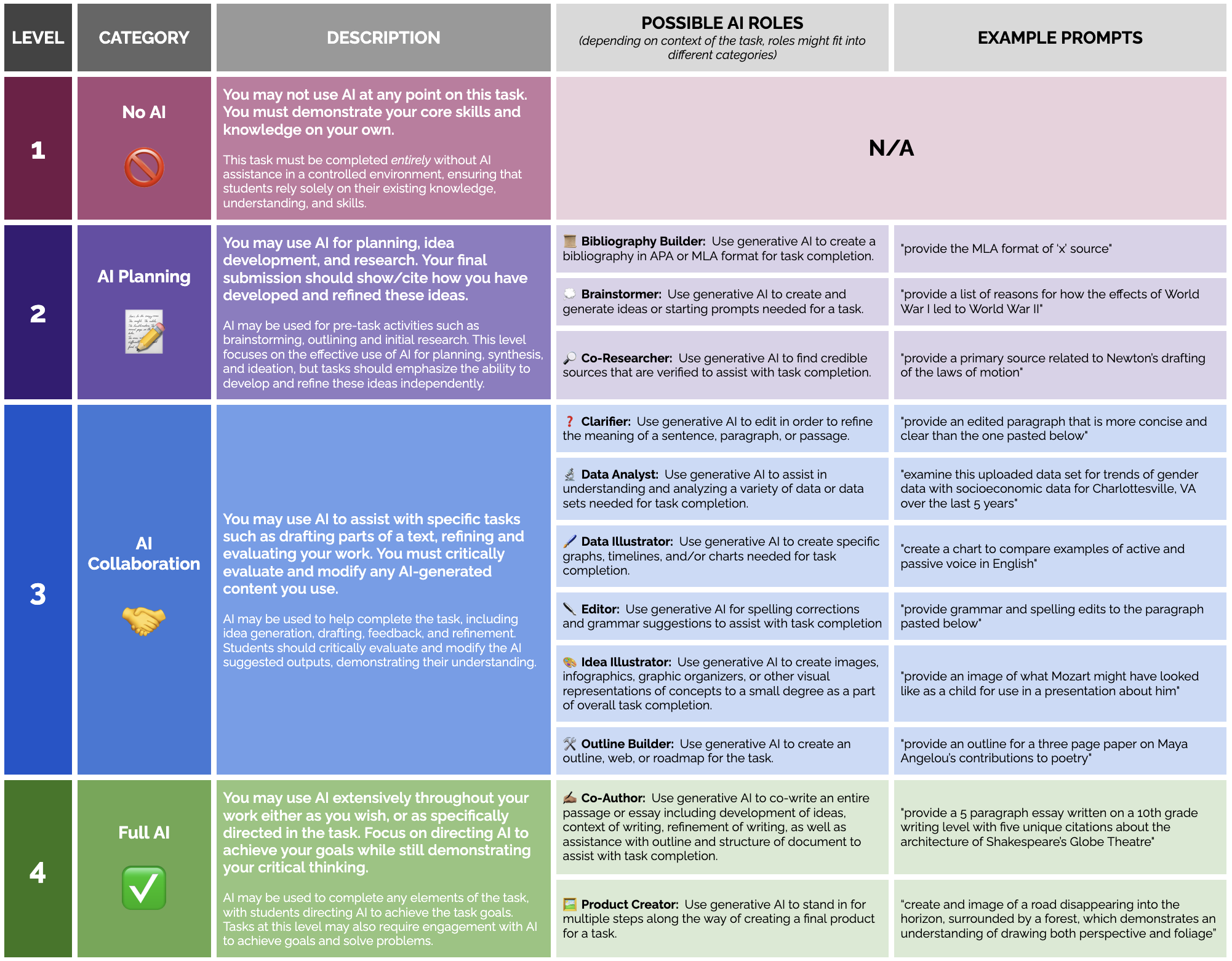
The policy of my home county (Albemarle, Virginia) is similar. There are published categories of AI support from which teachers may choose.

1

In short, teachers are given a good amount of leeway to allow students to use AI or to forbid it. There is, however, little or no guidance about how that choice should best be made.

These policies share a vibe. The goal is that students use AI as an associate in their work, but the student is still very much the lead. The second goal is that students be honest about exactly what AI has contributed.

This lead/associate orientation makes sense for life after graduation. Once a student is in the workforce, they will use AI to produce products: new ideas, reports, and so on. A guiding principle of “Use AI, but let me see your work” makes sense.

This is not, however, an optimal guiding principle for students. Students produce products, but the product is seldom the point. No one wants to read the papers they write, and the math problems they solve have no practical value. Teachers have them do these tasks because they provide practice in cognitive abilities that we think matter.

Writing is an especially interesting example. Writing a substantial paper requires integrating what you know across multiple sources, formulating a detailed argument, articulating your thoughts precisely, anticipating what your reader knows and can understand, and more.

For many educators, writing papers was the only tool we had to ensure that students engage these cognitive processes. AI took that tool from us, and we don’t know of a good replacement.

This loss was unprecedented. The closest analog might be math problems and calculators or Google Translate for foreign language. But in those cases a teacher could still remind students that they would not have these tools available during in-class assessments. I can’t give my students an in-class assessment that is cognitively comparable to writing a ten-page paper.

So the point of assignments is the mental processes required to complete them, and the point of the mental processes is learning. That seems to suggest a simple litmus test for the use of AI. Artificial intelligence tools should not substitute for tasks wherein students would benefit from doing the mental work themselves.

So…do students learn when they brainstorm? Do they learn when they edit their work? Of course they do. This principle indicates that students should use AI only when doing the work themselves would yield little learning. This guideline echoes how most of us think about calculator use. Once you’ve mastered arithmetic operations, there’s no benefit to hand calculations when you’re solving an algebra problem. But if you’re still learning algebra, don’t use the algebraic functions. The slogan might be:

“Only use AI for what you already know how to do.”

I can see two objections.

First, can’t AI scaffold learning? Part of the learning process is doing things badly. Can’t AI offer pointers for improvement?

I see two problems with this idea. The first is that the novice is not going to be a very good partner to AI in learning. The novice doesn’t know enough to ask good questions. He will give the AI system a vague prompt about the goal of the exercise whereupon AI will sharpen it for the user. Essentially, it will chivvy the user toward the polished product, and the novice will simply accept the suggestions. (Remember, I’m talking about independent use of LLMs, not about a product custom-made to provide instruction. That’s a different matter.)

The second problem I see with AI-as-scaffold is motivational. Sure, students could learn from AI by asking it to critique their work, to generate counterarguments, and so on. And I’m sure some would, some of the time. But I think it’s asking a lot of students—or better, asking a lot of human nature—to expect them to take a much harder mental path for a project in a typical curriculum, even if it is in the interest of their own learning.

A second objection to the principle might be this: even after you reach competence, you still need practice; that will deepen and refine the skill and/or knowledge. For example, if a ninth-grader can write a good paragraph, is it now okay for AI to write paragraphs for the student?

If students are competent, a teacher should ask whether doing the task themselves is still part of what students are meant to learn or practice. When students are writing, editing, reasoning, problem solving, or brainstorming (for example), the mental process is usually the thing. You don’t want the help of AI because it replaces the mental work that contributes to learning.

The alternative is that AI is replacing a task that merely supports the actual mental work you want the student to do; the replaced task was soaking up the students’ time and energy and providing no benefit. That would be the college student hand-calculating long multiplication problems required for her engineering problem set.

For this reason I add the word “well” to the candidate principle: “Students should only use AI for things that they already know how to do well.”

Now of course there’s a judgment to be made here. A physics teacher might think “It’s great that AI will polish my students’ writing for their lab reports” whereas someone else might argue “your students need to learn to write in your class too.” But of course this problem is not new. We’re just seeing the issue in a new guise.

We’ve all heard “They’re going to have to learn to use AI.” But I think that slogan applies to how students will use AI at home and in the workforce, where the product is the thing. For students, learning is the thing. That’s how I come to the principle, “Students should only use AI for things that they already know how to do well.”

Editor’s note: This was first published on the author’s Substack.

view
Teen survey data SR image

Digging into the findings of The American Teenagers Survey

Jeff Murray
8.25.2026
Ohio Gadfly Daily

How are today’s teenagers different from previous generations? Daniel Cox, a senior fellow at AEI and director of their Survey Center on American Life, dug into some new data to find out. The American Teenagers Survey project raises the specter of today’s young people eschewing traditional teen experiences—like eating regular family meals, reading for pleasure, and spending time with friends—in favor of whiling away hours a day on social media, playing video games, and trying to figure out the future.

Survey responses come from NORC at the University of Chicago’s AmeriSpeak, a probability-based panel designed to be representative of the U.S. household population, including all 50 states and the District of Columbia. Teenagers (13–17) were recruited to AmeriSpeak via parents/guardians who were already part of the panel. Cox’s sample consisted of 782 teens who completed the entire survey—self-administered online—in January and February of 2026. Three stages of weighting were conducted to align the final survey sample to specific population benchmarks drawn from the U.S. Census Bureau’s Current Population Survey as of March 2025.

Let’s start with a few data points on those traditional teen experiences. Only 37 percent of survey respondents said they share meals as a family every day, and 33 percent indicated this occurs no more than once a week. The older the teens, the lower the percentages. About one in three said they read a book for fun within the last week, roughly the same proportion who said they seldom or never do. Fifteen percent reported having a part-time job. Travel sports and music declined among older teens. And other traditional routines were also uneven, with one in four teens helping with household chores, and one in five seldom or never attending religious services.

How do today’s teens fill their time? Overall, 35 percent of respondents said they spent at least four hours a day on social media or playing video games. Short-form video platforms like YouTube and TikTok were the most-visited sites, and about 44 percent of teens spent at least an hour gaming every day. Thirty-five percent of teens said they seldom or never used AI chatbots; about one in five (21 percent) reported “irregular use,” a category that ranged from once or twice a month to a few times a year. There is, unfortunately, no differentiation as to whether any of this online time or device usage is required (schoolwork, college applications, job requirements, etc.) or voluntary.

Various aspects of family structure play strong roles in teens’ daily lives. Respondents with college-educated parents were more likely to participate in numerous extracurricular activities, including sports and school-sponsored clubs, than those whose parents did not have a four-year college degree. Just 37 percent of teenagers with divorced parents reported feeling very or completely satisfied with their lives, as compared with 55 percent of teens whose parents were married. Respondents with married parents also reported higher evaluations of their personal health and more satisfaction with their familial relationships than their peers with divorced parents.

One particularly bright spot concerns friendships. Sixty percent of teenagers reported they had four or more close friends, and another 34 percent said they had between one and three close friends. Only 2 percent of respondents said they had no close friends. And despite the long hours spent online, a majority of those with friends (55 percent) said they spent time with them—in person and outside school hours—at least once a week.

When it comes to their post-graduation options, approximately 48 percent of respondents planned on going to a four-year college after high school. Seventeen percent planned on enrolling in a two-year college or a vocational program, 10 percent were planning on a full-time job out of high school, and 3 percent planned on military enlistment. Eighteen percent of teens reported being uncertain about what they will do after high school graduation. Sixty percent of girls were planning on a four-year college, compared to 36 percent of boys. More boys than girls were planning for vocational school or getting a full-time job. More boys than girls also said they were unsure about their post-graduation plans.

What does the long-term future hold for today’s teens? In a word: traditional. Large majorities of respondents said they were very or extremely likely to find rewarding and good-paying jobs, to own their own home at some point in the future, and to marry someone “they really like.” Nearly 43 percent of teens said they are very or extremely likely to have children in the future, 30 percent said they are somewhat likely to have kids, and the rest said they are unlikely to or not interested at all in starting a family. Respondents from college-educated households were far more optimistic about their own college plans, ability to earn a living, and achieving the American dream of home and family than their peers whose parents did not have college degrees.

There’s lots more to unpack in these survey results, but the gist seems clear enough: Today’s teens may lead different, more-plugged-in lives from those of previous generations, but they still generally aspire toward traditional adult lives. Cox focuses heavily on reported technology use among teens in his conclusion, especially overuse among certain groups, noting that “it is their technology use that makes their formative experiences so distinctive” from their predecessors. But even in our rightful concern about the prominence of influencers both real and artificial in young Americans’ lives, we shouldn’t forget that some of those predecessors are their own parents and grandparents. Family ties and familial examples still serve to shape the lives and futures of young Americans today. The stronger and more connected our teenagers are to positive role models, mentors, and success stories, the better they can plan for—and reach—their own future goals.

SOURCE: Daniel A. Cox, “A Digital Divide in American Adolescence: Gender, Class, and the New Teenage Experience,” American Enterprise Institute (July 2026).

view
Students walking to school

The supply side of school choice: Who participates? Who doesn’t?

Mike McShane
8.27.2026
Flypaper

“If you build it, they will come” makes a great tagline for a mythical baseball movie but a poor strategy for educational improvement. Markets are not magic and are shaped by external factors that encourage or discourage participation.

School choice programs are no exception. How they are structured, how much money they offer, what regulations they place on families and providers, and more will determine if schools choose to participate and the level to which they will choose to participate.

For researchers, the fact that some states have choice programs and some states don’t and some schools choose to participate and some schools don’t provides the variation necessary to understand the differences in participation rates.

A new paper by Matthew Lee, Benjamin Scafidi, Roger Tutterow, and Damian Kavanagh does just that. Using a brief survey of 473 private school leaders, they collected information on school characteristics, including ethos (Liberal arts, Montessori, Classical, etc.), methods (language immersion, boarding, single-gender, etc.), enrollment, tuition, and private school choice program participation.

They then used some fancy statistical modeling to examine what factors are correlated both with participation in choice programs as well as the timing of that participation.

Here are the key findings:

In our preferred specification, we find ceteris paribus that religious private schools are nine percentage points more likely to participate (p < .10); private schools in the northeastern US (Pennsylvania and Maine in our sample) are 23 points more likely to participate than schools in the southeast (p < .01); and private schools that are specialized to focus on special needs students are 39 points more likely to participate in choice programs (p < .001), where the reference category on school type is private schools that are neither religious nor designed to serve only or mostly special needs students. Private schools with tuitions above $20,000 are 33 points less likely to participate than schools with tuitions below $20,000 (p < .001). Finally, small private schools that serve less than 250 students are 14 points less likely to participate in choice programs than larger private schools (p < .01).

With respect to timing, they found:

Among private schools participating in choice programs at the time of our survey, 43% participated in choice program at launch, but 40% of participating schools “waited” an average of 7.35 years to participate (SD = 6.15, ranging from one to 28 years); and the remaining 17% of participating schools were unsure about the first year of program participation.

I think of these findings as falling into three buckets: ones I expected, ones I didn’t expect, and ones that I can’t really make heads or tails of.

Expected findings

That schools whose tuition far exceeds the scholarship value do not participate should not surprise us. Given the smaller dollar value of scholarships in many of the states studied, it also shouldn’t surprise us that smaller schools are less likely to participate, as larger schools can take advantage of economies of scale that stretch the scholarship dollar.

The special needs finding might seem surprising, but given the fact that many programs are specifically for students with special needs and others plus up the value of scholarships for students with special needs, the fact that those schools participate at higher rates makes perfect sense.

Unexpected findings

I was surprised at the mean time schools waited to participate in choice programs. I wasn’t surprised that a healthy chunk of schools chose to participate from the outset and another sizeable chunk decided to wait and see, but I would have thought that waiting and seeing would have happened for a shorter period of time than nearly seven and a half years. What became apparent in year seven that wasn’t clear in year six or year five? That one is worth thinking about and trying to unpack.

Not sure what to do with these

I don’t really know what to think about the regional differences in participation. Why Northeastern schools are more likely to participate than Southeastern ones is not clear to me. Perhaps digging into the specific states and the funding/regulatory combinations would explain that.

Takeaways

Matt Continetti wrote a wonderful piece for the Wall Street Journal at the end of July titled Milton Friedman was Right. When thinking about research like the paper above, I sometimes ask WWMT (What Would Milton Think)?

I imagine he would tell me that organizations respond to incentives. If they get enough money to cover their tuition costs, they’ll participate in the program. If they get additional funding for students with special needs, they will enroll them. If they don’t, they won’t.

This is why, for years, I’ve been a sliding scale guy. I think that the amount placed in a student’s ESA should vary based on his or her needs. John broke down how the Arizona ESA program has a series of plus-ups for students with different identified disabilities, and how that varied funding has ensured that the program serves children at all points on the spectrum of special needs.

The same could be true for student disadvantage or anything else that we think might cause a child’s education to cost more. More disadvantage, more money. It is how public school funding formulae work. What is good for the goose is good for the gander.

But regardless of my half-baked thoughts, this was an interesting and thought-provoking paper that everyone should check out.

Editor’s note: This was first published on the author’s Substack, Informed Choice.

view

Head Start needs reforming, not dismantling | Episode 1032 of The Education Gadfly Show

8.26.2026
Podcast
 

Programming note: The Education Gadfly Show is taking a short end-of-summer break next week. We’ll be back with a new episode after Labor Day on Wednesday, September 9.

Checker Finn, president emeritus of the Thomas B. Fordham Institute, joins Mike Petrilli and David Griffith to talk about the future of Head Start and why he thinks the troubled federal preschool program needs rebuilding, not destroying. They discuss the Trump administration’s approach to Head Start, the program’s longstanding weaknesses, and what meaningful reform could look like.

Then, on the Research Minute, Amber Northern reviews a new two-year experiment with Khan Academy’s AI tutor, Khanmigo. The study finds modest gains in math achievement, but students rarely engaged deeply with the AI tutor, raising questions about whether the improvement came from the AI itself or simply from structured practice on Khan Academy.

Recommended content:

  • The Trump team gives Head Start the DOGE treatment —Chester E. Finn, Jr., Thomas B. Fordham Institute
  • Reroute the Preschool Juggernaut —Chester E. Finn, Jr., Hoover Press (2009)
  • Head Start Program Performance Standards —U.S. Department of Health and Human Services, Administration for Children and Families
  • Transformative for the motivated and mere meh for the unmotivated: How AI will and won’t affect learners —Sean Geraghty and Mike Goldstein, Thomas B. Fordham Institute
  • One Click Away: AI Tutoring with Khanmigo in a Two-Year School Experiment —Philip Oreopoulos and Nina Low, EdWorkingPapers (2026)

Feedback Welcome: Have ideas for improving our show? We would love to hear them. Send them to [email protected]


Transcript

This transcript was generated with the assistance of AI and lightly edited for clarity and readability.

Introduction

Mike Petrilli [00:00]

Welcome to The Education Gadfly Show.

I’m your host, Mike Petrilli of the Thomas B. Fordham Institute.

This week, we’re joined by Checker Finn, president emeritus of the Thomas B. Fordham Institute, to discuss the Trump administration’s proposed changes to Head Start, why Checker thinks the program badly needs reform, but why shifting control to the states may not be the answer.

Then on the Research Minute, Amber Northern reviews a new two-year experiment with Khan Academy’s Khanmigo that finds modest gains in math achievement while raising questions about whether students are engaging deeply enough with AI tutoring to realize its potential.

All that and more this week on The Education Gadfly Show.

Hello, this is your host, Mike Petrilli of the Thomas B. Fordham Institute, here at The Education Gadfly Show and online at FordhamInstitute.org.

Now, please welcome back to the show our special guest for this week, the original Education Gadfly, Checker Finn.

Checker Finn

Hey!

Mike Petrilli

Wow, that was enthusiastic. I love it.

You all should know, if you don’t, Checker is president emeritus of the Thomas B. Fordham Institute and the author, over a decade ago, of a book on universal preschool, which gives us an excuse to talk to you about Head Start.

Checker, welcome back to the show.

Checker Finn

Thank you very much. Yeah, I’ve been a Head Start critic for, it’s beginning to feel like, sixty-four years. And what the Trump people are doing with it isn’t going to make it any better. So I’m grumpy about it again.

Mike Petrilli

All right. Well, and I guess you were probably there in its creation, so you can speak about it. But before we do that, we’ve got to welcome David.

David Griffith, my co-host, welcome to you as well.

David Griffith

Hey, Mike. Hey, Checker. I’m also grumpy.

Mike Petrilli

He is grumpy. But David, you know, big, big preschool fanatic, I’d almost say, here on the show.

David Griffith

I embrace that. I embrace that title. Thank you.

Mike Petrilli

And not only because taxpayers are paying for his children to go to free preschool all day in the District of Columbia, which has got to be one of the best deals ever.

David Griffith

It’s a great deal. It’s one of those things, Mike, where sometimes it’s helpful to be on one end of the spectrum, right? Because you’re kind of peering into the future a little bit. And D.C. has two years of preschool for basically everyone, right? Which raises some questions like, you know, shouldn’t they be learning something?

Mike Petrilli

There we go. Well, we’re going to talk about that. Let’s talk all about the big changes to Head Start on Ed Reform Update.

Ed Reform Update: What is happening with Head Start?

Mike Petrilli [03:06]

All right. So, Checker, let’s start with the basics for folks who have been on summer vacation and not following the story. What is it that the Trump administration has proposed to do with Head Start?

Checker Finn

Well, keep in mind that Head Start dates back to 1964. It was part of the War on Poverty. It is a Lyndon Johnson legacy program, like many other things.

It was set up to be a so-called child development program for very low-income children, to help them prepare for life with dental appointments and medical appointments and learning to put on their snowsuits and all sorts of things that low-income young children need help in learning.

It was never intended to be a school readiness education preschool program that was meant to help kids get ready for reading, writing, and arithmetic. It never was that. There starts the problem. There also starts my own criticism of the program over the years.

Sixty-odd years later, Project 2025 at the Heritage Foundation proposed that the Trump administration eliminate the Head Start program. It’s about a $12 billion program, serves about 720,000 children a year.

There was no way on this planet that Congress was going to eliminate the Head Start program. It’s got this iconic motherhood aspect to it. It’s poor kids. In many cases, poor Black and brown kids. It’s got a whole lot of people working for it. There are a whole lot of jobs involved.

It was not going to be eliminated any more than the Department of Education was going to be eliminated by Congress.

The administration has instead proposed, somewhat similar to the Department of Ed, almost an outsourcing of the work of Head Start.

Instead of a highly regulated, centralized federal program, Head Start is supposed to now have all of its regulations basically scrapped and turned over to the states to run, if they want to, a Head Start program of whatever sort they like, without any of the Head Start program so-called quality standards attached to it.

The quality standards are the problem also. I mean, there are 120 pages of them. They’re far too many. They’re far too detailed. Head Start has needed a deregulation. It’s been in regulation for a very long time. It’s rigid and set in its ways and completely divorced from what’s been going on in states and communities, like the D.C. program David described, because back in the 1960s, those programs didn’t exist. So Congress created a federal program.

Well, it’s still just a federal program. It doesn’t even say hello to the state and local programs that have cropped up all over the place in the years since.

A federal program or a state program?

Mike Petrilli [06:02]

Yeah. So hold on just a second, then, because for folks that don’t follow the preschool space closely, the thing that was always unusual about Head Start is it goes directly from the federal government to local Head Start centers, right? Basically no role at all for the states.

And so are the Trump people saying they’re going to somehow now start routing the money through the states? Is that part of the idea?

Checker Finn

Yes. They’re not calling it a block grant, but they’re still going to give out grants to centers, but there are no rules by which the centers operate other than rules that the states might make for them.

Mike Petrilli

Okay.

Checker Finn

So it’s not a block grant, though the critics suspect that it’s going to one day turn into that, into just a state block grant program, which of course they claim is then easy to eliminate because it’s no longer a program. It’s just a funding stream.

But right now, it’s meant to be a bunch of deregulated centers instead of hyper-regulated centers, is what they have in mind. Which, deregulation, fine. Yes, it needs deregulation.

But it does not turn Head Start into a preschool program, into a learning program, which is what it’s needed all along at a time when half the kids in America are entering kindergarten unready for kindergarten.

Every state that assesses kindergarten readiness on the part of five-year-olds comes in with data like 48 percent, 52 percent of the kids entering kindergarten in this state are not prepared to succeed in kindergarten.

They’re not David’s children. They’re the children who are entering kindergarten who cannot yet identify big and little or left and right or round and square and cannot do all the things you need in order to even begin to start reading or doing math.

So what Head Start should be, especially for the poor kids that it’s targeted at, is a school readiness program. And that’s not what the Trump people are up to.

Mike Petrilli

Yeah, it’s interesting, Checker. I have to admit that listening to you describe it, I actually find myself saying, I don’t know, it kind of sounds kind of reasonable what they’re doing.

Only because, I mean, as you say, it’s been misguided for all these years. Nobody’s ever been able to change that, though you did write a piece recently saying that back in 2007, Bush 43 and Ted Kennedy were able to add some quality standards around the learning piece. So that’s good.

But I don’t know. It seems like we just expect that many states would then have to pick up the ball and say, okay, let’s focus then on quality on pre-K. That’s probably going to happen in red states.

I see all these people in blue states totally freaking out. I don’t know why. I’m like, well, can’t they just add back the regulations they like if that’s what they want to do? This doesn’t sound like gutting the program like I’ve been reading about in the press.

Checker Finn

It’s gutting it as a federal program and turning it into a state program.

And I don’t think that that’s the kind of national effort to get poor kids ready for school that I think the country needs.

Here, I guess maybe I’m an old-fashioned New Dealer. I think that this might require a national push to get kids ready for school. I don’t think the states are going to do that, except for David’s kids.

Mike Petrilli

I’m so confused. Checker’s making the New Deal case. I don’t know, David, do you want to play Milton Friedman here or something? What’s your take on this?

Who should be accountable for preschool quality?

David Griffith [10:10]

I don’t really, but I think it’s just such a revealing conversation because we’re searching for a level of government that will take accountability for results seriously.

It does almost feel like a role reversal sometimes because I don’t know. We’re all kind of despairing about the federal government, right? I mean, it’s a time when certainly many liberals are despairing or reevaluating their relationship to the federal government, which they’ve traditionally seen as the source of solutions and the way to get all these backwards states to get their act together is you just pass a national law.

And I don’t know. I mean, if you watch our current federal government, there are reasons to question that, right? But on the other hand, if you toss it back to the states, I can’t disagree with Checker, right? It doesn’t seem like the states are any more inclined to take the notion of accountability for results seriously.

And let’s just acknowledge it’s challenging in pre-K, right?

I guess I see it as kind of a broader cultural problem here, which is, it’s not obvious to me that Head Start has lots of problems, but it’s not obvious to me that they’re that different from the problems we have with scaling pre-K in general, right, with quality.

I mean, it feels to me like the broader problem is that nobody wants to hold pre-K accountable for what Checker’s calling for, which is for getting real results.

I don’t know, Checker. I mean, do you disagree with me? Is there something that’s actually uniquely bad about Head Start, or is it just part of this broader, I guess, lack of ambition when it comes to these years?

Checker Finn

I think deep in the marrow of so-called early childhood educators is a lack of interest in the education part of early childhood education. They really do emerge from a kind of psychology. It’s a technology of child development that does not pay much attention to the cognitive stuff that is school readiness, at least not as a very high priority.

I mean, Head Start does all these lovely things. Over the years, it’s been famous for ensuring that kids got their teeth checked by a dentist, that they learn to wash their face and hands and things like this. All perfectly good things for little two-year-olds, three-year-olds, four-year-olds to do.

Not against it, but there’s been a real mismatch. We’ve seen this in Fordham work, too, as we’ve begun to look at the sort of disconnect between preschool and kindergarten and the early grades, that they don’t have corresponding standards. They don’t have corresponding sequences of professional development for teachers.

There’s a whole bunch of things that just don’t match up, and I don’t think they’re going to.

Mike Petrilli

Yeah, it’s interesting to me. It sounds like, you know, you hear a lot in K-12 about community schools. This is something that especially the unions are big fans of, this idea of let’s have a dentist in this public school building or a health clinic, or at least referrals and a lot of other supports.

It’s like, basically, we’ve been doing this in Head Start all along. I don’t know enough about it to know whether that stuff is making a difference or not.

But this notion that nobody, David, wants to hold preschools accountable for learning. I don’t know. I guess I thought that in the preschool world that there’d been some progress. I mean, in Ohio, our home state at Fordham, they’ve got this five-star rating for the preschool programs. I can’t tell you if it’s perfect, but I think it’s making some effort to look at quality, including this academic readiness stuff.

My sense is a bunch of other places have something like that, too. And so it’s not like policymakers have completely ignored this, right?

So I don’t know. I guess it’s all about downstream.

Checker, let me ask you this. Is this a fait accompli? Like this is going to happen? They’re going to get rid of the regulations for sure, and then we’re going to just have to see sort of how the states respond? How does Congress respond? What happens depending on who wins the next presidential election, just like with the Department of Education unraveling?

Is that where we’re at, or is this still in play? Could this actually get stopped?

Checker Finn [14:29]

I think it’s a fait accompli unless there turns out to be some legal wrinkle that the critics can find where the administration is not following regulatory procedure properly, that kind of thing, and sue them for breach of some statute.

But I think that there’s no interest that I’m aware of, either in Congress or certainly in the executive branch, to really turn this into a significant education program. They’re just trying to get it out of the way. And this is their way of doing it, like sending bits and pieces of the Education Department to other departments.

Just out of sight, out of mind is, I believe, the mentality here. We wish we could get away with it, but instead we’ll just put it in a closet.

Mike Petrilli

Yeah, I know. And you can imagine that certainly the Democrats will then put forward some bills to undo this, right? But they won’t get past a filibuster or they’d get vetoed.

And a whole lot of things, as we know, hinge on upcoming elections. But in terms of what is likely to happen while this administration is in charge, I think this is probably a fait accompli.

David?

David Griffith

Yeah, I just want to respond to what you said earlier, Mike, which is I do think that there has been a gradual cultural shift. I do think that more people view these years as preschool, which is to say kind of part of school, maybe.

I just think I’m impatient. I mean, Checker, we haven’t talked about it, but there are these sort of academic aspirational standards embedded in Head Start. As far as I can tell, it all traces to one study from like twenty years ago that said, well, kids should learn about seventeen or eighteen letters by the time they’re done with preschool.

I’m not aware of anybody who takes education seriously who thinks that five-year-olds cannot learn nineteen letters. It’s just this insane lack of ambition. And it is trending in the right direction, but we need to press the accelerator and get real here.

Middle-class kids, they know their alphabet by the start of pre-K. And there’s no reason that poor kids can’t either.

So we just need to have a national sort of reckoning about what we’re doing with these years. And we need to get serious.

Mike Petrilli

I would be in favor of taking a few letters out of the alphabet, personally, that I think are just unnecessary. Like, you know, do we need Q? Is J doing a lot of good? I don’t know.

David Griffith

I will say I let Q slide, you know, because it doesn’t come up a lot. But yeah, let’s be real here.

Checker Finn

There’s a famous, famous line in the Mozart movie where they say, what’s wrong with the composition? And the answer is, too many notes in the piece. Take out some notes.

Mike Petrilli

Right. All right. Well, this is good, Checker. I appreciate you letting us know about it. I’m not saying it’s good that this changed, but this is helpful for us and our listeners and viewers to know what is going on with Head Start. It gives us some context.

It will be interesting to see, with the Department of Education unraveling efforts, you see that really it’s only Congress that can respond. With this one, if it gets further down the line, it’ll be interesting to see how states respond, maybe red versus blue. This is something that ed reformers are going to have to start paying attention to.

We shall watch.

All right. Great. Thanks so much, Checker. That’s all the time we got for that discussion.

Now it’s time for everyone’s favorite, Amber’s Research Minute.

Research Minute: Does AI tutoring improve math achievement?

Mike Petrilli [18:10]

Amber, welcome back to the show.

Amber Northern

Thank you, Mike.

Mike Petrilli

I believe a big chunk of the country is now in back-to-school mode. As the school start date, I think, slowly moves its way up from south to north. And it has now arrived here in the Washington metro area.

I know my 10th grader, Leandro, is officially back in school.

Amber Northern

Yep. Awesome. As are my nephews and nieces. So we are underway.

Mike Petrilli

Yeah. D.C. started, David. Y’all back in there too?

David Griffith

My first grader is back. My pre-K kid is starting on Thursday.

Mike Petrilli

Very good.

Okay, it is exciting. I feel like there’s been so much discussion this summer about the tech backlash and all of that, and yet school hasn’t been in. So I guess we’ll see how this goes.

At my son’s high school, Walt Whitman High School in Bethesda, Maryland, Montgomery County, supposedly is going to follow this new state law that has a bell-to-bell ban on phones, on Apple Watches, on personal devices.

I bet that it collapses by Friday is my guess, but we’ll see.

Amber Northern

We’ll see. So they’ve got to take their watches off too. This is interesting.

Mike Petrilli

I mean, that’s what they say. That’s what they say.

Amber Northern

Oh, okay.

Mike Petrilli

Yeah, I know. What about an Oura Ring? I haven’t seen that. I know. Right? Man, and the new Google glasses they’ve got. I mean, where is it going to end? What can our kids wear?

David Griffith

You know, guys, there are a lot of policies out there, like, for example, speed limits or jaywalking laws, that are not strictly followed that I am still glad are there. Right? Basic messages.

Mike Petrilli

Don’t be a jerk about it.

David Griffith

Right. Right.

Mike Petrilli

Well, I don’t know, where I live in Maryland, they’ve got speed cameras up the wazoo. So that’s next. See, we just put cameras in the classroom, guys.

Amber Northern

I can see it. Kid’s got a watch on.

Mike Petrilli

Yeah, yeah, yeah, yeah. We’re getting there.

David Griffith

Ever closer, Mike. Ever closer.

Mike Petrilli

Yep.

All right. Well, Amber, what you got for us on the research front today?

Amber Northern [20:23]

Well, we are kind of in that same neighborhood.

We’re going to look at a new RCT, love these, and ask a question: whether AI tutoring actually improves math achievement for struggling kids. And then they want to know, okay, if it does, then what might be driving those gains?

The authors kind of excitedly say it’s the largest and longest experimental evaluation of an AI tutoring program to date. However, as we get into it, we realize they kind of walk that back a little bit because it’s actually very programmatic. So it shouldn’t be seen as AI tutoring versus no AI tutoring because there’s a lot of other programmatic stuff going on in the control condition. So I’ll talk about that in a second.

Anyway, it’s a two-year, customized, randomized trial across eighteen Tennessee middle schools. They’re randomizing the classroom to either Khan Academy with an AI tutor embedded, Khanmigo, which is one of the more popular ones and one of the first ones out the gate, I think, that schools started adopting, or what they call business-as-usual remediation math instruction.

Of course, we want to know what that is.

But first, just a little bit about Khanmigo. I think most of our listeners are aware it’s designed to help kids conversationally, again, not giving them the answer, but sort of leading them to water. That’s the big thing.

But on this treatment condition, we’re told that also, and this is the other programmatic piece, those kids also get their existing MAP scores used to place them in a specific point on this Khan Academy, Khanmigo learning trajectory.

Which is kind of another piece of the puzzle, again, that sort of clouds the waters a little bit.

The business-as-usual is a mix of teacher-led practice, other math software without AI tutoring. So it’s not no technology. They can actually use computer-assisted learning, but it doesn’t have the platform of the AI tutoring trying to talk to them and so on and so forth.

And then they actually looked into the control classrooms, and a lot of them were using Waggle, which was new to me. But Waggle is an adaptive practice program. Again, it’s from their district curriculum provider, and it doesn’t have the AI component to it.

All right.

The participants were all mandated to attend the district’s existing daily remedial math sessions. This was 25 to 40 minutes in small groups that all below-grade-level students had to attend. So not optional, it’s mandated. And every day, 20 to 40 minutes.

And then they looked at it for two years, and they had about 6,900 student-by-term records. So in other words, if a kid appeared in two terms, that was two records.

All right, what happened?

On achievement, the program produced modest but real gains. That’s how I’m going to say that.

Assignment to Khan Academy and Khanmigo increased math scores by roughly 1.3 national percentile ranks per term. What does that mean? It’s about 0.06 to 0.08 standard deviations annually.

So modest but real gains.

Effects were larger in year two than year one, partly because kids were spending more time in year two practicing on Khanmigo and Khan Academy.

The treated students averaged, again, about thirty minutes. So, again, what they were supposed to, at least at the minimum, thirty minutes.

And then they basically said that the participation-adjusted effect for Khan Academy was 0.14 standard deviations. And then they looked into the costs a little bit and said, you know, fifteen bucks annually was how much it cost. And they thought, eh, that’s meaningful return for low cost compared to human tutoring, which could obviously run thousands of dollars more per student.

And I think they estimated the effects for the human tutoring was 0.2 to 0.4 standard deviations.

All right. And this is the interesting wrinkle after all of that.

The AI tutor itself was pretty much ignored.

So when they started looking into it, about 96 percent of the kids sent only one message to Khanmigo, and the median student only messaged it on about one third of practice days and in only 70 percent of the sessions where they actually made a mistake.

So they’re saying of nearly all the student messages sent to this AI tutor, 40 percent were just a bare numerical answer, like three, five, eight, whatever. It wasn’t actually engaging in a conversation with this AI tutor.

They said 24 percent were just clicks on a prewritten help button, like “help me with this,” click.

Only 14 percent involved any genuine questions to the AI tutor, like in-depth questions you might expect them to engage in.

And the interface was changed to Khanmigo by default, but you used to have to push a button to, I guess, have Khanmigo talk to you. Then they just turned it on, and engagement still didn’t improve.

And so the authors conclude that the observed achievement gains come less from Khanmigo’s conversational tutoring than from Khan Academy’s structured adaptive practice.

So again, students are working through sequenced math problems. They receive feedback and they keep progressing in the areas where they’re struggling. But that’s because of the way Khan Academy is structured.

And then they want to say, okay, what’s going on? And then they try to figure that out. But I mean, it’s free, it’s mandatory, it’s teacher supported. And they basically don’t have a good answer.

They just say that sometimes kids are just trying to quickly get through an assignment. Maybe they don’t want to ask for help. But anyway, again, it’s a design challenge, I think, for AI tutoring going forward. Less so much an AI tutor versus no AI tutor. So we can actually try to get kids to use it when they need it.

Mike Petrilli

Interesting. David, you go first this time. What do you think?

David Griffith [26:48]

Well, it makes me wonder, Mike, if we put a track and a weight room in my neighborhood, would all of my neighbors just suddenly become marathoners and bodybuilders? Would we all be in incredible shape because we have this adaptive tool?

You know, you can run two laps. Well, hey, it adjusts, and now you can run three laps, right? The sky’s the limit, right? I mean, it’s almost like there’s a motivation issue.

Mike Petrilli

Yeah. Not just access. Imagine that.

David Griffith

Yeah, it’s hard to believe, but it sounds like sixth graders don’t actually want to tutor themselves in math. Who knew?

I don’t know. I’ll drop the sarcastic act. But I guess I’m a little frightened by the notion that we have this tool that is everywhere, and it’s low cost, and it requires zero investment on the part of adults. It’s almost effortless, right? What could go wrong?

Let’s just go fix underachieving sixth graders’ math problems. We’ll just leave them in front of a screen. I don’t know. It’s seductive, and it’s almost certainly wrong.

And I just think that we need to be realistic here. Motivation is everything.

It’s not that hard with the internet to be really well-informed, and yet most people aren’t. And yeah, you can teach yourself a lot. I tried to teach myself computer science the last time I was unemployed. I know almost no computer science.

The issue is not how flexible or amazing the tool is. It’s other stuff.

Mike Petrilli

No, look, I mean, you can make the same argument from 100 years ago about libraries, right?

I mean, look, we put libraries in every community, and now everybody is going to be reading this wonderful stuff. And it turns out some people do read it. And it’s wonderful that we have libraries. I’m glad we do.

And it’s always been great for especially those precocious, high-achieving kids who will go to the library and spend all summer with their nose in a book.

Now those precocious, high-achieving kids can go on Khan Academy and help get ready for the SAT, or they can go on YouTube and watch a lot of amazing content to learn about the world, as my kids have done, and that’s great.

But yes, there are a lot of people out there who may not be so motivated around learning. And guess what? We adults know that it’s good for them to do it anyways, especially teenagers who may not be able to make that cost-benefit analysis in their head about why I’m going to do this perhaps boring and hard thing today to have a payoff tomorrow.

So, yes, hooray human beings that still need it.

But I am serious. It is good that we have these tools. These tools are going to make a big difference for some kids, high achievers in America, high achievers around the world.

I mean, some kid in Mongolia or, who knows? This is an amazing thing to unlock the world’s knowledge and to be able to do some of this super cool stuff, just like we’re all learning what AI can do for all of us. And some of it’s pretty awesome, right?

But yeah, this is not going to solve our fundamental problem, which is that learning is hard, and it’s going to take motivation. And that is particularly the case for kids who are already behind and may feel bad about themselves because they’re having trouble in school, et cetera, et cetera, et cetera.

David Griffith

Yeah, I’m just particularly disturbed by the posited connection between non-human tutoring and low-income kids or, not low-income, kids who are behind, right? Kids who are struggling. That’s the opposite of what those kids need, in my opinion. They need more human intervention.

It’s completely backwards to me.

So, I don’t know. Conduct a few more experiments. But in the meantime, let’s be cautious.

Amber Northern

I think, too, it made me wonder whether they were giving any instruction in how to write a prompt instead of, like, just give me the answer. You know what I mean?

Because obviously, if it’s not set up to give you the answer, then it should teach you what types of questions you can ask it to help you effectively.

Mike Petrilli

Yeah. And I wonder if it does that. I mean, certainly, as I play around with Claude, it’s offering some helpful suggestions at the end where it says, would you like me to do this next thing for you?

Amber Northern

That’s right. That’s right.

Mike Petrilli

And I find myself saying, yes, actually, that would be lovely.

David Griffith

Let’s say the quiet part out loud, Mike.

Mike Petrilli

What?

David Griffith

Yeah, but it has to see their work.

Amber Northern

It’s true. You have to show their work for then Claude to be able to say, okay, let’s talk about this part here where you kind of got off track or whatever.

I know the AI developer, I’m sure, thought of this. But I’m just trying to figure out, why would kids not ask it? It’s right there.

Mike Petrilli

Oh, man. Well, hey, at least kudos for a randomized assignment study on this stuff. Right? And it would be great if more tech companies and providers and curriculum providers did this sort of thing. So we should give credit for that.

Amber Northern

Yes, absolutely.

Mike Petrilli

All right, gang. Well, let’s leave it there.

That is all the time we’ve got for this week. So until next week.

David Griffith

I’m David Griffith.

Mike Petrilli

And I’m Mike Petrilli of the Thomas B. Fordham Institute, signing off.

The Education Gadfly Show is a production of the Thomas B. Fordham Institute, located in Washington, D.C. For more information, visit us online at FordhamInstitute.org.


Fordham Logo

© 2026 The Thomas B. Fordham Institute
Privacy Policy
Usage Agreement

National

P.O. Box 110
Burke, VA 22009

202.223.5452

[email protected]

Ohio

P.O. Box 82291
Columbus, OH 43202

614.223.1580

[email protected]

Sponsorship

130 West Second Street, Suite 410
Dayton, Ohio 45402

937.227.3368

[email protected]