Mobile Navigation

  • National
    • Policy
      • High Expectations
      • Quality Choices
      • Personalized Pathways
    • Research
    • Commentary
      • Gadfly Newsletter
      • Flypaper Blog
    • Events
    • Scholars Program
  • Ohio
    • Policy
      • Priorities
      • Media & Testimony
    • Research
    • Commentary
      • Ohio Education Gadfly Biweekly
      • Ohio Gadfly Daily
  • Charter Authorizing
    • Application
    • Sponsored Schools
    • Resources
  • About
    • Mission
    • Board
    • Staff
    • Career
Home
Home
Advancing Educational Excellence

Main Navigation

  • National
  • Ohio
  • Charter Authorizing
  • About

National Menu

  • Topics
    • Accountability & Testing
    • Advanced Education
    • Career & Technical Education
    • Charter Schools
    • Curriculum & Instruction
    • ESSA
    • Evidence-Based Learning
    • Facilities
    • Governance
    • Personalized Learning
    • Private School Choice
    • School Finance
    • Standards
    • Teachers & School Leaders
    • Think Again
  • Research
  • Commentary
    • Gadfly Newsletter
    • Flypaper Blog
    • Gadfly Podcast
  • Events
  • Scholars Program

The Education Gadfly Weekly

Sign Up to Receive Fordham Updates

We'll send you quality research, commentary, analysis, and news on the education issues you care about.
Thank you for signing up!
Please check your email to confirm the subscription.

The Education Gadfly Weekly: America’s oldest school model may be its future

Volume 26, Number 35
9.3.2026
9.3.2026

The Education Gadfly Weekly: America’s oldest school model may be its future

Volume 26, Number 35
view
Catholic school
Quality Choices

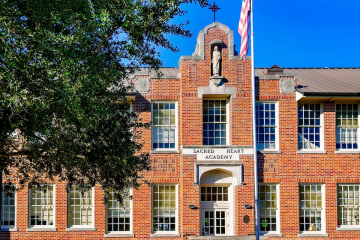
America’s oldest school model may be its future

Many of the qualities that will matter most for students going forward are those that cannot be automated: judgment, self-command, compassion, and courage. They are also traits that Catholic schools have spent generations cultivating. In an age hungry for meaning, Catholic schools understand what humans need to flourish.

Stephanie Saroki de Garcia 9.3.2026
NationalFlypaper

America’s oldest school model may be its future

Stephanie Saroki de Garcia
9.3.2026
Flypaper

Don’t just defend or destroy the National Center for Education Statistics. Rebuild it.

Bruno V. Manno
9.3.2026
Flypaper

Education got there first? The breakdown of traditional left-right delineations.

Andrew J. Rotherham
9.3.2026
Flypaper

Examining outcomes-based contracting in eight pilot districts

Jeff Murray
9.3.2026
Flypaper
view
Bricklaying

Don’t just defend or destroy the National Center for Education Statistics. Rebuild it.

Bruno V. Manno 9.3.2026
Flypaper
view
Hands shaking

Education got there first? The breakdown of traditional left-right delineations.

Andrew J. Rotherham 9.3.2026
Flypaper
view
Graduation

Examining outcomes-based contracting in eight pilot districts

Jeff Murray 9.3.2026
Flypaper
view
Catholic school

America’s oldest school model may be its future

Stephanie Saroki de Garcia
9.3.2026
Flypaper

Every so often a nation becomes so intent on finding something new that it forgets to notice what has quietly worked all along.

The latest National Assessment of Educational Progress—the Nation’s Report Card—showed that millions of students have yet to recover from pandemic-era learning losses, and fewer than one-third of young Americans are proficient in reading or math.

But there’s a big silver lining in this cloud that almost no one is talking about.

For much of the 20th century, Catholic schools took the children of factory workers, dockworkers, and new immigrants—Italians, Irish, Poles, Puerto Ricans—and gave them an affordable education that launched them into the middle class and beyond. Catholic schools were, by almost any measure, one of the greatest engines of upward mobility in the nation’s history.

Then came the reckoning. Beginning in the 1960s, urban Catholic schools lost the religious vocations—the nuns and priests—that had staffed them and thus had to absorb rising labor costs even as demographics shifted beneath them. Thousands of schools closed. Many observers concluded that Catholic education’s most consequential chapter had ended.

They were wrong.

Even as enrollment fell, Catholic entrepreneurs, philanthropists, and pastors quietly reinvented the sector. New governance and funding models emerged. Bishops created space for innovation in communities where Catholic schools had been shuttering for decades.

The Covid pandemic put that commitment to the test. One example came in Cincinnati, where Seton Education Partners opened Romero Academy in person, every day, for every child in the early days of the crisis even as the public schools around it tried to “go virtual.” In fact, while many school systems remained closed, more than 90 percent of Catholic schools reopened for in-person instruction in the fall of 2020. Families noticed. Catholic schools once again earned a depth of trust that could not be manufactured.

For the first time in half a century, the winds are now at Catholic education’s back.

The Supreme Court’s decisions in Espinoza v. Montana and Carson v. Makin barred states that fund private school choice from excluding religious schools. State-level education savings accounts and tax-credit scholarships have expanded accordingly. With Texas rolling out new education savings accounts, nearly half of America’s school-aged children now live in states that offer publicly funded private school choice.

Then came the most significant development of all. Tucked into the sweeping reconciliation package Congress passed in July 2025 was the first federal tax credit for donations to K–12 scholarship organizations. The credit takes effect in 2027 and requires states to opt in, so its full impact still lies ahead. But its passage was no accident: Catholics were instrumental. Among them was New York’s Cardinal Timothy Dolan, who had argued for years that families should be given the dignity to choose the schools that best serve their children. For the first time in a generation, federal policy is not merely tolerating Catholic education. It is creating room for it to grow.

Catholic schools enter this era with enduring strengths that are difficult to replicate: institutional cultures built around clear expectations and shared values; generations of experience serving working-class and immigrant families; existing facilities, community trust, and established reputations; and tuition historically far below that of most other private schools. At a moment when many institutions struggle to answer basic questions about purpose, Catholic schools possess a coherent vision of the human person and an understanding of what education is for. Academic excellence matters—but it is not education’s ultimate purpose. The goal is the formation of free, virtuous human beings capable of serving God, family, community, and country. Indeed, research has found that Catholic school graduates are more likely to vote and are highly engaged in civic and charitable life.

The challenge facing American education today is not simply the transmission of knowledge—AI is making information ever more accessible. The qualities that will matter most are those that cannot be automated: judgment, self-command, compassion, and courage. These are the habits of character that, in a time of AI-driven disruption, matter more than ever. They are also traits that Catholic schools have spent generations cultivating. In an age hungry for meaning, Catholic schools understand what humans need to flourish.

Real challenges remain. Leadership pipelines are thin, institutional inertia is real, and start-up capital for expansion is scarce. Perhaps the most important challenge is cultural rather than financial: Catholic leaders must be willing to preserve what is essential while rethinking how it is delivered. Catholic identity and mission are non-negotiable; the traditional parochial school model should not be. The future of Catholic education will depend not simply on sustaining existing schools, but on opening new ones—through independent Catholic schools, regional schools, classical academies, microschools, hybrid models, homeschool partnerships, and forms of education delivery not yet imagined.

But policy alone will not determine what comes next; opportunity never does. It simply reveals whether Church and lay leaders possess the imagination and will to seize it.

For decades, Catholic education has been defined by closure announcements and questions about survival. That story is over. Public confidence in traditional education systems has weakened, families are seeking schools that offer both academic excellence and moral purpose, and new funding opportunities are emerging.

Whether this moment becomes a renaissance depends on what happens next. Policymakers must continue expanding educational freedom. Catholic bishops, pastors, philanthropists, educators, and entrepreneurs must respond with equal ambition—not merely preserving schools but widening and diversifying the embrace of Catholic K–12 education.

The opportunity is here. The only question is whether we have the wisdom to recognize it—and the courage to create.

view
Bricklaying

Don’t just defend or destroy the National Center for Education Statistics. Rebuild it.

Bruno V. Manno
9.3.2026
Flypaper

In early 2025, the National Center for Education Statistics (NCES) was largely dismantled. The Trump administration, acting through the Elon Musk–led Department of Government Efficiency (DOGE), cut NCES’s federal staff from 103 employees to three, removed its commissioner, and canceled roughly three-quarters of its contracts. This disrupted or halted much of its important statistical work. That is a problem that must be remedied. The question is how. A new report from the American Statistical Association (ASA) argues that the answer is not to recreate what was dismantled, but to build a new and better agency.

Written by Shelly Wilkie Martinez and Stephen Provasnik, A Vision and Strategy for Remaking the National Center for Education Statistics is a starting point. And to that end, the ASA is seeking public feedback as it moves into a second phase, expected to commence in 2027, that will refine the vision and develop a fuller roadmap for rebuilding NCES.

The report begins from two propositions that are sometimes—mistakenly—treated as contradictory.

The first is that NCES performs an indispensable national function. States, school districts, colleges, researchers, policymakers, and families need objective, trustworthy statistics to understand what is happening in American education, make comparisons, and track changes. No collection of states, universities, think tanks, or private companies can sufficiently accomplish this.

The second proposition holds that the pre-2025 NCES wasn’t working well enough. The report argues that the agency was constrained for years by insufficient internal capacity, slow and inaccessible products, fragmented data systems, and difficulty keeping pace with changing information needs. Simply recreating that version of the agency would restore many of those same weaknesses.

The ASA’s proposed solution—rebuild rather than recreate—has a useful historical precedent. Forty years ago, NCES faced a different kind of crisis, and Washington rejected the status quo and made it better by asking what America’s education statistics agency should look like. Today’s situation presents the same opportunity.

In 1986, a National Academy of Sciences report delivered a scathing judgment of NCES as it then was. Creating a Center for Education Statistics: A Time for Action identified serious problems with the agency’s capacity, statistical standards, timeliness, and ability to meet the nation’s information needs.

Its message to the powers that be boiled down to this: Undertake fundamental reform or consider eliminating the center. NCES survived. More important, it improved.

I saw part of that rebuilding firsthand. From 1985 to 1988, Chester E. Finn, Jr. served as the U.S. Assistant Education Secretary responsible for the Office of Educational Research and Improvement, or OERI, where NCES was housed. I served as OERI’s chief of staff. The late Emerson Elliott, who led NCES during this period and later became its first presidentially appointed commissioner, was the career federal civil servant at the center of the effort to turn the agency around. The rebuilding involved multiple actors from outside the federal government and across the legislative and executive branches.

The goal was not to defend everything NCES had been doing. It was to make the agency worthy of the mission it had been given. That history matters now more than ever, given what DOGE did to it last year.

The NCES crisis of 1986 was different from today’s. The agency had not just undergone an abrupt and massive reduction in force, as happened under DOGE. Rather, years of declining capacity and organizational weakness had left it struggling to carry out its responsibilities.

The National Academies panel identified shortcomings involving data quality, timeliness, statistical standards, staffing, contracting, dissemination, and responsiveness to users. It questioned whether NCES had the capacity and institutional commitment necessary to function as the nation’s education statistical agency.

The political setting is worth remembering. This was the Reagan era. President Reagan had come to office seeking to abolish the newly created Education Department, but the national report A Nation at Risk had helped make school reform a national concern. And the statistical function at issue was much older than the department itself. Collecting and disseminating information on the condition of American education had been a federal responsibility since the original education agency was created in 1867.

Washington could have responded defensively by protecting the agency, rejecting the criticism, and asking for more money. It could have responded destructively by declaring NCES a failure and eliminating it.

Instead, policymakers largely chose a third course. They rebuilt it.

Finn later recalled that he and Education Secretary William Bennett agreed that NCES needed “tuning up, speeding up, and beefing up.” NCES also became a budget priority within OERI. Whenever additional OERI resources became available, NCES tended to get them, even when that frustrated other OERI units. Bennett fully supported that approach. With Emerson Elliott leading the center, OERI also pressed for faster, clearer data.

NCES hired a chief statistician, developed written statistical standards, sought more systematic advice from researchers and data users, expanded and upgraded its data collections, and worked to improve the timeliness and usefulness of its publications. The Education Department pressed for faster dissemination, while Congress strengthened the agency’s status and its capacity to cooperate with states.

The changes worked. By 1992, a follow-up National Academies review found that NCES had upgraded or replaced several data collections, added new data series, and sought outside statistical advice. Its budget tripled between 1987 and 1991. More important, the review reported “nearly unanimous agreement” among researchers, professional associations, and congressional analysts that NCES data and reporting had markedly improved.

The turnaround was visible outside the agency as well. In 1992, Education Week reported that Congress had given NCES a “ringing vote of confidence,” pointing to a 33 percent House-approved budget increase and Elliott’s confirmation as the first presidentially appointed commissioner of education statistics.

The turnaround endured. Decades later, NCES Commissioner Peggy Carr described the 1986 report as having “initiated NCES’s modernization and ushered in new levels of professionalism and productivity.” By then, NCES had become a trusted, professionally independent source of federal education statistics.

That experience offers both reassurance and warning. Federal institutions can recover from serious failure. But successful recovery requires more than putting back what was lost.

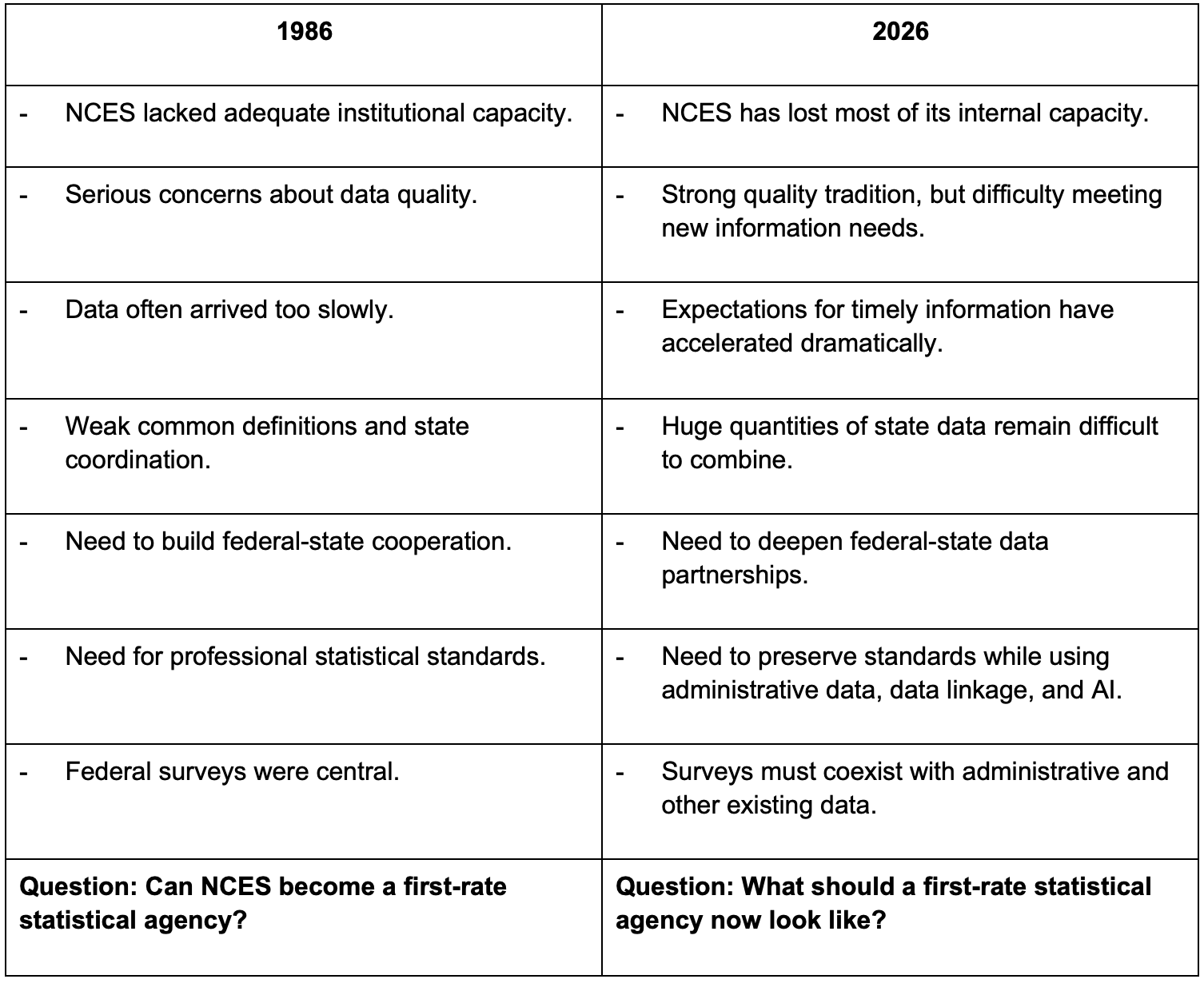
Some similarities between 1986 and 2026 are striking. But the differences may be even more important. Here is a table I’ve created (with the assistance of ChatGPT) suggesting some of the major differences.
1

The last distinction in the form of a question is the most important. In 1986, the question was whether NCES could become the statistical institution the country needed.

In 2026, we already know that it can. It did. The question now is whether the institution that emerged from that earlier rebuilding is suited to a radically different information environment.

It would be a mistake to tell this story as though everything at NCES was working until the 2025 cuts. Problems were evident earlier.

In 2022, another National Academies report, A Vision and Roadmap for Education Statistics, called for NCES to develop a bolder strategic approach and make better use of administrative records, new technologies, partnerships, and emerging sources of information. Carr herself called that report an ambitious successor to the 1986 study and said it could guide NCES into the future.

Another important call for change came from inside the Trump administration itself. In May 2025, Education Secretary Linda McMahon brought Amber Northern, then on leave from the Thomas B. Fordham Institute, into the department as a senior adviser charged with reimagining the Institute of Education Sciences, of which NCES is a part. McMahon said that even as the administration sought to “return education to the states,” educators still needed accurate data to make good decisions.

Northern described her assignment as looking at IES “with fresh eyes” and working with the education community on its rebuild. Her February 2026 report, Reimagining the Institute of Education Sciences: A Strategy for Relevance and Renewal, combines a critique of the old operation with a defense of NCES’s essential functions.

Northern’s report, like the ASA’s, views national statistics as indispensable and says NCES’s core collections and the National Assessment of Educational Progress (NAEP, the “Nation’s Report Card”) should be preserved and strengthened. It also calls for overhauling the agency’s many data collection efforts, arguing that some of them overlap, contain outdated questions, or no longer justify their cost.

Northern proposes making NCES’s data easier to use through the use of modern technology, as well as connecting education information more effectively with data held by the Departments of Labor, Health and Human Services, Commerce, and other agencies. The goal, her report says, should include better understanding the nation’s “education-to-employment ecosystem.”

There is considerable overlap here with the National Academies report and what the ASA now proposes. They all differ in diagnosis, emphasis, and proposed remedies. But at a high level, they share the two aforementioned propositions: The federal government still needs a credible national education-statistics capacity, and simply recreating the pre-2025 system would miss an opportunity for modernization.

The most interesting proposal in the ASA report is a call for NCES to move from what the authors describe as a “survey-centric” model toward a “curation-centric” one. For much of its history, the agency approached an information problem by asking what data the federal government needed to collect. It then designed a survey, gathered the information, checked it, and published the results.

Today, however, enormous amounts of potentially useful information already exist in state longitudinal data systems, school district records, and other federal agencies. So a modern NCES should increasingly begin with a different question: What reliable information already exists, and how can we make it useful? That means helping establish common definitions and quality standards, strengthening states’ data capacity, linking information across different systems, protecting students’ privacy, and supplementing existing information with federal surveys when needed.

NCES would, in other words, remain a producer of statistics, but it would become something else, as well.

For decades, federal education statistics have helped answer fundamental questions: Who attends school? Who graduates? How much do schools spend? What do students know? We still need those answers.

But another reason to expand NCES’s role, according to the ASA report, is that families and policymakers increasingly want to know what happens next. Where do different credentials and pathways lead? What do students typically earn afterward? What becomes of students who leave college without earning a degree?

Answers to those questions frequently require connecting education data to other information such as workforce participation and employee earnings. That’s a harder technical and institutional task than simply compiling data, and one that places NCES at the intersection of the nation’s education-data systems and its broader federal statistical infrastructure. The National Academies panel also calls for NCES to take on this integrative role.

The experience of the first rebuilding 40 years ago and the demands of the current one suggest five principles.

First, rebuild expertise, not simply headcount. NCES needs enough statisticians, survey experts, data scientists, and other professionals to effectively oversee its work. Contractors will remain important, but government must possess the expertise to direct them rather than outsource too much of its institutional capacity.

Second, protect professional independence. Education statistics have value only if governors, educators, researchers, Republicans, Democrats, and the public trust that political officials cannot dictate what the numbers say. The first rebuilding strengthened NCES partly by strengthening its identity as a professional statistical agency. Today’s rebuild must do the same. Congress also should examine whether NCES needs a stronger external governance structure. NAEP, arguably the crown jewel of NCES, already has an independent, nonpartisan governing board that sets policy while NCES administers the assessment. A comparable arrangement for some or all of NCES could be one way to reinforce statistical integrity and professional independence across administrations.

Third, treat states as partners, not simply data suppliers. Much of the information a 21st-century NCES needs originates in state and local systems. Washington should help make those systems stronger and their information more comparable while respecting the federal structure of American education.

Fourth, make timeliness and accessibility part of quality. A statistic can be methodologically sound and still have limited value if it arrives years after people need it. The challenge is becoming faster without sacrificing rigor.

Fifth, connect education to opportunity. The nation needs to know not only what happens inside schools and colleges but how education connects to employment, earnings, mobility, and adult life.

None of this exonerates the Trump administration’s decision to dismantle NCES in 2025. Rebuilding the agency will require restoring expertise, capacity, and institutional protections. But that restoration should be the starting point, not the goal.

Forty years ago, I watched Washington confront an education statistics agency that clearly needed help. Finn, Elliott, their colleagues, many career employees inside OERI and NCES, and congressional staff responded by asking what America needed the institution to do. And then they set about creating an agency that did just that. Today’s circumstances may be different, but the principle isn’t.

Beltway arguments about federal agencies too often leave us with two choices: Defend the bureaucracy or destroy it. The history of NCES suggests there’s a third option: Rebuild it, this time for the next 40 years.

view
Hands shaking

Education got there first? The breakdown of traditional left-right delineations.

Andrew J. Rotherham
9.3.2026
Flypaper

Education is rarely accused of being ahead of the curve. We’re usually the last to get the memo. Just consider how K–12 education delivery has been one of the few large sectors of the American economy not really disrupted by technology—it’s an open question whether that will even happen in the AI era. We treat things that are long settled in the literature as “who knows” jump balls.

But when it comes to politics, K–12 education may have foreshadowed what we’re now starting to see in national politics: a breakdown of the traditional left-right delineations we’ve all gotten used to using as reference points because they are less and less serving any useful purpose.

When I first started doing this work, the field was moving toward odd-bedfellows alliances. This was disorienting, especially for those expecting education debates to run on the same political rails as everything else. Civil rights groups pushing for accountability. Left-right alliances on choice, arguing that low-income Black and Latino families deserved options the wealthy already had. Hard left types allied, uneasily but genuinely, with free-market conservatives who wanted choice for entirely different reasons. Business groups and civil rights organizations finding themselves on the same side of No Child Left Behind (hat tip to Susan Traiman and Kati Haycock). At the same time, some on the left called it a betrayal and some on the right called it grotesque federal overreach. The NEA found itself aligned with conservative states’ rights types to fight it—perhaps that was the real betrayal? In any event, none of it sorted neatly into a partisan column, and it never really has. It was honestly sort of a freak show, and it was fun.

Things started to become more partisan during Obama, especially post–Tea Party, and Trump’s conduct supercharged everything. Now it’s mostly hardened partisanship even where it makes no sense. It’s not fun. Yet in general, beyond education, many clean partisan delineations are breaking down.

The label people reached for at the time was “bipartisanship,” but that misses what was happening. Bipartisanship implies two intact camps agreeing to meet in the middle. That happened at times, but what was mostly happening in education was closer to what some now call cross-partisanship: coalitions that didn’t split along party lines at all, because party wasn’t the operative variable. The real fault lines ran elsewhere—between people committed to whatever their side’s interest groups demanded, and people who weren’t. The fundamental dynamic in education politics, then and now, is a tension between producer interests and consumer interests. The Dems heed producer demands while the Rs champion the consumers. It’s why even when the Dems have compelling ideas or the Rs are going off the rails, the donkey can never quite vanquish the elephant on this issue.

That producer-consumer tension was especially visible in the coalitions that formed around school choice. You had actors on the left and the right who agreed on very little else, but who agreed on this: the system, as structured, wasn’t reliably going to act in the best interest of individual children and families, and so those families needed more agency within it. Some of those actors were libertarians who distrusted institutions on principle. Some were civil rights advocates who had watched the institution fail their communities and realized that large systems are large systems and behave as such regardless of their political valence. Jack Coons, Milton Friedman, and Howard Fuller walk into a bar...

What united them wasn’t broad ideology. It was a shared conclusion about whose interests the system was actually organized around—and a shared appetite for something closer to mass customization, letting families and students shape their own path rather than accepting a single delivery model built for the convenience of the producers running it.

Left-right was, and is, the language people had on hand to describe this, so that’s the language they used. But it never really explained what was happening. Lefty and center-left ed reformers getting labeled as conservatives was, and is, silly. In education, the people resisting change are the real conservatives.

In any event, national politics is now catching up to that same reshuffling, and the evidence is piling up. Affordability has become the animating anxiety in both parties—President Trump may dismiss it as a hoax, but plenty of Republicans are not. In fact, they are now starting reeducation camps for Republicans about the benefits of the free market (even as the government takes stakes in various companies).

Pols in both parties are running against “elites,” and that fight is much more top-versus-bottom and inside versus outside than left-versus-right; candidates from both parties are running on attacking Congress over stock trading. And it shows up in candidates like the ones now being called “Bernie Dogs”—Democratic challengers endorsed by both the Blue Dog Coalition and Bernie Sanders, two wings of the party that agree on little except, apparently, that the current arrangement isn’t working for the people it’s supposed to serve. Micro, but telling: a John Cornyn staffer just went to work for James Talarico, the Democrat running against ethically challenged Texas Attorney General Ken Paxton for the seat Cornyn holds now—a defection that would have been unthinkable under the old partisan sorting rules. Rahm Emanuel—who I think is an underrated presidential candidate should the electorate decide they want change but want it done with no-bullshit competence—is a case study in the same pattern: he’s getting headlines for his willingness to speak hard truths on education, but that same instinct shows up on the Mideast and on the inequitable structure of the U.S. economy.

Data centers are quickly becoming another inside-out issue where the fights are not clean red v. blue at all. Bernie likes many of the Trump tariffs. Biden kept many in place. The ground is shifting.

Part of this is structural: we’re really operating four political parties within the shell of two—DSA-style Democrats and moderate Democrats on one side, MAGA and establishment Republicans on the other. But it’s more than that. It’s an indication the underlying alignments themselves are shifting or at least no longer on firm footing. Recall 2016, when a meaningful share of voters were choosing between Bernie Sanders and Donald Trump in the primaries. Some in the political class waved that off as evidence of ignorant, low-information voters. It wasn’t. Those voters were sorting on a different axis entirely—whether they wanted left-wing populism versus right-wing populism. Independent voters are overrated, since most of them are actually weak partisans, but it does seem like there’s an increasing number of voters up for grabs if something compelling came along. Trump squandered his advantage among those voters in his second term. They wanted lower prices and common sense. They got Iran and Lake America. AP polling shows the president is down 17 among independents (and more among independents without a college degree), a number not politically survivable in the current electoral structure. Still, that 2024 coalition that swept him back into office was remarkable. If talented pols come along, I’d expect more of that, not less, even as partisan identity looks superficially more hardened than ever. They may not be independent, but they are persuadable.

For education, that’s good news. Once we get past the tired, symbolic fights—abolishing the Department of Education and the like—this kind of realignment could be a genuinely fruitful moment for educational change. The sector tends to do its best work when the fights aren’t hard-partisan, when political tension is real and constructive (think 2000), and when coalitions form around what actually serves kids rather than blind partisan adherence.

Editor’s note: This was first published on the author’s Substack, Eduwonk.

view
Graduation

Examining outcomes-based contracting in eight pilot districts

Jeff Murray
9.3.2026
Flypaper

Contracted or purchased services (tutoring, professional development, after-school care, etc.) constitute the second-largest category of school district expenditures after staff compensation. They add up to tens of billions of dollars each year. Typically, the procurement process for such services focuses on inputs and price, and unless something goes drastically wrong, districts are on the hook for the entire payment amount regardless of how well services are delivered. In 2021, the Center for Education Policy Research at Harvard University began piloting a different contracting model, looking to tie expenditures to specific, measurable results. A group of researchers at WestEd have published a new report evaluating these pioneering efforts.

Data come from eight unnamed districts that were early adopters of outcomes-based contracting (OBC) between the 2022–23 and 2024–25 school years in four states: California, Florida, Mississippi, and Texas. In the OBC model, contractors receive a baseline payment for providing services, with additional compensation—representing at least 40 percent of the overall contract value—contingent upon meeting predetermined success metrics that the district and provider agree upon collaboratively. Participating districts ranged in size from 10,000 to 100,000 students. The vast majority of students in all districts (more than 70 percent) were students of color, and the population of English language learners ranged from 3 percent to over 38 percent.

The specific services piloted via OBC were high-dosage tutoring (one-on-one or small-group tutoring focused on literacy or mathematics, delivered virtually or in person) and what is vaguely termed educational technology, described as “technology-based interventions for reading or math, typically implemented during the school day.” Between 700 and 2,500 students received one or both of these services in a given district each year. Quantitative data include student achievement and implementation metrics; qualitative data comprised interviews, observations, and document reviews.

WestEd’s analysts report six key findings, most of which focus on the contracting process itself and the “systems capacity” of districts. This is very important to those with a vested interest in OBC implementation, but less interesting for general audiences. So we will limit discussion here to the two most important findings. The first is district spending on OBC services. The analysts were limited in this regard to a subset of districts where data were available, but spending on services rendered via outcomes-based contracting in them was comparable to previous services obtained via traditional contracting processes. In other words, the new model did not lower district cost. They suggest, optimistically, that districts may therefore have received “greater intensity of services for a comparable cost,” but that is true only if student performance increased.

The second finding concerns student performance. Once again, data were limited to a subset of districts, but analysis showed some statistically significant gains caused by OBC compared to traditionally contracted services. For two examples: English language arts test proficiency boosts for second graders in one district, and a higher number of students meeting or exceeding typical literacy growth targets in another. On the upside, the specific OBC interventions under study were targeted at students determined to have the greatest need (low-income students, English language learners, students with special needs, etc.), thus magnifying the positive impact of OBC in those districts. On the downside, however, findings of positive impacts were limited to just two districts where contracted intervention services were delivered for the intended duration and in the contract-prescribed dosages. In the other districts, numerous implementation issues on both the provider and the school sides combined to render null impacts or, more commonly, no usable data at all.

It is this latter point that leads the report’s authors to cautiously conclude that OBC has “potential” to change contracting models in schools for the benefit of students. But fidelity of implementation (as ever) matters, and OBC generated a whole raft of new issues throughout the contracting process. The many lessons learned from these pilot programs (as detailed in the procedural findings) must be addressed before any more “potential” can be realized. To that point, it is also interesting to note that neither in the report nor in a recent interview did the analysts indicate whether any of the contracts had been reduced in scope or in price based on providers not achieving results. There seems to be plenty of evidence that a number of outcome goals were not realized, yet no clear evidence that payments contingent upon those outcomes were denied.

SOURCE: Kelsey Krausen et al., “Evaluation of Outcomes Based Contracting (OBC): Final Report,” WestEd (July 2026).

Fordham Logo

© 2026 The Thomas B. Fordham Institute
Privacy Policy
Usage Agreement

National

P.O. Box 110
Burke, VA 22009

202.223.5452

[email protected]

Ohio

P.O. Box 82291
Columbus, OH 43202

614.223.1580

[email protected]

Sponsorship

130 West Second Street, Suite 410
Dayton, Ohio 45402

937.227.3368

[email protected]