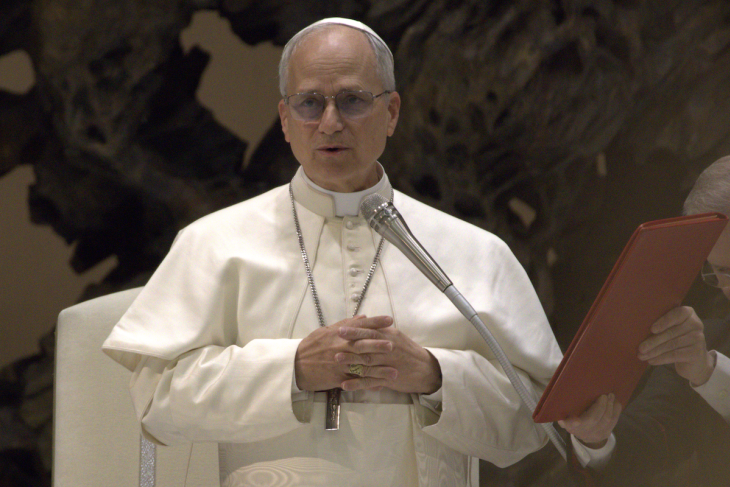
Shortly after being elected Pope in 2025, Leo XIV explained that he chose his name as an homage to Pope Leo XIII, who is remembered for his historic 1891 Encyclical Rerum Novarum, which provided an enduring framework for tackling the enormous social and ergonomic disruptions unleashed by the industrial revolution. “In our own day,” Leo XIV explained, “the Church offers to everyone the treasury of her social teaching in response to another industrial revolution and to developments in the field of artificial intelligence that pose new challenges for the defense of human dignity, justice, and labor.”
Next week, on the first anniversary of that speech, Pope Leo will release his first encyclical, “Magnifica Humanitas,” which will focus on safeguarding the human person amidst the disruptions that are emerging from the artificial intelligence revolution. It is sure to be a defining moment in his papacy and could have far reaching consequences for both how Catholics and those influenced by Catholic thought rise to the challenge of this new era. The release is timely because these disruptions are coming at us fast, as AI progresses rapidly. The tools available today are much more powerful than those released just a few months ago, and the capacity of these tools to do work once only humans could do has expanded exponentially.
What’s more, people are currently responding to the acceleration of AI with considerable fear and dread. Last weekend, Google CEO Eric Schmidt was met with boos from the crowd during a commencement speech when he mentioned AI. Other speakers at graduations around the country have encountered similar hostility. This week, the Wall Street Journal published a piece cataloguing the growing pushback against AI: “consumers resent energy-price jumps exacerbated by the spread of data centers. Workers fear widespread job losses. Parents worry about AI undermining education and harming children’s mental health.”
Pope Leo XIV has already spoken at length about artificial intelligence, and so has hinted at what we might expect. We can anticipate that his upcoming words will aim to help us move beyond a fear-based reaction to something much more proactive and hopeful. In January, he previewed his views in a message for the 60th World Day of Social Communications, “Preserving Human Voices and Faces.” “The question,” Leo explained in his remarks, “is not what machines can or will be able to do, but what we can and will be able to achieve by growing in humanity and knowledge through the wise use of the powerful tools at our service.”
Against the backdrop of the widespread fear we now are seeing, Pope Leo’s words of optimism are, in many ways, a salve because they suggest that there is a way to keep human flourishing at the center of the AI revolution—to view AI not for its power to destroy, but rather for its potential to enable and support. But the question of how we do that is as urgent as ever, particularly in our schools. For if the past two decades have taught us anything, it’s that the quick adoption of new technology in education can do a lot more harm than good.
The challenges that technology has brought into the classroom are equal parts practical and existential. But the biggest worries have come from the steady stream of evidence we’ve seen about the impact that screens have on student learning and wellbeing. As early as 2015, an OECD study based on more than half a million fifteen-year-olds across 65 countries found that countries that had invested heavily in classroom technology saw “no appreciable improvements in student achievement in reading, mathematics, or science,” and that students who used computers very frequently at school “do a lot worse in most learning outcomes, even after accounting for social background and student demographics.”
A 2018 study showed that reading on screens “was consistently associated with lower reading comprehension scores” and that “as time went on (from 2000 to 2017) the advantages of print increased and devices that require scrolling are worse than those that do not.” Those findings were echoed by a 2024 meta-analysis by Oxford Learning, showing that “students who read on paper consistently scored higher on comprehension tests than those who read the same material on screens.”
Add this to the overwhelming evidence that increased screen time is making it more difficult for students to sustain attention during academic tasks and that it is worsening mental health challenges, and you begin to understand why AI is being met with such skepticism.
Of course, we cannot simply sit back and pretend that the AI revolution is not happening. But we can take a far more proactive, human-centered approach to how we incorporate any technology—particularly AI—into our work, our lives, and our schools. That’s undoubtedly why Pope Leo has argued that “it is increasingly urgent to introduce media, information, and AI literacy into educational systems at all levels.”
Before we rush to adopt AI literacy in our classrooms, however, it’s critical to take a moment to pause and consider what Canadian educator Andrew Cantarutti recently described as the difference between AI literacy and AI proficiency. He explained it this way: “Proficiency is knowing how to use something. Literacy, on the other hand, is understanding what something is—how it works, whose interests it serves, what it costs, and what it does to the person using it”—an exercise that takes far more time.
Pope Leo himself makes this critical distinction, explaining that AI literacy must be paired with humanistic and cultural education in order “to understand how algorithms shape our perception of reality, how AI biases work, what mechanisms determine the presence of certain content in our feeds, what the economic principles and models of the AI economy are, and how they might change.”
Unfortunately, our anxiety about AI stems in part from the fact that the average person can’t keep up with the technology’s rapid progression. We are struggling with basic AI proficiency at a moment when prudence tells us that what we really need is literacy. And, as is often the case, technology companies are quick to offer products designed to solve the problems their other products create—all with the promise of accelerating student learning. This February, Google announced a partnership with ISTE and ASCD that included a commitment to make its suite of AI products and “AI literacy training” available to all 6 million teachers and higher-education faculty in the United States.
When viewed through Cantarutti’s lens, however, a close read of Google’s offerings makes it clear that they are offering training in AI proficiency, not AI literacy. That is, they are offering to train 6 million educators in how to use Google’s AI-powered tools. Among the topics:
- How educators can create personalized lessons for each student in their classroom based on their same-day assessment results.
- How faculty can use Gemini to give each student in a crowded lecture hall their own individualized study coach.
- How K–12 teachers can adapt existing curricular materials to meet students’ diverse needs, such as reading levels, primary languages, and visual learning needs.
- How faculty can use NotebookLM to enable students to create customized study guides, infographics, or interactive podcasts so they can learn in a way that's most effective for them.
Conspicuously absent is any education that would help teachers discern whether these tools are good for their own learning, their students’ development, or their school’s culture. Said differently, Google’s AI literacy trainings offer proficiency under a veneer of literacy. They boost educators’ fluency with a particular set of products, built on a particular company’s data and assumptions, and shaped by a particular set of commercial interests. But teaching students to query Gemini effectively is no more “AI literacy” than teaching them to scroll Instagram is “media literacy.”
Genuine literacy requires the harder, slower work that Pope Leo described, work that would allow us to understand the technology as a prerequisite to making decisions about whether and how to use it.
Catholic tradition holds that education is formation, not simply transaction, and that students must be formed in wisdom and virtue, not optimized for output. That tradition gives us every reason to resist the rush to the “next big thing,” to insist on evidence before adoption, and—in the present case—to build AI curricula that strengthen rather than substitute for human reasoning.
The “wise use of powerful tools” Pope Leo calls for is the fruit of formation, carefully and patiently cultivated by educators who know their students well. Tools can only serve formed persons, they cannot form them. The alternative—allowing Big Tech to define AI literacy on its own terms at its own pace—risks producing a generation fluent in AI tools but illiterate in the very capacities that make us human.