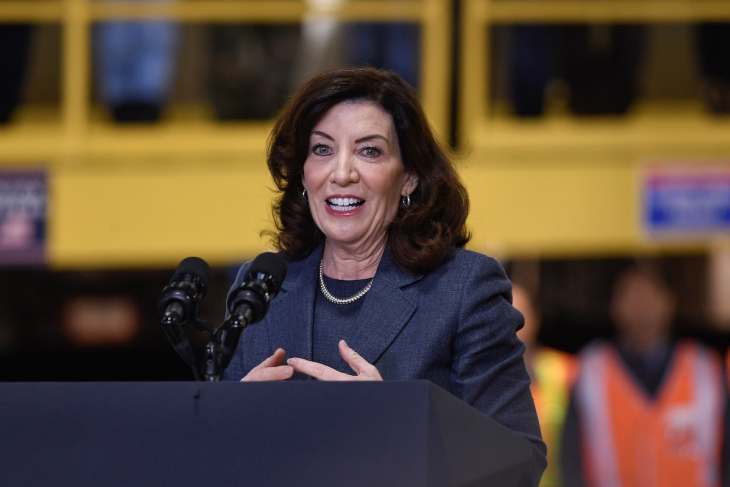
Last week, New York Governor Kathy Hochul made big news by announcing her intention to opt her state into the federal Education Freedom Tax Credit (EFTC)—though her office later hedged a bit. In a statement to the press, her staff said they “await information from the federal government on the program and will thoroughly review the details of the policy for poison pills that could harm New York’s education system.”
They will have to wait another few months for said “information”—i.e., the Treasury Department regulations that will govern the initiative—if current rumors about Treasury’s timing are correct. And most likely, those rules won’t say much, except that governors like Hochul will have little say over which Scholarship Granting Organizations can work in their states, as long as they meet the minimum requirements of the law.
That would, indeed, be a poison pill for those who are dead set against private school choice, including funding for religious schools. Peter Greene, for example, went on a rampage against Colorado Governor Jared Polis last weekend for opting into the tax credit initiative—the only Democrat besides Hochul to do so to date—even though it could support schools that discriminate against gay kids. (Polis is openly gay.)
The federal voucher program is simply federally-funded discrimination, a chance for the government to transfer its tax liability to private schools without holding them to any sort of anti-discrimination standards. It’s the government spending what were supposed to be tax dollars on activities that only benefit a selected few.
But what about those of us who support school choice in all its varieties but aren’t crazy about the particulars of the EFTC? Who wish it were targeted more narrowly to low-income students, or included requirements for participating schools to test children regularly? Who view private school choice, including for faith-based schools, not as “discrimination” but as support for educational pluralism? Should we celebrate the decisions by Hochul and Polis?
Regular readers know that I’ve been defending Democratic governors who want to wait for the Treasury regs before they opt in. That only seems fair, and reflects my hope that perhaps the Trump administration will yet decide to give governors some leeway in how the initiative works in their states. For example, if a blue-state governor wanted to limit eligibility to poor and working-class families, or require some testing and transparency provisions, Washington might go ahead and let them.
But those are my policy preferences. As the Rolling Stones taught us, you can’t always get what you want. So what if the option is a clear binary choice:
- States opt in and agree to approve every qualified Scholarship Granting Organization, even those that plan to provide scholarships to upper-middle-class families and/or those that don’t require any testing or transparency from participating schools; or
- States don’t opt in, and their students and families—in both the public and private school sector—can’t benefit from taxpayer donations funded by the tax credit.
If that’s the choice, I say: Opt-in. Blue states included.
The New York opportunity is particularly exciting. The Empire State has long been home to among the largest Catholic school sectors in the country, with a proud history of serving poor and working-class families well and providing their students a boost to upward mobility. Yet given the state’s deep-blue politics, no private school choice program has ever been in the cards. Now, thanks to Governor Hochul’s brave decision, we can imagine that thousands of low-income and working-class families could gain access to high-quality urban Catholic schools.
And Catholic dioceses are probably the entities best positioned to turn the EFTC into life-changing scholarships. That’s because church leaders can petition their affluent parishioners to take the tax credit, donate to a Scholarship Granting Organization affiliated with the church, and then turn those donations into scholarships for poor and working-class students. There aren’t many other organizations in America that serve both rich and poor and an play matchmaker at scale between donors and recipients.
And for me, keeping Catholic schools open, thriving, and full of low-income and working-class families would be an outcome worth celebrating, even if the initiative doesn’t include the policy designs I prefer. (I do hope they choose not to exclude gay kids or the children of gay parents, though they have a First Amendment right to do so.) And that’s without contemplating the potential benefits to public school and charter school students, who can benefit via mini-scholarships for tutoring and the like.
It was probably Voltaire who first said, some 250 years ago, “Let not the perfect be the enemy of the good.” When comes to the far-from-perfect EFTC, that’s good advice for us today.
Editor’s note: This was adapted from an article first published on Mike’s Substack, SCHOOLED.