
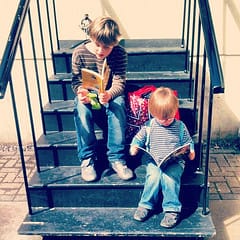
 Should we trust the judgment of pre-adolescents to decide for themselves what makes educational sense? Photo by slightly everything |
While visiting a local high school as a liaison between my department at the University of Missouri–St. Louis and the high school’s Advanced Credit program, I had occasion to speak with its young principal—a newly minted doctor of education. I told him about a challenge facing those of us who teach in K–16 education: the difficulty of getting students to summon the patience, stamina, and will to read dense text, particularly book-length writings, in an age of instant gratification, sound-bites, jazzy graphics, and condensed versions of knowledge. In short, I asked him, do students still have the capacity for deep reading, followed by deliberation and reflection? Can they conduct serious discourse? The principal’s response struck me: “Today’s students are actually smarter and better than students of yesteryear, since students today get to choose their own readings.” Really? I immediately wondered whether we should trust the judgment of adolescents, much less pre-adolescents, to decide for themselves what makes educational sense. And for that matter, since when has the mere act of “choice” been a measure of intellect?
Bizarre as this principal’s comment seemed at the time, it was grounded in mainstream progressive thinking—the student-centered, active, discovery-learning paradigm—that goes back to Rousseau, Dewey, and Piaget and that was more recently promoted by disciples of Lucy Calkins’s “Reading and Writing Project” at Columbia University’s Teachers College. A 2009 New York Times article, “A New Assignment: Pick Books You Like,” noted the example of a Georgia teacher letting her seventh- and eighth-grade English students select their own books, reflecting “a movement to revolutionize the way literature is taught in America’s schools” that “is catching on” in New York City, Seattle, Chicago, and other school districts. “Voice and choice,” as this perspective has been dubbed, means giving students themselves more choices. Indeed, voice and choice has been extended to preschoolers through the so-called “emergent curriculum,” “Reggio Emilia,” and other offshoots of progressive education. (Little Johnny and Shirley cannot find the potty, but somehow they are expected to think critically, including about what it is they should read—or even if they should read at all, as opposed to playing in the sandbox.)
Of course, there is much to be said for encouraging students to take ownership of their own education, to take personal responsibility for choices in their lives, to be active rather than passive learners, and to think more self-consciously about their abilities and interests. This all sounds well and good, but the educators pushing these ideas have been guilty of considerable pretentiousness, hypocrisy, and self-delusion.
First, the lectures on personal responsibility suddenly give way to a “kids-will-be-kids” mantra, with regard to enforcement of rules and standards. When students turn in late papers and flunk exams, for example, the consequences of their behavior can be easily reversed via grade-inflating redos, test retakes, and extra credit. Want to enforce cheating and plagiarism rules? You won’t get far in most American schools.
Second, unless one believes in the Orwellian logic of “less is more” promoted by Ted Sizer and others, student workloads are becoming lighter, not heavier. Popular perception and warnings about K–12 students being overburdened with homework are belied by trends that seem to be in the direction of assigning shorter books or articles (albeit with more pictures) and shorter papers. Jay Mathews of the Washington Post has noted that only about 10 percent of American high schools—predominantly located in affluent suburbs—maintain a culture of high academic expectations reflected in lots of homework. Rather, most fifteen- through seventeen-year-olds study less than one hour a day, while the homework done by elementary-schoolers takes “less time than watching an episode of ‘Hannah Montana Forever.’” A 2011 study by UCLA’s Higher Education Research Institute found that only 39 percent of incoming college freshmen “report that they studied 6 or more hours a week on average as high school seniors.” Not surprisingly, this lack of academic engagement has carried over into college itself. In the 2010 study Academically Adrift, Richard Arum and Josipa Roska found an overall 50-percent decline in the number of hours a student spends studying from previous decades; less than half of the students surveyed had ever written more than twenty pages for any class, and relatively few had been assigned more than forty pages of reading per week.
What is the likelihood that the voice-and-choice movement in K–12 will produce an increase in academic standards rather than further erosion? After all, as Diane Ravitch once framed the issue, “What child is going to pick up Moby Dick?” Where all this “choice” leads can be seen in the recent case of an Honors English course at my local high school where at least one student, entrusted with selecting a “great book” to read as the basis for a semester project, opted for Paris Hilton’s autobiography. I guess we should be impressed that this student was reading a book rather than watching and reporting on Entertainment Tonight. If you believe that the average student, when given a choice, will choose to read a 200-page book rather than a book half that size, or will choose to write a twenty-page paper rather than a ten-page paper, well, then you probably also believe in E.T. Have we carried the idea of empowering students with “choices” a bit too far? You be the judge.
