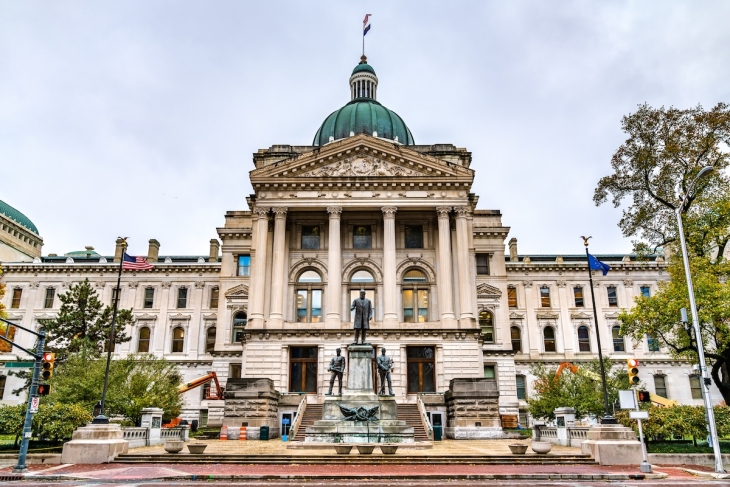
With eighteen words tucked into a 37-page education bill, the Indiana state legislature took a major step towards easing the lives of educational entrepreneurs.
Those words?
“A public school, charter school, or nonpublic school shall be considered a permitted use in all zoning districts.”
While that might not seem like much, according to educational entrepreneurs, it removes one of the major barriers to starting a new school.
For some background, an educator cannot simply open a new school anywhere they want. Different plots of land are zoned differently and siting a school on a plot of land can require reaching out to the local planning authority for permission.
In some parts of Indiana prior to this year (and in states all across the country to this day) local municipalities were able to restrict schools from operating in areas under their zoning control. What’s more, as a report about Florida by the Teach Coalition documented, some localities regulate private schools differently than public schools, creating far more hoops for private schools looking to open.
In many municipalities, educators need to file for a “change of use” permit (sometimes called a “variance” or “conditional use permit”) before they are able to operate a school, asking planning authorities to grant them the opportunity to operate there. This requires school leaders to go before a zoning board, city council, or other authorities that do not have to approve their application. These bodies routinely request copious documentation from architects, engineers, traffic analysts, and others in order to win their support. There can be hearings, often with opportunity for public comment, site visits, and more. All of this takes time and money and does not necessarily lead to a yes from the authorities.
And, because the criteria can be so ambiguous, school leaders are at the mercy of boards with lots of reasons to deny an application if they want to. For example, schools can be denied on aesthetic grounds, with their facility deemed “incompatible” by a planning board. But compatibility is in the eye of the beholder, and in practice this gives boards a catchall mechanism to say no.
The incentives of the situation are such that boards are more likely to be punished for saying yes to something that they shouldn’t have than for saying no to something that they should. When a building deemed an eyesore or one that mucks up traffic gets built, people ask “who let that happen?” But if students spread between a bunch of different schools are getting a subpar education because they don’t have better options, there is not one person or body to blame. Thus the risk aversion.
As a result, planners’ scales start tipped towards no, and educators have to push a stone uphill to change their minds.
Indiana did away with all of this.
By moving schools, of all types, into “by right” zoning status, educators don’t need to go through the approval process. Usually by simply filing the appropriate paperwork with planning authorities, schools are able to operate. Boards do not have a veto, so there is no need for hearings, and more certainty for school leaders.
To be clear, “by right” zoning does not suddenly make everything into a free for all. Schools still have to abide by zoning regulations, there is simply an affirmative understanding that they are permitted to do what they are doing until someone can demonstrate otherwise. Rather than having to convince authorities that they are compliant, authorities would have to actively seek out issues to block their progress.
Moving schools to “by right” zoning does not fix all of the issues that educational entrepreneurs, especially those that are looking to start smaller schools, encounter when trying to get started. Many municipalities treat any institution with more than five unrelated children attending them for a regular period of time to be “schools” and subject them to the same regulations as a 1000-student high school. Whether it is fire suppression, parking mandates, fencing, lot size, designated recreation space, or more, there is little flexibility for small school operations looking to use unconventional, but perfectly appropriate, facilities.
Utah took a big step to deal with these issues last year with the passage of SB 13. That legislation allowed for schools of less than 100 students to be classed as businesses permitted to open in all zones in the state. They would be subject to the International Building Code, the standard for commercial properties that does not have the same requirements as the code for school buildings.
What moving schools to “by right” zoning does do is ease confusion and establish a baseline level of certainty. Whereas big property developers have the time and resources to make change of use applications and win some and lose some, educators do not. They do not have the money lying around to conduct traffic studies, let alone to conduct studies that eventually comes to nothing. Add in architectural reports, engineering reports, and more, and one can easily see that the risk is far too great. Indiana made a big step towards changing that.
States like Indiana have made substantial investments in the demand side of school choice, dramatically increasing the supports available to families to choose their child’s school. But, if states do not put the same effort (or possibly more!) into the supply side of school choice, there will not be enough options for those parents to choose.
Editor’s note: This was first published by Forbes.