
Today’s “exquisitely timed” GAO report has set off an avalanche of accusations at charter schools for “discriminating” against students with disabilities. George Miller, who requested the study, told the Washington Post that the news was “sobering.”
No single public school is expected to serve students with every single type of disability.
Everyone already knows, as Eva Moskowitz told the Wall Street Journal, that the best charter schools try to help students with mild disabilities shed their labels (and Individual Education Plans) by improving their math and reading abilities. That could explain a significant part of the discrepancy.
But there’s another point that’s overlooked entirely: No single public school is expected to serve students with every single type of disability. In fact, traditional public schools regularly “counsel out” students with severe disabilities because they don’t have the resources and expertise to serve them. Many school districts operate separate schools (or programs) precisely for those kids.
To test this argument, I just spent 30 minutes on the Office of Civil Right’s Data Collection website. I pulled up the special education data for Montgomery County, Maryland—where I happen to live, and a system that’s widely considered one of the best large districts in the country.
I wanted to see the degree to which schools in the county are serving their fair share of students with severe disabilities. (I counted all of the disability groups except for Emotional Disturbances, Specific Learning Disorders, and Speech or Language Impairments.) In total, Montgomery County serves 4,765 such students (with disabilities including Autism, Intellectual Disabilities, Traumatic Brain Injury, etc.)—or 3.4 percent of its total student population.
By the GAO’s reckoning, then, and maybe that of Congressman Miller, every school in Montgomery County should come close to hitting that mark. Yet see what I found:
Students with Severe Disabilities:
Share of Student Population in Each Montgomery County (MD) School
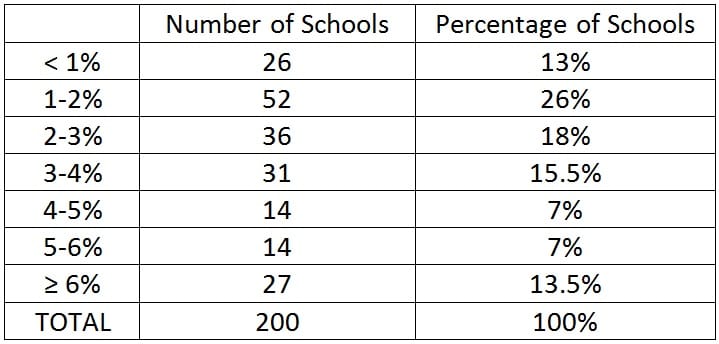 |
So are the 26 schools that serve virtually no students with severe disabilities “discriminating” against such children? Are they out of compliance with federal law? What about the 52 additional schools whose students with severe disabilities amount to fewer than 2 percent of their totals? Should the GAO put out a report blasting Montgomery County for skirting its responsibilities? Has George Miller yet spoken about this outrage with his colleague, Chris Van Hollen, who represents Montgomery County in Congress?
Of course not. What Montgomery County is doing—what every school district of any size does—is to create special programs at particular schools that can better meet the needs of students with particular disabilities. (Five of its schools enroll 40 percent-plus students with severe disabilities.) Because, again, No single public school is expected to serve students with every single type of disability.
Scratch that: Except for charter schools, which are somehow expected to do the impossible.
