Across the nation, charter schools continue to expand. Over the past five years, their enrollment has grown by 70 percent, so that approximately 2.7 million youngsters now attend these schools of choice—over 5 percent of the total number enrolled in public schools. Dozens of cities educate more than one in five of their public school students in charter schools.
This is a hugely positive development—provided, of course, that those schools are delivering a high-quality education.
Whether you think the current “mixed economy” of district and charter schools should be an all-charter system (as in New Orleans) or a dual model (as in Washington D.C.), for the foreseeable future, most cities are likely to continue with a blend of these two sectors.
Can they peacefully coexist? Can they do better than that? Can they actually collaborate in the service of students, families and the public interest?
To answer these questions, we at the Fordham Institute teamed up with Public Impact to publish a new report, Is Détente Possible? We examined five cities that had among the best conditions for district-charter collaboration: Boston, Cleveland, Denver, Houston, and Washington, D.C.
Boston, for instance, boasts some of the highest-performing charters in the land. All sixteen charter operators there participate in an alliance that communicates directly with the Boston Public Schools.
Cleveland, also home to several high-performing charters, promotes buy-in between the sectors with an attitude of “We’re in this together.” The Cleveland Municipal School District includes in its accountability rating the performance of the charter schools it authorizes.
Denver, which benefits from a string of pro-reform superintendents and school board members, has taken seriously its work as a Gates compact site since 2010. Several local and national philanthropies have supported its charter sector as well as the district itself.
Houston is the birthplace of two of the charter sector’s rock stars (KIPP and Yes Prep), and the market share of its charters grew within the boundaries of the Houston Independent School District for much of the last decade.
Finally, Washington, D.C., hosts a quality-conscious charter authorizer and has been led by mayors who view district-charter collaboration as a promising vehicle to improve student outcomes in the nation’s capital.
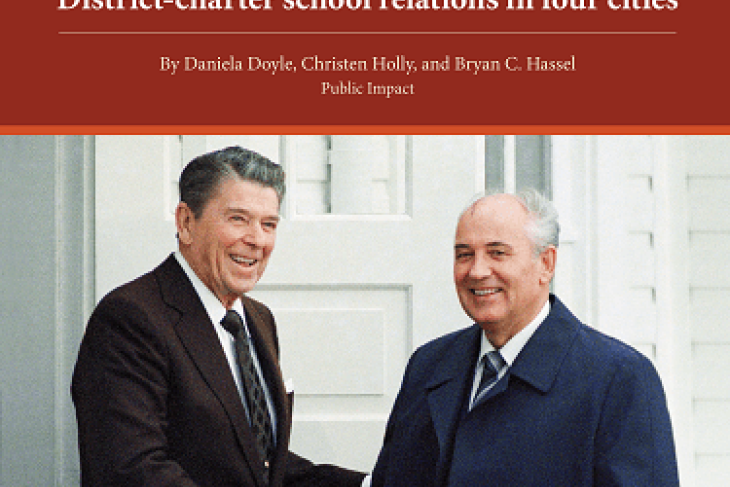
After scouring available data and interviewing local policy leaders and insiders, the Public Impact team emerged with a simple conclusion: District-charter engagement is unique to each city. These relationships are so distinct that the authors settled on the metaphor of foreign policy to characterize each case. So, for instance, the District of Columbia is the “superpower summit” where two sectors of similar size and influence are compelled to work together while jealously guarding their own interests. Houston is a lesson in “isolationism” as each sector mostly pursues its own course (so much so that we omitted it from full discussion in the report). And Boston, whose charter restriction functions like a protective tariff, is analogized to a protectionist state (Massachusetts caps the number of students in the state’s lowest-performing districts who can attend charters to no more than 18 percent).
In the end, we found that the sectors now communicate with one another better than in the past, and some even share instructional strategies. Still, collaboration in all five sites is limited and often fragile.
That’s somewhat disappointing, but not surprising (institutions, after all, nearly always pursue their own interests). Nor does it mean that efforts to boost communication, share best practices, and lower the cost of providing services aren't worth trying. Think of it again in terms of foreign policy: Even superficial interactions (like student exchange programs) can ease tensions and keep the pot from boiling over. Peaceful co-existence is surely better than the alternative.
But nobody should expect either sector to cede much territory to the other anytime soon.