Over the past few months, a quiet but intense debate has broken out among education-reform Democrats over whether the party should embrace private school choice—particularly the ESAs spreading kudzu-like across the country. The growth of these programs, donor interest, and a broader strategic “what now?” conversation—post-pandemic and with Democrats on their heels on an issue the party usually performs well on—are driving the conversation.
Ashley Berner, Chris Cerf, and I talked through some of this in a webinar earlier this month.
Predictably, establishment Democrats—especially the teachers unions—are a hard no. They want Democrats to stop even being charter-curious, sticking solely to public sector–controlled options. That stance is politically out of step and does little for families seeking more than what they currently get. It also overlooks the solid (though increasingly pressured) record of urban charters and the energy for new options percolating across the system.
Still, my take on the broader question is no—and not just because I doubt that today’s backlash-fueled rush to private choice will reliably expand opportunity for low-income students. And I don’t lose a lot of sleep about giving persistently underserved families some options. Politically, however, I just don’t think Democrats need to embrace private school choice wholesale or without meaningful guardrails around civil rights and transparency as well as means testing to meet this moment.
They do, however, need to change. At a time of real disruption and frustration Democrats need to be a party that welcomes a much wider range of perspectives on these questions—especially given the broad support for choice around the country. A flat “no,” or even the perception of being a party of no, isn’t a viable long-term strategy. A rigid stance amazingly manages to turn off some centrist and conservative Dems as well as some pro-reform progressive ones. It’s not the only reason Donald Trump made gains among non-white voters 2016 to 2024, but it’s one of them.
I could show you polling all day, but forget that for a moment: This is America—we like choice. Being on the wrong side of that culturally and politically is not a great place to be.
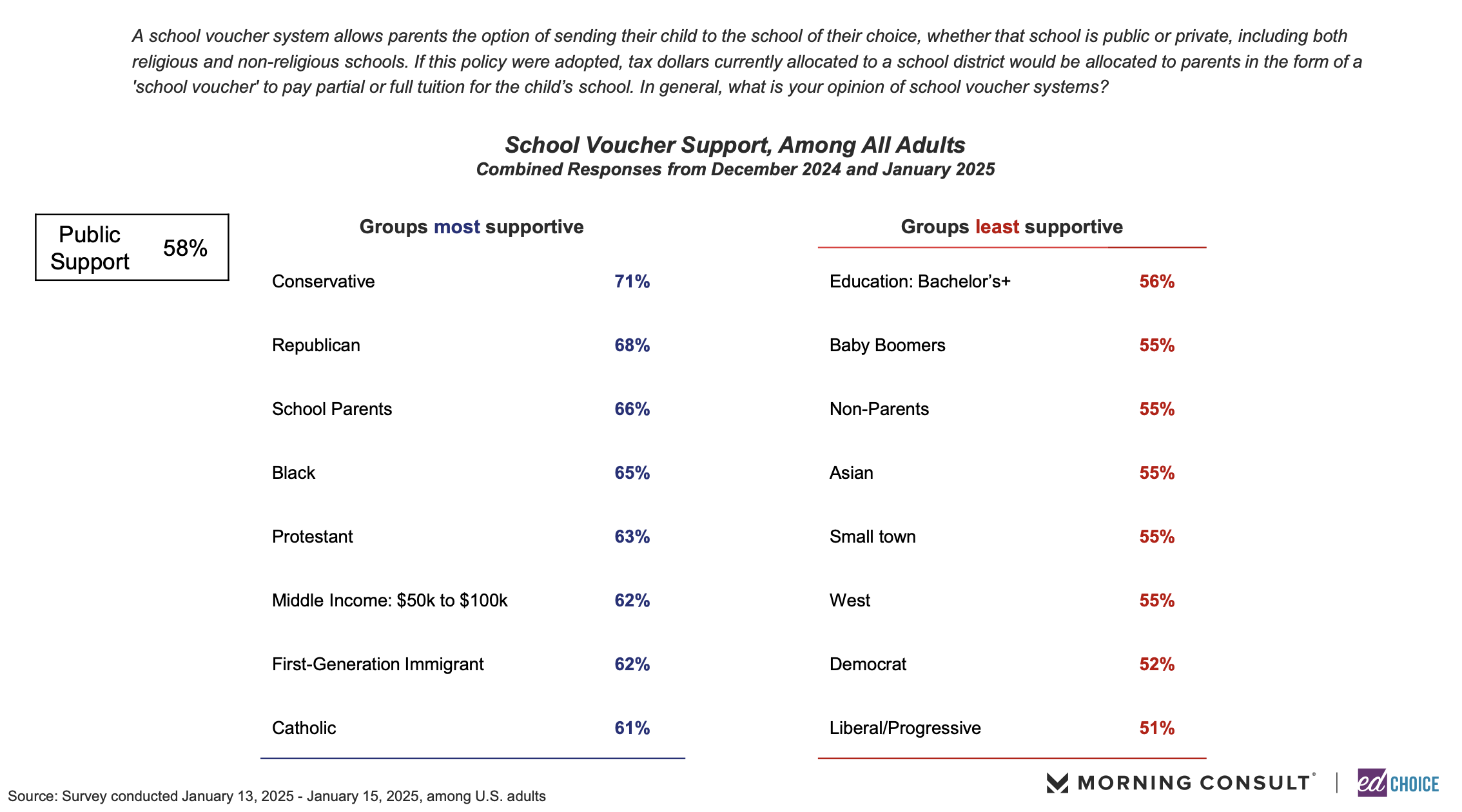
Political parties need contrast, yes—but they also need inclusion. Winning in today’s tight races depends on addition, not subtraction. Democrats don’t need to become Republicans on education, but they do need to change their ways. That’s why Democrats should make room for people who see school choice differently, even if the party doesn’t officially adopt those positions. And it’s worth remembering that good artists borrow, great ones steal.
Politically, even post-pandemic, choice plus accountability matches up well against anything goes. People don’t want to pay for the affluent to go to private school. What doesn’t work is being seen as lashed to the status quo or dismissive of the concerns. Or worse, politicians who emphatically say they’re not for the status quo either but then go on to offer five lame and exhausted ideas as evidence of their appetite for change.
Put plainly: Don’t blackball Democrats who support ESAs or vouchers. 2028 Democratic hopefuls, including governors like Josh Shapiro (PA) and J.B. Pritzker (IL), flirt with choice alternatives. Jared Polis, the maverick governor of Colorado is a longtime charter school champion and education innovator. California Governor Gavin Newsom was OK on charter schools—even pre-podcast! Rahm Emanuel is serving up some hard truths. This is the conversation Democrats must have.
The teachers unions will push hard for ideological purity. They have an existential financial interest in doing so. But Democratic leaders should prioritize winning elections and actually governing. Sensible policy would be nice, too. Especially right now. And especially policy that is responsive to families who have been denied educational quality for far too long. All those things are attainable.
Editor’s note: This was first published by the author on his Eduwonk blog.