I remember a meeting when Backyard Brains was just beginning in early 2009, when we were receiving guidance from the Center for Entrepreneurship at the University of Michigan. We were just finishing up graduate school and learning the actual mechanics of forming a startup company, something very new to us—the basic things: how to incorporate, how to find customers, how to scale a prototype into a product, and how to raise funding with government technology grants or venture capital. We were two recent PhDs with a couple prototypes, some cockroaches, a bit of presentation chutzpah, but not much else than that.
During a meeting on ideas to formalize the business and begin sales, an engineering advisor said, “I love the cockroach, but you guys need a better logo. Engineers are not creative, so hire a design student to help you with it.”
Working with designers to develop a logo is useful and certainly uncontroversial advice, but the comment that “engineers are not creative” hit me like a punch, and I remember little else that occurred in that meeting.
Engineers are not creative? And this was an engineer saying this?! Any time I look at any machine that does its function well, such as a production robot in a manufacturing facility, the SpaceX Falcon 9 recoverable rocket, an ICU machine keeping a patient alive, or a simple hand-operated tool in my workshop, I think of the human beings that designed and invented it, and I feel a companionship and desire to contribute.
My grandfather, who earlier in his adult life had been an auto-mechanic, ultimately became a high school teacher, instructing Mechanical Arts to students in New Jersey. Shop class as a class option was already fading away as I was going through my formal high school education in the 90s, but the use of the word “arts” reveals much.
It can be a useful cognitive exercise to replace “arts” or “engineering” with “creativity” anytime the words are used. Visual Arts, Mechanical Arts, Electrical Engineering, Computer Engineering, etc. These are all disciplines where practitioners attempt to build, interpret, and understand something never done before.
In the Backyard Brains summer intern program, one of the most important questions we ask on our application is: “Tell us about something creative you did. It can be an experiment you designed. A prototype you built. A story you wrote. A program you made. A piece of music composition. A choreography. Anything you hacked, anything you modified, anything you designed.”
We ask this because when you are approaching the edge of engineering and science knowledge, it is creative thinking that pushes you further, beyond the threshold of where previous efforts have gone.
We celebrate formal science and engineering education, having spent many formative years in institutional settings, but the creative part of science and engineering is often minimized when you are learning the discipline. Read about Louis Pasteur’s famous germ theory experiments and you will be struck about how creative his manipulations of flask neck shapes were. Or look at Leeuwenhoek’s microscopes and try not to marvel at their design simplicity. Or the first transistor by Shockley, Bardeen, Brattain, and just how bizarre the idea is. Alchemy made real. Changing conductivity through doping. Or think of what a cognitive jump Einstein made when he imagined the dilation of time as the speed of light is approached. Visit any science or engineering history museum and be mesmerized by what creative minds can accomplish. Visit any modern university or technology company and see the same.
****
Thus, we often receive emails from students asking: “How can I get into Neuroscience, learn more about Neuroscience, etc.?” Beyond mentioning our favorite books—The Spark of Life by Frances Ashcroft; Galvani’s Spark by Alan McComas; and Neuroscience for Dummies by Frank Amthor—our most important advice goes beyond Neuroscience and takes a step back into how to get into general Science.
Begin becoming comfortable building your own tools to answer the questions you have. Do projects only because they intrigue you. Show your projects off to friends and people you admire. See what they think. If they like it, continue. If they don’t like it, reflect on why, and make the decision to continue or stop. But always continue building. Learning by reading and attending formal education is necessary, but learning by being creative is the most rewarding way to educate oneself.
So keep inventing and make friends along the way. Let’s make this current age appear backwards in one hundred years as we contribute to humanity’s intent to improve its lot and understand this world we inhabit.
And never think engineering is not a creative process.
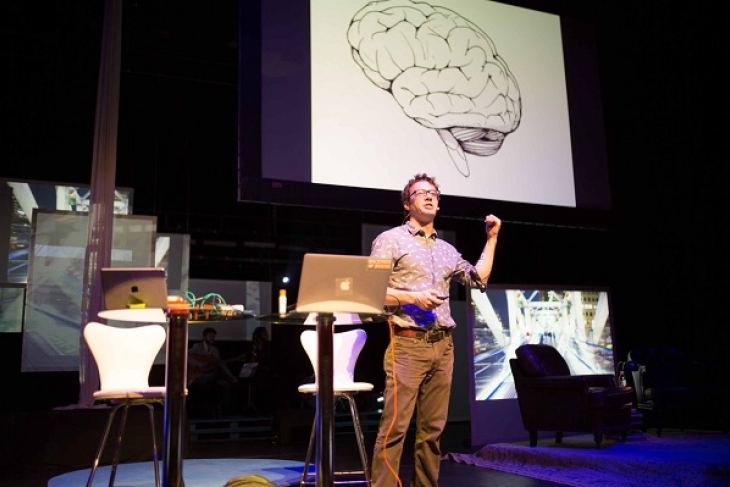
Tim Marzullo, Ph.D., is co-founder of Backyard Brains. He will be the keynote speaker at the NAGC 64th Annual Convention on Friday, November 10, 2017.
The views expressed herein represent the opinions of the author and not necessarily the Thomas B. Fordham Institute.