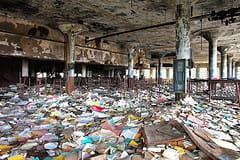
 School closures are traumatic. Photo by Thomas Hawk |
Secretary Duncan and his team were mobbed the other day by agitated parents and kids protesting the closing of public schools around the land. Though Uncle Sam has no real control over this, it's true that Duncan came to Washington promising to close (or overhaul) a thousand schools a year and, more recently, has been pressing for radical action in the lowest-performing 5 percent—i.e., about 5000 schools. Actual data in this realm are scarce, but NCES reports roughly a thousand closings a year among “regular” public schools (meaning that, in one sense, Duncan's promise is being kept, though not by him), as well as who knows how many charter and private schools that bite the dust. But even if the total is closer to 2000, in a country with 100,000 schools that's just 2 percent a year. Moreover, schools keep opening, too, hundreds of them every year in every sector.
Nobody likes to close schools. Secretary Duncan remarked to the crowd, “I don't know any educator who wakes up in the morning and says, ‘I want to close schools.’” And it’s self-evident that nobody likes to have his or her own school closed. It's traumatic for families, teachers, students, neighborhoods, communities, even entire villages and towns.
But there are three big reasons why schools close and will continue to close—while others open.
First and most obviously, big demographic shifts. Some communities (mainly in the sunbelt and exurbia) are growing like topsy with thousands more kids who need to be accommodated in schools—and other places are losing population at a rapid rate. (In 2010, Cleveland had shrunk back down to its 1920 size. Don't even ask about Detroit.) This causes all manner of institutions to falter, to close, to be needed and to open, not just schools (think grocery stores, movie theaters, fast-food emporia, playgrounds, libraries…).
Second, particularly in an era of school choice, scads of families voluntarily exit bad schools in search of better ones. Sometimes they move home and hearth, sometimes they stay put in their house or apartment but send their kids to different schools. Charters are often the chosen alternative—suburbs, for those who can afford it. In some places, youngsters can access vouchers and thereby make their way into private schools, too. And new and growing forms of education delivery—technology above all, but also home schooling, early college options, and more—mean that families have learning opportunities separate and apart from their traditional neighborhood schools. If enough avail themselves of those alternative opportunities, especially if the neighborhood school is bad (in any of a dozen ways, including safety, physical plant, etc.), there won't be enough kids left to justify keeping it open. It's simply unviable to continue operating schools that few kids attend.
Third, today's focus on results-based education, combined with plenty more data on school performance in an era of educational accountability, means that reform-minded education leaders are getting bolder about closing bad schools—and sometimes (but not always) opening new ones in the same building. We know from ample research that bad schools will otherwise tend to stay bad.
None of this eases the pain. And it's a sad fact that the schools that do get closed almost always have some kids attending them—and these kids, too often, are the least fortunate youngsters of all, boys and girls whose families lack the means, the concern, or the savvy to access better options for their sons and daughters than the neighborhood school whose continued existence cannot be justified on any other grounds.