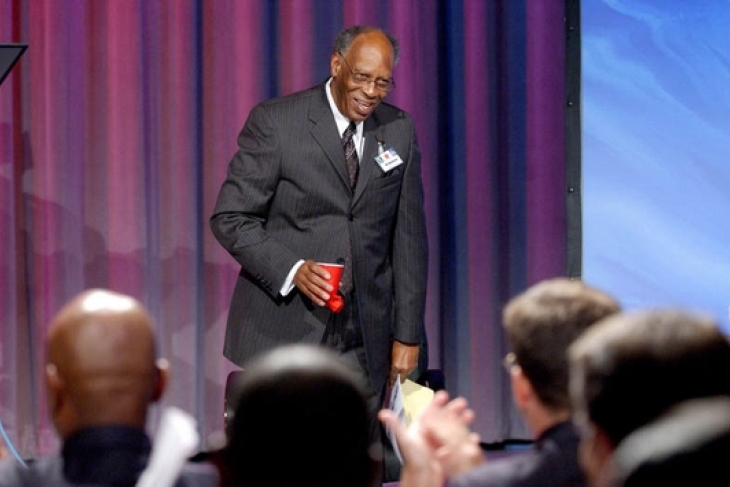
It has always puzzled me why the Rev. H.K. Matthews hasn’t drawn more attention for his support for private school choice. His name may not carry the weight of King, Randolph, or Rustin, but it’s doubtful that the civil-rights movement would have quickened in Florida at the pace it did without the sacrifices Matthews made.
Chief among those sacrifices was Matthews’ freedom: When he was president of the Pensacola Council of Ministers in the 1960s, he led sit-ins at segregated lunch counters throughout Northwest Florida that led to his arrest—thirty-five times. He was gassed and beaten by police on the march with Martin Luther King, Jr., from Selma to Montgomery, and he was blacklisted from jobs after protesting police brutality in the Florida panhandle. More recently, Matthews helped to lead protesters who bemoaned the verdict in the George Zimmerman trial.
So when Matthews calls school choice an extension of the civil rights movement, that assertion ought to at least merit a few high-profile headlines.
At least the Birmingham News recognized the allure of Matthews’s position. This week, the News published commentary from Matthews supporting the new Alabama tax-credit-scholarship program and reprimanding the Southern Poverty Law Center for its attempt to sue the program out of existence.
“I’m sure the Southern Poverty Law Center does many good things for low-income families—but they have it wrong on this program,” said Matthews, who presently works as a minister in Brewton, Alabama. “They say: if you can’t help all low-income families at once, you shouldn’t help any. It’s a good thing we didn’t take that attitude towards civil rights—change didn’t happen overnight; we made progress one lunch counter at a time.”
A statement like this is in keeping with Matthews’s primary interest for the last several years. In 2010, he led a march of 5,500 people to the steps of the Florida capitol to push for a law that would expand that state’s tax-credit-scholarship program (I was there that day, working for the organization that administered the scholarship program). He has been to Fort Lauderdale, Orlando, and Jacksonville to speak with community leaders, businesses, and news reporters about the merits of the program and the level of empowerment school choice provides to low-income families.
But more importantly, he has tried to convince naysayers of just what a public education means.
“Public education is not a system of buildings or employees—it’s a goal, an ideal,” he wrote this week. “Despite the best efforts of everyone—teachers, parents, principals—some children will not fit well with their assigned school. Low-income parents must be empowered to find the environment in which their children will succeed. Parents with means always have choices. They move to neighborhoods for their public schools. Or they pay for an alternative. Only those without means lack choices.”
It’s fitting that this discussion is happening on the fiftieth anniversary of Martin Luther King Jr.’s historic “I Have a Dream” speech. I make no argument that King would have supported school vouchers, but there are those who marched with him who see the need for a different kind of empowerment. Matthews endured the worst resistance to the civil-rights movement. The least we can do is hear him out.