Mobile Navigation

  • National
    • Policy
      • High Expectations
      • Quality Choices
      • Personalized Pathways
    • Research
    • Commentary
      • Gadfly Newsletter
      • Flypaper Blog
    • Events
    • Scholars Program
  • Ohio
    • Policy
      • Priorities
      • Media & Testimony
    • Research
    • Commentary
      • Ohio Education Gadfly Biweekly
      • Ohio Gadfly Daily
  • Charter Authorizing
    • Application
    • Sponsored Schools
    • Resources
  • About
    • Mission
    • Board
    • Staff
    • Career
Home
Home
Advancing Educational Excellence

Main Navigation

  • National
  • Ohio
  • Charter Authorizing
  • About

Ohio Menu

  • Topics
    • Accountability & Testing
    • Advanced Education
    • Career & Technical Education
    • Charter Schools
    • Curriculum & Instruction
    • ESSA
    • Evidence-Based Learning
    • Governance
    • Personalized Learning
    • Private School Choice
    • School Finance
    • Standards
    • Teachers & School Leaders
  • Research
  • Policy
  • Commentary
    • Ohio Gadfly Newsletter
    • Ohio Gadfly Blog
    • Events

The Education Gadfly Weekly

Sign Up to Receive Fordham Updates

We'll send you quality research, commentary, analysis, and news on the education issues you care about.
Thank you for signing up!
Please check your email to confirm the subscription.

Ohio Gadfly—Some lawmakers want to make it easier for kids to skip school

Volume 17, Number 21
9.19.2023
9.19.2023

Ohio Gadfly—Some lawmakers want to make it easier for kids to skip school

Volume 17, Number 21
view
OH needs accurate absenteeism data blog image
Standards & Accountability

As chronic absenteeism rates soar, some Ohio lawmakers want to make it easier for kids to skip school

The negative impacts of chronic absenteeism are well known. In elementary school, truancy can contribute to weaker math and reading skills that persist into later grades.

Jessica Poiner 9.19.2023
OhioOhio Gadfly Daily

As chronic absenteeism rates soar, some Ohio lawmakers want to make it easier for kids to skip school

Jessica Poiner
9.19.2023
Ohio Gadfly Daily

Ohio’s long and winding road back to where it started with novice teachers

Jessica Poiner
9.18.2023
Ohio Gadfly Daily

The Great Recession offers insight about the impact the impending fiscal cliff will have on Ohio school districts

Stéphane Lavertu
9.11.2023
Ohio Gadfly Daily

Why Ohio’s school board elections should be on-cycle

Aaron Churchill
9.12.2023
Ohio Gadfly Daily

Ohio Senate proposes much-needed tweaks to College Credit Plus

Jessica Poiner
9.13.2023
Ohio Gadfly Daily

2021 PIRLS test results starkly illustrate global learning loss

Jeff Murray
9.18.2023
Ohio Gadfly Daily

Test-based retention, student achievement, and sibling spillover effects

Jeff Murray
9.14.2023
Flypaper

Fordham Institute statement on Ohio’s school report cards

Ohio Education Gadfly
9.14.2023
Ohio Gadfly Daily
view
Changes to REP blog image

Ohio’s long and winding road back to where it started with novice teachers

Jessica Poiner 9.18.2023
Ohio Gadfly Daily
view
Lavertu Fiscal cliff blog image

The Great Recession offers insight about the impact the impending fiscal cliff will have on Ohio school districts

Stéphane Lavertu 9.11.2023
Ohio Gadfly Daily
view
School board turnout blog image

Why Ohio’s school board elections should be on-cycle

Aaron Churchill 9.12.2023
Ohio Gadfly Daily
view
SB 104 CCP changes blog image

Ohio Senate proposes much-needed tweaks to College Credit Plus

Jessica Poiner 9.13.2023
Ohio Gadfly Daily
view
PIRLS learning loss SR image

2021 PIRLS test results starkly illustrate global learning loss

Jeff Murray 9.18.2023
Ohio Gadfly Daily
view

Test-based retention, student achievement, and sibling spillover effects

Jeff Murray 9.14.2023
Flypaper
view
Media alerts stock image

Fordham Institute statement on Ohio’s school report cards

Ohio Education Gadfly 9.14.2023
Ohio Gadfly Daily
view
OH needs accurate absenteeism data blog image

As chronic absenteeism rates soar, some Ohio lawmakers want to make it easier for kids to skip school

Jessica Poiner
9.19.2023
Ohio Gadfly Daily

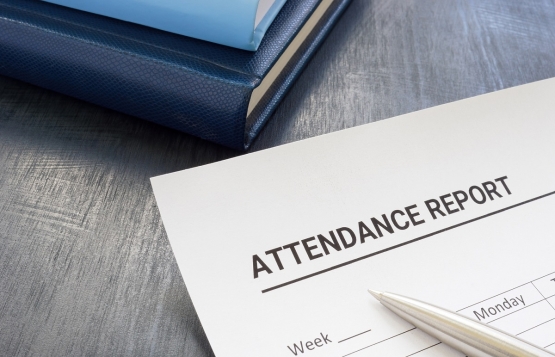
The negative impacts of chronic absenteeism are well known. In elementary school, truancy can contribute to weaker math and reading skills that persist into later grades. In high school, where chronic absenteeism rates are higher, students who are chronically absent often experience future problems with employment, including being limited to lower-status occupations, less stable career patterns, higher unemployment rates, and low earnings. Across all grade levels, increased absenteeism has clear negative effects on both student test scores and social and emotional learning outcomes.

To prevent these negative outcomes, policymakers have done considerable work over the last decade to overhaul Ohio’s student attendance and absenteeism policies. Their efforts began in 2016 with the passage of House Bill 410. Among its many provisions, the legislation transitioned the state’s definition of chronic absenteeism from days to hours to ensure a more accurate measurement of how much class students are missing (and to align attendance policies with the state’s instructional requirements). It also required districts to adopt new or amended policies for how they would address student absences, to assign truant students to an absence intervention team responsible for creating a personalized intervention plan, and to notify parents if a student is absent with or without “legitimate excuse” for thirty-eight or more hours in one month (about six days) or sixty-five hours in a school year (about two weeks). Additionally, districts were prohibited from suspending or expelling students solely based on absences—a necessary change, as many districts had previously dealt with absenteeism by suspending truant students rather than attempting to help them.

In 2017, Ohio leaders took things a step further by officially incorporating chronic absenteeism into state report cards. As part of its plan to comply with ESSA—the federal education law that replaced the No Child Left Behind Act—Ohio was required to add at least one additional measure of school quality or student success to its accountability system. Like a majority of other states, Ohio opted to add an indicator for chronic absenteeism, which it defines as missing at least 10 percent of instructional time for any reason, including both excused and unexcused absences. The indicator compares the chronic absenteeism rates of schools and districts to goals and benchmarks that are set for annual improvement. As of this year, the chronic absenteeism indicator contributes a possible five points to the Gap Closing component, which is one of five components on which districts are evaluated. Including chronic absenteeism in this way signals to districts that improving attendance should be a priority. But it also prevents attendance from being a deciding factor in districts’ scores. Chronic absenteeism is just one of eight indicators within the Gap Closing component, and one of dozens on the report card overall.

Still, these changes represented major steps forward. They improved how schools, districts, and the state track student absences. They held schools accountable for communicating with parents and supporting (rather than punishing) students. And they ensured that districts had a consistent incentive to improve chronic absenteeism rates. Most importantly, they did all this prior to the pandemic, when chronic absenteeism rates shot through the roof and made it abundantly clear that accurately measuring student attendance is crucial.

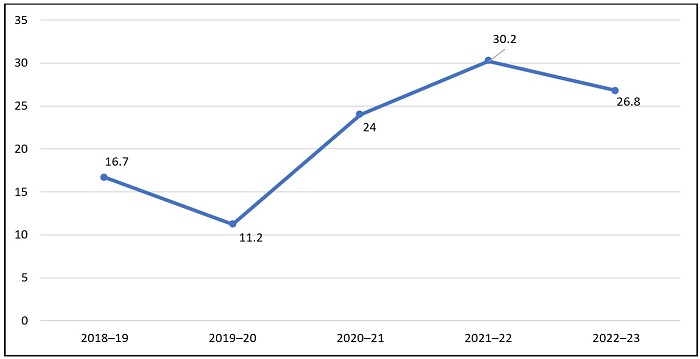
Consider the table below, which shows the state’s chronic absenteeism trends over the last five school years. Prior to the pandemic, Ohio’s chronic absenteeism rate was well below 20 percent. During and after the pandemic, though, rates shot up, and reached a whopping 30 percent in 2021–22.

Figure 1. Statewide chronic absenteeism rate, 2018–2023
OH needs accurate absenteeism data blog figure 1

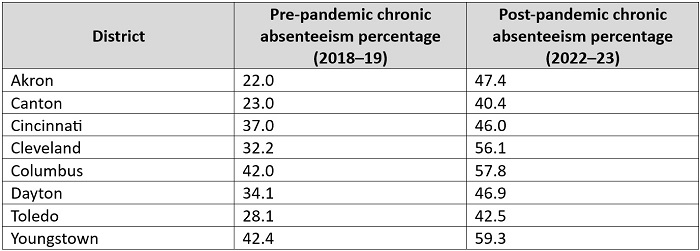
Things look even worse for high-poverty districts. The table below provides the pre- and post-pandemic chronic absenteeism rates in the Big Eight, the state’s largest urban districts. In each district, the most recent rates are markedly higher than they were pre-pandemic. In at least three districts—Cleveland, Columbus, and Youngstown—the chronic absenteeism rate is well above 50 percent. That means the majority of students enrolled in these districts are missing enough school to be identified as chronically absent.

Table 1. Pre- and post-pandemic chronic absenteeism percentages in the Big Eight
OH needs accurate absenteeism data blog table 1

It’s important to remember what these sky-high percentages mean. It’s not just that students are missing a few classes. It’s that huge numbers of them are missing at least 10 percent of their instructional time, possibly more. That would be egregious enough on its own. But given how important instructional time is to helping students catch up from pandemic-caused learning loss, these percentages are horrifying.

With these data in mind, it is essential that Ohio stays the course. Districts and the state must continue their rigorous absenteeism tracking efforts so that we know how severe the problem is statewide, which districts are struggling most, and how the numbers are—or aren’t—improving over time. Districts and schools need to renew their commitment to consistent parental notification and the intervention efforts required under law.

Unfortunately, lawmakers are considering doing the opposite. A recently proposed amendment to Senate Bill 49 recommends making several troubling changes to existing school attendance laws.

First, the amendment seeks to establish a list of “legitimate excuses” for a student’s absence from school. Such excuses would include all of the following:

  • Illness of the student

  • Illness in the family necessitating the presence of the student

  • Quarantine in the house

  • Death of a relative

  • Medical, behavioral, or dental appointment

  • Observance of religious expression days

  • College visitation

  • Pre-enlistment reporting to a military enlistment processing station

  • Placement in foster care or change in foster care placement or any court proceedings related to the student’s foster care status

  • Student homelessness

  • Deployment activities of a parent or guardian

  • Participation in scheduled 4-H and FFA activities or programs

  • Farm work of the parent or guardian during a time of year in which the amount of work to be performed is exceptional

  • Inability of the parent or guardian to employ help in the family business, as determined by the district superintendent

  • Emergencies or any other set of circumstances which, in the judgment of the school district superintendent, constitutes a good and sufficient cause for absence

Obviously, this is a huge list, which is a problem in and of itself. As the Department of Education has pointed out, missing too much school has “detrimental effects on a student’s learning trajectory,” regardless of whether an absence is excused or unexcused. Some of the issues in this list might be understandable reasons for absence—kids do get sick and family emergencies do arise—but whether the absence is understandable doesn’t change the fact that it’s still an absence. When kids miss school, they miss instructional time, and that can have short- and long-term academic consequences. Those are consequences we can’t afford in the wake of pandemic learning loss. Even worse, some of these things—like a parent’s inability to employ help in the family business—should not be considered a legitimate reason for a child to miss school. Homeless students and children in foster care might miss more class than their peers due to circumstances that are outside of their control, but counting those absences as excused and failing to track them (more on this below) does nothing to help those students. Given the awful chronic absenteeism numbers on this year’s state report cards, the last thing the state should be doing is offering districts and parents a mile-long list of all the reasons why it’s OK to miss school.

Second, the amendment would specify that the first cumulative sixty hours that a student is absent from school with a legitimate excuse cannot be factored into habitual truancy determinations. This change would torpedo state and district efforts to intervene with frequently absent students by allowing them to miss sixty hours—approximately nine days, or nearly two weeks—of school for “free” before districts start counting their absences.

Third, the department would be prohibited from including absences for which a student has a legitimate excuse in the calculation for the chronic absenteeism indicator on school report cards. This change would render the state’s effort to hold districts accountable for improving their attendance rates essentially useless by incentivizing them to encourage students and parents to provide “legitimate” excuses for absences. Under current law, students are labeled chronically absent if they miss at least 10 percent of instructional time for any reason. That amounts to roughly 100 hours for students in grades 7–12, and ninety hours for students in grades K–6. Under the proposed amendment, students could miss 10 percent of their school year but still not be considered chronically absent as long as they offered a “legitimate” reason.

Ohio can’t afford to take its foot off the gas when it comes to chronic absenteeism. The stakes for students are way too high. State leaders have done good work over the last decade to improve policies around data collection and intervention efforts aimed at keeping kids in school. Backing down from those policies now, when chronic absenteeism is at an all-time high and schools are still struggling to catch students up from pandemic-caused learning loss, is the wrong move. 

view
Changes to REP blog image

Ohio’s long and winding road back to where it started with novice teachers

Jessica Poiner
9.18.2023
Ohio Gadfly Daily

In 2011, Ohio lawmakers introduced a state initiative focused on new teachers—specifically, those who were in the first four years of their career. The policy was referred to in law as the Ohio teacher residency program, though it’s now more widely known now as the Resident Educator Program (REP), and it was designed to mimic the residency model used by the medical field. Like doctors, Ohio teachers would graduate from training programs and then complete a residency under the watchful eye of veterans who were charged with mentoring them. Every newly licensed teacher in the state was required to participate in the program, and successful completion was a prerequisite for moving on to a professional and renewable teaching license.

According to the Ohio Department of Education, the goals of REP were to “improve teacher retention, enhance teacher quality, and result in improved student achievement.” Given the evidence pointing to the benefits of induction and mentoring programs for new teachers, lawmakers were right to think that REP could accomplish those goals. Moreover, setting a high bar for teachers to enter and remain in the classroom is important. Research is clear that teachers matter most among school-related factors when it comes to students’ academic performance, and quality teaching improves not only student achievement, but labor market outcomes.

Unfortunately, research and good intentions weren’t enough to take REP from promising policy to standard practice. That’s because almost immediately after the initiative went into effect, lawmakers started to tinker with it, and they’ve yet to stop. To be clear, not all of these adjustments were bad. But they were made prior to earnest implementation and without hard data to back them up, and that’s resulted in death by a thousand cuts for a teacher residency program that had a lot of potential.

Don’t just take my word for it, though. Consider the following timeline of changes:

  • In 2015, the state budget made several changes to the residency program. Chief among them was an effort to raise the bar for teachers—a crucial policy goal, given how much teachers matter. In this case, lawmakers sought to raise expectations via the Resident Educator Summative Assessment (RESA), a performance-based test prescribed by the state board that requires teachers to submit a portfolio of tasks online, including videos of them teaching, so that trained reviewers can evaluate their ability to design and deliver high-quality instruction. Specifically, the budget included a provision that identified RESA as one of the required “measures of appropriate progression” through REP. Since successfully completing REP was already a prerequisite for a professional educator license, and resident educators had to obtain a professional license to continue teaching in Ohio, this change effectively made passing RESA a requirement for any new educator who wanted to make teaching their long-term career.

  • In 2017, the General Assembly did an about face and attempted to eliminate the residency program. These efforts appeared to be driven by significant pushback from the field regarding the 2015 changes, namely the expectation that new teachers had to pass a tough performance-based assessment to remain in the classroom. Rather than stand their ground, lawmakers caved and sought to get rid of the policy in its entirety. A last-minute veto from Governor Kasich saved the program, but the complaints prompted a significant administrative overhaul of the test soon after. The biggest change was to significantly decrease the amount of work required of resident educators. Now, instead of completing four graded tasks to pass the assessment, they have to complete just one. The overhaul also changed how teachers are graded on RESA and how they receive those grades.

  • Beginning in 2018, resident educators were permitted no more than three total attempts to successfully complete RESA. Those who failed to pass after three attempts would be permanently ineligible to advance to a professional license or to renew or extend their existing resident educator or alternative resident educator license. This change—another attempt to hold a high bar—meant that not only did new teachers have to pass a performance-based assessment to remain in the classroom, they only had three tries to do so.

  • In 2021, House lawmakers tried and failed to amend the law so that teachers could take RESA an unlimited number of times. That same year, legislation was enacted that reduced the duration of REP from four years to two.

  • In the 2023 budget, lawmakers made some changes aimed at streamlining the support new teachers receive through the program. For example, mentoring for novice teachers can now be provided online or in-person. Going forward, teachers and mentors will have free access to online professional development resources and sample videos of lessons submitted for RESA purposes. And novice teachers who do not receive a passing score on RESA will be provided with the opportunity (at no cost) to meet online with a trained instructional coach who will review the teacher’s RESA results and discuss with them strategies and professional development that could help them improve. The budget also includes a provision that prohibits the state board from limiting the number of attempts novice teachers have to successfully complete RESA.

Clearly, Ohio’s novice-teacher policy has been on a rollercoaster for more than a decade. As a result, the state’s promising residency program has been transformed into one of those “what I ordered versus what I got” memes that proliferate on social media. There is a mentorship component. But it only lasts two years, mentorship doesn’t have to happen in-person, and there’s no clear-cut accountability for mentors or schools to ensure they’re doing right by new teachers. There’s also a performance-based assessment. But it’s been significantly simplified, and teachers have as many bites of the apple as they need.

Worst of all, this isn’t a first-of-its-kind transformation. Ohio leaders do this all too often. They decide to take a stand by setting high expectations and pushing for improvement. They receive predictable but persistent pushback. And then they cave to the pushback and repeatedly water down standards until the new policy is indistinguishable from the original policy they set out to improve. One need look no further than the not-so-distant wars over school intervention, graduation requirements, and reading retention for proof. Unfortunately, after more than a decade of turmoil, it seems we can now add novice teachers to the list, too.

view
Lavertu Fiscal cliff blog image

The Great Recession offers insight about the impact the impending fiscal cliff will have on Ohio school districts

Stéphane Lavertu
9.11.2023
Ohio Gadfly Daily

Some Ohio public schools may be headed for a world of hurt. They’ve been on a spending binge due to the massive $6.7 billion infusion of federal pandemic relief funds, and they’re facing a potentially devastating fiscal cliff when those funds run out during the 2024–25 school year.[1] If school leaders don’t plan wisely for the phase-out of these emergency dollars, student progress could suffer in the years ahead. And because the funds were distributed in a manner that awards more money to low-wealth districts, disadvantaged students are at greatest risk.

The purpose of the unprecedented federal aid was to help schools reopen safely and remediate student learning loss. But the dilemma facing many districts today is that they’ve used the temporary funds to take on long-term financial obligations, such as hiring new staff and raising educator salaries, that will be difficult to scale back when these dollars dry up. Indeed, some districts have taken on additional long-term spending when they should have been cutting expenses to address both long-term and pandemic-related enrollment declines.

The influx of federal funds has also significantly distorted district budgets, in that some districts have been so awash in money that they have little sense for the essential costs of running their schools and what they can afford. For example, over the last three years, Columbus City Schools has been awarded nearly $475 million dollars in federal Covid money, which is about half of the district’s pre-pandemic annual expenditures.[2] Even if Columbus City Schools has somehow maintained perspective on how to run a district within its means, getting back to a right-sized budget could be a shock to the system. The district’s May 2023 budget forecast mentions the impending “fiscal cliff” as a “significant risk,” specifically noting concerns about how to pay for 430 new full-time staff members hired using pandemic relief funds. This figure likely understates the excess staffing, as enrollment declines warranted cuts in district staff.

By now, all Ohio districts should see the fiscal cliff coming. The federal government made clear that these were emergency funds, not a permanent allocation, and budgeting experts and government officials have regularly warned districts about the approaching cliff. Ohio is also one of the few states that requires school districts to conduct and report multi-year financial forecasts, which forces districts to grapple with projected declines in future revenue. Sensing the coming storm, some districts are already cutting spending or putting tax levies on the ballot, hoping local taxpayers will bail them out by paying for some of their new, long-term obligations, such as increases in staffing and salaries. The Ohio General Assembly’s financial generosity in recent years will cushion some of the blow, as well.

Even if districts see the cliff coming, however, my research on the aftermath of the Great Recession—when federal American Recovery and Reinvestment Act (ARRA) funds eventually expired—suggests that the negative impact on student achievement will be significant if they don’t plan wisely.[3] Districts can make significant errors when forecasting future funding streams, even when they generate forecasts at the end of one school year about how much revenue they will have in the next year, just a few months later. That’s how uncertain school financial management can be. A surprise revenue shortfall due to an overly optimistic forecast requires districts that lack cash reserves to make sudden budget cuts that can disrupt district operations and student learning. Pandemic aid has significantly distorted district finances and make costly forecasting errors more likely after federal money runs out beginning in 2025.

The impact of such forecasting errors can be significant. My coauthor, Travis St. Clair, and I found that after federal stimulus funds ran out in 2012, every percentage point increase in unexpected revenue shortfalls led to a decline in student achievement of 0.02 standard deviations (about eight days’ worth of learning) among Ohio public-school students. For the average district that had an unexpected revenue shortfall (approximately 15 percent of Ohio districts in a given year), students lost about three weeks’ worth of learning relative to students in districts that spent a comparable amount per pupil but that did not make such a forecasting error. Predictably, these shortfalls corresponded to sudden cuts in staff and efforts to raise revenue with new tax levies on district residents.

The harmful disruptions documented in our study were not due to lower spending levels or the shock of the Great Recession itself. The negative impacts all occurred after federal relief funding expired after 2012—three years after the recession ended—because districts failed to accurately forecast changes in revenue. Students experienced achievement declines because districts unexpectedly had to cut spending all at once, as opposed to gradually reducing spending in anticipation of lower revenue in the future.

As one would expect, the large negative impact of budget forecasting error was particularly acute among districts with relatively low cash balances. Districts with cash balances below the median of 22 percent of annual operating expenditures—just over the sixty days of reserves at the top end of recommendations from the Ohio Department of Education and the Government Finance Officers Association—experienced large student achievement declines. Further analyses (which we did not publish) suggested that these districts continued to cut expenses in subsequent years—even in the absence of forecasting errors—as they sought to build up their depleted reserves.

Although it is easy to identify districts most at risk because they received the most federal aid (as a percentage of pre-pandemic expenditures) or experienced the largest enrollment declines, it is difficult to identify the districts most at risk due to low fund balances. One could use budget forecasts for fiscal year 2026 (FY26) to assess projected fund balances after pandemic funding is set to expire, but this wouldn't take account of planned tax levies meant to sustain current spending (e.g., the replacement of expiring tax levies). There’s also the possibility that districts might inflate costs or understate revenues if they look to secure voter approval for a tax levy. So looking at forecasted FY26 cash balances could vastly overestimate the number of districts at risk. Nevertheless, by my calculations using May 2023 financial projections, if no districts passed levies ahead of FY26 and if projected expenses are accurate (both of which are doubtful), then 140 Ohio districts will have cash balances of under 10 percent of expenditures or less and 224 will have balances of less than 20 percent of expenditures.

Districts tend to be conservative when forecasting revenues relative to expenditures, typically by a magnitude of 2–3 percentage points during the period of our study (2009–16).[4] It seems to me that all districts should err on the side of being even more conservative than usual in their budget forecasts for FY26 and FY27. Post-ESSER budgets are a “known unknown,” as our study clearly documents the negative impact of budgeting uncertainties after federal funding runs out. Districts receiving a lot of federal aid should assume that there’s a good chance they’ll get their forecasts wrong because of the distortions that relief funds introduce.

Although my analysis focuses on revenue shortfalls that Ohio districts didn’t anticipate, it’s important to reiterate that shortfalls are often entirely predictable and of districts’ own making. That’s because districts often lack the political will and strength to manage their finances such that necessary spending cuts occur gradually. For example, a district experiencing declines in enrollment might continue to run under-enrolled buildings as long as possible to avoid upsetting local stakeholders by consolidating schools. In the case of pandemic funds, they might be waiting for the post-2025 budget shortfall before closing under-enrolled buildings or laying off staff, as stakeholders might be less likely to punish them for the closures when it comes in the wake of fiscal stress. Such political expediency may save the district some controversy and the wrath of teachers unions—at least for a time—but it comes at the expense of kids’ learning and wellbeing. If done gradually and carefully, however, the closure of low-performing schools and the layoff of ineffective or unnecessary staff can even improve student learning.

Districts are likely making major errors in forecasting future revenues (a “known unknown”), and many have taken on financial obligations they know they can’t afford (a “known known”). The former requires conservative revenue forecasting to mitigate risk, and the latter requires that districts phase in spending cuts immediately to avoid the negative impact of making sudden larger cuts down the line. My research on Ohio districts in the wake of the Great Recession makes clear that students will suffer if districts fail to act accordingly. 

Stéphane Lavertu is a Senior Research Fellow at the Thomas B. Fordham Institute and Professor in The Ohio State University’s John Glenn College of Public Affairs. The opinions and recommendations presented in this editorial are those of the author and do not necessarily represent policy positions or views of the John Glenn College of Public Affairs or The Ohio State University.


[1] The final batch of Elementary and Secondary School Emergency Relief (ESSER) funds must be obligated by September 30, 2024, the end of the 2024 federal fiscal year. The funds must be spent (“liquidated”) by January 20, 2025, though districts can apply for extensions so long as funds are obligated by the deadline.

[2] This figure includes non-ESSER funding sources. See page 46 of their May 2023 financial forecast.

[3] Stéphane Lavertu and Travis St. Clair. (2018). “Beyond spending levels: Revenue uncertainty and the performance of local governments” Journal of Urban Economics 106: 59-80. The pre-print version available here. Published version is here.

[4] Research has documented that both state and municipal governments systematically (and often purposefully) under-forecast revenues by a similar magnitude.

view
School board turnout blog image

Why Ohio’s school board elections should be on-cycle

Aaron Churchill
9.12.2023
Ohio Gadfly Daily

It’s September and that means fall elections are coming soon. Not that election—the presidential is still more than twelve months away—but local school board races are right around the corner. These are important contests, as school boards play a critical leadership role in public education, but if history is any indication, turnout will be small.

First, why are school boards so important? These bodies establish the academic policies and priorities that drive district actions. They adopt curricula and instructional materials and institute policies that heavily impact the daily work of educators. They make budgetary choices about which programs are funded or cut, and with district administrators, they negotiate sprawling, multi-million-dollar employment contracts with the unions. They also make decisions about putting local tax requests on the ballot, which can directly impact citizens’ finances. Last but not least, their attitudes and values can influence the way districts respond to the sensitive, sometimes charged, issues that arise in education.

Despite the significant powers and responsibilities of school boards, appallingly few citizens vote in these elections. One key reason for the low turnout is their “off-cycle” timing. School board races—along with other municipal elections, per state law—are held in odd-numbered years when national and statewide elections are off the ballot. That needs to change, and here’s why.

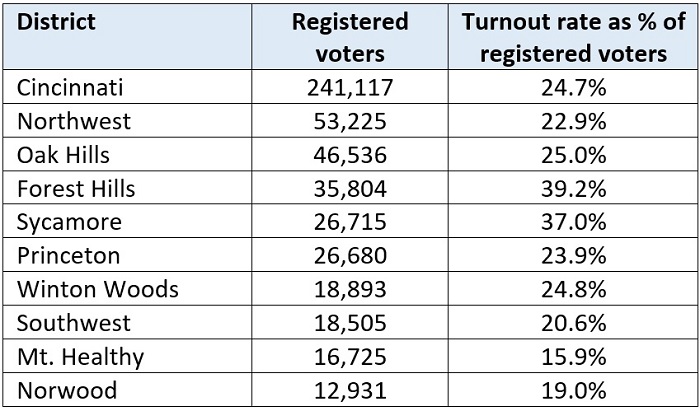
Table 1 shows the sharp differences in turnout for the most recent fall elections in Ohio’s three most populous counties. In Cuyahoga County, an abysmal 27 percent of registered voters participated in the fall 2021 off-cycle elections when school board races were contested. Meanwhile, 71 percent of the county’s voters went to the polls in fall 2020—a presidential election—and 47 percent voted in fall 2022 (mid-terms). The turnout patterns are very similar in Franklin and Hamilton counties.

Table 1: Voter turnout rates for off-cycle (2019 and 2021) and on-cycle (2020 and 2022) elections

School board turnout blog table 1
Source: Cuyahoga, Franklin, and Hamilton County boards of elections. This table displays turnout rates as a percentage of registered voters who voted in an election cycle (rates would be lower if the total voting-age population were used).

Given these countywide numbers, turnout for school board races at an individual district level are predictably low. Just a quarter of Cincinnati voters went to the polls to choose district board members in the 2021 cycle. Less than 20 percent of voters in Mt. Healthy and Norwood turned out.

Table 2: Voter turnout rates in ten largest Hamilton County districts by voter registration, fall 2021

School board turnout blog table 2
Source: Hamilton County Board of Elections

Low turnout shouldn’t be laid at the feet of citizens, many of whom are busy with occupational and family responsibilities. It’s possible that employers may not give employees time off to participate in off-cycle elections, as they do for national races. And some voters may not have the bandwidth to plug into board races that are held at a time when politics and campaigning is usually more subdued. Writing recently in The Atlantic, Jerusalem Demsas opines, “We have too many elections, for too many offices, on too many days. We have turned the role of citizen into a full-time, unpaid job.... One of the most pernicious ways politicians overburden voters is by holding off-cycle elections.”

Scholars also contend that sleepy school board races give disproportionate influence to certain segments of the electorate—most notably, district employees. This voting bloc has an obvious self-interest in school board elections, no matter when they are held, as sympathetic boards can ease working conditions, provide more generous leave, and increase pay, among other things. Moreover, because most district employees are unionized, they can organize both themselves and their allies to vote as a unified bloc for a “slate” of union-endorsed candidates. In most districts, no other group is likely to have the same organizational capacity to get candidates elected, especially during an oddly-timed school board race.[1]

Commenting on the undue sway of employee unions in low-turnout races, Stanford University’s Terry Moe writes, “In school-board elections, the incentives of the teacher unions are strong and clear. If they can wield clout at the polls, they can determine who sits on local school boards—and in so doing, they can literally choose the very ‘management’ they will be bargaining with.” A study by Sarah Anzia of the University of California finds that teachers do in fact benefit from this cozy arrangement. They receive higher pay when their districts hold off-cycle races, with senior teachers accruing the greatest benefit.

Ohio lawmakers should put an end to these poorly attended and skewed elections, and instead require school board races to appear on the ballot in even-numbered years. This “on-cycle” scheduling would substantially increase voter turnout, as Ohioans could select their local board members at the same time they cast their vote for president, governor, and other national and statewide leaders. This scheduling change would ensure that parents are given a stronger say in their districts’ board membership. It would also promote a more diverse electorate that looks more like the students attending district schools, as less advantaged groups tend to vote at higher rates in general elections. 

Moving school board elections on-cycle not only makes common sense, but should also find bipartisan support. Progressive groups such as the League of Women Voters and the ACLU have long supported voting policies that encourage more public participation. On-cycle board elections certainly check that box. Conservatives, too, have lent support for on-cycle elections, arguing that it would increase public accountability and enhance the voice of parents. Former Ohio Secretary of State Ken Blackwell (R) recently wrote in the Cincinnati Enquirer: “If we can increase voter turnout in school board elections [through on-cycle voting] and get more parents to vote, we are likely to see a school board with policies more representative of the entire constituency rather than one small group.”

For democracy to work, citizens should be encouraged to participate in the electoral process. Unfortunately, off-cycle timing suppresses widespread public participation in school board elections and gives special interests undue power to “capture” the board. To give all citizens a more equal voice in district leadership, it’s time for Ohio lawmakers to move school board elections on-cycle.  


[1] Seniors also disproportionately vote in off-cycle elections, but they may not vote as a bloc in the same way as employee unions. They are also unlikely to have the same organizational structure to influence other voters.

view
SB 104 CCP changes blog image

Ohio Senate proposes much-needed tweaks to College Credit Plus

Jessica Poiner
9.13.2023
Ohio Gadfly Daily

During the 2015–16 school year, Ohio launched a revamped dual-enrollment program called College Credit Plus (CCP). This state-run, state-funded program offers academically eligible students in grades 7–12 the opportunity to earn postsecondary credit by taking college courses for free before graduating from high school. State law requires all public schools and public colleges and universities to participate, but dozens of private schools and private higher education institutions also choose to do so.

Given the state’s significant investment—just over $55 million was paid to colleges and universities through CCP in 2022—as well as the program’s myriad potential benefits for students and families, it’s imperative that state leaders keep a close eye on it. In 2021, the Ohio Auditor of State conducted a performance audit that offered an in-depth look at the program.

The good news is that overall participation, student impacts, and tuition savings are positive. The bad news is that traditionally underserved groups are missing out on CCP’s benefits for a variety of reasons, and one of them seems to be a lack of state oversight. The audit found that there were “significant levels of non-compliance with program requirements among school districts.” For instance, surveys revealed that nearly half of districts—43 percent—didn’t start communicating with students about CCP until high school, even though state law requires them to begin in sixth grade. Similar non-compliance issues cropped up with digital information access. Districts are required by law to promote CCP on their website, but 37 percent reported that they didn’t. In both cases, districts that followed the law—they began their communication efforts prior to high school, and promoted the program on their website—reported a higher number of CCP hours per student.

The audit also suggested that by modifying forms and muddying informational waters, some districts were discouraging students from participating (perhaps because CCP courses are funded via a deduction to districts’ state aid). The Ohio Department of Higher Education provides schools with standard templates for program applications and forms, but the audit notes that it’s “common” for districts to edit these templates before using them. The department’s annual notice form, for example, is intended to provide families with concise and accurate information about CCP. But approximately 80 percent of the documents reviewed by the audit team were different from the template, and more than half were missing at least one element. Audit findings also indicated that some districts added “guidance” regarding costs to their intent to participate forms. Because they “did not clearly indicate” that the default participation option allows students to complete courses for free, families might have assumed there was a substantial cost associated with the program and avoided signing up.

You might be wondering how a state-run program that’s well past its infancy could allow so many districts to break or bend the law to the detriment of students. The audit offers an answer: Because there’s no “formal compliance or oversight function for CCP” established in law, the state education agencies that oversee it “are not required to, and have chosen not to, take the initiative necessary to follow through with compliance-related activities.” In other words, even though the law says that districts have to do these things, no one is making sure they actually do. As a result, students and families all over the state are losing out on the potential benefits of dual enrollment.

Fortunately, lawmakers have been paying attention. Senate Bill 104, which was introduced this spring, would address many of the problems identified by the audit. The most significant provision mandates that the leaders of the state agencies responsible for running the program—the Department of Education and Workforce and the Department of Higher Education—shall “monitor and enforce compliance” with state requirements for public and participating nonpublic secondary schools, state colleges and universities, and participating private institutions of higher education. This explicit mandate would add much-needed oversight to the program, and would eliminate the existing loophole that allows districts and schools to ignore state rules and laws.

Should it become law, the bill would also do the following:

  • The Department of Education and Workforce would be responsible for including on state report cards data indicating whether a school provides information to students and families about CCP and promotes the program as required by law. This data wouldn’t be a rated component, and would be identified by a simple “yes” or “no.” 

  • Public and participating nonpublic schools would be required to use forms developed by the state. Schools would be prohibited from modifying any form without approval.

  • Public and participating private colleges would be required to provide participants with an orientation that meets guidelines issued by the overseeing agencies. This is likely an effort to smooth students’ transition between high school and college courses.

  • Under current law, students or their parents must notify their secondary school by April 1 that they intend to participate in CCP the following school year. SB 104 would adjust this timeline and allow for notification prior to the next semester rather than the next school year. There would still be a notification deadline chosen by the chancellor of higher education, but allowing students to opt-in every semester rather than once a year should make CCP more easily accessible.

  • The chancellor would be required to establish an alternative credentialing process to certify as CCP instructors those who have relevant teaching experience without requiring them to complete additional graduate-level coursework. This follows in the footsteps of other recent state policy changes seeking to eliminate burdensome requirements that keep qualified teachers out of classrooms.

  • Current law requires secondary schools to treat CCP courses as equivalent to AP, IB, and honors courses when awarding grades and determining class standing. That means if it’s school policy to weight AP, IB, or honors courses, then CCP courses must be weighted, as well. SB 104 clarifies that this requirement pertains to all CCP courses.

  • Under current policy, the cost of college textbooks is deducted from district funding when a student participates in CCP. These costs have long been the subject of ire from districts, which complain that prices are too high and textbooks often go unused. SB 104 would address this issue by requiring participating colleges and universities to “endeavor to use open-source materials, in lieu of purchase-only textbooks” in CCP courses as much as possible. If a purchase-only textbook is used when open-source materials are available, the higher education institution would be required to cover the textbook cost. However, if there are no open-source materials available, the cost of the textbook would be split fifty-fifty between the institution and the secondary school.

All things considered, SB 104 is a smart piece of legislation that directly addresses many of the issues identified by the CCP audit. These changes would strengthen the program, and would help ensure that every academically-prepared student has access to dual-enrollment courses. Here’s hoping lawmakers take up and pass SB 104 during the upcoming legislative session.

view
PIRLS learning loss SR image

2021 PIRLS test results starkly illustrate global learning loss

Jeff Murray
9.18.2023
Ohio Gadfly Daily

The first pandemic-influenced data from the Progress in International Reading Literacy Study (PIRLS) test are in. Unsurprisingly, an initial analysis says the news is bad.

PIRLS is administered every five years to a representative sampling of fourth grade students in more than fifty countries and regions around the world (including the U.S. and other industrialized nations, as well as some less-developed countries). It provides internationally comparative data on how well children read; the trend data are meant to measure the big picture ups and downs in reading achievement over time. This report offers almost no nation-specific results—including for the United States.

The new study compares results from assessment rounds in 2001, 2006, 2011, 2016, and the most recent in 2021. The sample includes more than 1 million students from each administration, but represents more than 16 million boys and girls worldwide. Achievement is compared using traditional socio-demographic characteristics, but in the years since Covid disrupted education worldwide, the influence of school closures has become a new data point of extreme interest. To wit: Principals in PIRLS schools were asked to estimate the number of weeks during the testing year “where normal primary school operations have been affected by the COVID-19 pandemic.’’ As an additional measure of pandemic disruption, the researchers utilized UNESCO data on the length of government mandated school closures in countries and regions.

The researchers model the effect of school closures on student achievement by predicting the deviation of the most recent 2021 results from an estimated linear trend in reading achievement using data from the four previous testing rounds included in the analysis. They estimate each country or region’s linear trend separately—including country-level fixed effects to control for unobserved characteristics—and report the difference between the estimated and the actual outcomes. Overall, reading achievement declined by 15 points on average across countries, or 18 percent of a standard deviation (SD). Since some countries delayed test administration due to the pandemic, the researchers also adjusted their analysis to account for students of differing ages and grade levels. This effort finds an even larger decline: 27 points, or 33 percent of an SD overall, which the researchers point out is roughly equivalent to a year’s worth of learning loss. Some countries, such as India at 73 points, lost even more.

The longer schools stayed closed, the worse their students performed on the PIRLS test. Countries with no school closures per UNESCO data (such as Australia and Sweden) achieved results in 2021 that accord with predicted outcomes. That is, they saw no decline in achievement based on previous trends. With each week of full or partial school closures, though, the results decline by 0.8 points from predictions. Thus, ten weeks of full or partial closures resulted in an 8-point decline (or 9 percent of an SD), twenty-five weeks resulted in a 20-point decline (24 percent of an SD), and fifty weeks resulted in a nearly 40-point decline (47 percent of an SD). To highlight India once again, their schools were partially or fully closed for 93 weeks, and its students registered one of the largest learning losses per this international test.

There was no difference in the findings for boys versus girls, but lower-achieving students (here defined as the first decile of achievement) experienced much larger losses than their higher-achieving peers. For example, in countries with ten weeks of full or partial closures, high achievers experienced no loss, while the lowest performing students lost 12 points. But in countries with fifty weeks of full or partial closures, the best students lost 28 points, while their low-achieving peers lost 37 points. Interestingly, there was barely any difference in outcomes for countries which postponed their PIRLS administration compared to those which did not postpone. This suggests that, for up to a year, countries’ efforts to mitigate the losses experienced during the pandemic were minimally effective. 

Interested readers can peruse supplementary data, which is broken down by country/region, indicating that there is considerable heterogeneity across them, especially in terms of student achievement in the face of school disruptions. But there are no direct comparisons between countries provided by these researchers. The new report, unfortunately, leaves it at the overall finding for this one international test of reading achievement: A bleak picture of global learning loss directly tied to the length of school closures.

SOURCE: Maciej Jakubowskia, Tomasz Gajderowicza, and Harry Anthony Patrinos, “Global learning loss in student achievement: First estimates using comparable reading scores,” Economics Letters (August 2023).

view

Test-based retention, student achievement, and sibling spillover effects

Jeff Murray
9.14.2023
Flypaper

Most public policy efforts are very specific about the individuals or groups intended to benefit from their implementation, and evaluations of such policies generally stick to impacts on the target population. However, education policies aimed at helping certain K–12 students can also have wider implications for other students. A recent working paper from David Figlio, Krzysztof Karbownik, and Umut Özek illustrates this very clearly by focusing on the ways a mandatory third grade retention policy impacts others through a “sibling spillover” effect.

Florida’s third grade retention policy was enacted in 2002 as part of a broad literacy push. Students who do not meet a designated target score on the state test (called “Level 2”) are, with a few exceptions, retained in third grade and—importantly—given substantial additional instructional support. This includes development of an academic improvement plan that address students’ specific learning needs, assignment of students to high-performing teachers, providing at least ninety minutes of daily reading instruction, and offering six to eight weeks of summer camp that facilitates intensive reading intervention.

The researchers focus on seven cohorts of students who entered third grade in Florida for the first time between 2002–03 and 2008–09, as well as their closest younger sibling. Sibling identification comes from administrative date from the Florida Department of Education. Students without identified siblings are excluded. The researchers limit their sample to sibling pairs where the younger sibling was already enrolled in a public school (kindergarten through second grade) at the time when the older sibling entered third grade for the first time. Treatment group students were those third-graders retained when falling just below the Level 2 cutoff, along with their siblings. A comparison group of students comprised third-graders who scored just above the cutoff, along with their siblings. All students were followed through fifth grade.

Overall, students retained in third grade showed improved test scores (approximately 0.2 standard deviations in both reading and math) and lower likelihood of grade repetition in future elementary grades than their peers who scored just above the Level 2 cutoff. This accords with other research showing similar outcomes. But the big news is that the nearest younger siblings of retained students also showed improved test scores (between 22 and 31 percent of the effects on their older siblings), as compared to students with non-retained older siblings. The effects were particularly pronounced in families where one of the children had an IEP, for boys, and in immigrant families.

What’s going on here? The analysts suggest, with abundant caution, that some combination of in-school and home-based factors are involved. For some reason, the younger siblings of retained third-graders are significantly more likely to be assigned to higher-quality teachers (using value-added scores) than their control group peers, and are also more likely to be in classrooms with higher-performing classmates. On the home side, data suggest that parents of retained third-graders are more likely to move their younger children (although not the retained child) to higher-performing and better-resourced schools, particularly in terms of reading resources.

While nothing causal can be concluded using the available data, the firm indication is that test-based retention triggers action in both educators and parents—not just for the retained student, but also for his or her younger sibling. Researchers should dig further to figure out the details and to see if the same spillover effects can be found elsewhere. But the headline finding should also stand on its own: Test-based retention policies accompanied by strong student supports can work even better than intended.

SOURCE: David Figlio, Krzysztof Karbownik, and Umut Özek, “Sibling Spillovers May Enhance the Efficacy of Targeted School Policies,” Retrieved from Annenberg Institute at Brown University (June 2023).

view
Media alerts stock image

Fordham Institute statement on Ohio’s school report cards

Ohio Education Gadfly
9.14.2023
Ohio Gadfly Daily

This morning, the Ohio Department of Education released its annual school report cards based on results from the 2022-23 school year. This year’s iteration makes clear that the impacts of the pandemic on student learning are still being felt, especially for students from less advantaged backgrounds. As usual, the report card also includes user-friendly ratings that assist parents and citizens who seek information about the quality of schools in their community. For the first time since 2019, this year’s report card features an overall rating—on a scale of one to five stars—that summarizes the performance of each district and school.

“All Ohio students deserve to attend schools that unlock their full potential,” said Aaron Churchill, Ohio Research Director for the Thomas B. Fordham Institute. “Through a user-friendly overall rating, this year’s report card shines a light on the many excellent public school options available to parents. It also reveals struggling schools that require significant help and intervention to ensure students receive the education they need to succeed.”

Table 1: Overall ratings for Ohio public schools, 2022-23

Fordham Institute_Media Statement on Report Cards Table 1
* This table displays the percentage of public schools (both district and charter) receiving each overall rating. Schools are classified by ODE’s school typologies (e.g., rural or urban).

* * *

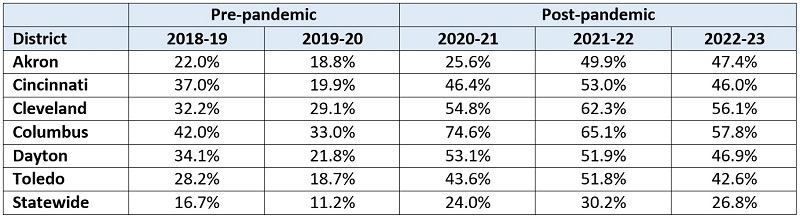
State assessment results from the 2022-23 school year indicate a mixed picture of post-pandemic academic recovery. Ohio students on average have generally recovered in reading, but progress remains sluggish in mathematics with students still significantly behind pre-pandemic levels. Meanwhile, chronic absenteeism data indicate that too many students are missing large amounts of class time. As the chart below indicates, chronic absenteeism soared in 2020-21 and 2021-22, and remains at alarmingly high levels in many Ohio districts.

Table 2: Chronic absenteeism rates statewide and selected urban districts, 2018-19 to 2022-23

Fordham Institute_Media Statement on Report Cards Table 2
*Chronic absenteeism rates are the percentage of students who miss 10 percent or more of the school year for any reason.

“If the pandemic has taught us anything, it’s just how crucial it is for students to be in the classroom,” said Churchill. “Unfortunately, too many students are still missing valuable instructional time that can help them catch up. Parents, communities, and schools need to work together to address chronic absenteeism. Getting back to a clear expectation that students are in school every day, five days a week, is the first step in combatting this attendance crisis.”

Fordham Logo

© 2026 The Thomas B. Fordham Institute
Privacy Policy
Usage Agreement

National

P.O. Box 110
Burke, VA 22009

202.223.5452

[email protected]

Ohio

P.O. Box 82291
Columbus, OH 43202

614.223.1580

[email protected]

Sponsorship

130 West Second Street, Suite 410
Dayton, Ohio 45402

937.227.3368

[email protected]