Mobile Navigation

  • National
    • Policy
      • High Expectations
      • Quality Choices
      • Personalized Pathways
    • Research
    • Commentary
      • Gadfly Newsletter
      • Flypaper Blog
    • Events
    • Scholars Program
  • Ohio
    • Policy
      • Priorities
      • Media & Testimony
    • Research
    • Commentary
      • Ohio Education Gadfly Biweekly
      • Ohio Gadfly Daily
  • Charter Authorizing
    • Application
    • Sponsored Schools
    • Resources
  • About
    • Mission
    • Board
    • Staff
    • Career
Home
Home
Advancing Educational Excellence

Main Navigation

  • National
  • Ohio
  • Charter Authorizing
  • About

Ohio Menu

  • Topics
    • Accountability & Testing
    • Advanced Education
    • Career & Technical Education
    • Charter Schools
    • Curriculum & Instruction
    • ESSA
    • Evidence-Based Learning
    • Governance
    • Personalized Learning
    • Private School Choice
    • School Finance
    • Standards
    • Teachers & School Leaders
  • Research
  • Policy
  • Commentary
    • Ohio Gadfly Newsletter
    • Ohio Gadfly Blog
    • Events

The Education Gadfly Weekly

Sign Up to Receive Fordham Updates

We'll send you quality research, commentary, analysis, and news on the education issues you care about.
Thank you for signing up!
Please check your email to confirm the subscription.

Ohio Gadfly—Ohio cleans up its industry credentials list

Volume 20, Number 16
8.6.2026
8.6.2026

Ohio Gadfly—Ohio cleans up its industry credentials list

Volume 20, Number 16
view
Ohio cleans up its industry credentials list blog image
Standards & Accountability

Ohio cleans up its industry credentials list

Ohio’s industry-recognized credentialing system for high-schoolers ballooned out of control in recent years—wasting time, inflating grad rates, and leaving thousands of students with unmarketable credentials. All that’s about to stop, and we explain why.

Aaron Churchill 8.6.2026
OhioOhio Gadfly Daily

Ohio cleans up its industry credentials list

Aaron Churchill
8.6.2026
Ohio Gadfly Daily

To improve awareness of CTE opportunities, lawmakers should mirror College Credit Plus

Jessica Poiner
8.11.2026
Ohio Gadfly Daily

Why Ohio’s third-grade retention law worked (until lawmakers killed it)

Vladimir Kogan
8.3.2026
Ohio Gadfly Daily

Two ways Ohio can keep the pedal to the metal on math and reading

Jessica Poiner
8.4.2026
Ohio Gadfly Daily

Effectiveness of co-requisite college remediation: Evidence from Kentucky

Jeff Murray
8.11.2026
Ohio Gadfly Daily
view
CTE communications blog image

To improve awareness of CTE opportunities, lawmakers should mirror College Credit Plus

Jessica Poiner 8.11.2026
Ohio Gadfly Daily
view
Third grade retention report blog image

Why Ohio’s third-grade retention law worked (until lawmakers killed it)

Vladimir Kogan 8.3.2026
Ohio Gadfly Daily
view
TNTP coherence blog image

Two ways Ohio can keep the pedal to the metal on math and reading

Jessica Poiner 8.4.2026
Ohio Gadfly Daily
view
Developmental Education reform SR image

Effectiveness of co-requisite college remediation: Evidence from Kentucky

Jeff Murray 8.11.2026
Ohio Gadfly Daily
view
Ohio cleans up its industry credentials list blog image

Ohio cleans up its industry credentials list

Aaron Churchill
8.6.2026
Ohio Gadfly Daily

Attainment of industry-recognized credentials has soared across Ohio. Just 2.3 percent of students in the graduating class of 2014 earned credentials during high school, while 25.6 percent of the class of 2024 did so. These credentials include anything from basic training certificates in CPR or MS Word to full occupational licenses in welding or healthcare.

State policy is largely responsible for these skyrocketing numbers. Most notably, Ohio allows students to meet alternative graduation requirements through credentials—a strong incentive for schools to encourage credential attainment among students who are struggling to demonstrate competency in reading and math. Credentials are intended to signify students’ acquisition of technical skills and help them gain an edge in the labor market, not simply be a workaround to a diploma.

Without serious quality controls at the state level, the number of graduation-eligible credentials has ballooned to over 700. With so many approved credentials, Ohio schools have discovered the easiest ones to attain and used them to get students to the finish line (and inflate their graduation rates as well as report card ratings).

Understanding the harms of giving students diplomas based on dubious credentials, lawmakers directed the Ohio Department of Education and Workforce (DEW) to review and overhaul the list of credentials applicable for graduation. Last month, the agency unveiled a leaner and more focused list that—if policymakers can hold the line—will encourage the attainment of credentials that are both valued by employers and boost students’ earnings.[1]

Here’s what to know about the reboot.

A new data-driven valuation framework

The previous framework, which linked each credential to a point value between one and 12, did acknowledge that credentials have markedly differing values in the workplace. But points were largely assigned based on gut instinct and anecdote rather than solid, data-driven analysis.

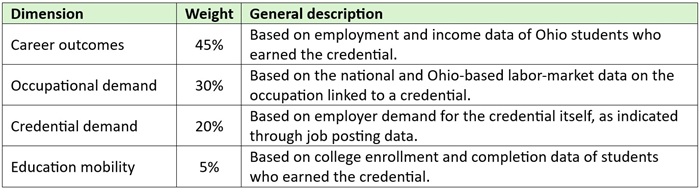
The new system is different. It ties a credential’s value to a slew of labor market and higher education data. As Table 1 shows, data elements are organized around four dimensions that indicate whether the credential opens doors to high-wage, high-demand jobs. Greater emphasis is given to “career outcomes” data—e.g., the earnings and employment rates of Ohio students who earned the credential—and to “occupational demand,” which is based on the labor-market trends of the jobs linked to a credential. Employer demand for the credential itself, as measured by appearances in job postings, and postsecondary data round out the framework. Results from the four dimensions are combined to produce an overall score ranging from 0 to 100. These results inform the approval decisions made by a state committee that is responsible for developing the list of graduation-eligible credentials. The scores, however, are not ultimately decisive, as the committee makes the final call.

Table 1: Overview of Ohio’s new credential-evaluation system

Ohio cleans up its industry credentials list blog Table 1
Note: More detail about the four dimensions, data sources (primarily government datasets and labor-market data from Lightcast), and calculations are available here.

A shorter list of graduation-eligible credentials

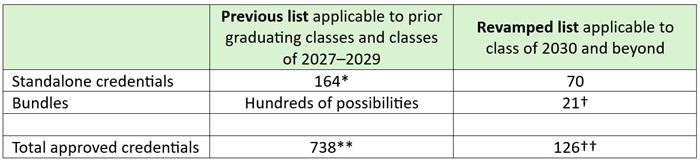
Informed by the results from the valuation framework, Ohio’s credentials committee approved a new list of eligible credentials. Under this system, they are deemed either: (1) standalones—a credential that meets the graduation marker by itself, or (2) bundles—a group of credentials that in combination meet the marker.[2] This bifurcation should be familiar to Ohio schools, but the lists are considerably shorter. On the standalone side, the number of state-approved credentials falls from 164 to 70. Most—though not all—of these standalones are linked to careers in construction, information technology, healthcare, manufacturing, and transportation.

An even more important culling occurred on the bundling side. Previously, struggling students could mix and match several low-level credentials for graduation purposes, with countless combinations possible. That is no longer the case. Moving forward, state policymakers will approve defined bundles that may be applied toward graduation. Just 21 such bundles—mainly tied to construction, healthcare, and manufacturing—made the cut. Bottom line: The new system scales back the number of graduation-eligible credentials from a whopping 738 to just 126.  

Table 2: Comparison of graduation-eligible credential lists

Ohio cleans up its industry credentials list blog Table 2
Notes: (*) These are credentials worth twelve points in Ohio’s current system and are equivalent to a “standalone” credential in the revamped system. (**) This number is based on the list that appeared on the Ohio DEW website in July 2026. (†) This is how many bundles were cited in the DEW press release; technically, there are roughly a dozen more possibilities as students have some (limited) options of which credentials to combine within three bundles (two related to welding and the other to construction). (††) This is the number of standalone credentials plus 56 credentials that can apply to a bundle.

What’s off the list?

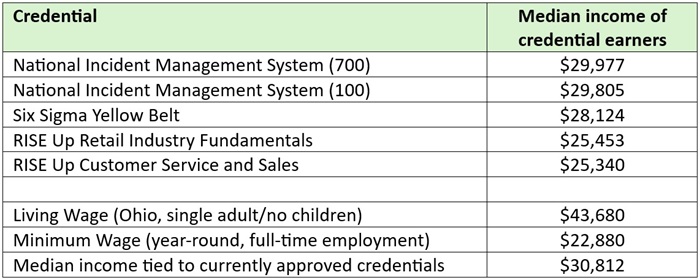
The credentials that schools have commonly used as graduation shortcuts were not approved under the new system. Rightly so, as Ohio students possessing these credentials—table 3 displays five of them—do not come anywhere close to earning a living wage of roughly $44,000 per year. In all five cases, the median annual income of students who attained these credentials fell between $25,000 and $30,000, or barely above the annual salary of a worker being paid minimum wage. They also lagged the income associated with the typical credential earned by Ohio students ($30,812).[3] Though income is only one element in the overall system, the poor wage outcomes associated with these credentials helped keep them off the list. Of note, the committee did approve two frequently earned certificates—CPR First Aid and OSHA-10 safety training—but their use for graduation purposes is now limited to just six bundles (one in healthcare and five in manufacturing). In the previous system, they could apply as part of a bundle across all career fields, which contributed to their widespread use.

Table 3: Median post-high-school incomes of Ohio students who earned selected credentials

Ohio cleans up its industry credentials list blog Table 3
Notes: The median incomes reflect the wages (up to three years post–high school) of Ohio students who earned the credential. The calculation excludes students earning less than $16,000 per year—students likely pursuing higher education, working part-time, or unemployed. The living wage income is based on the MIT living (hourly) wage calculator and 2,080 hours worked per year (year-round, full-time employment). The state’s minimum wage is $11 per hour and is multiplied by 2,080 to yield an annual income.

The challenge moving forward: Maintaining a clean list

The new data-driven system promotes more accurate credential valuations and greater transparency, as the public can see for themselves the underlying data for each credential. It also promises a system that is more immune to low-level credentials. In future review cycles—the next has already begun—vendors, industry groups, and schools seeking inclusion of a credential will need to demonstrate value based on objective workforce data.

But the list of credentials could balloon yet again if policymakers are not careful. Without a data-driven standard for approval—i.e., a minimum cut score—the credentials committee has wiggle room to deviate from the valuation framework. Vendors and industry groups with financial interests and schools looking to maintain sky-high graduation rates could urge the committee to approve their favored credential or pressure it to set a low bar. In fact, even in the midst of the just-completed overhaul, the committee accepted several debatable credentials as standalones. They include three cosmetology licenses that are linked to low pay (below $30,000) and are not likely stepping stones to higher-paying careers.[4] While these credentials are not necessarily “gameable”—they do require substantial time commitments—their approval raises questions about whether committee members will hold the line when other low-payoff credentials are put forward. If cosmetology is in, what about others?

* * *

Ohio policymakers deserve credit for recognizing the problems with pushing meaningless credentials onto students and creating a more empirically based framework to value them. With a tightened list, Ohio will begin incentivizing schools to offer stronger career preparation to the students most likely to join the workforce directly after high school. Policymakers, however, must remain vigilant, as all this work could easily go for naught if the political pressure to water down the credentials list catches up to Ohio yet again. 


[1] The classes of 2027 to 2029 will be able to use the existing credentials list for graduation, or use credentials approved under the new framework. The updated list (without an option to use previously approved credentials) will apply to the class of 2030, with updates to the list occurring annually for the class of 2031 and beyond.

[2] By default, a third category consists of credentials not approved for graduation.

[3] This amount ($30,812) is the median of the median incomes of the 347 credentials for which data were reported among the 700-plus credentials currently approved for graduation purposes (many credentials do not have sufficient number of students earning them to evaluate workforce outcomes).

[4] Several low-paying standalone healthcare certifications (e.g., medical assistant and pharmacy tech) were also approved as standalone credentials, but they may have stronger value as building blocks for higher-paying careers.

view
CTE communications blog image

To improve awareness of CTE opportunities, lawmakers should mirror College Credit Plus

Jessica Poiner
8.11.2026
Ohio Gadfly Daily

For more than a decade, Ohio’s dual credit program, known as College Credit Plus (CCP), has helped academically eligible students in grades 7–12 take college courses for free. According to the state’s most recent annual report, CCP enrollment reached its peak during the 2024–25 school year, with nearly 95,000 students participating. That’s an 8 percent jump from the previous year, and a considerable amount of growth from 2016, when just over 53,000 students participated.

There are several reasons why CCP has become so popular. Program supporters, for instance, tout that CCP gives students a leg up on college credits and helps them save money. But another reason why a growing number of students are participating might also be the simplest: Everyone knows about it.

State law requires every public and private secondary school in Ohio to annually provide information about CCP to students in grades 6–11 prior to February 1. To “ensure that students and parents are fully aware of the possible consequences and benefits of participating,” schools must also provide counseling services that communicate a broad range of details, from program eligibility and the consequences of failing or not completing a course to “necessary financial arrangements” for tuition, textbooks, and fees. Schools are also required to schedule at least one information session per year so that participating colleges within a 30-mile radius can meet with interested students and parents.

There isn’t any hard evidence that these requirements are the secret sauce behind sky-high CCP participation. But common sense says they’re likely a contributing factor. Students can’t participate in programs they don’t know about. When they—and perhaps more importantly, their parents—have access to detailed, annually updated information and an opportunity to meet in person with people who can answer their questions, the likelihood they’ll take advantage of the opportunity goes up.

That’s exactly why Ohio should carry its CCP awareness model into the career-technical education (CTE) space.

In theory, CTE opportunities are more accessible to Ohio students than dual enrollment. That’s because while CCP participation is limited to students who meet academic eligibility standards, state law requires every public school to ensure that every student in grades 7–12 has the opportunity to enroll in CTE programming. Just like College Credit Plus, participation in career-technical education has been on the rise. During the 2022–23 school year, for example, roughly one in four Ohio high school students completed at least one CTE course. Despite this progress, there are still thousands of students who are unaware of programs in their own backyards that offer pathways into well-paying, in-demand careers.

To their credit, state leaders have attempted to tackle the awareness issue. In 2024, the Department of Education and Workforce (DEW) launched a communications campaign called “Your Future. Your Way.” The centerpiece of the campaign was a brochure that provided students and their families with an overview of pathways and jobs associated with each of the state’s career fields. It was more information than many kids previously had access to. But it didn’t provide information about courses and programs that were available in a student’s specific geographic area. It also didn’t give families an opportunity to ask questions about course credit, transportation, credential attainment, or other issues that are critical for students and parents who are deciding whether to enroll in CTE courses.

Requiring districts to host an annual information session that outlines CTE opportunities, on the other hand, would accomplish both those things. Just like with CCP, these sessions should outline all the information students need to know to participate, including available courses and pathways; application or eligibility rules and associated fees; how courses fit within the district’s daily schedule and yearly calendar; how courses align to graduation standards; transportation options if the program is off-campus; and opportunities to earn credentials, certificates, and degrees or participate in work-based learning. Similar to CCP, districts should be required to invite joint vocational school districts, career centers, and other institutions that are located within a 30-mile radius and offer programming to students. DEW should also identify outcomes data that programs and districts must communicate, including credential attainment, wages, job demand, and college-going rates tied to specific courses and pathways.

It’s likely that some districts are already doing a good job of communicating available CTE programming to all students. But lawmakers must insist that an annual, in-person information session is non-negotiable for all districts. So, too, is communicating outcomes data. The point is to give students and families what they need to make informed decisions. CCP’s annual sessions are accomplishing that goal for college-bound students. Students who are interested in workforce-related pathways deserve the same opportunity.

view
Third grade retention report blog image

Why Ohio’s third-grade retention law worked (until lawmakers killed it)

Vladimir Kogan
8.3.2026
Ohio Gadfly Daily

Few education interventions are more controversial than retention mandates, which require students to demonstrate minimal academic competence before moving on to the next grade. They are also some of the most well-studied, with a large body of research from a number of states—including Ohio—showing positive effects among students facing retention that persist for many years.

Now a new Ohio study led by American University professor (and former Fordham intern) Sarah Souders demonstrates that the benefits of retention requirements are even broader than previous research has suggested. It also points to an entirely different set of mechanisms through which these mandates boost student achievement, challenging narratives long embraced by both proponents and critics.

Ohio lawmakers dramatically watered down the state’s prior retention requirement in 2023. The evidence in the new study comes from the years just before this legislative change, and it starkly illustrates why weakening the retention mandate will have a significant negative impact on many more students than legislators may have anticipated at the time. The findings from the study provide compelling reasons to revisit that decision and illustrate how broader attacks on school accountability fundamentally misunderstand why high standards are necessary to ensure that all students can realize the full benefits of their academic potential.

Evidence from Ohio’s natural experiment

Until now, almost all of the research about grade retention has focused on the students most directly impacted by these requirements—those who were actually held back. These studies took advantage of discontinuities in test scores, comparing outcomes of students who barely scored high enough to avoid being retained to those of students who barely fell short of the promotion threshold.

Although this research pointed to positive effects, at least for short- and medium-term outcomes like test scores, one major limitation is that it could not tell us why retention mandates seemed to benefit students. Did spending an extra year relearning and strengthening core skills in lower elementary grades help weaker students perform better when they confronted more advanced material? Or did low scores on the tests used to make retention decisions unlock access to a variety of intensive support services and interventions available only to at-risk students—with these additional supports (rather than retention) producing improvements in subsequent achievement? Consistent with the second view, recent evidence from Michigan, which showed gains among students identified for retention but not ultimately retained, strongly suggested that the apparent benefits long attributed to students repeating a grade were actually not due to an extra year of instruction.

Repeating a grade and receiving additional interventions represent two possible mechanisms through which retention laws could boost student achievement. The new study points to yet a third possibility: The threat of retention is enough to produce significant gains. Since many more students face such a threat than ultimately end up getting retained, this means that many more students benefit from retention mandates than previously thought.

The main contribution of the new study is to convincingly separate the threat effect from the consequences of actual retention. It does so in an ingenious way, by taking advantage of a natural experiment built into Ohio’s standardized testing schedule.

Ohio students take the state English language arts assessment at least twice in third grade—in the fall and spring. Since a student’s highest score on these assessments was used to determine whether they were ultimately retained, researchers focused on students after the first round of tests in the fall. Specifically, they compared students who scored well enough to move on to fourth grade (regardless of how much they learned during the remainder of the school year) to students who had fallen just short of the promotion bar on their fall test and so continued to face the threat of retention.

Students facing the threat scored significantly better at the end of the year than those who performed just well enough in the fall to avoid the threat of retention—not only in language arts but also in math. And these positive effects, although fading modestly over time, remained significant through at least seventh grade.

Importantly, these benefits were not limited to the “bubble students” near the promotion threshold. The study showed gains in performance across the board after the adoption of the retention mandate.

Although the positive effects of facing a retention threat are smaller than found in prior studies focused on actual retention,[1] these estimates are almost certainly a lower bound of the full benefits created by accountability pressures. Under Ohio’s early literacy framework, students at risk of retention are identified starting in kindergarten, and school districts face a strong incentive to focus on improvement all through lower elementary grades. The new study captures only the additional threat that students face in third grade based on their performance on that year’s fall exam, not the cumulative benefits that begin in kindergarten.

Retention improves outcomes by changing adult behavior

Although much of the debate about retention laws has focused on impacts on students, the new evidence suggests that benefits come primarily from changing the behavior of two sets of adults—parents and educators.

Ohio’s original Third Grade Reading Guarantee required school districts to notify parents that their child faced the possibility of getting retained. These notifications almost certainly came as a shock to many parents. Recent surveys show that 90 percent of parents believe their children are performing at or above grade level, far higher than the proficiency rates recorded on state assessments. Learning that their child was struggling appears to have caused parents to increase their own effort, as demonstrated by improved school attendance levels in the new study. (Parents likely played a role in these improvements since third graders can’t drive themselves to school.)

The current, watered-down system still requires some parental notification, although it’s unclear whether information alone is sufficient to induce parental involvement without a credible retention threat.

Making parents take child’s academic struggles seriously has always been a struggle in public education. When districts proposed extending the school year to make up for time lost during pandemic-era school closures, many parents pushed back, upset about the possibility of having to reschedule long-planned vacations. Attendance at optional summer school and after-school tutoring is woeful, with students who most desperately need these interventions least likely to take advantage of them. When it comes to getting parents to take responsibility for their student’s learning, the real possibility that their child will be held back seems to accomplish what nagging, lecturing, and pleading cannot.

The evidence that the retention threat changes the behavior of teachers and schools is similarly indirect, but at least as powerful. First, the positive effects of the retention threat are largest for the subset of students whose performance most influences state report card ratings—those who were previously identified as not being on track to pass the third-grade reading test. Second, low performance on the fall state assessment causes schools to significantly increase the reading interventions they provide at the beginning of third grade to students at risk of retention. Such additional investments of time and effort not only improve reading but also appear to boost math scores. And third, the benefits of the retention threat are largest in schools with the most at-risk students, clearly showing that these schools are capable of improving performance through systemic changes without becoming overwhelmed.

The changes made to Ohio’s retention law several years ago dramatically weaken the incentives for both groups of adults. Parents must now choose to have their child retained—and schools hoping to avoid the hard work of helping these students can persuade parents that doing so is a terrible idea. The new system guts the threat effects, transforming the previous mandate with teeth into an opt-in program no different from the ones that have routinely failed to reach struggling students.

Rethinking accountability

Critics of retention laws have long complained that they disproportionately affect lower-income and minority students. The new research turns this argument on its head. Since few students are actually ever retained (even with a strict mandate), the law’s greatest impact is through the threat mechanism—which also disproportionately benefits the same disadvantaged student subgroups, including many who are successfully promoted by meeting state reading standards.

In the new study, for example, fewer than 2 percent of students whose fall third-grade score put them right above or below the promotion threshold were ultimately retained. But all of them faced the threat at some point, benefiting from the additional attention and investment from adults this set in motion.

This point is particularly important for contextualizing other recent research showing long-term negative impacts of retention on adult earnings and criminal justice involvement. Although these effects are potentially overstated—for technical statistical reasons—we should take even modest harms for retained students seriously. But we must also balance these harms with the positive effects generated by the retention threat that accrue to many more students.

Indeed, the findings from the Ohio study have a clear policy lesson: The ideal accountability system sets high standards and creates strong enough incentives for both students and adults to ensure that all students ultimately clear the bar, without having to suffer the consequences of retention.

Ohio’s original retention law wasn’t perfect, but it went a long way toward accomplishing these goals. It’s a shame lawmakers gutted it before the true evidence on the scale of its success became available.

Vladimir Kogan is a senior research fellow at the Thomas B. Fordham Institute and a professor of political science at the Ohio State University. He is the author of the 2025 book No Adult Left Behind: How Politics Hijacks Education Policy and Hurts Kids (Cambridge University Press).



[1] The recent Michigan study discussed above suggests that we should discount these large estimates because the technical statistical assumptions required to believe they capture the actual retention effect are clearly violated. As a result, previous findings about the positive effects of retention are probably massively inflated.

view
TNTP coherence blog image

Two ways Ohio can keep the pedal to the metal on math and reading

Jessica Poiner
8.4.2026
Ohio Gadfly Daily

Earlier this summer, when Governor DeWine signed Senate Bill 19 into law, it marked the end of a long legislative process and the beginning of what could be a turning point for Ohio education. Collectively, the math-focused Senate Bill 19 and the sweeping early literacy initiative already underway have the potential to boost student achievement.

Around the same time lawmakers were putting the finishing touches on SB 19, TNTP released its latest report on coherence. While an earlier report focused on how schools could champion instructional coherence (aligning instruction, content, and goals so students are prepared for grade-level learning), the latest report focuses on systems coherence (ensuring that policies, structures, and practices across a state or district make instructional coherence possible).

The report offers a “practical roadmap” aimed at helping state leaders establish and sustain coherent instructional systems. To their credit, Ohio leaders have already laid a solid foundation. In fact, TNTP’s report spotlights Ohio’s progress in connecting intervention to core instruction.

Ohio, like most states, employs a multi-tiered system of support (MTSS). MTSS uses screening, progress monitoring, and data-based decision-making to proactively identify the academic, social, and behavioral intervention that students need. It divides support into three tiers: Tier 1 (high-quality, schoolwide programming), Tier 2 (small-group, standardized interventions to support those identified as at-risk), and Tier 3 (intensive intervention based on student need).

In August 2025, Ohio launched Integrated MTSS, a framework designed to help districts develop local MTSS. According to TNTP, this framework is praiseworthy because it “anchors all three tiers of support to the same instructional foundation rather than treating intervention as a separate system with its own standards for quality.” State officials also connected Integrated MTSS to Ohio’s planning and funding infrastructure through ED STEPS, which consolidates needs assessment, planning, and funding allocation on a single platform.

The most promising aspect of Ohio’s framework, however, is its requirement for schools to evaluate the implementation of high-quality instructional materials (HQIM) and evidence-based practices before they conclude a student needs intervention. TNTP notes that this safeguard “prevents districts from moving students to more intensive tiers when the underlying issue may be implementation fidelity.” Asking schools to check whether teachers and staff are faithfully implementing HQIM and evidence-based instructional practices should increase the likelihood of rigorous implementation and help ensure that intensive intervention is reserved for students who most need it.

Ohio’s Integrated MTSS is a step toward coherence and deserves kudos. But TNTP’s report also offers some additional ideas for how Ohio can further strengthen system coherence.

First, lawmakers should direct the Department of Education and Workforce (DEW) to help districts ensure alignment between core and supplemental materials.

As part of its early literacy initiative, Ohio developed lists of state-approved core curriculum and evidence-based reading intervention programs. Thanks to SB 19, Ohio will soon have lists for math, too.[1] But as TNTP points out, a district’s chosen curriculum and intervention programs could “both be fully aligned to state standards and still follow different scopes and sequences, use different terminology, build different knowledge, and teach skills in a different order.” When core and supplemental materials are misaligned, intervention efforts won’t reinforce what students are learning in class. DEW could help prevent this by creating rubrics and tools districts can use to evaluate whether supplemental and intervention materials are aligned to the core programs they’ve adopted.

Second, policymakers should improve coherence for teachers by providing access to professional learning grounded in the specific curriculum and materials they use in their classrooms.

In a recent piece, I argued that curriculum-based professional learning (CBPL) is the next frontier for Ohio’s early literacy push. With SB 19 on the books, the same can be said for math. CBPL pairs high-quality curriculum and materials with regular training and consistent coaching that gives teachers individualized feedback on how they’re using the materials they interact with on a daily basis. To bring CBPL to Ohio, DEW could send out a request for proposals to CBPL providers that specialize in the reading and math materials on the state’s lists. DEW could vet applicants and establish a list of approved providers—just like Rhode Island does—and then incentivize districts to offer CBPL by covering all or part of the cost if they work with an approved provider.

Over the last few years, Ohio lawmakers have established a policy environment that could boost student achievement. The bulk of implementation work will happen in classrooms, so it’s crucial for lawmakers and DEW to support educators and schools. The ideas outlined above would be a great place to start.


[1] All districts must use state-approved materials in reading, but only those with low achievement scores must use math materials from the state list.

view
Developmental Education reform SR image

Effectiveness of co-requisite college remediation: Evidence from Kentucky

Jeff Murray
8.11.2026
Ohio Gadfly Daily

Historically, students who enroll in community colleges unprepared for college-level work have been required to take prerequisite courses to boost their math and English skills before they’re permitted to enroll in credit bearing courses. This unexpected burden of additional time and money often leads large numbers of students to drop out prior to earning a degree.

To combat widespread attrition, many state education authorities began developing co-requisite remediation models, where underprepared students are simultaneously enrolled in credit-bearing courses alongside the non-credit courses designed to boost their reading and math skills. Research from Tennessee and elsewhere showed some success in speeding students up, lowering costs, and increasing persistence in the short term, but dropout numbers ended up as bad or worse in the longer term. A new working paper from CALDER looks at Kentucky’s recent efforts to help remedial students and finds a small ray of hope among their short term outcomes, with long term impacts still unclear.

The Bluegrass State’s 16 community colleges (collectively known as the Kentucky Community and Technical College System, or KCTCS) long followed the traditional prerequisite remediation process described above for all enrollees who did not meet statewide college readiness standards—typically based on a single ACT cutoff score on math and/or English tests. This could mean up to three semesters of coursework at full price without earning a single credit toward an associate degree. Of the students assigned to this type of remediation, less than 17 percent went on to meet readiness for credit-bearing coursework in their first year. The rest either switched to less-intensive certificate programs, dragged their non-credit bearing remediation into a second year, or dropped out before completing a full year. As in many other states, the Kentucky Council on Postsecondary Education began developing a co-requisite model to try and reverse these problematic trends.

The new KCTCS plan, rolled out systemwide in fall 2019, was three-tiered. Officials set two ACT test cutoff scores in both math and English. Above the highest cutoff, students were considered college-ready and required no remedial courses (although they could take them if they wanted). Below the lowest cutoff, students were generally required to take the traditional non-credit, prerequisite remedial courses. Students in the middle tier had access to a new co-requisite path.

Rather than comprising a preparatory curriculum to be completed before starting college-level coursework, co-requisite remedial courses were paired directly with the college-level classes they supported—often taught by the same instructor and/or teaching assistants—and provided what the CALDER authors describe as “on-demand support.” Students also earned credit toward their degree for completing them (1 or 2 credits per remedial course, depending on frequency, as compared to 3 credits for the typical college-level course). This could be interpreted as a lowering of standards for graduation—requiring fewer college-level credits among those earned toward a diploma—but the researchers do not delve into this. They do, however, discuss a new math course sequence (called Quantitative Reasoning, or QR) introduced alongside the remediation model, which is definitely characterized as a “less-intensive” pathway for students. It allowed for fewer math courses/credit hours toward degrees whose program area was deemed not to require college algebra. Students scoring in both the middle and lower tiers in math could opt into the QR path—with or without co-requisite remedial classes—if their degree area allowed for it.

The CALDER researchers use student-level administrative records obtained from the Kentucky Center for Statistics covering more than 43,600 newly-enrolled freshmen pursuing an associate degree (as opposed to certificate-program enrollees) at any KCTCS school between 2019–20 and 2023–24. Only 17 percent of students in the study sample met the highest (college-ready) cutoff in math and 49 percent in English. Approximately 69 percent and 21 percent of students had ACT scores below the lowest cutoff in math and English, respectively. CALDER’s researchers compared students just above and just below the two cutoff scores for their analyses.

The report details the differences in prerequisite and co-requisite enrollment around each cutoff point, but those numbers are difficult to make sense of due to students choosing non-required pathways (middle-tier folks enrolling in a co-requisite course when they don’t have to, a significant number of lower-tier students somehow avoiding prerequisite remediation, etc.). The most interesting finding in this regard, however, is that the shorter and less-rigorous QR math pathway proved popular with middle-tier students. Students just below the highest ACT math cutoff score were 5 percentage points more likely to start with a QR math course—as opposed to a college algebra course—than their higher-scoring peers. At the lower ACT cutoff, low-tier students were 4 percentage points more likely to start with the QR pathway (including co-requisite remediation) than their middle-tier peers just above the cutoff.

The analysts then estimate causal effects of remediation using a regression discontinuity design around the ACT score cutoffs in both subjects. In English, some benefits of co-requisite remediation were clear. Middle-tier students who took co-requisite remedial classes were about 5 percentage points more likely to pass college English within their first year than similar students who began credit-bearing courses without remedial support. These benefits accrued most strongly to male students and those attending college part-time. However, co-requisite remediation requirements reduced first-year college English enrollment overall by 6 percentage points. The co-requisite benefits in math were even smaller than those in English, but were still statistically-significant, especially for female students who opted for the QR math pathway. There are no longer-term impacts on persistence and completion yet available for the KCTCS model.

The report concludes with an expectedly downbeat assessment of the findings: Co-requisite remediation in Kentucky appears to be less harmful than the prerequisite system it largely replaced; however, that previous system was almost universally detrimental to student success. A small improvement on the very worst efforts to keep underprepared college freshman from dropping out of community college is not much to cheer about. The report’s authors talk briefly about ways higher education institutions could modify their remedial education to better support students (research finds positive impacts of advising, coaching, and even non-educational financial support), but ignore the obvious answers—ending the “college for all” mentality and making sure that those kids who are moving on to college are fully prepared before they leave high school.

SOURCE: Zeyu Xu and Benjamin Backes, “First, Do No Harm. But Can We Do Better? An Evaluation of a Statewide Developmental Education Reform,” CALDER Working Paper (March 2026).

Fordham Logo

© 2026 The Thomas B. Fordham Institute
Privacy Policy
Usage Agreement

National

P.O. Box 110
Burke, VA 22009

202.223.5452

[email protected]

Ohio

P.O. Box 82291
Columbus, OH 43202

614.223.1580

[email protected]

Sponsorship

130 West Second Street, Suite 410
Dayton, Ohio 45402

937.227.3368

[email protected]