Attainment of industry-recognized credentials has soared across Ohio. Just 2.3 percent of students in the graduating class of 2014 earned credentials during high school, while 25.6 percent of the class of 2024 did so. These credentials include anything from basic training certificates in CPR or MS Word to full occupational licenses in welding or healthcare.
State policy is largely responsible for these skyrocketing numbers. Most notably, Ohio allows students to meet alternative graduation requirements through credentials—a strong incentive for schools to encourage credential attainment among students who are struggling to demonstrate competency in reading and math. Credentials are intended to signify students’ acquisition of technical skills and help them gain an edge in the labor market, not simply be a workaround to a diploma.
Without serious quality controls at the state level, the number of graduation-eligible credentials has ballooned to over 700. With so many approved credentials, Ohio schools have discovered the easiest ones to attain and used them to get students to the finish line (and inflate their graduation rates as well as report card ratings).
Understanding the harms of giving students diplomas based on dubious credentials, lawmakers directed the Ohio Department of Education and Workforce (DEW) to review and overhaul the list of credentials applicable for graduation. Last month, the agency unveiled a leaner and more focused list that—if policymakers can hold the line—will encourage the attainment of credentials that are both valued by employers and boost students’ earnings.[1]
Here’s what to know about the reboot.
A new data-driven valuation framework
The previous framework, which linked each credential to a point value between one and 12, did acknowledge that credentials have markedly differing values in the workplace. But points were largely assigned based on gut instinct and anecdote rather than solid, data-driven analysis.
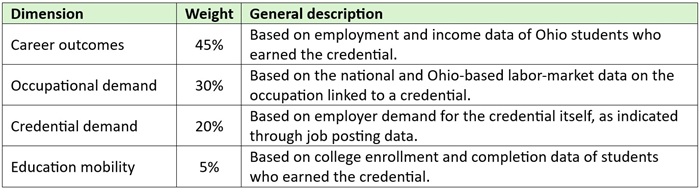
The new system is different. It ties a credential’s value to a slew of labor market and higher education data. As Table 1 shows, data elements are organized around four dimensions that indicate whether the credential opens doors to high-wage, high-demand jobs. Greater emphasis is given to “career outcomes” data—e.g., the earnings and employment rates of Ohio students who earned the credential—and to “occupational demand,” which is based on the labor-market trends of the jobs linked to a credential. Employer demand for the credential itself, as measured by appearances in job postings, and postsecondary data round out the framework. Results from the four dimensions are combined to produce an overall score ranging from 0 to 100. These results inform the approval decisions made by a state committee that is responsible for developing the list of graduation-eligible credentials. The scores, however, are not ultimately decisive, as the committee makes the final call.
Table 1: Overview of Ohio’s new credential-evaluation system
A shorter list of graduation-eligible credentials
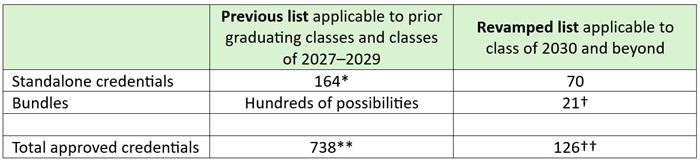
Informed by the results from the valuation framework, Ohio’s credentials committee approved a new list of eligible credentials. Under this system, they are deemed either: (1) standalones—a credential that meets the graduation marker by itself, or (2) bundles—a group of credentials that in combination meet the marker.[2] This bifurcation should be familiar to Ohio schools, but the lists are considerably shorter. On the standalone side, the number of state-approved credentials falls from 164 to 70. Most—though not all—of these standalones are linked to careers in construction, information technology, healthcare, manufacturing, and transportation.
An even more important culling occurred on the bundling side. Previously, struggling students could mix and match several low-level credentials for graduation purposes, with countless combinations possible. That is no longer the case. Moving forward, state policymakers will approve defined bundles that may be applied toward graduation. Just 21 such bundles—mainly tied to construction, healthcare, and manufacturing—made the cut. Bottom line: The new system scales back the number of graduation-eligible credentials from a whopping 738 to just 126.
Table 2: Comparison of graduation-eligible credential lists
What’s off the list?
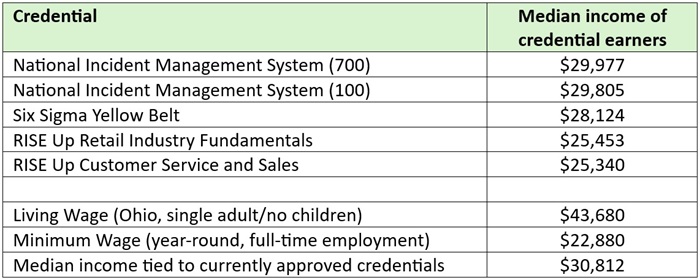
The credentials that schools have commonly used as graduation shortcuts were not approved under the new system. Rightly so, as Ohio students possessing these credentials—table 3 displays five of them—do not come anywhere close to earning a living wage of roughly $44,000 per year. In all five cases, the median annual income of students who attained these credentials fell between $25,000 and $30,000, or barely above the annual salary of a worker being paid minimum wage. They also lagged the income associated with the typical credential earned by Ohio students ($30,812).[3] Though income is only one element in the overall system, the poor wage outcomes associated with these credentials helped keep them off the list. Of note, the committee did approve two frequently earned certificates—CPR First Aid and OSHA-10 safety training—but their use for graduation purposes is now limited to just six bundles (one in healthcare and five in manufacturing). In the previous system, they could apply as part of a bundle across all career fields, which contributed to their widespread use.
Table 3: Median post-high-school incomes of Ohio students who earned selected credentials
The challenge moving forward: Maintaining a clean list
The new data-driven system promotes more accurate credential valuations and greater transparency, as the public can see for themselves the underlying data for each credential. It also promises a system that is more immune to low-level credentials. In future review cycles—the next has already begun—vendors, industry groups, and schools seeking inclusion of a credential will need to demonstrate value based on objective workforce data.
But the list of credentials could balloon yet again if policymakers are not careful. Without a data-driven standard for approval—i.e., a minimum cut score—the credentials committee has wiggle room to deviate from the valuation framework. Vendors and industry groups with financial interests and schools looking to maintain sky-high graduation rates could urge the committee to approve their favored credential or pressure it to set a low bar. In fact, even in the midst of the just-completed overhaul, the committee accepted several debatable credentials as standalones. They include three cosmetology licenses that are linked to low pay (below $30,000) and are not likely stepping stones to higher-paying careers.[4] While these credentials are not necessarily “gameable”—they do require substantial time commitments—their approval raises questions about whether committee members will hold the line when other low-payoff credentials are put forward. If cosmetology is in, what about others?
* * *
Ohio policymakers deserve credit for recognizing the problems with pushing meaningless credentials onto students and creating a more empirically based framework to value them. With a tightened list, Ohio will begin incentivizing schools to offer stronger career preparation to the students most likely to join the workforce directly after high school. Policymakers, however, must remain vigilant, as all this work could easily go for naught if the political pressure to water down the credentials list catches up to Ohio yet again.
[1] The classes of 2027 to 2029 will be able to use the existing credentials list for graduation, or use credentials approved under the new framework. The updated list (without an option to use previously approved credentials) will apply to the class of 2030, with updates to the list occurring annually for the class of 2031 and beyond.
[2] By default, a third category consists of credentials not approved for graduation.
[3] This amount ($30,812) is the median of the median incomes of the 347 credentials for which data were reported among the 700-plus credentials currently approved for graduation purposes (many credentials do not have sufficient number of students earning them to evaluate workforce outcomes).
[4] Several low-paying standalone healthcare certifications (e.g., medical assistant and pharmacy tech) were also approved as standalone credentials, but they may have stronger value as building blocks for higher-paying careers.