When Ohio lawmakers established a science of reading initiative in 2023, they included two provisions aimed at ensuring that higher education institutions are training teacher candidates in scientifically-based reading instruction. The first focused on inputs. Lawmakers tasked the Ohio Department of Higher Education (ODHE) with conducting audits of teacher preparation programs to determine if their course materials and instruction are aligned with the science of reading. Findings from the first audit were released in December and showed that some programs still have work to do.
The second provision focused on outputs. By requiring ODHE to develop a public dashboard that reports first-time and overall passage rates on the Foundations of Reading licensure exam, policymakers sought to measure how effectively programs are preparing future educators. State law requires most teachers—anyone looking to teach in grades pre-K through eight—to pass the Foundations of Reading exam prior to receiving an Ohio teaching license. The test evaluates a candidate’s knowledge of reading development, comprehension, instruction, and assessment. And by all accounts, it does a good job. NCTQ, which has a long track record of evaluating preparation programs and considerable expertise in reading science, considers it to be a strong exam. If an institution has a high pass rate, then it’s reasonable to assume that the educators it produces are well-prepared to teach reading.
There’s a difference, though, between overall and first-time pass rates. Prior to the early literacy reforms of 2023, Ohio only tracked overall pass rates. Those numbers include any teacher candidate who passes the exam, regardless of how many attempts it took them to do so. First-time pass rates, on the other hand, identify the number of students who passed the test on their first try. Candidates who need more than one attempt to pass the test can still go on to be excellent teachers. But first-time pass rates are an important marker of how rigorously preparation programs are training aspiring educators.
ODHE’s dashboard is now up and running, giving Ohioans their first glimpse at first-time pass rates for 49 preparation programs. The dashboard itself could use some work—more on that later—but the data it contains are a key indicator as to how well programs are training future teachers in reading instruction. Here are the major takeaways.
1. The statewide first-time pass rate ticked up in 2024.
In 2023, the statewide pass rate among first-time test takers was 64.6 percent. In 2024, it rose to 69.2 percent. That’s an increase of nearly 5 percentage points. The number of first-time test takers also climbed, from nearly 2,600 in 2023 to over 3,200 in 2024.
2. More than half of Ohio institutions earned a higher first-time pass rate in 2024 than the year prior.
Twenty-five institutions earned a higher first-time pass rate in 2024 than in 2023. Some of those increases were large—like the University of Mount Union, which jumped a whopping 20 percentage points. Others were much smaller. Twelve institutions registered lower passing rates in 2024, while another two remained flat.[1]
3. Four institutions had first-time pass rates at or above 80 percent in both 2023 and 2024.
The College of Wooster, Cedarville University, John Carroll University, and Baldwin-Wallace University all earned first-time pass rates at or above 80 percent in both years. All four are private universities. They’re also relatively small, with undergraduate enrollment ranging from 1,600 to 4,200 students. (For comparison, Ohio State has nearly 47,000 undergraduates enrolled at the Columbus campus.) Kudos to the College of Wooster, which earned a 100 percent pass rate in 2024 among its 11 first-time test takers. Another four institutions—Indiana Wesleyan University, University of Mount Union, Ohio Dominican University, and Otterbein University—earned pass rates above 80 percent in 2024 but not 2023.
4. Two universities had Ohio’s lowest first-time pass rates in both 2023 and 2024.
In 2023, the University of Rio Grande registered a pass rate of just 35 percent, low enough to earn it last place among the 49 institutions. Heidelberg University clocked in at second-to-last with a pass rate of 45 percent. In 2024, these institutions remained in the bottom two spots but flipped places: Heidelberg University had the lowest pass rate—an abysmal 25 percent—while the University of Rio Grande earned a 45 percent.
5. More than half of Ohio’s institutions had large discrepancies between their first-time and best-attempt pass rates in 2024.
Twenty-seven institutions had best-attempt pass rates that were 10 to 29.9 percentage points higher than their first-time pass rates. Some of the state’s biggest preparation programs were in this group, including Kent State University, Miami University, and Wright State University, all of which had discrepancies of more than 20 percentage points. Another three institutions (Lourdes University, Marietta College, and Ohio Northern University) posted differences of more than 30 percentage points. The largest gap was at Heidelberg University, where the first-time pass rate of 25 percent and the best-attempt pass rate of 87.5 percent produced a whopping 62 percentage point difference.
6. Four of the state’s ten biggest preparation programs—those that account for the largest share of first-time test takers—had first-time pass rates below 70 percent in 2024.
Chart 1 identifies the ten institutions with the most first-time test takers in 2024. Together, they account for a majority (nearly 61 percent). Four of them—Ohio State University, Bowling Green State University, Miami University, and Wright State University—posted pass rates below 70 percent. On a letter grade scale, that would be a D. The remaining six fell between 71 and 79 percent, which would be good enough to earn a C.
Chart 1. Passing rates at the ten institutions with the most first-time test takers in 2024

7. Most of the institutions that were identified as “Not In Alignment” on the state’s science of reading audit fell below the statewide average first-time pass rate in one of the last two years.
Chart 2 identifies 2023 and 2024 first-time pass rates at the ten institutions that earned a designation of Not In Alignment on ODHE’s science of reading audit. Institutions shaded in red failed to meet the state average, while those in green met or surpassed it. The University of Toledo, Ohio Dominican University, and Ohio University are the only ones that performed better than the state average in 2024.
Chart 2. First-time pass rates at institutions identified as out of alignment on Ohio’s science of reading audit
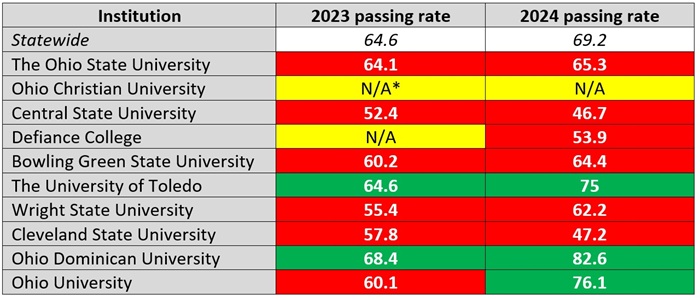
*Institutions marked N/A did not have enough information available to determine a pass rate.
***
Overall, the data on reading licensure test pass rates are a mixed bag. Some institutions are doing a solid job of ensuring that their teacher candidates have a strong foundation in reading instruction. Others, not so much. The big question now is where Ohio should go from here.
First, state officials should work on improving the dashboard. The current version has limited capabilities to sort and analyze data, which makes it difficult to compare results for a single institution over time or to compare individual institutions or groups. Making the database more interactive and user-friendly—and allowing users to download the data to sort on their own—would be a good step forward.
Second, state officials should consider keeping all of Ohio’s early literacy data in one place. Right now, audit results and the pass rate dashboard can be found on ODHE’s website. Everything else that’s science-of-reading related is housed on the Department of Education and Workforce’s website or the state’s report card page. Creating an annually-updated site that tracks all of Ohio’s early literacy reform data in one easily-accessible place would give policymakers and the public a much simpler way to track progress.
Third—and most importantly—policymakers should discuss how to support institutions with abysmally low first-time pass rates. The Foundations of Reading exam is a critical part of ensuring that teachers are well-prepared to teach reading when they enter the classroom. And yet, according to ODHE’s new dashboard, there are at least seven institutions where fewer than 60 percent of first-time test takers passed the exam in 2024. On a letter-grade scale, that’s an F.
Prospective teachers—many of whom have taken out student loans to pay for their education—deserve better from their training programs. So do the students these educators will one day teach.
[1] Ten institutions didn’t have enough data to calculate a passing rate in either 2023 or 2024.