Mobile Navigation

  • National
    • Policy
      • High Expectations
      • Quality Choices
      • Personalized Pathways
    • Research
    • Commentary
      • Gadfly Newsletter
      • Flypaper Blog
    • Events
    • Scholars Program
  • Ohio
    • Policy
      • Priorities
      • Media & Testimony
    • Research
    • Commentary
      • Ohio Education Gadfly Biweekly
      • Ohio Gadfly Daily
  • Charter Authorizing
    • Application
    • Sponsored Schools
    • Resources
  • About
    • Mission
    • Board
    • Staff
    • Career
Home
Home
Advancing Educational Excellence

Main Navigation

  • National
  • Ohio
  • Charter Authorizing
  • About

Ohio Menu

  • Topics
    • Accountability & Testing
    • Advanced Education
    • Career & Technical Education
    • Charter Schools
    • Curriculum & Instruction
    • ESSA
    • Evidence-Based Learning
    • Governance
    • Personalized Learning
    • Private School Choice
    • School Finance
    • Standards
    • Teachers & School Leaders
  • Research
  • Policy
  • Commentary
    • Ohio Gadfly Newsletter
    • Ohio Gadfly Blog
    • Events

The Education Gadfly Weekly

Sign Up to Receive Fordham Updates

We'll send you quality research, commentary, analysis, and news on the education issues you care about.
Thank you for signing up!
Please check your email to confirm the subscription.

Ohio Gadfly—Looking at Ohio’s historic education budget

Volume 17, Number 16
7.10.2023
7.10.2023

Ohio Gadfly—Looking at Ohio’s historic education budget

Volume 17, Number 16
view
Ohio Budget Bill Update-blog image
School Funding

Ohio lawmakers pass historic policies on charter schools, private school choice, governance, and literacy

On June 30, the Ohio House and Senate passed the state’s biennial budget bill for FYs 2024–25, and Governor DeWine signed the bill into law on July 3.

Aaron Churchill 7.10.2023
OhioOhio Gadfly Daily

Ohio lawmakers pass historic policies on charter schools, private school choice, governance, and literacy

Aaron Churchill
7.10.2023
Ohio Gadfly Daily

Ohio lawmakers gut the third grade reading guarantee. What now?

Aaron Churchill
7.11.2023
Ohio Gadfly Daily

Hey parents: They don’t call it “college advantage” for nothing

Jeff Murray | Susan Ackerman
7.10.2023
Ohio Gadfly Daily

Technology integration in chemistry education: What teachers say

Jeff Murray
7.11.2023
Ohio Gadfly Daily

Piloting an advanced learning curriculum for typically underserved students

Jeff Murray
7.6.2023
Blog

Lorain schools don’t deserve special treatment in the budget bill

Jessica Poiner
6.29.2023
Ohio Gadfly Daily
view
3rd grade reading state budget blog image

Ohio lawmakers gut the third grade reading guarantee. What now?

Aaron Churchill 7.11.2023
Ohio Gadfly Daily
view
Parents and 529 plans blog image

Hey parents: They don’t call it “college advantage” for nothing

Jeff Murray, Susan Ackerman 7.10.2023
Ohio Gadfly Daily
view
Technology in chemistry ed SR image

Technology integration in chemistry education: What teachers say

Jeff Murray 7.11.2023
Ohio Gadfly Daily
view

Piloting an advanced learning curriculum for typically underserved students

Jeff Murray 7.6.2023
Blog
view
Lorain's ASD carve out blog image

Lorain schools don’t deserve special treatment in the budget bill

Jessica Poiner 6.29.2023
Ohio Gadfly Daily
view
Ohio Budget Bill Update-blog image

Ohio lawmakers pass historic policies on charter schools, private school choice, governance, and literacy

Aaron Churchill
7.10.2023
Ohio Gadfly Daily

On June 30, the Ohio House and Senate passed the state’s biennial budget bill for FYs 2024–25, and Governor DeWine signed the bill into law on July 3. The legislation makes historic strides in K–12 education, most notably through strengthened educational choice programs, an overhaul of the state’s school governance framework, and requirements that schools adopt scientifically based reading practices. The bill also includes significant steps forward in career-technical education, teacher licensing, and transportation. The one blemish: Gutting the state’s third-grade retention policy, an issue that I’ll cover in a follow-up post. That aside, the budget bill is packed with reforms that promise a better future for Ohio students. Let’s take a look.

Significantly increases overall K–12 education funding: The budget increases core foundation funding for all public schools, including both traditional district and public charter schools. The decision to update the “inputs” to the school funding formula drove the increase—e.g., using 2022 teacher salary data to calculate base amounts, rather than 2018 salary data as in the prior biennium. The table below indicates that both districts and charters receive a 12 percent boost in state foundation aid between FY23 and FY25.

Ohio Budget Bill Update-blog table 1

Narrows longstanding charter funding gaps: Ohio charter schools have historically been underfunded, receiving just 70 to 75 percent of local districts’ overall taxpayer funding. This year’s budget helps to close this large and persistent funding gap in the following ways:[1]

  • High-quality funding. Led by Governor DeWine, charters that register strong performance on key report card indicators will now receive an additional $3,000 per economically disadvantaged student and $2,250 per non-disadvantaged student annually. In FY23, the supplemental funding amounts provided to high quality charter schools were $1,416 and $809 respectively.

  • Facilities funding. All brick-and-mortar charters will receive $1,000 per pupil for facilities—up from $500 per pupil in FY23.

  • Equity supplement. In a brand-new funding component, all brick-and-mortar charters will now receive an additional $650 per pupil.

The average Ohio brick-and-mortar charter school is projected to receive 86 percent of district funding in the next biennium; high-quality charters will receive 92 percent. In terms of actual amounts—including the increased foundation aid—the average high-quality charter will receive approximately $4,000 per pupil in additional monies (or roughly 40 percent more aid) in FY 25 compared to FY 23. Though still less than the total taxpayer support received by similar district schools, these dollars will help Ohio’s best charters recruit and retain talented teachers, cover more of their facilities costs, expand their capacity so they can reach more students, and make Ohio an attractive destination for top national charter networks.

Expands private school scholarship eligibility to all families: Under former policy, students whose incomes were under 250 percent of the federal poverty level ($75,000 for a family of four), or those of any income level attending specific low-performing schools, were eligible for EdChoice scholarships. Led by Senate President Matt Huffman, the budget moves Ohio to universal eligibility, as any student—regardless of family income or school attended—is now eligible for EdChoice. Students whose family income is above 450 percent of federal poverty ($135,000 for a family of four) will receive reduced scholarship awards—the exact amounts will be based on a “sliding scale”—while lower-income students will receive the full amount. Ohio can now proudly join seven other states with universal private school choice programs.

Consistent with public school increases, the budget raises the scholarship amounts (including for special-needs scholarships). The full EdChoice scholarship is estimated to be $6,165 for students in grades K–8 and $8,407 in grades 9–12. These funding levels, while above prior scholarship amounts, still remain modest in comparison to total average public school funding of roughly $14,500 per pupil. Considering all programs—including EdChoice,[2] Cleveland’s, and two special-needs programs—Ohio is expected to increase scholarship funding from $595 million in FY 23 to $1.05 billion by FY 25.

The legislature also wisely added a requirement that the state education agency calculate and report student-growth results of scholarship students attending private schools. This new provision will offer parents a more complete picture of school quality relative to the current system that only considers proficiency rates on standardized assessments.

Overhauls K–12 education governance: Due in part to an incoherent governance structure at the state level, Ohio has struggled to rigorously implement education initiatives. One of the most obvious  stumbling blocks has been its nineteen-member State Board of Education. Its structure currently consists of eleven members elected from broad regional districts and eight appointees of the governor. Unfortunately, the body has often failed to provide clear direction for and oversight of the state education agency. To address these problems, the budget bill puts the agency—and its chief—under the direct oversight of the governor, rather than the state board. The renamed Department of Education and Workforce will be responsible for implementing most education laws, with the state board largely relegated to handling matters of licensure. With a clearer chain-of-command and fewer cooks in the kitchen, the new governance model should promote stronger, steadier state leadership.

Aligns literacy instruction to the science of reading: The governor made literacy the centerpiece of his education budget this year. He proposed requiring all schools to follow the science of reading—an approach that emphasizes phonics and other key elements of effective reading instruction—and prohibiting discredited reading curricula from Ohio classrooms. His budget also set aside roughly $170 million over the biennium to provide high-quality curricula that align with the reading science and to support professional development for teachers. The governor’s proposals were approved, and the General Assembly even built on them by requiring teacher preparation programs to train prospective educators in the science of reading.

Invests in high-quality career-technical education: Another major priority of the governor was career-technical education (CTE). He proposed $300 million over the biennium in additional state spending that would support the expansion of CTE programming in in-demand career fields, with a particular focus on covering facility and equipment costs unique to advanced CTE fields. These investments will allow Ohio’s schools and career-technical centers to upgrade their programs to meet the demands of high-tech industries, while expanding access to quality CTE to more high school students. The funding was approved in the final budget bill.

Strengthens teacher pipelines: With many schools (including charters) expressing concerns about teacher shortages, the legislature pared down some of the licensing requirements that make it harder to recruit and retain teachers. The budget eliminates burdensome coursework requirements for out-of-state teachers to become licensed in Ohio, as well as for current teachers who entered the profession via alternative pathways to renew their license. Lawmakers also created a “grow-your-own” teacher initiative that provides scholarships for individuals who aspire to teach in high-need schools ($15 million allocation over the biennium).

Improves pupil transportation: Ohio law requires districts to provide transportation to eligible district, charter, and private school students. Unfortunately, some districts have struggled to fulfill this responsibility, often citing issues with busing non-district students. As a result, transportation has become a major headache for charter and private school families. The legislation should improve transportation by allowing greater flexibility in the use of vans, strengthening the state’s noncompliance provisions, and creating a pilot program in which regional educational service centers take responsibility for busing non-district students.

Shines a light on intradistrict open enrollment: Thousands of students likely attend non-residentially-assigned schools within their home district—to access a magnet school, for instance—but there are currently no numbers on how many do this. The budget requires districts to report how many students participate in intradistrict open enrollment, allowing for a more comprehensive picture of school choice in the Buckeye State. Policymakers, however, didn’t mandate that all Ohio districts participate in interdistrict open enrollment. The decision to open their doors will continue to be up to districts and many suburban ones will refuse to accept non-resident students who might benefit from attending their schools.

Holds the line on charter school accountability: As discussed in this piece, Senate lawmakers included provisions that would have softened accountability for charter school sponsors (or authorizers)—and would have weakened accountability for the schools they oversee. To their credit, these provisions were stripped from the final budget during conference committee, reiterating Ohio’s commitment to strong, academic-focused charter accountability which has helped drive improved performance in recent years.

Ensures that parents receive test scores in a timely manner: The budget adds a requirement that schools provide parents with their child’s state exam results by June 30 annually. Without a deadline, many parents have received this information too late to take steps on behalf of their child.

* * *

A landmark budget is now on the books, exciting things are ahead for Ohio schools, families, and students. Schools—from all sectors—will have more resources they can use to provide students with a quality education. Parents can look forward to having a larger set of quality public and private school options at their fingertips. With the promise of more effective instruction and personalized opportunities, more Ohio students will be well prepared for life after high school. Kudos to state lawmakers for making K–12 education a top priority. 


[1] Ohio has 7 independent STEM schools that are funded in a similar manner to charter schools. The budget includes them (for the first time) in the high-quality fund, and for the equity supplement. STEM schools have always received the facilities allotment in the same way as charters.

[2] The longstanding “performance-based” EdChoice scholarship remains in place, which allows (as under current policy) higher-income families to receive full scholarship amounts provided their children would otherwise attend a low-performing public school. 

view
3rd grade reading state budget blog image

Ohio lawmakers gut the third grade reading guarantee. What now?

Aaron Churchill
7.11.2023
Ohio Gadfly Daily

Enacted in 2012 under the leadership of Governor John Kasich, Ohio’s Third Grade Reading Guarantee included a retention requirement aimed at ending “social promotion,” the misguided practice of passing students along even though they are academically unprepared for their next step. Yet after much debate in recent years, state lawmakers chose to weaken Ohio’s retention policy via the recently passed state budget bill. House lawmakers led the charge, voting to outright ditch the requirement. The Senate reversed that repeal in its version of the budget. But the final legislation backs off mandatory retention by creating a significant loophole that allows schools to avoid retaining struggling readers as long as their parents request promotion to fourth grade.

A quick refresher: Ohio schools have been required to retain third graders who do not meet promotional standards on state reading exams or an alternative assessment. Schools have also been required to provide intensive interventions to help retained students catch up. Between 2013–14 and 2018–19, roughly 3 to 5 percent of third graders were retained under this policy.[1] A recent study from the Ohio Education Research Center at Ohio State University found that retention worked as intended. Retained students made significant academic gains compared to similar students who just narrowly passed the promotional bar. This positive finding is consistent with results from Florida, Indiana, and Mississippi, states that also have third-grade retention laws on the books.

Despite the strong evidence that it benefits children, and despite massive learning loss stemming from the pandemic, Ohio legislators still chose to gut this policy. Why so? The driving force was district administrators and teachers unions that pushed to remove retention, a policy that—while benefitting children—holds them more accountable for literacy outcomes. With a retention requirement, schools are pushed to improve literacy instruction in the early grades and “guarantee” that every child reads proficiently by the end of third grade. Without it, there isn’t much accountability for reading outcomes at this critical checkpoint in a student’s education. That allows adults to breathe easier, but does little good for students.

During the policy debates, detractors didn’t just say they wanted less accountability. They also trotted out several other reasons for pulling the plug, one of which was parent involvement. Representative Gayle Manning, co-sponsor of standalone House legislation eliminating retention, said, “I guess my problem is why we allow the government to make the decision [to retain a child] instead of the parent.” Whether parental agency was a genuine concern—especially from the education establishment—is highly questionable, given their opposition to school choice policies that empower families. Nevertheless, the argument resonated with some lawmakers and clearly shaped the final version of the budget bill.

As noted at the top, lawmakers ended strict mandatory retention through a parental override provision. Specifically, schools are excused from holding back a third grader if:

“A student’s parent or guardian, in consultation with the student’s reading teacher and building principal, requests that the student, regardless of if the student is reading at grade level, be promoted to the fourth grade.”

In practice, the new process is likely to look something like this: (1) parents are notified that their child did not meet the state’s third grade reading standards; (2) parents and school officials meet (or maybe even just trade emails) to discuss next steps; (3) parents, likely following advice from educators, make a request for promotion.

The legislation further stipulates:

“A student who is promoted [via parental request] shall continue to receive intensive reading instruction in the same manner as a student retained under this section until the student is able to read at grade level.”

This provision—a wise addition—provides some hope that students who move to fourth grade via parental request will still receive some form of “intensive reading instruction.” It also requires schools to provide these extra supports into middle or high school if a student remains below grade level in reading.

An affirmative parental request for promotion is better than an outright elimination of the requirement, but only barely so. It could easily become an avenue for schools to avoid retention and intervention. Given their well-known aversion to holding students back, schools are apt to pressure parents into making a request. A few schools might even disregard these requirements and promote children anyway. How many schools followed temporary law in 2021–22 that required consultation with parents regarding third grade retention? In many districts—Akron, Cincinnati, and Youngstown among them—100 percent of students were promoted that year. Did not one parent have concerns about promoting their child? Finally, whether schools continue to provide continuing “intensive reading instruction” remains uncertain.

To safeguard against abuse or neglect, the newly restructured—and one hopes more muscular—Department of Education and Workforce (DEW) needs to ensure these laws are being followed by schools. At a basic level, the agency should check whether schools are indeed consulting with parents and that a parental request for promotion is on file. It should release an annual public report regarding compliance with these provisions. It should also ensure that students promoted via parent override do in fact receive intensive reading instruction. DEW should also support parents by making available information about the importance of literacy and how to navigate a consultation with their school. Finally, if schools are not complying with these laws, it should consider penalties or corrective action.

Making sure that all children read fluently remains a critical goal for Ohio. Softening retention does nothing to achieve that objective or solve the underlying problem of reading failure. It also directly counters many of the other bold literacy reforms in this year’s budget. What it does do, however, is ease up on schools, while putting students at-risk of further academic struggle in middle and high school. Backing off mandatory third grade retention was a policy blunder. Now it’ll be up to parents and state officials at DEW to make sure that Ohio schools are helping all children read proficiently.


[1] The retention law was suspended in 2019–20, 2020–21, and 2021–22 via Covid-related legislation. While the law was in effect for 2022–23, the budget bill—for this year only—allows schools to promote students who would otherwise be retained (unless a parent requests retention).

view
Parents and 529 plans blog image

Hey parents: They don’t call it “college advantage” for nothing

Jeff Murray | Susan Ackerman
7.10.2023
Ohio Gadfly Daily

The end of our parental education journey is drawing near: Less than a year from now, both of our children will be looking at college graduation. Their K–12 trajectories were covered occasionally here, including the various decision points we faced in trying to find them the best educational fit available and how Ohio’s evolving school choice infrastructure has helped and hindered us along the way. The goal since 2020 has been bachelor’s degrees, and those are finally in sight. So we want to end the ride on a positive note—with a little paean to Ohio’s 529 plan, which helped make the last leg of the journey from high school graduation to college graduation successful and a bit easier than it otherwise might have been.

First up, a little primer. 529 plans are investment accounts designed to allow folks to save up over time for education expenses in the future and generally include some nice tax benefits, both while you save and when you ultimately use the money. They are commonly sponsored by states, and most states have them. You can open a 529 plan at any time and name nearly anyone as a beneficiary—including yourself—but they are most popularly used by parents to save up for their children’s future college expenses. Anyone can contribute to an established 529 plan, including extended family or friends. Ohio’s version, called CollegeAdvantage, began under a different name in 1990 and was one of the first in the country to adopt the new 529 (named after federal tax code) structure following its nationwide launch in 1996. It is overseen by the Ohio Tuition Trust Authority (OTTA).

From parents to parents, here are three ways that CollegeAdvantage has helped us and can help you and your children afford college.

Easy to start up

You can start a CollegeAdvantage account with as little as $25 via a simple application. Don’t have the time for or interest in deciding your account’s investment strategy in detail? The OTTA offers several pre-set investments with specific options generated for you following a brief questionnaire regarding goals, timeline, and risk tolerance. Risk over time is a real concern, as with all investments, but even a small return is free money.

Deposits can be made at any time by a number of means, including payroll deduction. And while there are some maximums imposed (see below), the $25 minimum deposit seems tailor-made as a budget-friendly option to set it and forget it. Those deposits will add up before you know it.

There are no fees for participation—although you should look out for fees on the investments that can reduce yield—and information is provided regularly, as well.

Don’t miss out on UPromise, either. It’s a way to link your everyday spending on things like groceries and clothes and school supplies to retailers’ cashback programs. The credits go right into your 529 account like magic.

Ability to save over time, with tax benefits

The money invested in a CollegeAdvantage account grows tax-free and remains tax-free when used to pay for qualified expenses. (This doesn’t only mean four-year college tuition, by the way. Other undergrad expenses like room and board can be covered tax-free, as well as trade school, certificate programs, graduate school, and apprenticeship costs. Even K–12 private school tuition can be paid for via 529s.) Because of these tax advantages, OTTA says they offer “better growth potential than a typical savings account,” which has been our experience for the entire ride. Sometimes, way better.

Contributions to Ohio’s 529 plan are also tax deductible in the year they are made, up to a maximum of $4,000 per child per year. (That’s state taxes only, not federal, and every state does it differently.) What’s best: Anyone can contribute to a plan, so grandparents and aunts and family friends can turn a birthday gift or holiday celebration or lottery win into a long-term investment in a child’s future, with a tax benefit to boot.

When you have twins like we do, stuff generally enters the house in pairs (toys, clothes, etc.), and you really don’t need two of everything. But we were rarely successful at nudging family members towards college fund contributions as presents. We hope you have better luck than we did, and the new-ish UGift program might help. Keep trying!

However, we were diligent about plowing any surprise savings into our children’s accounts. The school options we preferred for our children meant that we paid tuition for most of their K–12 education, but for the three years our children attended the Metro Early College STEM School, a tuition-free public school, those extra funds went into the 529 instead. We also benefited from a couple of strong stock market rallies, as well. Here’s hoping for more of those in your future, too.

We didn’t do anything complex or fancy—we just started early and were slow, steady, and focused throughout. The mantra of “out of sight, out of mind” helped tremendously. We cannot overstate the value of budgeting, and it was probably second nature in some ways for us because we were used to paying out of pocket for K–12 education. But even the smallest automatic deposit will grow exponentially with enough time.

Start early, don’t stop, save whatever you can—and if a little extra comes your way, drop that in there, too.

Ease of distribution

The biggest surprise for us came when it was time to actually pay for college. It’s where the “this investment is actually real money” revelation finally dawned. As noted above, CollegeAdvantage funds are not just for college tuition, but since that’s where we were always headed, here’s what we know.

Colleges, particularly private colleges, are not as expensive as you might fear. Fill out your FAFSA, be honest about your financial resources, and talk to every institution rep you can find. Ask questions and really listen to the answers. College fairs are fun, interesting, and eye-opening. College visits are even better, and many schools will help pay for visits to make sure you get there and can see what they have to offer. It’s exciting to see your child’s name on a big welcome sign on a visit day—even more so if they happen to fall in love with the place.

Every college in the country will accept your 529 funds toward tuition, housing, and other fees. Both our kids went to college out of state, and there was no problem sending that Buckeye money to institutions in New York or That State Up North. While the size of your 529 account will be factored in ahead of the final tuition tally, it won’t impact scholarship consideration like other college savings approaches can. You can also choose how much of your investment you wish to spend at any given time. We split ours up across school years and semesters, but you can pay as much or as little of a given bill using 529 funds as you wish.

The bottom line: Having funds in a CollegeAdvantage account when you go to pay tuition means that your bill will be smaller. The more you have, grown tax-free over time and non-taxable when you use it on qualified expenditures, the lower the bill. We can’t say it more plainly than that.

*****

Just like choosing a middle or high school, prepping for college is about looking ahead and investing in your child’s future. With twins, we knew from the start that higher ed was going to be a major expense, and it was something that we wanted to make sure we could provide for our children. And when you know where you’re going, getting there becomes that little bit simpler...especially with high-quality help.

Financial stability has always been important to us, and having met in planning school, we are two people who are hardwired to always think ahead. We worked hard to pay off our own student loans while our kids were young, and then turned to their education needs for the future, hoping to use Ohio’s 529 plan to reduce their chances of accruing overwhelming college debt themselves. The end of the journey is almost upon us, and the education goals we set when we became parents have been met.

You can do the same, and CollegeAdvantage can help you, too.

view
Technology in chemistry ed SR image

Technology integration in chemistry education: What teachers say

Jeff Murray
7.11.2023
Ohio Gadfly Daily

The value of incorporating technology into secondary education courses is a matter of debate, but if there’s anywhere that it might be beneficial, it is most likely within STEM-related subjects—meaning that high schoolers might better see themselves pursuing science in the future if they are able to work with the same tools as professionals do in the field. Theorizing that any successful application of technology in teaching comes via the buy-in of teachers, a trio of researchers surveyed chemistry instructors to determine their views on the relevance, potential value, and ease of use of classroom technology. The findings and their implications are limited, but interesting.

The research team, led by Olivia Wohlfart, of the Karlsruhe Institute of Technology in Karlsruhe, Germany, interviewed ten chemistry teachers at the secondary level (students age twelve to eighteen) in Baden-Württemberg state, in the country’s southwest. They were of varying ages and had varying degrees of professional experience—both with chemistry education specifically and teaching generally. The interviewees were whittled down from an initial group who responded to an open call for participants, aimed at best representing the demographics of the state.

Baden-Württemberg was chosen because its chemistry education curriculum covers a diverse range of topics and activities spanning multiple grade levels. In secondary schools, chemistry is first introduced as a two-hour course in eighth grade, building upon the competencies acquired in earlier biology, natural sciences, and technology classes. In eleventh grade, chemistry becomes a core subject with three hours of instruction per week, and students may also opt to take it as a five-hour-long advanced subject. Chemistry curricula prioritize an experimental culture, the analysts write, placing a strong emphasis on hands-on learning and student research. Digital tools are incorporated into the curriculum to aid teaching and learning.

While the researchers clearly proceed from the view that students can benefit from the types of technology and instrumentation that lab chemists use in their daily work, it is the teachers’ attitudes toward that tech which forms the focus of the interview and analysis. Interviews took place in mid-2022.

While all ten teachers reported using technology in their classes, the most commonly cited digital tools in use were general applications for communication and organization purposes (think Microsoft Teams and spreadsheet software). Only four reported using chemistry-specific technology, such as digital data acquisition programs and molecule drawing programs like ChemSketch.

A majority of teachers reported positive feelings toward chemistry-specific technology, especially for illustrating complex or abstract concepts. Videos and “augmented reality” tools were cited as potentially helpful for visualizing the three-dimensional nature of atoms and the steps involved in chemical processes. Additionally, students could experience dangerous phenomena, such as nuclear chain reactions safely or time-compress slow chemical processes to better observe the outcomes using technology. Despite this positivity, however, teachers who felt that a given technology was difficult to use reported limiting its use in the curriculum. General tools, such as integrating videos (YouTube, Prezi, etc.), learning apps (like Kahoot), and digital displays (such as Apple TV or smart boards), were largely thought to be simple, quick, and intuitive—and were, thus, widely used. Beyond that, specific reported barriers—such as a perceived lack of tech support, unavailability of training, and/or a lack of student facility with a given technology—were strong factors in teachers’ decisions to avoid using a given application or software. Teachers who experienced problems with lower-level technology (Apple TV won’t work properly) were similarly deterred from regular use of higher-level technology, despite understanding the potential value of it. Responses did not vary with either teacher age or years of teaching experience.

Overall, Wohlfart and her team felt the interviewees indicated a “pragmatic, functional, and minimalistic attitude towards digital tools” in chemistry education. Technology could have a part to play, but even at its best, it was largely seen as a supplement to traditional teaching and experimental pedagogy. And once issues of unreliability came into play, even supplemental use could easily be halted by a given teacher.

Since the analysts are fully sold on the value of technology in secondary classrooms, rattling off a list of instruments and software both old and new that research shows add value to the study of chemistry at that level, their recommendations predictably focus on breaking down the barriers identified by German teachers: more training, more time in the day, more support from vendors and school administration. These are not the worst possible goals for German education leaders to pursue; however, it is interesting to note that other research into technology integration has called into question the value of technology usage as an end unto itself. Is removing barriers to having a working spectrometer in a high school chemistry course really where things should stop? Or would it be better to perhaps start with student outcomes—surveying those who pursued STEM education in college and attained employment in the research sciences—and work backward to make sure that courses and classrooms are equipped with everything they need to produce more of the same?

SOURCE: Olivia Wohlfart, Alina L. Wagner, and Ingo Wagner, “Digital tools in secondary chemistry education – added value or modern gimmicks?” Secondary Digital Education (June 2023).

view

Piloting an advanced learning curriculum for typically underserved students

Jeff Murray
7.6.2023
Blog

In many schools, being identified as advanced or gifted doesn’t guarantee that students will receive “gifted services.” For low-income students, Black and Brown students, rural students, and many others, the odds of being identified as gifted and having access to advanced coursework are even lower than for their higher-income and White or Asian peers. A new report from Purdue University’s Sarah Bright and Northwestern’s Eric Calvert digs into the results of a pilot project testing a curriculum that could make it more likely that all identified students—especially those typically underrepresented in advanced education—receive services.

Project OCCAMS (Online Curriculum Consortium for Accelerating Middle School) is a collaboration between the Center for Talent Development at Northwestern University, the Center for Gifted Education at the College of William & Mary, and the Ohio Department of Education (ODE). It’s a two-year-long, accelerated English language arts curriculum for seventh and eighth graders that combines in-class instruction and out-of-class “technology-based assignments,” such as student-created videos, podcasts, literary magazines, mini-newspapers, audio recordings, and various other Google platform-based projects. Beyond this basic information, however, the report is light on details of how the program actually functions and, thus, is limited in its ability to enlighten us.

A five-year pilot of Project OCCAMS was launched simultaneously in five large Ohio school districts in the 2018–19 school year. The goals of the pilot were to determine the efficacy of the course to accelerate learning, especially for students traditionally underrepresented in advanced education, and to determine if the model is simple enough to easily replicate, and is thus a potential tool to increase service provision elsewhere.

The researchers chose Ohio as the laboratory for this intervention because the state began implementing universal screening for giftedness in 2018. Identification numbers have been tracked annually by ODE since then, but the provision of gifted services was not—and still is not—mandated by the state. This the first published analysis following completion of the five-year pilot, although the data are limited in time and only reference one of the participating districts.

Project OCCAMS was rolled out in five unidentified “diverse urban middle schools” within Columbus City School District—buildings chosen because underrepresentation of minority students in gifted education was a “significant concern” in each—starting in the 2018–19 school year. To qualify for the Project OCCAMS intervention, students had to be entering seventh grade in those buildings. They also had to have been identified as gifted in their General Cognitive Ability in ELA specifically or to have scored at or above the 85th percentile on a state or national achievement assessment in reading or ELA at any point prior to seventh grade. No definitive student n-size is provided (another limitation to drawing conclusions from it), although it is likely less than seventy-five per cohort; see below for details. Bright and Calvert do report that students participating in the Columbus intervention reflect the diversity of the district overall: Sixty-seven percent of students were Black, just over 11 percent were Hispanic, nearly 8 percent were multi-racial, and more than 19 percent were White. Income data on students were not collected, but all schools in the study were fully Title I–eligible.

When schools were shut down and students sent home in response to the Covid-19 pandemic, Project OCCAMS continued in a fully-online form for the rest of the 2019–20 school year, with synchronous virtual teaching taking the place of classroom instruction. During the following school years, the program toggled between hybrid and fully online as each building’s changing instructional modalities required.

In keeping with its acceleration model, each student received three years’ worth of instruction covering typical ELA content for grades seven through nine in “compacted” form over two school years. Details of the curriculum structure are included in the report’s appendices—a plus point. Participating students took the state’s ELA I test—which, at the time, was given as an end-of-course exam to all ninth graders—at the end of the intervention, and the results of that exam are the basis of the achievement data in this report. The researchers also examined seventh- and eighth-grade administrations of above-level ACT tests. Students received credit for both eighth and ninth grade English language arts courses upon completion of the OCCAMS program.

Full outcome data are not provided, but eighth graders who participated in Project OCCAMS and took the state ELA I test in 2019 outperformed both the district average and the average posted by students in the district’s highest-performing high school. The majority of program students achieved scores of proficient or advanced. Program students also showed higher growth on the above-level ACT tests between seventh- and eighth-grade administrations, compared to a set of “more academically selective but economically similar students” in the district.

Student surveys completed at the end of the two-year course were generally positive. (We get our only hint at n-sizes here—which seem small—with sixty-five participating students noted as responding to a particular survey question in 2021, the largest number observed for any response.) A majority of students responding said that they learned to be more independent learners, that the course helped them improve how they analyze and understand what they read, and also helped improve their writing. Percentages for all of these positive responses grew between 2020 and 2021.

Students and teachers alike expressed positive sentiments toward the structure of the course and the learning community built around it. This includes communication and group work conducted via email, message boards, video chat, and text messages, as well as in-person work. The same difficulties faced by other schools when switching to fully-remote learning in 2020—technical problems, students not using cameras during synchronous instruction, absenteeism—manifested here, as well, but seemed far less debilitating than the issues arising in more typically-structured courses. Similarly, lack of access to devices and high-speed internet only impacted a small handful of students, even at the height of pandemic school closures. Part of this is because Project OCCAMS’s implementation included free Chromebooks for all students from the start, and because kids and adults already had experience using them in exactly the same way at school (or on the bus or in libraries or wherever) as they needed to when locked down at home. Bright and Calvert include descriptions of how students helped each other to overcome glitches to continue full participation with minimal interruption.

Perhaps reflecting the dearth of data provided, this analysis of Project OCCAMS is mainly descriptive. There’s clearly much to learn from the information presented here. Essential but unanswered questions include which students were recruited and how, how any oversubscribed spots were filled, how teachers were trained, how the program impacted students’ daily schedules, and whether any participating students were receiving other gifted services provided by the district. But the report raises even more questions regarding what is not included.

Bright and Calvert focus their discussion on the technology piece of the puzzle: Does the computer-based nature of much of the work (and indeed all of the work during Covid shutdowns) actually help achieve the goal of more equitable access to advanced learning opportunities? Data show that, overall, remote learning during the pandemic was a dismal failure that set most kids back months or even years. Advanced students lost ground, too, but they fared a bit better than their lower-achieving peers, both nationally and, it seems, in this very small, very local program focused on underrepresented students. The intent of the Project OCCAMS pilot was to provide effective and efficient services to students typically underrepresented in advanced education. This report suggests that at least some answers could be available by digging further—and more rigorously—into the data.

SOURCE: Sarah Bright and Eric Calvert, “Educational Technology: Barrier or Bridge to Equitable Access to Advanced Learning Opportunities?” Gifted Child Today (June 2023).

view
Lorain's ASD carve out blog image

Lorain schools don’t deserve special treatment in the budget bill

Jessica Poiner
6.29.2023
Ohio Gadfly Daily

It’s been a very busy budget season in Ohio. Issues including private school choice eligibility, charter funding, and the state’s third grade reading retention requirement have drawn the lion’s share of attention, and when the budget is finalized, these items will likely be the primary bullet points in any summary coverage. As they should be, as they’ll impact thousands of students.

But there’s an under-the-radar provision related to Academic Distress Commissions that first appeared in the Senate’s version of the budget that could also have big implications. If left untouched by the conference committee and the governor’s veto pen, this provision would dissolve the Lorain City School District’s Academic Distress Commission, as well as the district’s state-required academic improvement plan. In doing so, it would remove the district from state oversight for the first time in over a decade. This would be a major mistake.

To understand why this is a big deal, some background is needed. Academic Distress Commissions (ADCs) were first created in 2007 as a way for the state to intervene in districts that consistently failed to meet academic standards. In 2015, after failing to generate much improvement, the state strengthened the law by boosting the authority of ADCs and empowering an ADC-appointed CEO with significant managerial authority to create and implement a rigorous turnaround plan. After years of lobbying, Ohio lawmakers caved to political pressure in the summer of 2021 and created an off-ramp for the three districts under an ADC: Youngstown, Lorain, and East Cleveland. As part of the deal, each district’s board was tasked with developing an academic improvement plan containing annual and overall improvement benchmarks. If districts met a majority of these benchmarks by June 2025, their ADC would be dissolved.

Or at least that’s what was supposed to happen. The tiny budget provision introduced in the Senate dissolves Lorain’s ADC and its academic improvement plan. The district will no longer be required to demonstrate that they’re improving on behalf of their students. Their counterparts in Youngstown and East Cleveland, however, weren’t given the same free pass.

Unsurprisingly, the education establishment in Lorain is rejoicing over their special treatment. But for the rest of us, this carve-out raises some troubling questions. Why, after establishing an off-ramp during the previous budget cycle, did lawmakers suddenly decide to change course? Why did they change their minds for only one district? And what could possibly justify letting a district that’s performed so poorly for so long that it’s been under state oversight since 2013 go back to business as usual?

The only acceptable answer to any of these questions is improved student outcomes. If officials in Lorain could prove to state lawmakers that, based on reliable and comparable academic measures, their schools were rapidly and consistently improving—and if Youngstown and East Cleveland couldn’t do the same—that might justify Lorain’s special treatment.

The problem is that Lorain hasn’t had enough time to claim that its schools consistently improved. The 2022–23 school year, Lorain’s first year implementing their academic improvement plan, ended on May 31. The Senate added the Lorain ADC amendment to its budget roughly two weeks later. Could district officials have gathered enough evidence in that time to prove to lawmakers that their first year under a self-designed improvement plan had been a rousing success? Possibly. Many of the benchmarks in their plan are based on iReady and other locally-calculated measures, rather than on state exams and school report cards. That means district officials didn’t have to wait around for state test results. (Lorain’s decision to focus on local measures that aren’t easily comparable to other districts is worth pointing out.)

But even if lawmakers did consider data from the locally-calculated measures included in Lorain’s plan, and even if those results were positive (they don’t seem to be publicly available), it would still only be one year’s worth evidence. Despite what the district has tried to claim, one year of progress doesn’t prove much. To responsibly dissolve an ADC, lawmakers should need several years’ worth of data. There’s no other way to ensure that the improvements are real and sustainable, and not just a fluke. After years of underperformance, years of improvement are needed.

But what about state exam results from 2018–19, 2020–21, and 2021–22? Those data cover more than just one year. But they don’t show the kind of significant improvement that could justify letting Lorain exit state oversight early.

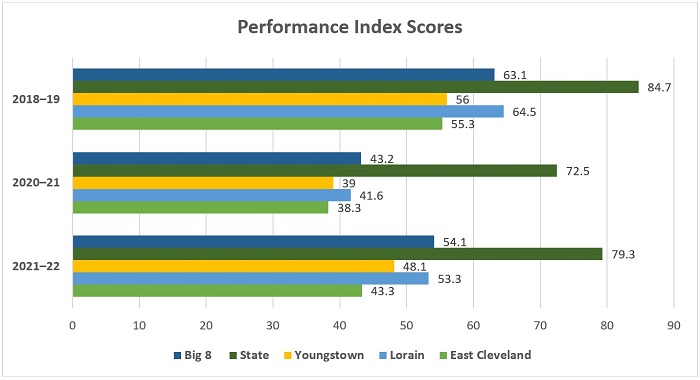
Consider the table below, which illustrates performance index scores in ADC districts, with averages from the state and the Big Eight districts included for comparison. Like its ADC and Big Eight counterparts, Lorain saw huge drops in student achievement during 2020–21. But there was also a bounce back the following year. Lorain’s performance index score for 2021–22 wasn’t just better than their prior year performance, it was better than that of Youngstown and East Cleveland, and pretty close to the Big Eight average.

Lorain's ASD carve out blog Figure 1
Note: Results from 2019–20 are omitted because state tests weren’t administered that year due to the pandemic.

Lorain deserves kudos for recovering some of that lost ground. But it’s also important to note that the district still hadn’t bounced back to pre-pandemic levels, which were troublingly and persistently low to begin with. Data from the recently finished school year, 2022–23, would go a long way toward determining whether Lorain is actually getting better, and not just recovering ground lost during the pandemic. Unfortunately, state lawmakers opted not to wait for that.

Achievement isn’t the only state report card measure that’s worthy of consideration. Ohio’s progress component, which measures the academic growth students make over the course of a year, is also crucial. It yields results that are more neutral regarding demographics, making it possible for districts where students are far behind in reading and math to showcase their contribution to student learning and reveal positive academic growth. Lorain earned a four-star rating on this component during 2021–22, which means students made more progress than expected. That’s an excellent start that the district’s teachers and students should feel great about. But it’s still just a start. Without additional years of data, lawmakers have no way of knowing whether the progress will continue.

And then there’s early literacy. For school report cards, the state tracks three measures and combines them to create an overall early-literacy rating for districts and schools. During the 2021–22 school year, Lorain earned just one star in early literacy. Only 28 percent—less than one third—of its students were proficient on the reading segment of the third grade English language arts state test. Furthermore, the district moved only 10 percent of its students from off- to on-track in reading. Given the heavy emphasis that the governor and lawmakers in both chambers placed on early literacy during this budget cycle, one would think that Lorain’s horrific performance would give state leaders pause. Sadly, that doesn’t seem to have entered the calculations.

***

We have no way of knowing why lawmakers suddenly decided to let Lorain off the hook. Given the data outlined above, it seems highly unlikely that they were wowed by sizable and sustainable academic improvements because little evidence of improvement exists. There hasn’t been enough time for Lorain to prove itself under its improvement plan.

State lawmakers have a moral obligation to ensure that students receive a quality education. Giving Lorain a pass in this way abdicates that responsibility—not because Lorain deserves to be “punished,” but because it had decades worth of poor performance in its past that has negatively impacted generations of students and the community. Easing up the pressure—as weak as it may be—will do nothing to improve student learning in Lorain. 

Fordham Logo

© 2026 The Thomas B. Fordham Institute
Privacy Policy
Usage Agreement

National

P.O. Box 110
Burke, VA 22009

202.223.5452

[email protected]

Ohio

P.O. Box 82291
Columbus, OH 43202

614.223.1580

[email protected]

Sponsorship

130 West Second Street, Suite 410
Dayton, Ohio 45402

937.227.3368

[email protected]