
Despite serving tens of thousands of students each year—most of whom are low-income—Ohio has a regrettable track record of underfunding its public charter schools. Since their advent in the late 1990s, brick-and-mortar charter schools have received on average roughly 25 to 30 percent less funding per pupil than the districts in which they’re located.
This funding gap puts charters at a serious disadvantage when it comes to offering competitive teacher salaries and providing much-needed student supports and enrichment. Moreover, though Ohio’s brick-and-mortar charters provide a superior education—and some of the finest charters have waitlists—the funding disparities have throttled their growth, as they are left with less capacity to expand and serve more students.
Don’t just take my word for it. Consider the testimony of school leaders from several of Ohio’s best charter schools—schools our sister organization is proud to oversee as their sponsor. Andrew Boy, founder of the United Schools Network, a group of high-performing charters in Columbus, discussed the challenges of fully meeting the needs of low-income students on shoestring budgets:
Limited resources make it difficult to offer certain programs and provide the unique support our students need. At stake here is...the life outcomes of vulnerable students and families who receive less per-pupil funding, if they exercise their right to choose a school that better meets their needs.
Dave Taylor, superintendent of Dayton Early College Academy, one of best urban high schools in the state, noted the difficulties of retaining talented teachers with fewer dollars:
Each year we watch our traditional public school counterparts raise their salaries and poach our best, most talented teachers. Too many times, we had teachers tell us that they will have to leave because the next district is offering $5,000, $10,000, or even upwards of $15,000 more than we can offer them.
To their credit, state lawmakers are poised to make historic progress in bridging charter funding gaps via the biennial budget for FYs 2024–25. A quick recap of the action thus far (the bill is currently pending in conference committee).
- High-quality charter funding: In his budget, Governor DeWine proposed a healthy boost to the extra aid that high-quality charters receive via a supplemental funding program launched in 2019. Both the House and Senate have commendably approved his proposal.
- Charter facilities allowance: The governor also wisely increased the state’s per-pupil charter facility funding. Both the House and Senate have approved the increased allowance from $500 to $1,000 per pupil, an amount that will help charters more adequately cover building expenses.
- Charter equity supplement: In a new funding component, the Senate has proposed a $400-per-pupil supplement for every brick-and-mortar charter school. This critical addition recognizes the basic need to fund all charter students more equitably.
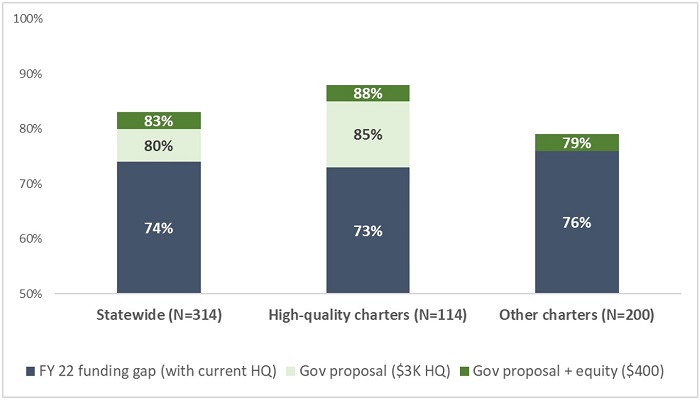
What is the impact of these funding measures? As figure 1 indicates, the average brick-and-mortar charter in Ohio currently receives 74 percent of the funding of their local district—but that’s slated to increase to 83 percent should the Senate version of the budget pass. Put another way, the statewide charter funding gap would narrow from a 26 to 17 percent shortfall. Meanwhile, due to the big increase in high-quality allotments, the gap would decrease even more substantially for the highest-performing schools—from 27 to 12 percent. Note, facilities are not included in this figure because the gaps are based on operational expenditures, which exclude capital outlay.
Figure 1: Average brick-and-mortar charter funding relative to districts—current gap versus gap under Senate-passed budget
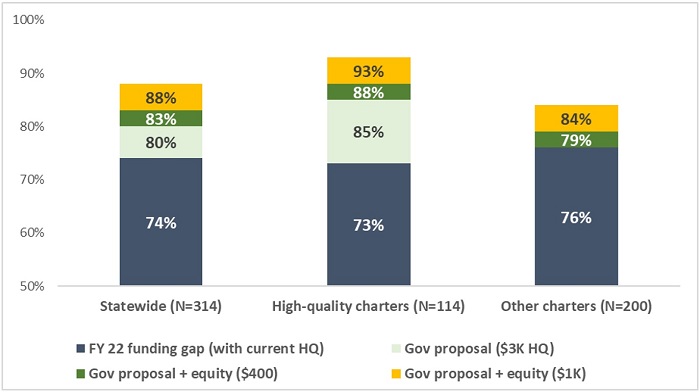
While this is remarkable progress, a sizeable funding gap still remains. In the waning days of this year’s budget process, state lawmakers should ratchet up the equity supplement to the $1,000 per pupil that we at Fordham have previously recommended. As figure 2 indicates, this enhanced amount would bring the average charter funding statewide to 88 percent of districts’. For high-quality charters, it would put them at 93 percent, just a 7 percent shortfall relative to local districts. An enhanced equity supplement would be especially helpful for charters that do not currently qualify for the high-quality funds, as many of them serve at-risk adolescents who have dropped out or specialize in serving children with disabilities.
Figure 2: Average brick-and-mortar charter funding relative to districts—current gap versus gap under Senate-passed budget (with enhanced equity supplement)
* * *
Under the Senate bill, high-quality charters are slated to receive roughly $2,400 per pupil in additional supplemental state aid—and that could rise to $3,000 per pupil should the legislature further enhance the equity amount. These dollars will help charters serve additional students in even more effective and individualized ways. If legislators can seal the deal and level the playing field, thousands more Ohio students will get the education they need to succeed in school and in life.