In 2023, we at Fordham released a publication titled Will Ohio’s Covid Generation Get Back on Track? The report documented the pandemic-era plunge in academic performance reflected in the 2021–22 state test scores and urged an all-hands-on-deck recovery effort. With four Covid-free years now on the books and billions upon billions spent, one might think that Ohio has surely recovered from the pandemic wreckage.
But has it recovered? Based on the just-released assessment results from 2025–26, the answer regrettably remains “no” (it was “nein” last year, too). It’s true: Ohio students still have not caught up to the achievement marks of their pre-pandemic peers.
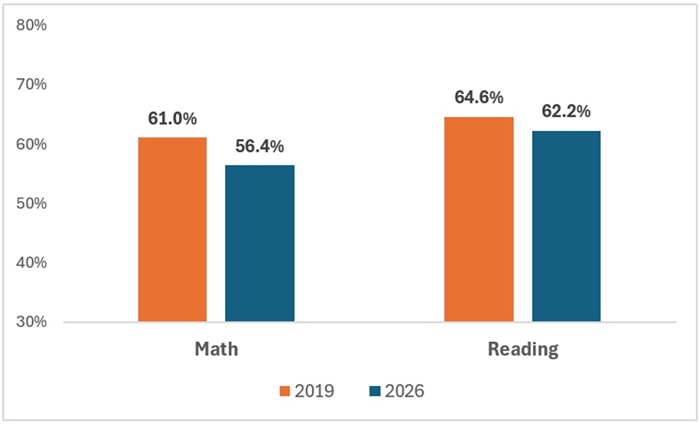
Here are the unsettling data. Figure 1 begins with a basic comparison of statewide math and reading proficiency rates in 2018–19—the pre-pandemic baseline—and 2025–26. Just prior to the pandemic, 61 and 65 percent of Ohio students achieved proficiency in math and reading, respectively. Last year’s proficiency rates fell short of that benchmark, in math by a sizable margin of 4.6 percentage points and 2.4 percentage points in reading.
Figure 1. Statewide math and reading proficiency rates (all tested grades), 2018–19 versus 2025–26
One major concern in the wake of the pandemic was that disadvantaged students would have the hardest time catching up—what some dubbed the “K-shaped” recovery. The next figure explores whether this has materialized in Ohio. Figure 2 shows statewide proficiency rates (math and reading combined)[1] and indicates sluggish recovery across the board. Virtually all student groups continue to fall short of their respective pre-pandemic benchmarks, though students with disabilities have struggled noticeably more than others to meet their pre-pandemic benchmark. In contrast, Black students have demonstrated somewhat stronger recovery and their 2025–26 proficiency rates slightly top their respective pre-pandemic rates. Economically disadvantaged students’ proficiency also exceeds their pre-pandemic target, though that result is highly suspect due to the rapid compositional change within that group (see note below the figure).
Figure 2. Proficiency rates by student group on all state exams, 2019 and 2026
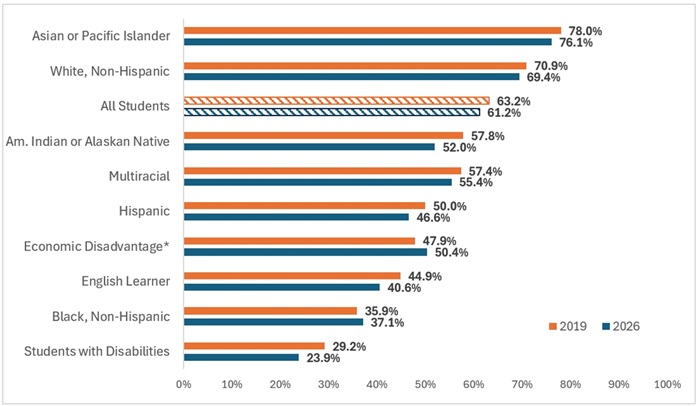
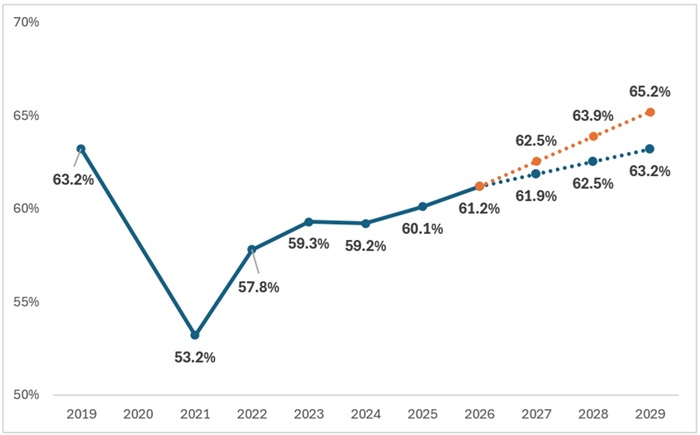
Figure 3 displays statewide proficiency rates (all tests) from 2019 to 2026 as well as projections based on the current rate of improvement. After significant jumps in proficiency shortly after scores bottomed out in 2020–21, the rate of improvement slowed, with a gain of just 2.1 percentage points over the past four years. At this rate of improvement, Ohio won’t return to the pre-pandemic mark until 2028–29—a full decade after the pandemic struck. If Ohio can step up the rate of improvement (double it), students would make it back to square one a year earlier.
Figure 3. Trend in statewide proficiency rates, all state exams
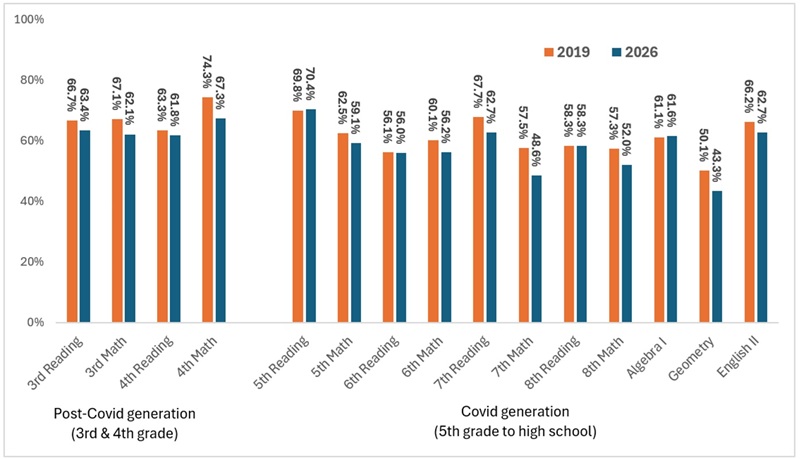
Finally, Figure 4 shows proficiency rates by grade level, an important aspect of tracking recovery. Students in the early elementary grades during 2025–26 were infants and toddlers during Covid, and one would expect “post-Covid generation” scores to more closely track with the 2018–19 benchmarks. But as the figure indicates, third and fourth grade proficiency rates sank noticeably below pre-pandemic standards. Meanwhile, the higher grades represent students who were directly impacted by school disruptions during the pandemic. Here, we see recovery in fifth, sixth, and eighth grade reading as well as algebra I, but proficiency rates still lag for seven other grade-subject assessments. Overall, these data indicate significant work still ahead to help both the post-Covid and Covid generations catch up to Ohio’s historical achievement marks.
Figure 4. Statewide proficiency rates by grade and subject, 2019 and 2026
* * *
Outwardly, schools have returned to normalcy. But the long shadow of Covid continues to be felt inside of Ohio classrooms. Students today—due to the closures and the anemic recovery—are still behind in comparison to where their peers stood six years ago. Can Ohio make a full academic recovery? When will it finally happen—and for all student groups, in both math and reading, and across all grades?
To their credit, Ohio policymakers have established critical academic initiatives that, if rigorously implemented, should move the needle faster for students. It’ll take continuing resolve from state and local leaders to put the pandemic—and all its ill effects—behind us once and for all.
[1] It also includes grade 5 and 8 science and the biology, U.S. government, and American history end-of-course exams.