With students’ math scores still mired in a post-Covid slump—and not so impressive prior to it—Ohio policymakers have begun exploring ways to improve math instruction. Most of the attention focuses on what happens in primary and secondary schools—e.g., high-quality curriculum for all, strong interventions for students who need them, and advanced coursework for those who are ready. Another critical policy lever runs through colleges and universities: Making sure that teaching candidates, including those expecting to work in elementary schools, have the knowledge and skills needed to effectively teach math.
Scholars have long expressed concerns about the mathematical prowess of U.S. teachers. Writing in the Los Angeles Times back in 2019, University of Virginia professor Daniel Willingham stated, “Many elementary teachers don’t understand math very well, and teaching it makes them anxious.” A recent Hechinger Report piece discusses how shaky content knowledge and math anxiety among teachers leads to shallow instruction, less time on the topic, and ultimately, diminished student achievement.
Concern around content knowledge doesn’t imply that elementary teachers struggle to recite basic math facts such as 5 x 5 = 25. Rather, the difficulties lie in the conceptual underpinnings of mathematical facts and procedures. For instance, it’s one thing to compute 0.75 x 0.60 using the standard algorithm. But it’s another thing to immediately intuit the answer is less than 0.75 and arrive at a reasonably accurate estimate using “mental math.” Doing that requires a deeper understanding; e.g., knowing that multiplication doesn’t always yield higher numbers, and that the problem entails splitting 0.75 by slightly less than half.[1]
Teaching children the algorithms and the concepts behind them—not to mention illustrating how math problems apply in the real world—takes considerable mathematical knowledge. As the landmark National Research Council report on numeracy stated, “The mathematics of the elementary and middle school curriculum is not trivial, and the underlying concepts and structures are worthy of serious, sustained study by teachers.”
Unfortunately, most educators don’t undertake the “serious, sustained study” needed for rigorous math instruction. That’s because too many preparation programs skimp on math content, particularly those training future elementary teachers. As evidence, consider a recent report from the National Council on Teacher Quality (NCTQ) which compares the time that prep programs spend training elementary candidates in math content to a minimum coursework standard of 105 hours.[2] The standard is informed by recommendations from the Conference Board of the Mathematical Sciences and the National Council of Teachers of Mathematics, along with an NCTQ-convened panel of math experts and survey input from practitioners. Nationwide, the study finds that undergraduate prep programs provide an average of eighty-five hours of instruction in math content, which is roughly 20 percent less than the recommended minimum. Graduate programs fare worse, averaging just fourteen hours of math content.
The averages, however, mask leaders and laggards among teacher preparation programs. Nationwide, 16 and 2 percent of undergraduate and graduate programs, respectively, meet the hour-based standard for math content and pedagogical coursework (A+ or A’s per the NCTQ analysis). On the other hand, 32 and 89 percent of undergraduate and graduate programs fall far below the standard (D’s or F’s).
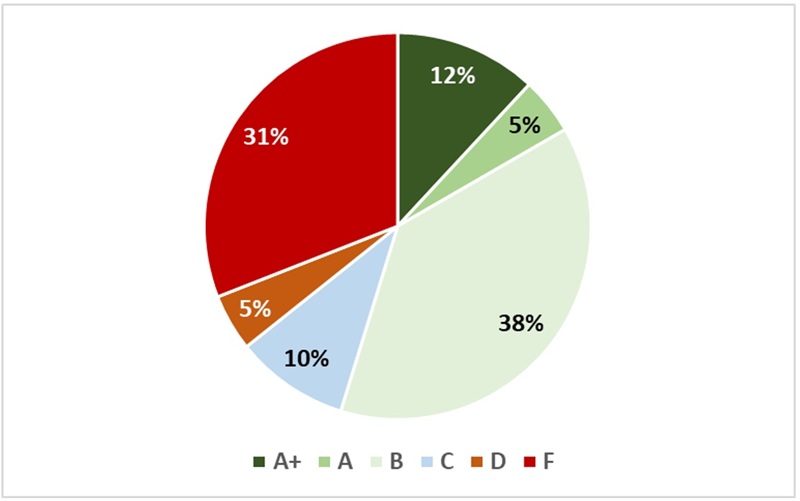
NCTQ finds similarly uneven results in Ohio. Figure 1 shows that just 17 percent of our elementary programs earn A+ or A’s—marks indicating sufficient time on math preparation. Meanwhile, 36 percent receive unacceptable D’s or F’s, with the rest receiving middling ratings.
Figure 1: NCTQ ratings of Ohio teacher preparation programs—elementary math
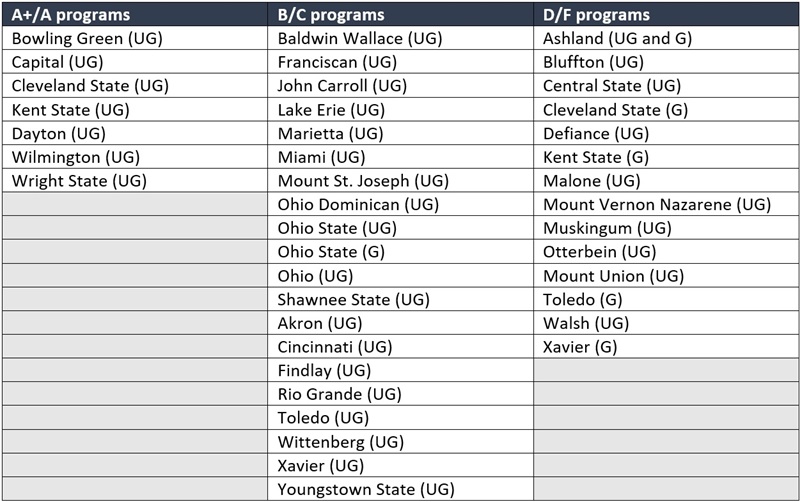
The table below displays the marks for each elementary teacher preparation program in Ohio. On the top end, we find seven exemplars: Bowling Green, Capital, Cleveland State, Kent State, Dayton, Wilmington, and Wright State. The middle of the pack includes some of the state’s largest preparation programs (Miami, Ohio State, Ohio), while several graduate programs and smaller undergraduate institutions bring up the rear.
Table 1: Individual teacher preparation program ratings—elementary math
To address shortcomings in math preparation, NCTQ offers a slate of solid recommendations for both leaders of preparation programs as well as state policymakers. Two state-level policy ideas merit special mention.
First, Ohio should articulate teacher preparation standards—something NCTQ indicates has not been done—to encourage effective and consistent elementary math training. Once standards have been developed, state lawmakers should require periodic audits of programs to verify curricular alignment and sufficient math coursework requirements. This would follow the footsteps of Ohio’s recent move to hold prep programs accountable for effective training in the science of reading.
Second, as we at Fordham have also recommended, Ohio should require prospective elementary teachers to pass the math section of the state licensing test in order to teach math. Currently, incoming teachers take a composite content knowledge exam that encompasses literacy, math, social studies, science, and the arts. This means that teachers could fail the math section but pass the overall exam and still be licensed to teach elementary math. Requiring a demonstration of competency before leading math classes should be non-negotiable. A requirement would also push prep programs to ratchet up their math coursework to help candidates pass the licensing exam.
Students benefit greatly when they learn from educators with strong mathematical knowledge. But too many teachers, particularly in our elementary schools, receive inadequate training. To help more children get off to a strong start in math, Ohio policymakers need to address deficiencies in elementary teacher preparation.
[1] This paper has numerous illustrations of pre-service teachers struggling to understand the decimal system.
[2] NCTQ notes that 105 hours of content instruction is equivalent to roughly two and one-third semester-long college courses. The analysis also includes a forty-five hour recommendation for math pedagogical training. Prep programs tend to meet or exceed the pedagogical minimum, but fall short on math content. NCTQ’s program ratings take into account hours versus both content and pedagogy minimums.