
Last year, the Ohio Senate unanimously passed Senate Bill 19. The legislation, which is currently being considered by the House Education Committee, aims to improve student achievement by providing academic intervention services to those who score at the lowest level (“limited”) on state assessments in math or English language arts. It’s also designed to support high achievers by requiring public schools to enroll any student in grades 3–7 who scores at the two highest levels on their state math exam (“accomplished” or “advanced”) in an advanced math course the following year.
For the typical seventh grader, this would mean enrolling in Algebra I during eighth grade. Plenty of students already do that, so it’s important to recognize that Senate Bill 19 isn’t a start-from-scratch effort. Instead, it aims to ensure that all seventh graders who demonstrate readiness have access to algebra in eighth grade—something that isn’t happening today and is keeping high-ability students from pursuing advanced math and science courses when they reach high school and STEM majors when they reach college.
State level data show us how many students are being overlooked for advancement. During the 2023 school year, more than 23,000 seventh graders scored accomplished or advanced on the state’s math assessment. These students are considered to be on-track for college. Their scores are a clear indicator that they’re ready for more challenging work. Testing data indicate that high-ability students taking Algebra I in eighth grade almost universally perform well on the state’s end-of-course exam. And yet, more than half of them (55 percent) weren’t enrolled in algebra during eighth grade and thus didn’t take the end-of-course exam in 2024. That’s nearly 13,000 students who missed out on advanced math opportunities despite proving their readiness.
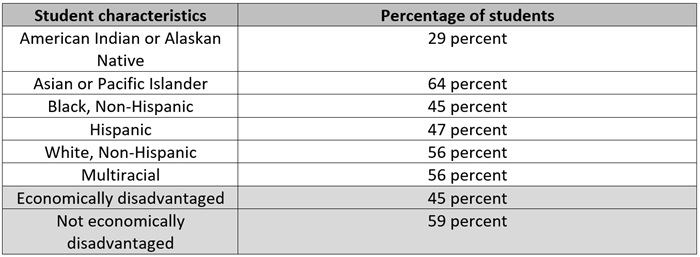
High-achieving low-income and minority students are more likely than their peers to miss out on advanced math. Less than 50 percent of Black, Hispanic, and American Indian/Alaskan native students who scored in the top two levels took algebra in eighth grade, while 56 percent of their White peers did so. A similar gap exists based on income: Just 45 percent of economically disadvantaged students who scored accomplished or advanced were enrolled in Algebra I in eighth grade, compared to 59 percent of their more affluent peers.
Chart 1. Percentage of seventh graders who scored accomplished or advanced on Ohio’s 7th grade math exam and took the Algebra I exam the following year
There are several reasons why these gaps exist. One is that some schools offer fewer opportunities for students to take advanced math. According to a nationally representative survey of teachers and principals published by the RAND Corporation in 2023, only 65 percent of principals in urban schools with middle grades said they offered Algebra I compared to 86 percent of principals in suburban schools. In Ohio, a majority of students who attend urban schools are Black or Hispanic and economically disadvantaged. The RAND survey results suggest these students are less likely to have access to algebra courses than their suburban counterparts, who are predominantly White and affluent. The state-level data outlined above seems to suggest the same.
Even when low-income and minority students attend schools that offer advanced math courses, they can still miss out on the opportunity to enroll. The RAND survey found that nearly one-quarter of principals said teacher nominations were included as part of the selection process for taking Algebra I before high school. That’s concerning, the RAND researchers say, because “previous research demonstrates that use of subjective measures—especially teacher nominations—during the enrollment process is a known contributor to persistent disparities in representation in advanced math courses.”
Senate Bill 19’s automatic enrollment policy would help Ohio address both these issues. Districts and schools that haven’t been offering advanced courses would be required to do so. And every student who demonstrates their academic readiness would have access to Algebra I regardless of whether they have a teacher or parent to advocate for them.
Some stakeholders have expressed concern that taking Algebra I instead of a typical eighth-grade math course could inadvertently cause students to miss out on important concepts and skills they’ll need down the road. Senate Bill 19 is structured in a manner meant to assuage these concerns, as it requires schools to begin identifying students for advanced coursework as early as third grade. Moreover, the bill requires districts to adopt a comprehensive math placement policy that includes a curriculum plan beginning in third grade and a timeline for how students will be prepared to be placed in Algebra I. Districts that align their policies and practice with state law should have plenty of time to identify algebra-bound seventh graders and provide accommodations to ensure they don’t miss out on important content.
For anyone still on the fence, it might be helpful to consider data from other states that have established similar policies and are seeing positive results. Federal Way School District in Washington State was one of the first to establish an automatic enrollment policy. After just one year of implementation, the number of students of color who took an advanced course jumped from 35 percent in 2009–10 to 61 percent in 2010–11. Even with this sizable increase, the course pass rate remained high (94 percent). A high school in Colorado Springs found that students who were automatically enrolled in AP courses based on prior performance had higher AP exam scores than their peers who self-enrolled. And after passing automatic enrollment legislation in 2018, a whopping 92 percent of eligible students in North Carolina were placed in advanced math courses during the 2025–26 school year.
Senate Bill 19 is a golden opportunity for Ohio to level the playing field for disadvantaged students by identifying high-achievers early and offering them support through a prescribed academic sequence. Like other statewide policies, automatic enrollment will require rigorous implementation. But the benefits for students are numerous. The sooner these policies can get underway, the better it will be for Ohio kids.