
Mobile Navigation

  • National
    • Policy
      • High Expectations
      • Quality Choices
      • Personalized Pathways
    • Research
    • Commentary
      • Gadfly Newsletter
      • Flypaper Blog
    • Events
    • Scholars Program
  • Ohio
    • Policy
      • Priorities
      • Media & Testimony
    • Research
    • Commentary
      • Ohio Education Gadfly Biweekly
      • Ohio Gadfly Daily
  • Charter Authorizing
    • Application
    • Sponsored Schools
    • Resources
  • About
    • Mission
    • Board
    • Staff
    • Career
Home
Home
Advancing Educational Excellence

Main Navigation

  • National
  • Ohio
  • Charter Authorizing
  • About

National Menu

  • Topics
    • Accountability & Testing
    • Advanced Education
    • Career & Technical Education
    • Charter Schools
    • Curriculum & Instruction
    • ESSA
    • Evidence-Based Learning
    • Facilities
    • Governance
    • Personalized Learning
    • Private School Choice
    • School Finance
    • Standards
    • Teachers & School Leaders
    • Think Again
  • Research
  • Commentary
    • Gadfly Newsletter
    • Flypaper Blog
    • Gadfly Podcast
  • Events
  • Scholars Program

Topics

Displaying 301-330 of 441 results
Commentary
4.14.2004

Redefining gifted education

Most people can agree on two propositions: that programs for gifted youngsters are a good thing, challenging the fast learner more than the standard curriculum, so long as they have high standards and expectations for participating students. And that such programs should be readily accessible to students of every race. But what happens when those two principles come into conflict?
Commentary
4.14.2004

When in doubt, spend more money

In 1993, the Campaign for Fiscal Equity (CFE) in New York City filed a lawsuit against the state, claiming that New York State had failed to live up to its constitutional obligation to provide a "sound, basic education" to all its students.

Commentary
4.14.2004

School discipline, revisited

Christian N. Braunlich

Checker Finn's editorial on "The Discipline Paradox" discussed several difficulties of maintaining classroom order - particularly when a classroom contains some students who don't want to learn.

Commentary
4.14.2004

Evaluating Value-Added Models for Teacher Accountability

Chester E. Finn, Jr.

RAND Corporation2003

Commentary
4.14.2004

Opportunity and Responsibility for National Board Certified Teachers

Kathleen Porter-Magee

Andrew J. Rotherham, Progressive Policy InstituteMarch 2004

Commentary
4.14.2004

Curbing grade inflation at the Ivies

Between 1971 and 2000, the average GPA at Princeton rose from 2.99 to 3.66.  By 2002, only 5 percent of seniors graduating from that eminent institution earned less than a B-minus cumulative GPA.

Commentary
4.14.2004

Manipulating history teachers

Chester E. Finn, Jr.

If America's history teachers were broadly educated, deeply knowledgeable about the content that they're responsible for imparting to students, and free to draw their information, textbooks, and other instructional materials from whatever sources they judge best, all within a framework of sound academic standards and results-based accountability - under that dreamy scenario there'd be no reason

Commentary
4.14.2004

Nebraska: Mo' money, less accountability

It's no secret that some states and districts have threatened to decline federal Title I funding to avoid the accountability provisions of NCLB.  That is, of course, their choice to make.  The state of Nebraska, however, has taken a more underhanded route, working hard since the passage of the law to have it

Commentary
4.14.2004

More Math, Please: The Surprising Consensus on Math Among Parents, the Public, and Business Leaders in Two "New Economy" States

Mass Insight EducationApril 2004

Report
4.13.2004
Curriculum & Instruction

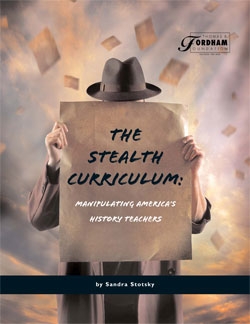
The Stealth Curriculum: Manipulating America's History Teachers

Sandra Stotsky

Widely used supplemental materials may be dangerous to educational health! These works often include hefty doses of political manipulation and ideological bias, courtesy of their authors. This study casts a wary glance toward materials that seldom come under scrutiny. This study is the fifth in a series dedicated to reforming social studies education.

Commentary
4.7.2004

Vouchers for disabled youngsters

Chester E. Finn, Jr.

It's apparent by now that Congress is not going to follow most of the excellent recommendations of the Bush administration's commission on the reform of IDEA, least of all its suggestion that federal funds be able to be used by states for special-ed vouchers a la Florida's "McKay Scholarships." (See

Commentary
4.7.2004

A school run amuck

Juvenal said, "Two things only the people anxiously desire, bread and circuses." Even that famously cynical Roman poet might have been taken aback by some quarters of American K-12 education.

Commentary
4.7.2004

Drunken sailors in our schools

The Bush administration has recently come under fire for insufficient education spending.

Commentary
4.7.2004

And nothing but the truth

The latest issue of American Educator has a fantastic series of stories urging high school teachers and counselors to level with students about a basic truth: if you don't do well in high school, you won't do well in college or in the labor market.

Commentary
4.7.2004

One bad apple doesn't spoil the barrel

This week, headlines lit up with the news that "one school [in Milwaukee, Wisconsin] that received millions of dollars through the nation's oldest and largest voucher program, was founded by a convicted rapist" and that "another school reportedly entertained kids with Monopoly while cashing $330,000 in tuition checks for hundreds of no-show students." Voucher critics were quick to charge that "

Commentary
4.7.2004

Sixth Annual Report on School Performance, 2002-2003

Chester E. Finn, Jr.

Edison Schools, Inc.2004

Commentary
4.7.2004

Comparison of Traditional Public Schools and Charter Schools on Retention, School Switching, and Achievement Growth

Lewis C. Solmon, Human Resources Policy Corporation, and Pete Goldschmidt, Center for the Study of Evaluation, UCLAMarch 2004

Commentary
4.7.2004

Grading Vouchers: Ranking America's School Choice Programs

Kathleen Porter-Magee

Robert C. Enlow, Milton & Rose Friedman FoundationMarch 2004

Commentary
4.7.2004

Keeping her eye on the prize

Lately, it seems that just about everyone has a bone to pick with No Child Left Behind. Critics on right and left complain that the law's provisions are causing too many headaches, and schools, districts, and legislators are vowing to reject federal funding so as to avoid some of its tricky accountability provisions.

Commentary
4.7.2004

Military schools deliver

More high praise for the Defense Department's school system, where last year black and Hispanic 8th graders outperformed their peers in every single state. To be sure, the DoD system has built-in advantages, such as a unified command structure and ability to enforce parental involvement that other schools can't match.

Commentary
3.24.2004

Violence, mismanagement, and apathy in D.C.

Evidence that D.C. Public Schools are in crisis is not hard to come by.

Commentary
3.24.2004

The discipline paradox

Chester E. Finn, Jr.

Just about everyone - principals, parents, students, the general public - knows that many U.S. schools have a discipline problem, that kids are often out of control, not to mention rude, inattentive, and sometimes violent. Nearly every survey of problems facing U.S. schools puts discipline near the top of the list.

Commentary
3.24.2004

Working out the details in Denver

In any reform of anything, the devil is always in the details. And the Old Deceiver lurks still in the fine print of the pay-for-performance plan approved last week by Denver teachers. How realistic is a plan that won't fully take effect for another eight years? How will the inevitable tension between teachers on the old tenure-based system and teachers on the new plan be resolved?

Commentary
3.24.2004

Ending Social Promotion: The Response of Teachers and Students

Eric Osberg

Consortium on Chicago School ResearchFebruary 2004

Commentary
3.24.2004

Education Matters: Government, Markets, and New Zealand Schools

Chester E. Finn, Jr.

Mark Harrison, Education Forum2004

Commentary
3.24.2004

Beating the Odds IV: A City-by-City Analysis of Student Performance and Achievement Gaps on State Assessments

Kathleen Porter-Magee

Michael Casserly, Council of the Great City SchoolsMarch 2004

Commentary
3.24.2004

Common Sense School Reform

Chester E. Finn, Jr.

Frederick M. Hess, Palgrave-MacMillan2004

Commentary
3.24.2004

Buy a degree, get a raise

Two months ago, Georgia's Professional Standards Commission (PSC) - the committee that is responsible for "certification, preparation, and conduct of certified, licensed, or permitted personnel employed in the public schools of the State of Georgia" - quietly launched an investigation into "diploma mill" teachers.

Commentary
3.24.2004

Control for cash a bad deal

In New York City, Mayor Michael Bloomberg took control of the board of education, with decidedly mixed results so far (see http://www.edexcellence.net/gadfly/issue.cfm?issue=140#1730).

Commentary
3.24.2004

Homeschooling comes of age, and under fire

Homeschooling - once considered the education option of choice for gun-toting religious fanatics or a haven for social misfits - is coming of age as home-schooled students begin to find themselves welcomed at prestigious colleges and universities. It's hardly surprising that many homeschooled students, who get personalized attention in a nurturing educational environment, are doing well.

Pagination

  • First page « First
  • Previous page ‹ Previous
  • Page 7
  • Page 8
  • Page 9
  • Page 10
  • Current page 11
  • Page 12
  • Page 13
  • Page 14
  • Page 15
  • Next page Next ›
  • Last page Last »

Type

  • Commentary (434)
  • Report (7)

Topics

  • Accountability & Testing (1)
  • Advanced Education (1)
  • Charter Schools (1)
  • Curriculum & Instruction (3)
  • Governance (1)
  • Private School Choice (1)
  • Standards (1)
  • Teachers & School Leaders (1)

Date

  • (-) 2004 (0)
  • September 2004 (43)
  • October 2004 (49)
  • November 2004 (26)
  • May 2004 (44)
  • March 2004 (41)
  • June 2004 (40)
  • July 2004 (19)
  • January 2004 (40)
  • February 2004 (43)
  • December 2004 (37)
  • August 2004 (30)
  • April 2004 (42)
Fordham Logo

© 2026 The Thomas B. Fordham Institute
Privacy Policy
Usage Agreement

National

P.O. Box 110
Burke, VA 22009

202.223.5452

[email protected]

Ohio

P.O. Box 82291
Columbus, OH 43202

614.223.1580

[email protected]

Sponsorship

130 West Second Street, Suite 410
Dayton, Ohio 45402

937.227.3368

[email protected]