
Mobile Navigation

  • National
    • Policy
      • High Expectations
      • Quality Choices
      • Personalized Pathways
    • Research
    • Commentary
      • Gadfly Newsletter
      • Flypaper Blog
    • Events
    • Scholars Program
  • Ohio
    • Policy
      • Priorities
      • Media & Testimony
    • Research
    • Commentary
      • Ohio Education Gadfly Biweekly
      • Ohio Gadfly Daily
  • Charter Authorizing
    • Application
    • Sponsored Schools
    • Resources
  • About
    • Mission
    • Board
    • Staff
    • Career
Home
Home
Advancing Educational Excellence

Main Navigation

  • National
  • Ohio
  • Charter Authorizing
  • About

National Menu

  • Topics
    • Accountability & Testing
    • Advanced Education
    • Career & Technical Education
    • Charter Schools
    • Curriculum & Instruction
    • ESSA
    • Evidence-Based Learning
    • Facilities
    • Governance
    • Personalized Learning
    • Private School Choice
    • School Finance
    • Standards
    • Teachers & School Leaders
    • Think Again
  • Research
  • Commentary
    • Gadfly Newsletter
    • Flypaper Blog
    • Gadfly Podcast
  • Events
  • Scholars Program

Topics

Displaying 151-180 of 319 results
Commentary
9.5.2001

Another Skirmish in the Battle over Teacher Certifications

In 1999, the Thomas B. Fordham Foundation published a study by Dan Goldhaber (of the Urban Institute) and Dominic Brewer (of RAND) that found that students of teachers with emergency credentials do no worse than students whose teachers have standard teaching credentials.
Commentary
9.5.2001

Parents try to remake a reluctant public school

Most children who live in the Hollywood Hills go to private schools, but a small group of parents from that affluent Los Angeles neighborhood decided two years ago that they might like to send their kids to the local public school.

Commentary
9.5.2001

Recent Studies from Education Privatization Center

Chester E. Finn, Jr.

Henry Levin's National Center for the Study of Privatization in Education, based at Teachers College, Columbia University, hasn't always done important and well-balanced work, but it's certainly been prolific. What's more, several of the recent "occasional papers" now available on its burgeoning website strike us as worth knowing about, maybe even reading.

Commentary
9.5.2001

Pay-for-Performance: Key Questions and Lessons from Five Current Models

Kelly Scott

Education Commission of the States June 2001

Commentary
9.5.2001

Results of a School Voucher Experiment: The Case of Washington, D.C. after Two Years

Kelly Amis

Patrick J. Wolf, Paul E. Peterson and Martin R. West August 2001

Commentary
9.5.2001

Mobile students mess with accountability systems

As if House and Senate conferees didn't already face enough difficulties in creating a fair definition of "adequate yearly progress" for the new ESEA, an article in this month's Washington Monthly explains how high rates of student mobility can doom an otherwise solid accountability system. According to a GAO study, one out of every six U.S.

Report
9.1.2001
School Finance, Governance

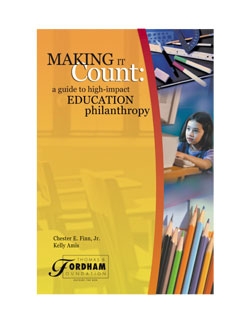
Making it Count: A Guide to High-Impact Education Philanthropy

Chester E. Finn, Jr., Kelly Amis

Charitable giving in the U.S. is at an all-time high, as is the public's concern with the state of our K-12 education system. This guide provides practical advice for the philanthropist who is fed up with the status quo and eager to support effective education reforms. Making it Count reviews the state of U.S. public education, examines different ways that philanthropists are trying to improve it, explains why some strategies work better than others, profiles a number of education philanthropists, and recounts the experiences of the Thomas B. Fordham Foundation.

Commentary
8.29.2001

Taking aim at AIMS

Diane Ravitch

My older sister lived in Scottsdale, Arizona, for many years and her six children attended the public schools there. Her oldest child, my niece, took most of her public schooling in Texas and is now a teacher in Florida. The rest are graduates of the Arizona school system.

Commentary
8.29.2001

About Harold O. Levy

Diane Ravitch

In recent weeks, the Chancellor of the New York City public school system has been heavily criticized, especially about cost overruns in school construction. The sharks have been circling, and the New York Times ran an editorial defending him (a sure sign that he is in big trouble). I'd like to say a few things in his behalf. Harold O.

Commentary
8.29.2001

On the road with the KIPP Academy Orchestra

Can you think of anything more fun than chaperoning 76 junior high school kids on a bus trip across America?

Commentary
8.29.2001

Why new teachers leave (and what would make them stay)

Almost 75 percent of new teachers in the Cleveland Municipal School District either were considering leaving or were unsure whether they would stay, according to the results of a survey administered this spring.

Commentary
8.29.2001

Teacher Workload Survey: Interim Report

Kelly Scott

Department for Education and Skills (UK) August 2001

Commentary
8.29.2001

Options for Restructuring the Safe and Drug Free Schools and Communities Act: Report with Background Papers and Focus Group Summary

Judy Goss

RAND 2001

Commentary
8.29.2001

Charter Schools as laboratories for personnel policy experiments

Charter schools have come under criticism in some quarters for failing to realize one of the goals emphasized by proponents: that they would serve as laboratories in which novel ideas and methods could be tested and best practices identified for dissemination among traditional public schools. For example, a recent study of California charter schools concluded: "...

Commentary
8.29.2001

Is the GED as good as a high school degree?

Since 1975, the percentage of young adults who have gotten their diploma through the GED program has risen from less than 3 percent to 12 percent. Since the Census Bureau includes GED holders as high school completers, these statistics mask a steady rise in the nation's dropout rate. But does the GED measure up as a high school equivalence exam?

Commentary
8.29.2001

Summer school in New York City

Diane Ravitch

I read the results of the summer school program in New York City with a growing sense of dismay, in part because so many kids gained so little from the experience, but also because I had predicted this would happen in a New York Times op-ed a year ago, when the school system rashly threatened to send 325,000 kids to summer school.

Commentary
8.29.2001

How can one science education system produce elites and illiterates?

The US has the finest scientists in the world but the rest of the population is abysmally ignorant of science. Why? Because science education in the US today exists as a kind of mining and sorting operation in which existing scientists search for diamonds in the rough who can be cut and polished into elite scientists, according to David Goodstein, a professor of physics at Caltech.

Commentary
8.29.2001

Teacher Labor Market Imbalances in Massachusetts: A Review of the Evidence The New England Council

Kelly Scott

Commission on High Technology Workforce Development August 14, 2001

Commentary
8.22.2001

The art of polling

This week, Phi Delta Kappa (an "honorary fraternity" of professional educators) and Gallup released their 33rd annual poll of the public's attitudes toward the public schools. Normally polls bring good news or bad news, depending on which side you are on.

Commentary
8.22.2001

Teacher training programs face new competition

For the past hundred or so years, the training and certification of public school teachers has been largely in the hands of colleges of education, but this monopoly is now being challenged by private sector entrants into the teacher training business, explains Robert Holland in "The Rise of Private Teacher Training," an issue brief published by the Lexington Institute on August 10.  Sylvan

Commentary
8.22.2001

Evaluating teachers using value-added analysis

"Doesn't it make sense to link teacher evaluation and measures of student learning?" ask Pamela Tucker and James Strong in an article in the September 2001 issue of the American School Board Journal. Hardly a radical idea, though the NEA is officially opposed.

Commentary
8.22.2001

Crusade in the Classroom: How George W. Bush's Education Reforms will Affect Your Children, Our Schools

Jacob Loshin

Douglas B. Reeves

Commentary
8.22.2001

Class Dismissed

Karen Baker

Meridith Maran

Commentary
8.22.2001

When Theory Hits Reality: Standards-Based Reform in Urban Districts

Karen Baker

SRI International

Commentary
8.22.2001

Troops as Teachers in Texas: Are They Effective?

Jacob Loshin

Texas Military Initiative

Commentary
8.22.2001

Crazy things districts do to attract teachers

States and school districts struggling to hire teachers in the final days before school opens are offering all kinds of creative incentives to attract applicants. Among them: redesigning teachers' lounges to resemble quaint New England inns, replacing degree requirements with height requirements, offering free tickets to school plays, and promising unlimited bathroom passes.

Commentary
8.22.2001

How applying to college can warp your mind

Two articles in the September issue of The Atlantic Monthly take a sausage-factory-like look at the college application and admissions process. In "The Early Decision Racket," James Fallows explores how early-decision programs have distorted the admissions process and added an insane level of intensity to middle-class obsessions about getting into college.

Commentary
8.15.2001

Virtual charter schools that don't need to find buildings

In Pennsylvania and Colorado (among other states), parents can now register their children for charter schools that exist only in cyberspace.

Commentary
8.15.2001

Teachers learn to gamble, massage in order to maintain certification

Teachers in many states must accumulate professional development credits to maintain their certification, but those who pushed hard for a recently-enacted recertification program in Illinois were horrified to learn that some teachers are satisfying this requirement by taking courses in Tai Chi, massage, and gambling (conducted at a racetrack, no less).

Commentary
8.15.2001

Opposition to character education from an unlikely source

In this week's Weekly Standard, former Secretary of Education William J. Bennett and Boston University Ed School Dean Edwin J. Delattre take aim at the character education program included in the education bills now before Congress.

Pagination

  • First page « First
  • Previous page ‹ Previous
  • Page 2
  • Page 3
  • Page 4
  • Page 5
  • Current page 6
  • Page 7
  • Page 8
  • Page 9
  • Page 10
  • Next page Next ›
  • Last page Last »

Type

  • Commentary (311)
  • Report (8)

Topics

  • Charter Schools (2)
  • Governance (6)
  • School Finance (2)
  • Teachers & School Leaders (2)

Date

  • (-) 2001 (0)
  • September 2001 (40)
  • October 2001 (57)
  • November 2001 (33)
  • May 2001 (37)
  • June 2001 (36)
  • July 2001 (45)
  • January 2001 (1)
  • December 2001 (31)
  • August 2001 (50)
Fordham Logo

© 2026 The Thomas B. Fordham Institute
Privacy Policy
Usage Agreement

National

P.O. Box 110
Burke, VA 22009

202.223.5452

[email protected]

Ohio

P.O. Box 82291
Columbus, OH 43202

614.223.1580

[email protected]

Sponsorship

130 West Second Street, Suite 410
Dayton, Ohio 45402

937.227.3368

[email protected]