Commentary
Fans of "direct instruction," and those who would like to learn more about it, will want to examine this new report from the Wisconsin Policy Research Institute. It was catalyzed by three facts: (a) Direct Instruction, properly done, is a teaching method (and curriculum) that is known to be effective, particularly with younger children and especially in reading.
Crack education journalist Jay Matthews reacted to anti-testing articles in a thoughtful column appearing only in the electronic version of the Washington Post.
On May 23, 2001, the New York Times ran three major stories demonstrating cognitive dissonance about educational approaches. On the front page, we learned about Ms. Moffett, a first-year teacher assigned to a low-performing school who is extremely frustrated because she is required to follow lesson plans instead of doing what she wants, which is to demonstrate her creativity.
Committee for Economic Development
In a sideshow to the main debate over ESEA, the Senate passed an amendment on May 3 that would add $18.1 billion to the federal budget for special education over the next 10 years and would change special ed funding into an entitlement that Congress would be required to fund regardless of budget considerations. This measure has drawn criticism from the White House and others for not addre
The Third International Math and Science Study (TIMSS) made quite a splash in the U.S. when its 1995 results came out, mostly because it showed American kids sorely under-performing their counterparts in many other lands in math and science, especially in the upper grades.
The Education Trust's newsletter, Thinking K-16, is usually worth a look. The Winter 2001 issue is especially fine, being devoted almost entirely to a careful but exceptionally lucid discussion of U.S. high school results during the period since the Nation at Risk report of 1983 and the declaration of national education goals in 1989. How have we fared?
The National Assessment of Educational Progress (NAEP) recently released the results of the 4th grade reading assessment conducted in 2000. (By NAEP standards, alas, this is speedy: data available just a year after the test was given!) The news is not good: average scores were essentially flat across the 1990's.
Thirty percent of students surveyed in grades 6 through 10 have been involved in either bullying or being bullied themselves, according to a study released by the National Institute of Child Health and Human Development (NICHD) earlier this month.
by Craig Jerald, the Education Trust (published by the Business Roundtable)
Like many skillful leaders whose successes throw them before the public's eye, Wendy Kopp has her share of detractors, including some within the ranks of the unique teaching corps she created.
The redoubtable Paul Barton, formerly of the Educational Testing Service, prepared this March 2001 report for the National Education Goals Panel. Based on NAEP data, it seeks to track and explain state-level performance trends. He's done some interesting "quartile analysis" as well as taken a close look at minority/white achievement gaps.
White House aides have grown testy about the education bill, unwilling to acknowledge that the compromises Congress has forced upon it have sorely weakened George W. Bush's fine reform plan. Presumably because they assented to those compromises, they feel obliged to insist that the plan remains largely intact.Would that it were so.
Can a new breed of superintendents--drawn from outside the ranks of traditional educators--transform urban school systems?
The Council of the Great City Schools deserves plaudits for its ever-greater willingness to speak candidly about educational achievement (as well as its vigorous efforts to boost that achievement).
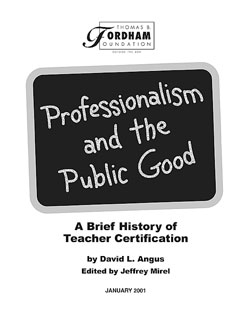
Why does our system of teacher certification emphasize training in pedagogy rather than subject-matter knowledge? The answer can be found in this report, which traces the emergence of state control over teacher certification. The focus is on efforts by the teacher education establishment to gain monopoly control over the licensing of teachers.