Mobile Navigation

  • National
    • Policy
      • High Expectations
      • Quality Choices
      • Personalized Pathways
    • Research
    • Commentary
      • Gadfly Newsletter
      • Flypaper Blog
    • Events
    • Scholars Program
  • Ohio
    • Policy
      • Priorities
      • Media & Testimony
    • Research
    • Commentary
      • Ohio Education Gadfly Biweekly
      • Ohio Gadfly Daily
  • Charter Authorizing
    • Application
    • Sponsored Schools
    • Resources
  • About
    • Mission
    • Board
    • Staff
    • Career
Home
Home
Advancing Educational Excellence

Main Navigation

  • National
  • Ohio
  • Charter Authorizing
  • About

National Menu

  • Topics
    • Accountability & Testing
    • Advanced Education
    • Career & Technical Education
    • Charter Schools
    • Curriculum & Instruction
    • ESSA
    • Evidence-Based Learning
    • Facilities
    • Governance
    • Personalized Learning
    • Private School Choice
    • School Finance
    • Standards
    • Teachers & School Leaders
    • Think Again
  • Research
  • Commentary
    • Gadfly Newsletter
    • Flypaper Blog
    • Gadfly Podcast
  • Events
  • Scholars Program

The Education Gadfly Weekly

Sign Up to Receive Fordham Updates

We'll send you quality research, commentary, analysis, and news on the education issues you care about.
Thank you for signing up!
Please check your email to confirm the subscription.

What parents want; and how policymakers can provide it

VOLUME 13, NUMBER 33
8.26.2013
8.26.2013

What parents want; and how policymakers can provide it

VOLUME 13, NUMBER 33
view
High Expectations

What Parents Want: Education Preferences and Trade-offs

This groundbreaking study finds that nearly all parents seek schools with a solid core curriculum in reading and math, an emphasis on science, technology, engineering, and math (STEM) education, and the development in students of good study habits, strong critical thinking skills, and excellent verbal and written communication skills.

Dara Zeehandelaar Shaw, Ph.D., Amber M. Northern, Ph.D. 8.26.2013
NationalReport

What Parents Want: Education Preferences and Trade-offs

8.26.2013
Report

What parents want—and how policymakers can provide it

Chester E. Finn, Jr. | Michael J. Petrilli
8.27.2013
Flypaper

All or nothing on teacher accountability

Michael J. Petrilli
8.29.2013
Blog

The civil rights movement and education reform

The Education Gadfly
8.29.2013
Blog

The Miley Cyrus-Britney Spears showdown

8.29.2013
Resource

What (ed-reformer) parents want

8.29.2013
Video

Sustained Progress: New Findings About the Effectiveness and Operation of Small Public High Schools in New York City

Adam Emerson
8.29.2013
Blog

Early Start: Preschool Politics in the United States

John Horton
8.29.2013
Blog
view

What parents want—and how policymakers can provide it

Chester E. Finn, Jr., Michael J. Petrilli 8.27.2013
Flypaper
view

All or nothing on teacher accountability

Michael J. Petrilli 8.29.2013
Blog
view

The civil rights movement and education reform

The Education Gadfly 8.29.2013
Blog

The Miley Cyrus-Britney Spears showdown

Michael J. Petrilli, Dara Zeehandelaar Shaw, Ph.D., Amber M. Northern, Ph.D. 8.29.2013
Resource
view

What (ed-reformer) parents want

Kathleen Porter-Magee, Robert Pondiscio, Marc Porter Magee, Joe Williams 8.29.2013
Video
view

Sustained Progress: New Findings About the Effectiveness and Operation of Small Public High Schools in New York City

Adam Emerson 8.29.2013
Blog
view

Early Start: Preschool Politics in the United States

John Horton 8.29.2013
Blog
view

What Parents Want: Education Preferences and Trade-offs

8.26.2013
Report

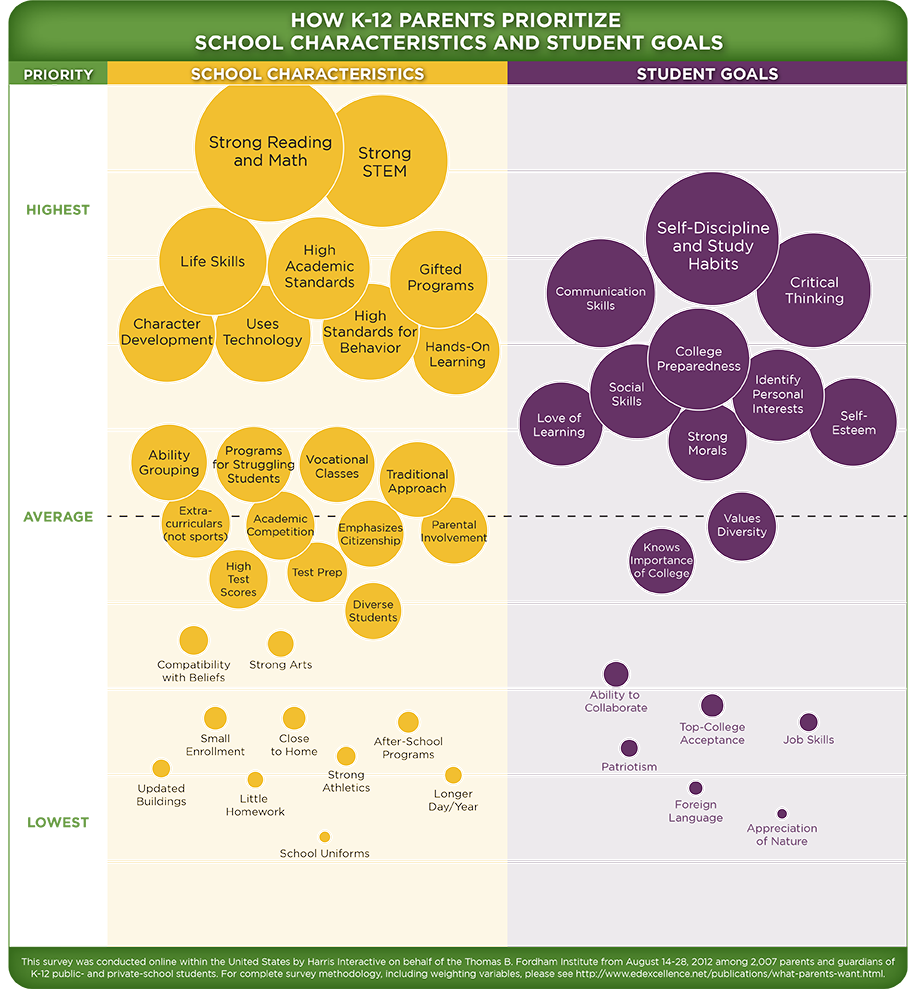
This groundbreaking study finds that nearly all parents seek schools with a solid core curriculum in reading and math, an emphasis on science, technology, engineering, and math (STEM) education, and the development in students of good study habits, strong critical thinking skills, and excellent verbal and written communication skills. But some parents also prefer specializations and emphases that are only possible in a system of school choice.

  • Pragmatists (36 percent of K–12 parents) assign high value to schools that, “offer vocational classes or job-related programs.” Compared to the total parent population, Pragmatists have lower household incomes, are less likely themselves to have graduated from college, and are more likely to be parents of boys.
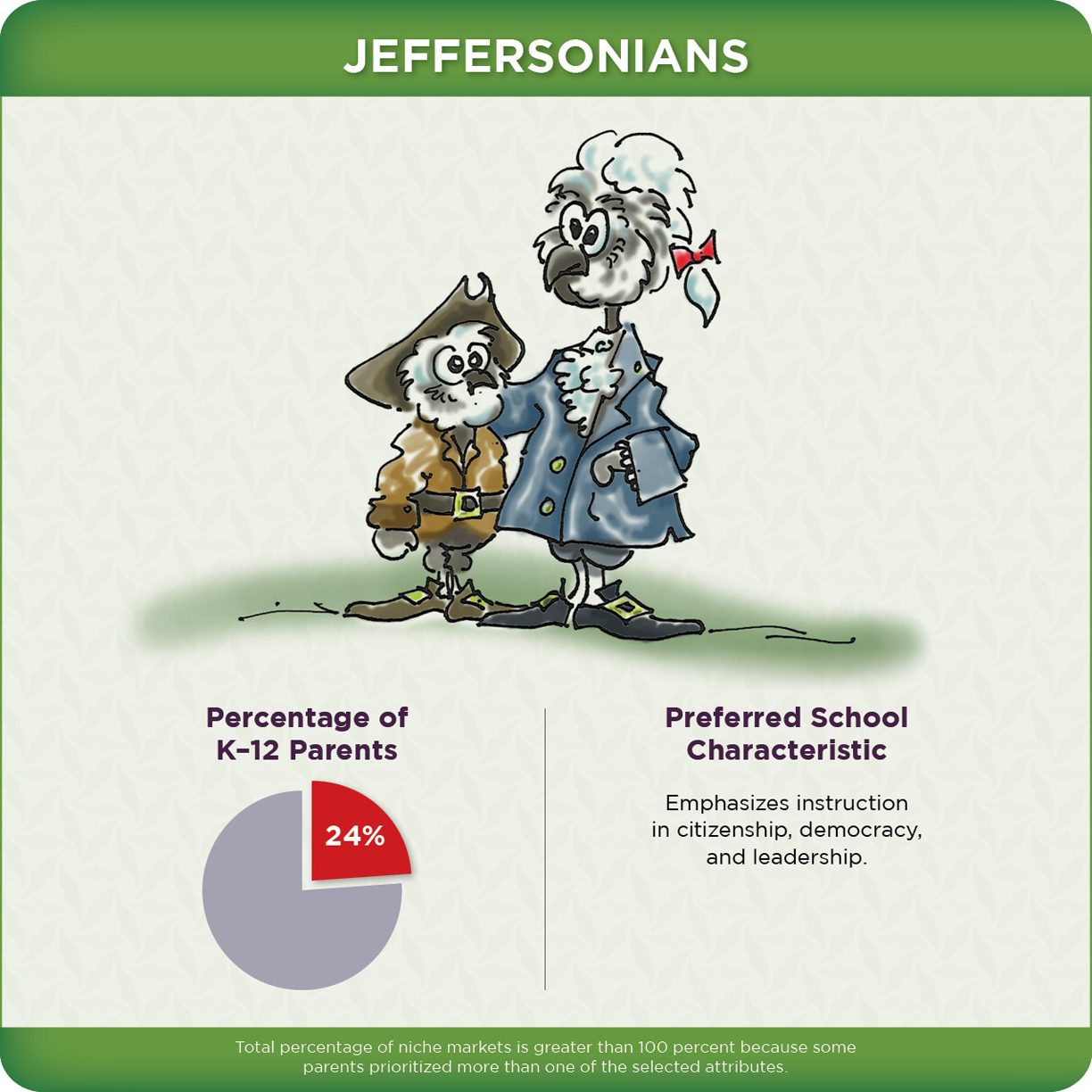
  • Jeffersonians (24 percent) prefer a school that “emphasizes instruction in citizenship, democracy, and leadership,” although they are no more likely than other parents to be active in their communities or schools.
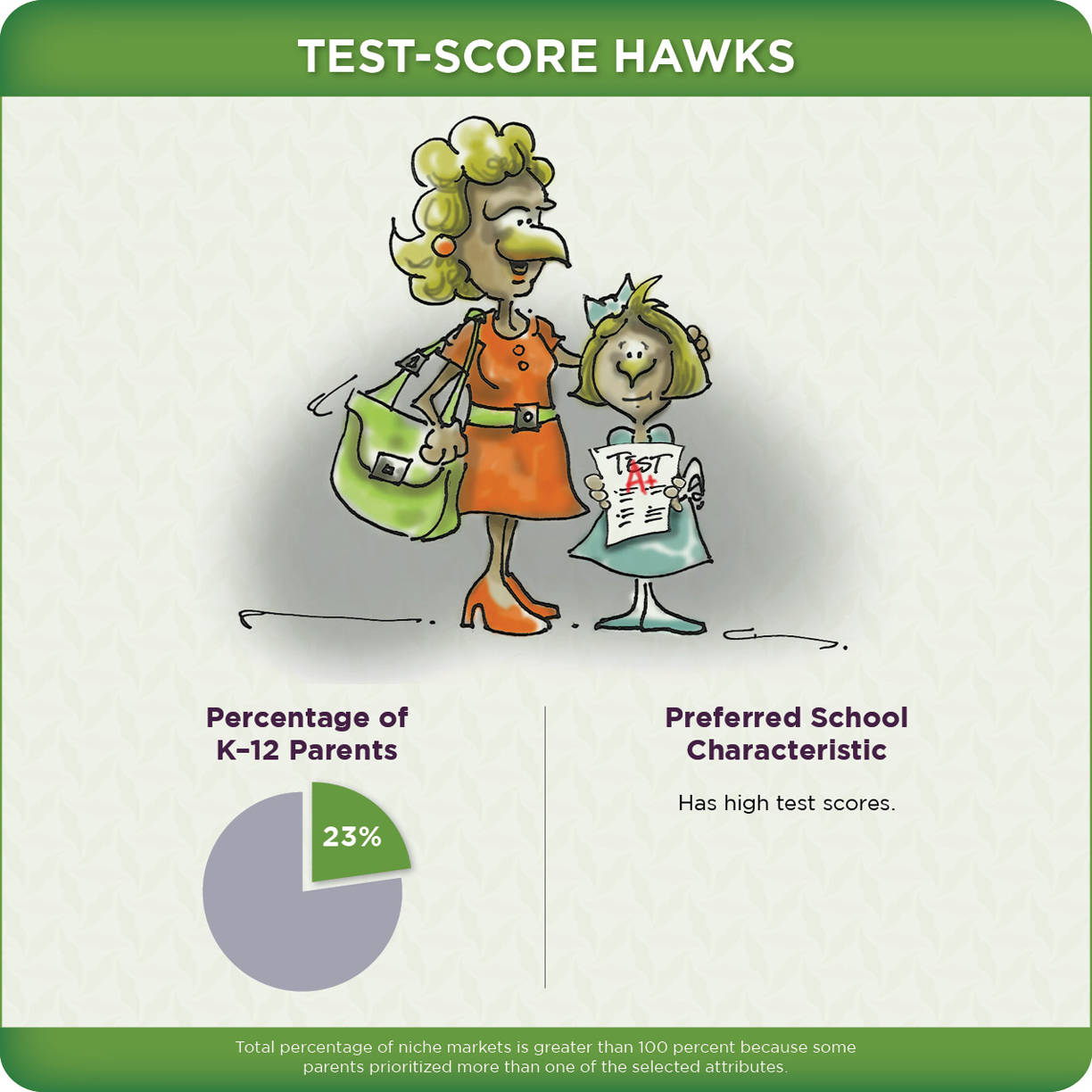
  • Test-Score Hawks (23 percent) look for a school that “has high test scores.” Such parents are more likely to have academically gifted children who put more effort into school. They are also more likely to set high expectations for their children, push them to excel, and expect them to earn graduate degrees. Test-Score Hawks are also more apt to report that their child has changed schools because, as parents, they were dissatisfied with the school or its teachers.
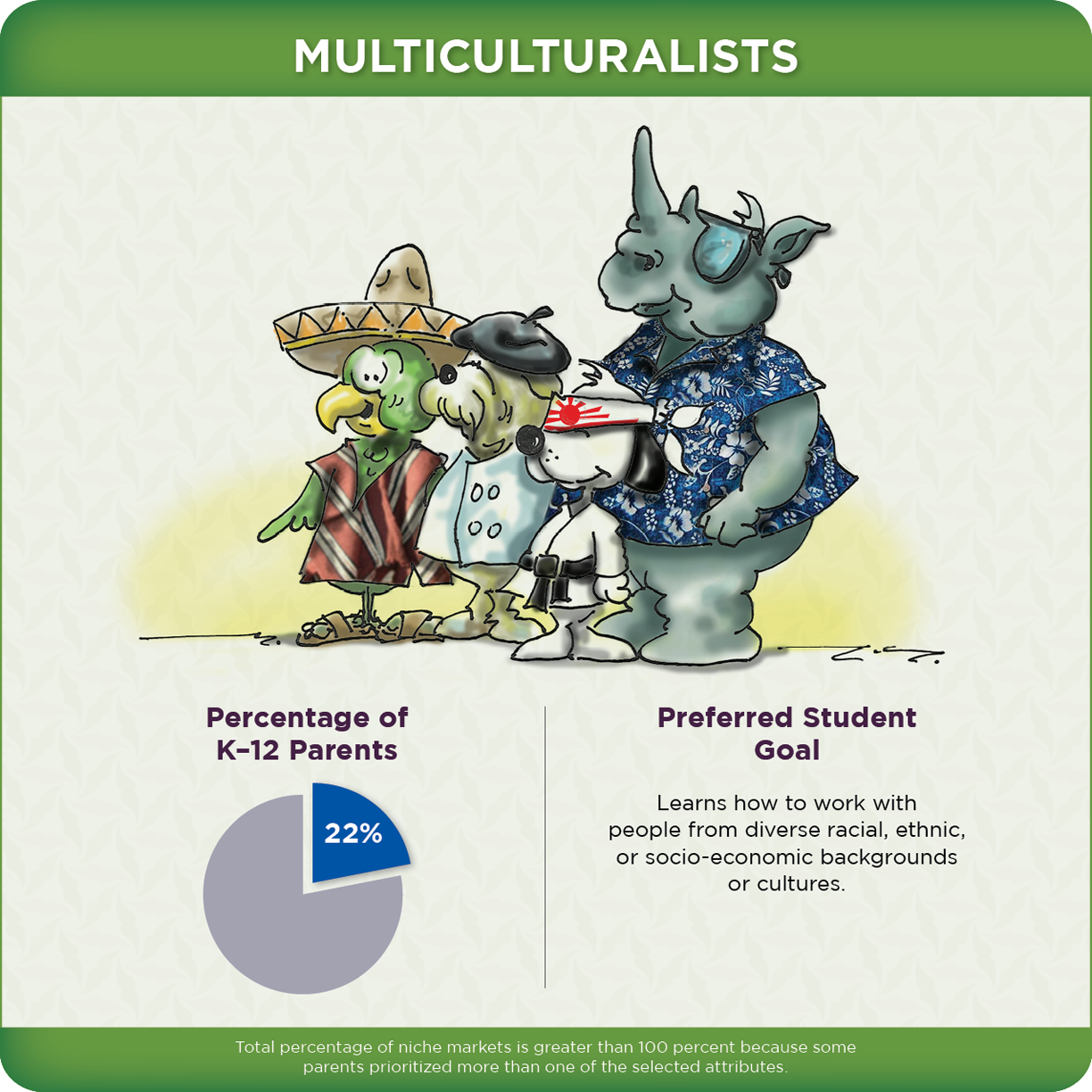
  • Multiculturalists (22 percent) laud the student goal: “learns how to work with people from diverse backgrounds.” They are more likely to be African American, to self-identify as liberal, and to live in an urban area.
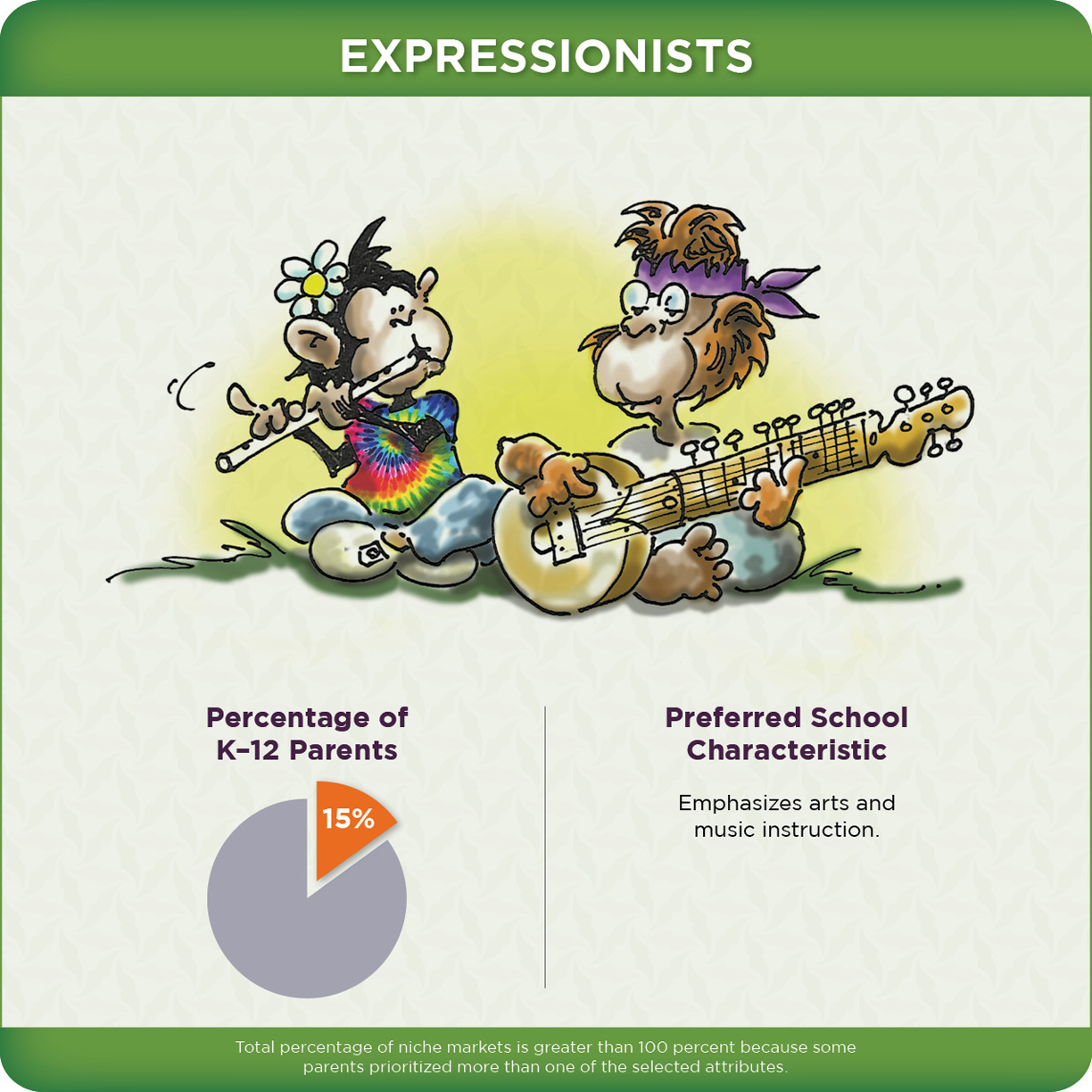
  • Expressionists (15 percent) want a school that “emphasizes arts and music instruction.” They are more likely to be parents of girls and to identify as liberal; they are less likely to be Christian. (In fact, they are three times more likely to self-identify as atheists.)
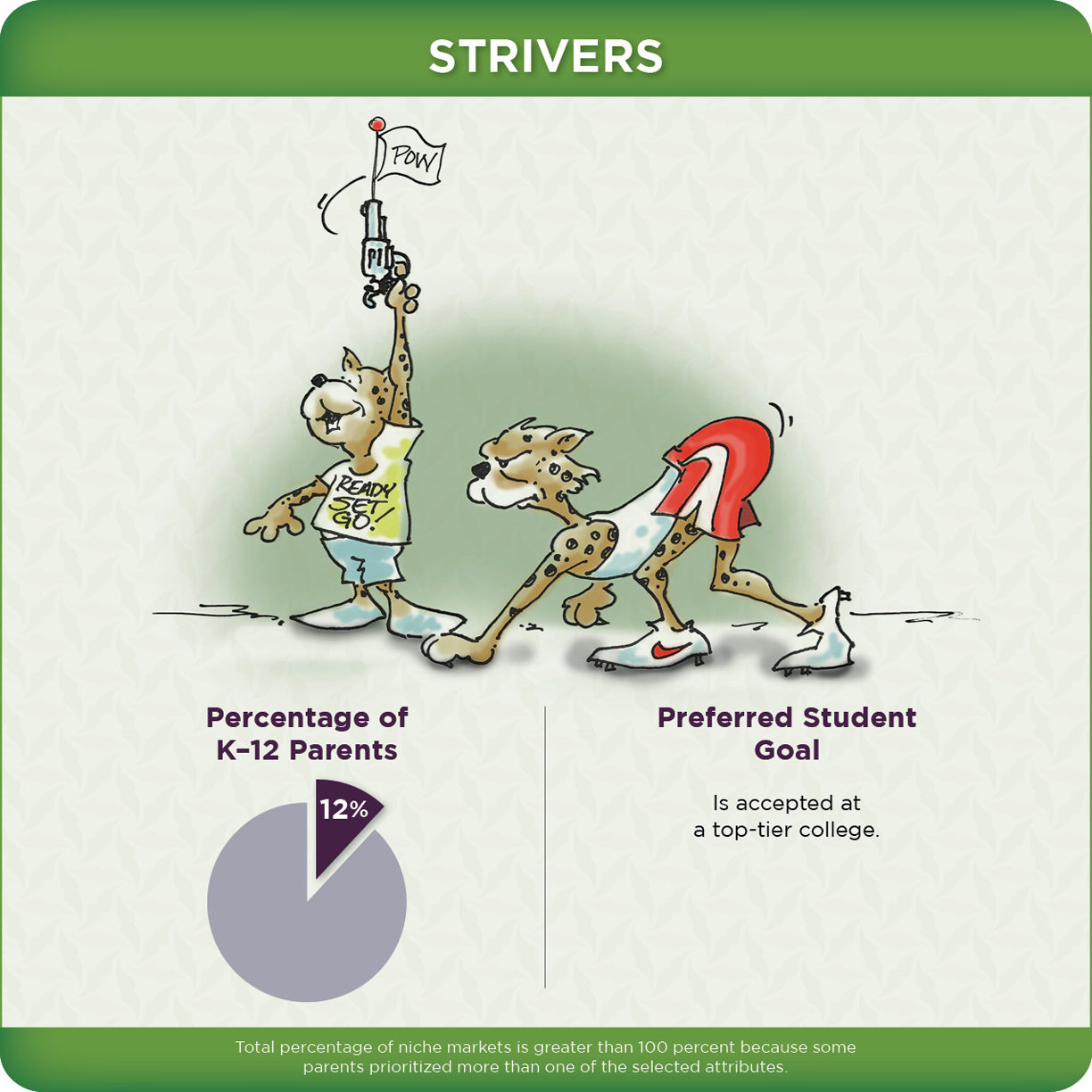
  • Strivers (12 percent) assign importance to their child being “accepted at a top-tier college.” Strivers are far more likely to be African American and Hispanic. They are also more apt to be Catholic. But they do not differ from the total population in terms of their own educational attainment.
     

What Parents Want: Education Preferences and Trade-Offs uses market-research techniques to determine what school characteristics and student goals are most important to parents.


What type of parent are you? Click here to take our quiz and find out!


Infographic

Pragmatists Jeffersonians Test Score Hawks Multiculturalists Expressionists Strivers
view

What parents want—and how policymakers can provide it

Chester E. Finn, Jr. | Michael J. Petrilli
8.27.2013
Flypaper

The dominant approach to public education for most of our nation’s history was for local districts to offer standard-issue schools, mainly neighborhood-based and essentially identical, that reflected some version of the community’s general preferences and values. Because those preferences differed somewhat from place to place, public schools differed somewhat, too. Schools might be a bit more “traditional” in more conservative suburbs and rural communities, a tad more “progressive” in liberal urban locales. But in any given community, there was usually just one flavor for everybody. (Even the exceptions were broadly standardized. For example, there might be a “vocational high school” in the community.) If you didn’t like it, you chose a private school or you moved—kind of like Henry Ford’s approach to car colors.

Today, however, families across much of the country can choose among multiple public-school options. These may include charter schools; magnet schools with various specialized or advanced programs; science, technology, engineering, and mathematics (STEM) schools; career or college-preparatory academies; other neighborhood schools (via intra- and sometimes inter-district choice); and even virtual schools. Some cities—New Orleans and Denver may be the best examples—are pursuing “portfolio” approaches, offering a variety of school options throughout their communities. And then there’s the private-school market, which is still accessible primarily to those who can afford the tuition, but is also changing as vouchers and tax credits spread to more states and communities.

But what do parents really want from their children’s schools? Are there patterns and categories? Is it possible to segment the parent market into identifiable groups, each with distinctive preferences? And if so, could we do a better job of creating and delivering the educational options that families most crave for their kids? Wouldn’t it be valuable to know how those groups sort out? Are they identifiable by race? Socio-economic status? Personal politics, ideology, or religion? Geography? And how large are these groups in relation to one another?

Analysts and advocates interested in the “demand” side of school choice have long focused on parents’ education preferences. But parents are too often viewed as a monolith of similar if not identical preferences, with researchers looking to determine what the “average” or “typical” parent seeks in a school—and how that parent makes decisions among types of schools. A groundbreaking new study from the Thomas B. Fordham Institute, conducted by the well-known market-research firm Harris Interactive, takes a different approach: It attempts to “segment” U.S. parents into distinguishable groups, each with its own values, priorities, and preferences regarding education. Let’s take a look at the major findings.

  • Parents’ “must-haves” do not vary greatly. At the outset, we thought we might find distinct groups of parents with sharply different values and preferences regarding schools. Instead, we found that parents are more alike than different when it comes to basic school attributes. A few key goals and features rose to the top of almost all parents’ lists, including a strong core curriculum in reading and math; an emphasis on STEM subjects; and the development of good study habits, strong critical-thinking skills, and excellent communication skills, both oral and written. These preferences persisted across parents of different races, household incomes, and political ideologies, and were consistently ranked highly by parents regardless of whether their children attended traditional district, public charter, or private schools.
  • Yet some revealing differences are also visible by race, income, and other demographic factors.For example:
    • White parents are somewhat more focused on their children learning “good study habits and self-discipline” than are African American or Hispanic parents. White parents, on the other hand, are less concerned with their child being accepted at a top-tier college;
    • Both African American and Hispanic parents rank “preparation for taking state tests” and “has high test scores” significantly higher than white parents do. (Low-income parents also rank preparing for state tests higher than more affluent parents do.); and
    • The goal of developing “strong critical thinking skills” has a nearly direct relationship to increasing income—the higher the parents’ income, the higher a priority this is.

We identified several school-market “niches” worth considering by those on the “supply side” of school choice. While we didn’t find sharply distinctive “segments” (parents did not fall into neat groups of shared values that differed substantially from other groups), we did identify parents who prioritized individual school attributes or student goals that most other parents viewed as less important. From this, six market niches surfaced.

  1. Pragmatists (36 percent of K–12 parents). These parents ranked highly the school attribute: “Offers vocational classes or job-related programs;”
  2. Jeffersonians (24 percent). These parents ranked highly a school that “emphasizes instruction in citizenship, democracy, and leadership;”
  3. Test-Score Hawks (23 percent). These parents ranked highly the school attribute: “Has high test scores;”
  4. Multiculturalists (22 percent). These parents ranked highly the student goal: “Learns how to work with people from diverse backgrounds;”
  5. Expressionists (15 percent). These parents ranked highly: “Emphasizes arts and music instruction;” and
  6. Strivers (12 percent). These parents ranked highly the student goal: “Is accepted at a top-tier college.”

What does all of this mean? Examining these data, one can make a case for an education system built both on commonality and on differences. Nearly all parents want a strong curriculum in core subjects, a focus on critical thinking skills, and for their children to acquire good study habits. This bodes well for policy initiatives such as the Common Core State Standards, which are designed to deliver much of that.

Yet parents are far from identical. Once their non-negotiables are satisfied—somewhat like the basic needs in Maslow’s well-known hierarchy—many start looking for something special. Some do indeed seek high test scores. Others favor vocational training. Some want diversity. Others value art and music. Some care about their kids going to top-tier colleges. It would be hard, outside a system of school choice, for all of these parents to get what they want.

In the end, it’s not unlike people’s view of cars. Nearly everyone wants a vehicle that’s reliable, safe, and affordable. But once those requisites are supplied, car buyers and drivers have markedly different preferences as to roominess, sportiness, seating capacity, gas mileage, and, of course—pace Henry Ford—color and style. The auto industry has this figured out. The education industry still has a lot to learn.

view

All or nothing on teacher accountability

Michael J. Petrilli
8.29.2013
Blog

Someday, when they write the history of the education-reform movement, future scholars will tug their chins in puzzlement as they ponder today’s obsession with high-stakes teacher evaluations. But not for all the usual reasons that people raise concerns: the worry about whether we’ve got good measures of teacher performance, especially for instructors in subjects other than reading and math; the likelihood that tying achievement to evaluations will spur teaching to the test in ways that warp instruction and curriculum; the futility of trying to “principal-proof” our schools by forcing formulaic, one-size-fits-all evaluation models upon all K–12 campuses; the terrible timing of introducing new evaluation systems at the same time that educators are working to implement the Common Core.

No, future historians are far likelier to wonder about the motivation behind the evaluation obsession. Was this a policy designed to identify, and remove, America’s least effective teachers? Or was it a kinder-and-gentler effort to provide critical feedback to instructors so they could improve their craft?

If the latter, as some reformers now claim, historians will wonder why we were so insistent on attaching high stakes to these evaluations—determined to “make human-resource decisions” based on the results, as the parlance goes.

And if the former, historians will ask: What the heck were they thinking? Did they really believe that teacher evaluations alone would be enough to push bad instructors out of the classroom?

***

Consider, for instance, the Obama Administration’s decision to place three states on “high risk status” because they have fallen behind on their promises to implement statewide teacher-evaluation systems (a condition—of dubious legality—of their ESEA waivers). One of those states—Washington—has fallen behind because its legislature hasn’t passed a bill enabling such an evaluation system.

Reformers in Washington State are gleeful, believing that the Administration’s actions may finally push their lawmakers to act. But then what? Even if the Evergreen State develops a well-designed system, will principals there be willing to give low marks to ineffective teachers? And will school leaders be able to push those instructors out of the classroom?

Doubtful. Washington’s teacher-tenure protections will remain in place, as will collective bargaining agreements, both of which guarantee extensive “due process” rights. And regardless of Arne Duncan’s exhortations, there’s no way that labor-friendly Washington is going to make it significantly easier to fire bad teachers (at least those who have already earned tenure).

Here’s a prediction: Whatever Olympia policymakers come up with, most teachers will continue to receive positive ratings and nearly all will cling to their jobs. Why? Why not. If you’re a school principal, why give a teacher a bad rating if you know you still can’t remove her from the classroom? All you’ve done is create an enemy—or set yourself up for a lawsuit. Smart principals know better and will do what they’ve always done, which is find a way to play the “dance of the lemons,” sending their bad teachers to another school.

Schools are hardly the only place this happens. Arne Duncan might take a look at the ratings for his own Department of Education employees. I bet he’ll find very few negative reviews—because federal employees more or less enjoy lifelong tenure from day one. Managers learn that negative ratings are futile, indeed hurtful of morale and esprit, so they don’t give them. Yet nobody thinks all 5,000 Department of Education employees are hitting it out of the park.

The lesson is this: When it comes to high-stakes evaluations, it’s all or nothing. Either policymakers need to combine evaluation systems with reforms that make it plausible to fire ineffective employees, or they shouldn’t bother with high stakes at all.

A few states have been willing to go the distance and in time perhaps others will. Mitch Daniels and Tony Bennett combined teacher-evaluation reforms in Indiana with tenure and collective bargaining overhauls. Colorado’s Senate Bill 191 redefined tenure to align with evaluation results. And Tennessee, just last week, connected “re-licensure” with teachers’ contributions to student achievement.

But let’s be honest: America’s bluer states aren’t likely to go this far anytime soon—states like Illinois, whose ESEA waiver request is languishing because of the teacher-evaluation issue. Or New York, where the evaluation issue turned into an all-out food fight between policymakers and the unions—and where nobody is talking about reining tenure in for veteran teachers.

Some reformers think enacting evaluation systems is a “win” anyway—it “moves the needle” in the right direction. I disagree. There are significant costs in terms of dampening teacher morale, provoking a parent backlash, and over-encouraging teaching to the test. Maybe it’s worth it if we can identify and remove the worst teachers. But if that’s not going to happen, it’s a loss, not a victory.

And if the goal is simply to provide feedback to teachers, in order to help them improve their craft, then let’s just do that. Don’t even call it “evaluation.” Don’t attach any stakes. Just provide the data to teachers and principals—and continue to train the latter on how to conduct high-quality teacher observations—and call it a day.

The stakes are high—not just for teachers, but for the reform movement. As, I suspect, history will show.


view

The civil rights movement and education reform

The Education Gadfly
8.29.2013
Blog

The fight for civil rights and empowerment didn’t happen overnight, but rather one lunch counter at a time, reminds reverend H.K. Matthews in an editorial supporting the new Alabama Accountability Act.

The Justice System petitioned a judge to stop Louisiana’s voucher program in thirty-plus districts operating under federal desegregation orders. This move is folly—and could have major implications for other modes of choice, including charter schools.

Original recipe?  The newly created Kentucky Charter Schools Association, along with the National Alliance for Public Charter Schools, Democrats for Education Reform, the Black Alliance for Education Options and senators Mitch McConnell and Rand Paul are teaming up to bring charter schools to the Bluegrass State.

The teachers union in Mexico has “wreaked chaos” in the nation’s capital, “blockading roads and setting up a tent city in the city's colossal main square” to protest recent education reforms, writes the Wall Street Journal.

Former Chicago public schools chief J.C. Brizard is making headlines in Chicago again—this time for a By the Company It Keeps interview with Andy Smarick, where Brizard says he underestimated the power of the teachers union and calls Rahm Emanuel a micromanager.

The Onion takes on Teacher For America and asks for real teachers who have “an honest-to-God degree in education and not a twentysomething English graduate trying to bolster a middling GPA and a sparse law school application.” Required reading for The Onion staff includes NCTQ’s Teacher Prep Review 2013.

The Miley Cyrus-Britney Spears showdown

8.29.2013
Resource

Can Common Core and school choice coexist? What’s the deal with Teach For America? Mike and Dara discuss what parents want, while Amber disses QRIS (and preps for the big day).

Amber's Research Minute

Can Rating Pre-K Programs Predict Children's Learning? by T. J. Sabol1, S. L. Soliday Hong, R. C. Pianta, and M. R. Burchina

view

What (ed-reformer) parents want

8.29.2013
Video

What (ed-reformer) parents want. Read What Parents Want: Education Preferences and Trade-offs and take the quiz to see if you fall into one of our parent categories.

view

Sustained Progress: New Findings About the Effectiveness and Operation of Small Public High Schools in New York City

Adam Emerson
8.29.2013
Blog

The small-schools movement has had its share of naysayers over the years, but results from New York City’s small high schools continue to show positive results, particularly for disadvantaged kids. This week, MDRC researchers Howard S. Bloom and Rebecca Unterman released the results of their latest installment of a multi-year study of the city’s small schools of choice (those that the Bloomberg administration has opened since 2002 to replace larger, failing high schools) and their findings still show that students who win lottery admission to these schools are significantly more likely to graduate than lottery losers. The newest study includes results for a new cohort of students and, for the first time, examines the outcomes of special-education students and English-language learners. The upshot: SSC students boasted a 70.4 percent graduation rate, compared with 60.9 percent at traditional schools (all the more significant because traditional students have been graduating at higher rates). Bloom and Unterman also suggest that SSCs increased the graduation rates of special-education students by 13.8 percentage points and of ELL students by 4.9 percentage points (though they admit the sample size for these subgroups was small). MDRC has promised another report that will look at the factors that have led to these positive results. With hope, that will give us a genuine blueprint—and a way to quiet the naysayers.

Source: Howard S. Bloom and Rebecca Unterman, “Sustained Progress: New Findings About the Effectiveness and Operation of Small Public High Schools of Choice in New York City,” MDRC, August 2013.

view

Early Start: Preschool Politics in the United States

John Horton
8.29.2013
Blog

Preschool policy is a fragmented hodgepodge, writes Andrew Karch, as he traces early-education policy since the 1970s. He starts with President Nixon’s veto of the Comprehensive Child Development Act—for some, a missed opportunity; for others, the beginning of the private and public program-mix we have today. Karch doesn’t focus on the effectiveness of this patchwork system (for that, read Reroute the PreSchool Juggernaut), but he’s not surprised that policymakers remain dissatisfied. The current system is the result of stakeholders protecting their entrenched interests and the status quo. True, they support tweaks—just as long as their own policy sphere is not changed; so most reforms efforts—a la President Obama—run amuck and we are left with the stasis we have today. (This more-than-obvious explanation could be used to describe any policy debate underway in Congress and many of our state houses.) Still, readers interested in early education or public-policy development at large would be wise to peruse this book for its insight into how we got the policies we have today and why we see so much paralysis in attempts to reform them.

SOURCE: Andrew Karch, Early Start: Preschool Politics in the United States (Ann Arbor, MI: University of Michigan Press, April 2013).

Fordham Logo

© 2026 The Thomas B. Fordham Institute
Privacy Policy
Usage Agreement

National

P.O. Box 110
Burke, VA 22009

202.223.5452

[email protected]

Ohio

P.O. Box 82291
Columbus, OH 43202

614.223.1580

[email protected]

Sponsorship

130 West Second Street, Suite 410
Dayton, Ohio 45402

937.227.3368

[email protected]