Mobile Navigation

  • National
    • Policy
      • High Expectations
      • Quality Choices
      • Personalized Pathways
    • Research
    • Commentary
      • Gadfly Newsletter
      • Flypaper Blog
    • Events
    • Scholars Program
  • Ohio
    • Policy
      • Priorities
      • Media & Testimony
    • Research
    • Commentary
      • Ohio Education Gadfly Biweekly
      • Ohio Gadfly Daily
  • Charter Authorizing
    • Application
    • Sponsored Schools
    • Resources
  • About
    • Mission
    • Board
    • Staff
    • Career
Home
Home
Advancing Educational Excellence

Main Navigation

  • National
  • Ohio
  • Charter Authorizing
  • About

National Menu

  • Topics
    • Accountability & Testing
    • Advanced Education
    • Career & Technical Education
    • Charter Schools
    • Curriculum & Instruction
    • ESSA
    • Evidence-Based Learning
    • Facilities
    • Governance
    • Personalized Learning
    • Private School Choice
    • School Finance
    • Standards
    • Teachers & School Leaders
    • Think Again
  • Research
  • Commentary
    • Gadfly Newsletter
    • Flypaper Blog
    • Gadfly Podcast
  • Events
  • Scholars Program

The Education Gadfly Weekly

Sign Up to Receive Fordham Updates

We'll send you quality research, commentary, analysis, and news on the education issues you care about.
Thank you for signing up!
Please check your email to confirm the subscription.

The two tracks of school reform

Volume 14, Number 14
1.8.2014
1.8.2014

The two tracks of school reform

Volume 14, Number 14
view
Quality Choices

Public accountability & private-school choice

The Fordham Institute supports school choice, done right. That means designing voucher and tax-credit policies that provide an array of high-quality education options for kids that are also accountable to parents and taxpayers.

Adam Emerson 1.8.2014
NationalReport

Public accountability & private-school choice

1.8.2014
Report

The two tracks of school reform

Michael J. Petrilli | Chester E. Finn, Jr.
4.2.2014
Flypaper

First shots fired in Louisiana Common Core battle

4.3.2014
Flypaper

A big win for the Big Apple’s charters

The Education Gadfly
4.3.2014
Blog

Dara and the Star Trek conventions

4.3.2014
Resource

Private Schools, Public Vouchers - School Leaders Panel

3.6.2014
Video

Building a Better Teacher: How Teaching Works (and How to Teach It to Everyone)

Andrew McDonnell
4.3.2014
Blog

From Promising to Proven: A Wise Giver’s Guide to Expanding on the Success of Charter Schools

Aaron Churchill
4.3.2014
Blog

PISA 2012 Results: Creative Problem Solving

4.3.2014
Blog
view

The two tracks of school reform

Michael J. Petrilli, Chester E. Finn, Jr. 4.2.2014
Flypaper
view

First shots fired in Louisiana Common Core battle

4.3.2014
Flypaper
view

A big win for the Big Apple’s charters

The Education Gadfly 4.3.2014
Blog

Dara and the Star Trek conventions

Michael J. Petrilli, Dara Zeehandelaar Shaw, Ph.D., Amber M. Northern, Ph.D., Pamela Tatz 4.3.2014
Resource
view

Private Schools, Public Vouchers - School Leaders Panel

3.6.2014
Video
view

Building a Better Teacher: How Teaching Works (and How to Teach It to Everyone)

Andrew McDonnell 4.3.2014
Blog
view

From Promising to Proven: A Wise Giver’s Guide to Expanding on the Success of Charter Schools

Aaron Churchill 4.3.2014
Blog
view

PISA 2012 Results: Creative Problem Solving

4.3.2014
Blog
view

Public accountability & private-school choice

1.8.2014
Report

The Fordham Institute supports school choice, done right. That means designing voucher and tax-credit policies that provide an array of high-quality education options for kids that are also accountable to parents and taxpayers. In that vein, Fordham has created the Public accountability & private-school choice toolkit to help with the design of strong outcomes-based accountability in private-school-choice programs.

We recommend that states

  • Require that all students who receive a voucher (or tax-credit scholarship) participate in state assessments. (While we prefer state assessments as policy, we think any widely respected test that allows for ready comparison against other schools or districts is a reasonable compromise);
  • Mandate public disclosure of those assessment results, school by school, save for schools that enroll fewer than ten voucher (or scholarship) students in grades that are tested; and
  • Use a sliding scale when it comes to acting on the test results—i.e., private schools that derive little of their revenue from programs of this kind should be largely left alone, while those that receive more of their dollars from state initiatives should be held more accountable.

This toolkit was updated in June 2014 to reflect that mandating nationally norm-referenced tests is a reasonable compromise for accountability measures in these programs.

Public accountability & private-school choice: Infographic

View a larger version

____________

If you have questions about the book, please email Amber Northern.

view

The two tracks of school reform

Michael J. Petrilli | Chester E. Finn, Jr.
4.2.2014
Flypaper

For two decades now, education reformers have promoted a two-track strategy for improving our schools. The first track is standards-based: Set clear, high expectations in core academic subjects; test students regularly to see which schools and students are clearing the bar; and hold schools (and perhaps also educators and pupils) to account for the results.

The second reform track is school choice: Allow parents to select among a wide array of education providers, encouraging innovation along the way.

We have argued for years that these two tracks are interdependent — even codependent. Let us explain:

Standards-based reform got underway in the late 1980s and early 1990s, in part as a reaction to A Nation at Risk, the 1983 report by President Reagan’s Commission on Excellence in Education. This reform track offered what Lamar Alexander called a “horse trade”: more autonomy for schools in return for stronger academic results. Previous waves of reform had focused on inputs, intentions, and regulation: boost the credentials and pay of teachers; increase course requirements for high-school graduation; mandate lower class sizes; etc. When that yielded paltry success, policymakers flipped the equation: less regulation but more focus on outcomes.

That only works, however, when the desired outcomes are clear. That’s the role of academic standards, which, if well crafted, provide guidance to teachers, parents, textbook writers, and test designers about what students are expected to know and be able to do, year by year, in a few core subjects. States labored for decades to put such standards in place, prodded in 1994 by the federal Goals 2000 Act, then in 2002 by the No Child Left Behind Act, with its insistence on annual testing and consequential accountability.

Standards-based reform has many pluses. For one, it works: test scores for America’s lowest-performing students, including many low-income and minority children, rose significantly, at least in the early grades, after the advent of the standards, testing, and accountability movement. Such children are now one to two grade levels ahead of where their mid-1990s counterparts were. That’s real progress. Done well, as in Massachusetts, standards-based testing encourages strong teaching in the classroom and gives parents and taxpayers reliable information about school performance. It also can touch every school in America in ways that few other reforms ever could.

But standards-based reform has an Achilles’ heel: its bark is worse than its bite. For all the talk of “accountability,” nothing much actually happens to “failing” schools or the people who work in them. The school-turnaround track record is dismal because, frankly, nobody is sure what to do with awful schools. Most of the evidence indicates that they are impervious to improvement. Yet policymakers are loath to shut them down; the kids need to go somewhere.

Enter school choice. The early 1990s gave birth to both charter schools (first in Minnesota) and vouchers (first in Milwaukee). The proposition—originally formulated by Milton Friedman—was (and remains) that parents, particularly the poor and those with children stuck in those failing schools, deserve better options and that a vibrant marketplace would lead to educational improvement. At least in the charter sector, the idea was also to create new schools from scratch, to be designed with Lamar Alexander’s horse trade in mind: they would have far greater autonomy than traditional district schools but would also face serious accountability. If they didn’t meet the terms of their charters, they would close.

Like standards-based reform, school choice has racked up some serious successes and has proven to be a highly effective way to educate children. Virtually every rigorous study of charter schools or private schools participating in voucher programs finds that they outperform traditional public schools; the track records on high-school graduation and college-going are particularly impressive.

But school choice also has a weak point: bad schools that emerge and persist in a marketplace that hasn’t brought nearly as much quality control as proponents expected. While the choice sector as a whole looks pretty good on test scores and other measures, the averages mask poor performance from a significant minority of choice and charter schools. For whatever reason—and it really is something of a mystery—some parents will choose and stick with schools that are no good by any measure of actual performance.

That’s why we (and many other choice supporters) have urged a degree of standards-based reform for the choice sector, too. We believe that low-quality charter schools, if they cannot be swiftly set right, should be shuttered, as was the original intent. And we believe that private schools receiving taxpayer dollars to educate needy kids should test their voucher students and report the (aggregated) results. Those that fail to show progress over time should be disqualified from continuing to receive public funds. This approach is good for kids—protecting them from bad schools—and it’s also good politics—safeguarding choice programs from criticisms about weak performance and shoddy quality.

Needless to say, not all choice-minded reformers share our enthusiasm for “choice plus accountability for results.” Some would rely on market forces alone. The libertarian Cato Institute is currently circulating a petition calling on reformers and policymakers to “dispense with rigid testing mandates” because “the compelled conformity fostered by centralized standards and tests stifles the very diversity that gives consumer choice its value.”

One factor that’s raising the temperature of this debate is contention about the Common Core. These English and math standards have been adopted by forty-five states and the District of Columbia, and represent (in our view) a rigorous, coherent set of expectations pegged to college and career readiness in those two important subjects. But they are under attack—from some conservatives, because President Obama has taken undue credit for their adoption, and from some liberals, because, well, because liberals hate standards and testing (and many educators don’t love accountability, particularly when applied to themselves).

In a recent policy paper, we argued that private schools participating in voucher programs should have to administer their state’s tests to their scholarship students. After all, a common test does make life easier for parents “shopping” for schools across the public, private, and charter sectors and for taxpayers seeking evidence of return on investment from their education dollars. But now that most states are transitioning to the Common Core, the state test will soon be some sort of Common Core test. And that has freaked out some choice supporters, some private-school teachers, and some charter-school teachers, too.

Without backing away from our commitment to the inseparability of the two tracks of education reform, we see room for compromise on specifics. Yes, some degree of transparency and accountability is essential for all choice schools. We don’t buy the argument that we should leave it to “parental choice alone”; experience in the real world demonstrates (here as in every other market that we know of) that some external quality control is needed if only to protect consumers. But in the case of private-school accountability, it doesn’t have to be the Common Core–aligned tests that states will be using for their district and charter schools (some of which also need “alternative” accountability arrangements). If states will allow schools in the choice sector to use other valid, respected assessments—the kind that make clear to policymakers, parents, and taxpayers whether a school and its pupils are making academic progress from year to year—we won’t complain. It’s not ideal but it’s better than nothing. We certainly never meant to force private schools (and specialized charter schools) to forfeit the curricular distinctiveness that is a major reason for choosing them in the first place.

It has taken many years to reach this point, but the school-reform train finally has momentum. Let’s keep the forward motion—and avoid getting stuck in a tunnel. America’s kids are at a station down the line, waiting for help to arrive.

This article originally appeared in the National Review Online.

view

First shots fired in Louisiana Common Core battle

4.3.2014
Flypaper

With Indiana making changes to the Common Core (and Oklahoma likely to follow), many are turning their attention to Louisiana. While some state legislative sessions began much earlier this year, the Bayou State is just getting started and has long been seen as a potential battleground in the fight over Common Core. Wednesday saw the battle get underway, with a marathon hearing to consider two bills: HB381 threatens to remove the Common Core standards, replace them with the old Louisiana standards, and begin the process of writing new ones, while HB558 would remove PARCC as the state assessment. This comes just days after a memorandum was issued pegging the cost of backing out of Common Core in the tens of millions of dollars. The bills were also probably more extensive than the previously referenced bills in Indiana and Oklahoma, due to the provision in HB381 that would have immediately reverted back to the old standards. After hours of testimony from both sides, including strong support for the standards from the education and business communities and strong opposition from activists and parents, there were two fairly major developments: First, Governor Jindal's office filed in support of the bills. And second, both bills failed by a 12–7 margin. Common Core foes have vowed to fight on, and it is likely we will see hearings on other bills to kill or modify Common Core.

RELATED ARTICLE: Julia O’Donoghue, “Education Department says scrapping Common Core would cost Louisiana,” Times-Picayune, March 28, 2014.

view

A big win for the Big Apple’s charters

The Education Gadfly
4.3.2014
Blog

Governor Andrew Cuomo and embattled Mayor Bill de Blasio have reached a tentative deal. The New York legislature has agreed to fund universal, daylong pre-Kindergarten for four-year-olds to the tune of three hundred million dollars per year (close to de Blasio’s original ask of three hundred and forty million), meaning de Blasio is scrapping his “tax-the-rich” plan. But the real headline: the governor, fully throwing his support behind charter schools, included in the agreement a provision barring the mayor from charging rent to charters co-located in public-school buildings.

Under the cloud of federal ethics charges, incumbent Vincent Gray lost the Democratic primary for mayor of D.C. on Tuesday to City Councilor Muriel Bowser. Bowser now runs against independent David Catania in the general election; though he's considered a tough candidate, not once has a Democrat lost the race. So if Bowser does assume office next year, what will become of the district’s school system and Kaya Henderson, its chancellor? Bowser has been noncommittal on the topic.

Dara and the Star Trek conventions

4.3.2014
Resource

Mike and Dara explain the de Blasio–Cuomo deal, the difficulties of studying high flyers, and what it takes to be cool in school. Amber thinks the new PISA data on creative problem solving are just a touch too creative.

Amber's Research Minute

PISA 2012 Results: Creative Problem Solving by OECD, (OECD, April 2014). 

view

Private Schools, Public Vouchers - School Leaders Panel

3.6.2014
Video
State-funded voucher programs have stoked political controversy, culture clashes, and pitched court battles. In Ohio, vouchers (aka "scholarships") enable students without access to a good public school--or limited means--to attend a private school. Research has consistently shown that voucher programs benefit the kids who participate: higher achievement, higher odds of graduating high school, and a greater likelihood of attending college.
 
But what do we know about the private schools that educate voucher students? How has school life changed? Can they uphold their distinctive mission, values, and culture--even as they participate in a state-run program? Very little is known.
 
In Fordham's latest research venture, we sought to understand what happens in schools that take voucher students. We enlisted veteran journalist and former Dayton Daily News editorial-page editor Ellen Belcher who visited five private schools across the Buckeye State. The findings of our research will be released in a groundbreaking report Pluck and Tenacity: How five private schools in Ohio have adapted to vouchers.
 
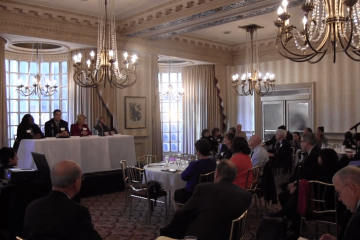
Please join the Thomas B. Fordham Institute, Ellen Belcher, four private-school leaders (including a newly-confirmed principal from Toledo), and education-policy experts to discuss the fascinating findings of this new report and their policy implications.
 
OPENING REMARKS
Ellen Belcher - Lead Investigator, Journalist and former editor, Dayton Daily News
 
SCHOOL LEADERS PANELISTS
Karyn Hecker - Principal, Immaculate Conception School, Dayton
Monica Lawson - Admissions Director, St. Martin de Porres High School, Cleveland
Deb O'Shea - Principal, St. Patrick of Heatherdowns School, Toledo
Mike Pecchia - President, Youngstown Christian School
 
MODERATOR
Chad Aldis - Vice President for Ohio Policy and Advocacy, Thomas B. Fordham Institute
view

Building a Better Teacher: How Teaching Works (and How to Teach It to Everyone)

Andrew McDonnell
4.3.2014
Blog

No one disputes that great teachers are essential. But how do we get more of them—do we find them or make them? In this book, an elaboration of her New York Times Magazine cover story, Chalkbeat’s Elizabeth Green roundly refutes the narrative that the teaching ability is like a “gene,” contending instead that teaching skills can be taught. The author retraces the history of pedagogical research—from education psychologist Nate Gage through math pedagogy expert Deborah Ball—to illustrate the institutional resistance to instruction-centered reforms. Though scholars, policy makers, and educators are obsessed with quality teaching, the myth of the teaching gene silences efforts to study and improve teachers’ techniques. New instructors, working in isolation, continually reinvent the wheel, with little success. But perhaps that’s starting to change. Some researchers are beginning to systematically observe and record teachers’ methods, allowing successful approaches to emerge. (For instance: Lemov’s taxonomy and Ball’s “This Kind of Teaching.”) This book bears good news for the American education community: if effective pedagogy can be learned, we needn’t wait for great teachers to come to the profession—we can start improving the ones we have.

SOURCE: Elizabeth Green, Building a Better Teacher: How Teaching Works (and How to Teach It to Everyone) (New York: W. W. Norton & Company, July 2014).

view

From Promising to Proven: A Wise Giver’s Guide to Expanding on the Success of Charter Schools

Aaron Churchill
4.3.2014
Blog

For two decades, path-breaking philanthropies have propelled the growth of charter schools. Today, more than 2.5 million American children attend a charter school, and research has shown that, done well, charters can produce impressive academic results. This guidebook from the Philanthropy Roundtable provides five key principles to help donors wanting to join the charter movement. First, philanthropists should focus on quality. At first blush, this might seem obvious, but the charter-school universe contains both fine and feeble schools—and sometimes it’s hard to distinguish between them. To ensure a return on investment, donors can work with “harbormaster” groups, which steer them toward promising entrepreneurs and proven charter models. Second, funders should back strong accountability and transparency measures, particularly via effective charter school authorizing. Third, philanthropists can support the flow of great teachers and leaders into the charter-school sector from national programs such as Teach For America and TNTP, as well as homegrown teacher- and principal-training programs. Fourth, philanthropy can encourage charter-friendly policies. In some states, the regulatory environment obstructs the growth of a healthy charter sector. Yet changing policy can be brutal, and philanthropic support can aid those who fight the good fight. Fifth, donors can strengthen the day-to-day operations of charter schools. This includes support for school facilities, oftentimes a barrier to growth. The charter movement has provided thousands of high-quality school options for children who would have otherwise had few good choices. With philanthropists’ steadfast support, a brighter future for America’s public schools is at hand.

SOURCE: Karl Zinsmeister, From Promising to Proven: A Wise Giver’s Guide to Expanding on the Success of Charter Schools (Washington, D.C.: The Philanthropy Roundtable, 2014).

view

PISA 2012 Results: Creative Problem Solving

4.3.2014
Blog

Is a consolation prize better than no prize at all? That’s the question American educators might ponder with this week’s release of the PISA 2012 problem-solving-assessment results. In its very first iteration, the computer-based test was administered to a subsample of the students assessed in PISA’s core subjects: just over 6,000 U.S. students took the core PISA tests, and 1,273 of those also took this problem-solving test (see the U.S. snapshot). In all, about 85,000 fifteen-year-olds in forty-four countries participated. It tested students’ creative problem-solving skills with real-life problems, such as “an unfamiliar vending machine or a malfunctioning electronic device.” (This is no April Fool’s day joke.) This is quite different from problem-solving questions found on the core assessments, which are more academic in nature. The results were closely correlated with math, science, and reading scores: Singapore, South Korea, and Japan topped the list; the U.S. was just above the OECD average; and Finland, Canada, and Australia were in between. The one potential bright spot for the U.S.—and the source of its consolation prize—is our “relative performance,” defined as the difference between the observed problem-solving score and the expected score, based on PISA core-subject scores. The U.S. had the fourth-highest relative performance and was one of only nine countries that had statistically significant higher-than-expected problem solving scores. The trophy, however, is made of cheap plastic. According to PISA, in countries with low overall performance—like the U.S.—these higher scores might indicate that schools are leaving students with unrealized potential. What a shame.

SOURCE: OECD, PISA 2012 Results: Creative Problem Solving (OECD, April 2014).

Fordham Logo

© 2026 The Thomas B. Fordham Institute
Privacy Policy
Usage Agreement

National

P.O. Box 110
Burke, VA 22009

202.223.5452

[email protected]

Ohio

P.O. Box 82291
Columbus, OH 43202

614.223.1580

[email protected]

Sponsorship

130 West Second Street, Suite 410
Dayton, Ohio 45402

937.227.3368

[email protected]