Mobile Navigation

  • National
    • Policy
      • High Expectations
      • Quality Choices
      • Personalized Pathways
    • Research
    • Commentary
      • Gadfly Newsletter
      • Flypaper Blog
    • Events
    • Scholars Program
  • Ohio
    • Policy
      • Priorities
      • Media & Testimony
    • Research
    • Commentary
      • Ohio Education Gadfly Biweekly
      • Ohio Gadfly Daily
  • Charter Authorizing
    • Application
    • Sponsored Schools
    • Resources
  • About
    • Mission
    • Board
    • Staff
    • Career
Home
Home
Advancing Educational Excellence

Main Navigation

  • National
  • Ohio
  • Charter Authorizing
  • About

National Menu

  • Topics
    • Accountability & Testing
    • Advanced Education
    • Career & Technical Education
    • Charter Schools
    • Curriculum & Instruction
    • ESSA
    • Evidence-Based Learning
    • Facilities
    • Governance
    • Personalized Learning
    • Private School Choice
    • School Finance
    • Standards
    • Teachers & School Leaders
    • Think Again
  • Research
  • Commentary
    • Gadfly Newsletter
    • Flypaper Blog
    • Gadfly Podcast
  • Events
  • Scholars Program

The Education Gadfly Weekly

Sign Up to Receive Fordham Updates

We'll send you quality research, commentary, analysis, and news on the education issues you care about.
Thank you for signing up!
Please check your email to confirm the subscription.

Teachers, race, and effectiveness

Volume 14, Number 19
8.26.2013
8.26.2013

Teachers, race, and effectiveness

Volume 14, Number 19
view
High Expectations

What Parents Want: Education Preferences and Trade-offs

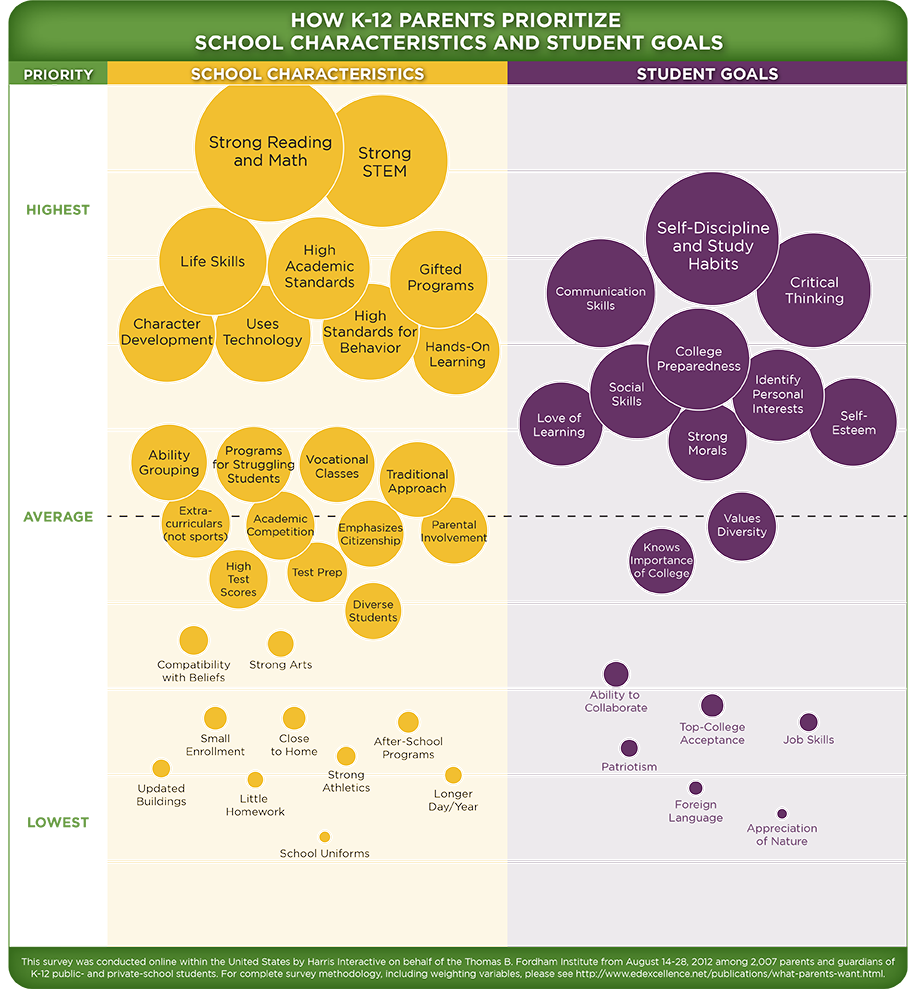
This groundbreaking study finds that nearly all parents seek schools with a solid core curriculum in reading and math, an emphasis on science, technology, engineering, and math (STEM) education, and the development in students of good study habits, strong critical thinking skills, and excellent verbal and written communication skills.

Dara Zeehandelaar Shaw, Ph.D., Amber M. Northern, Ph.D. 8.26.2013
NationalReport

What Parents Want: Education Preferences and Trade-offs

8.26.2013
Report

Teachers, race, and effectiveness

Chester E. Finn, Jr.
5.7.2014
Flypaper

Will students recover from credit recovery?

The Education Gadfly
5.7.2014
Blog

Mis-NAEP-ery

5.7.2014
Resource

What (ed-reformer) parents want

8.29.2013
Video

The Nation's Report Card, Grade 12: Reading and Mathematics 2013

Brandon L. Wright
5.7.2014
Blog

Preventable Failure: Improvements in Long-Term Outcomes when High Schools Focused on the Ninth Grade Year

5.7.2014
Blog

Sector Switchers: Why Catholic Schools Convert to Charters and What Happens Next

5.7.2014
Blog
view

Teachers, race, and effectiveness

Chester E. Finn, Jr. 5.7.2014
Flypaper
view

Will students recover from credit recovery?

The Education Gadfly 5.7.2014
Blog

Mis-NAEP-ery

Amber M. Northern, Ph.D., Pamela Tatz 5.7.2014
Resource
view

What (ed-reformer) parents want

Kathleen Porter-Magee, Robert Pondiscio, Marc Porter Magee, Joe Williams 8.29.2013
Video
view

The Nation's Report Card, Grade 12: Reading and Mathematics 2013

Brandon L. Wright 5.7.2014
Blog
view

Preventable Failure: Improvements in Long-Term Outcomes when High Schools Focused on the Ninth Grade Year

5.7.2014
Blog
view

Sector Switchers: Why Catholic Schools Convert to Charters and What Happens Next

5.7.2014
Blog
view

What Parents Want: Education Preferences and Trade-offs

8.26.2013
Report

This groundbreaking study finds that nearly all parents seek schools with a solid core curriculum in reading and math, an emphasis on science, technology, engineering, and math (STEM) education, and the development in students of good study habits, strong critical thinking skills, and excellent verbal and written communication skills. But some parents also prefer specializations and emphases that are only possible in a system of school choice.

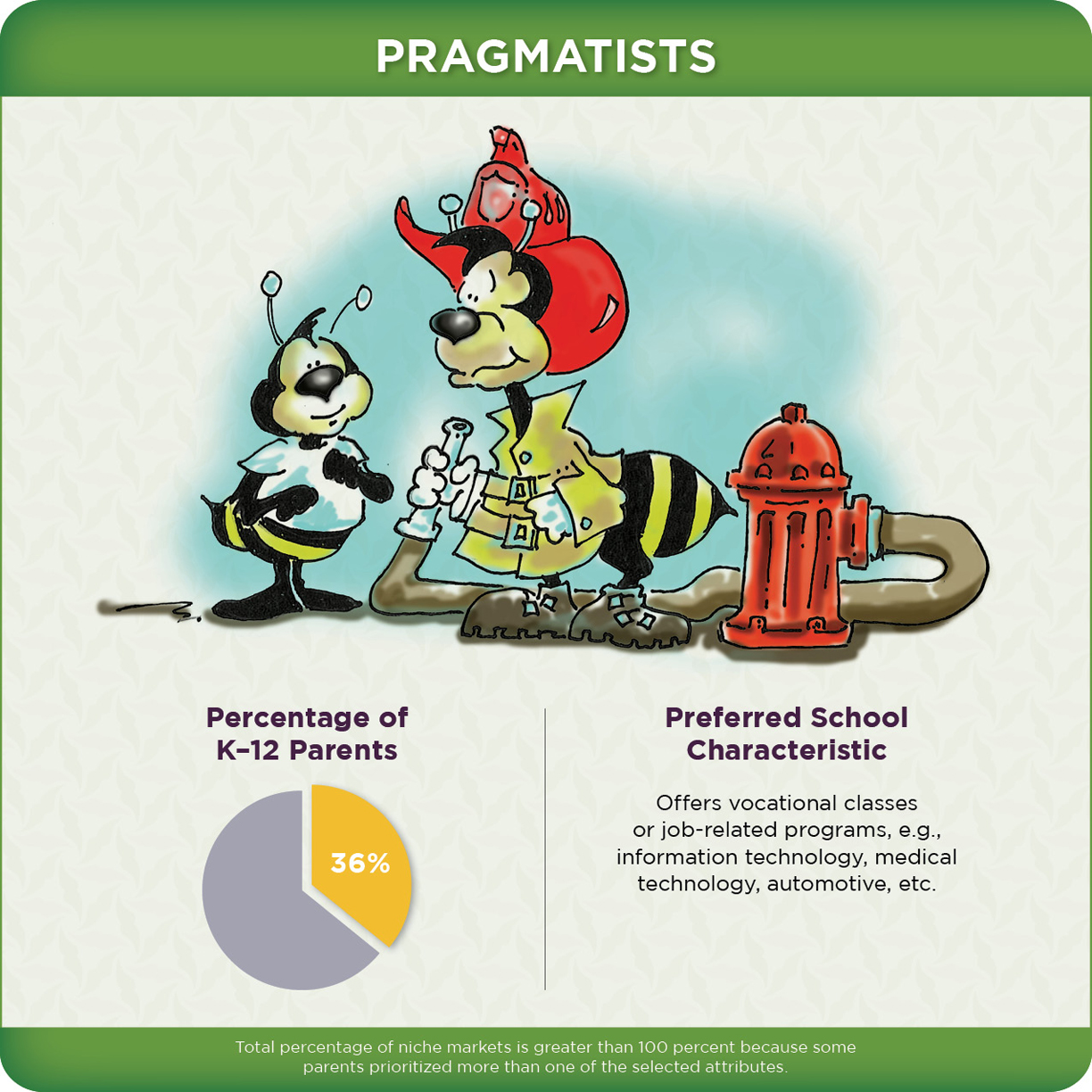
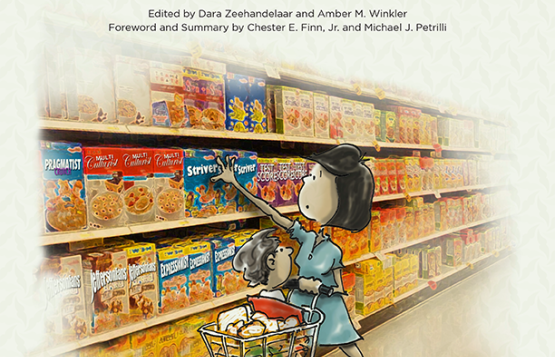
  • Pragmatists (36 percent of K–12 parents) assign high value to schools that, “offer vocational classes or job-related programs.” Compared to the total parent population, Pragmatists have lower household incomes, are less likely themselves to have graduated from college, and are more likely to be parents of boys.
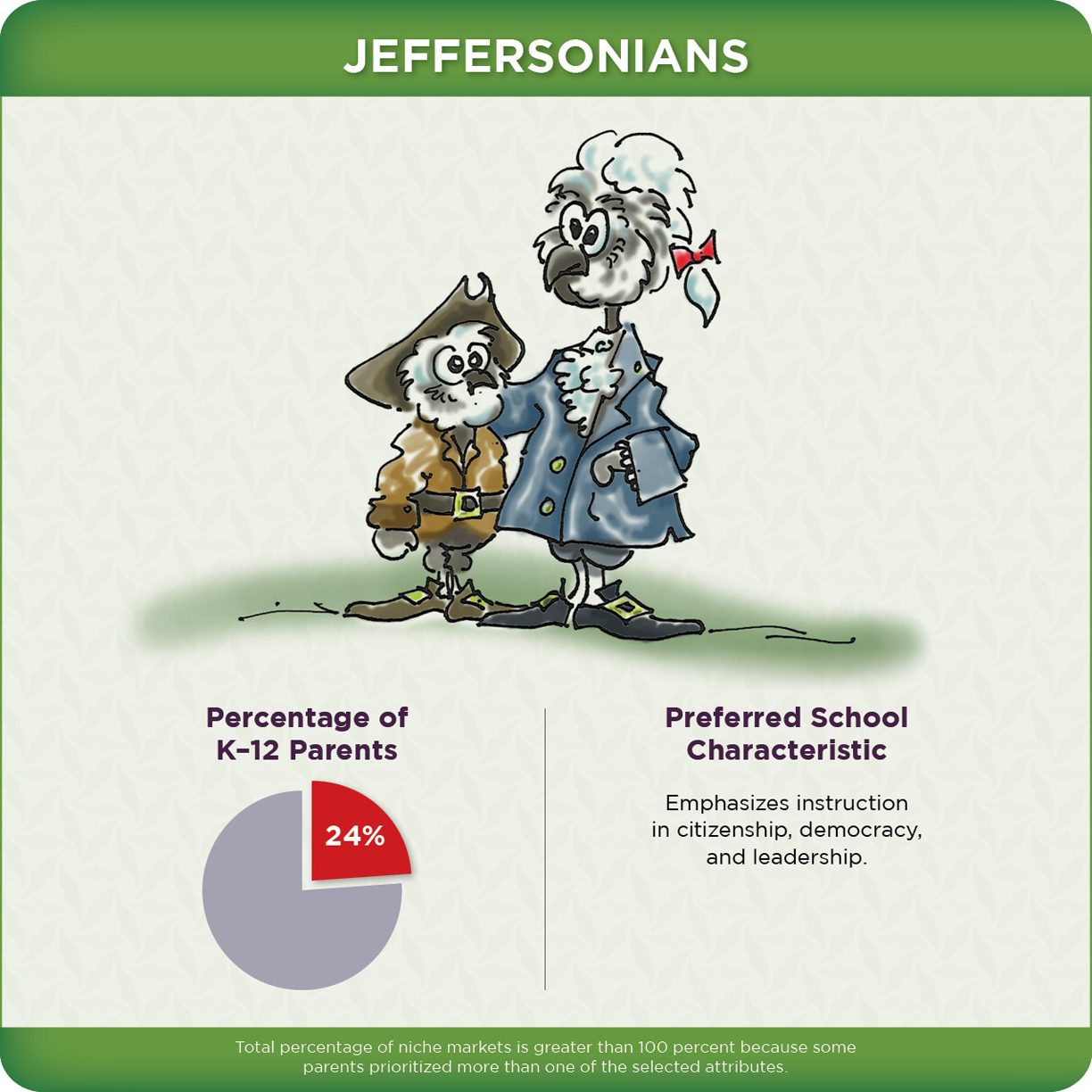
  • Jeffersonians (24 percent) prefer a school that “emphasizes instruction in citizenship, democracy, and leadership,” although they are no more likely than other parents to be active in their communities or schools.
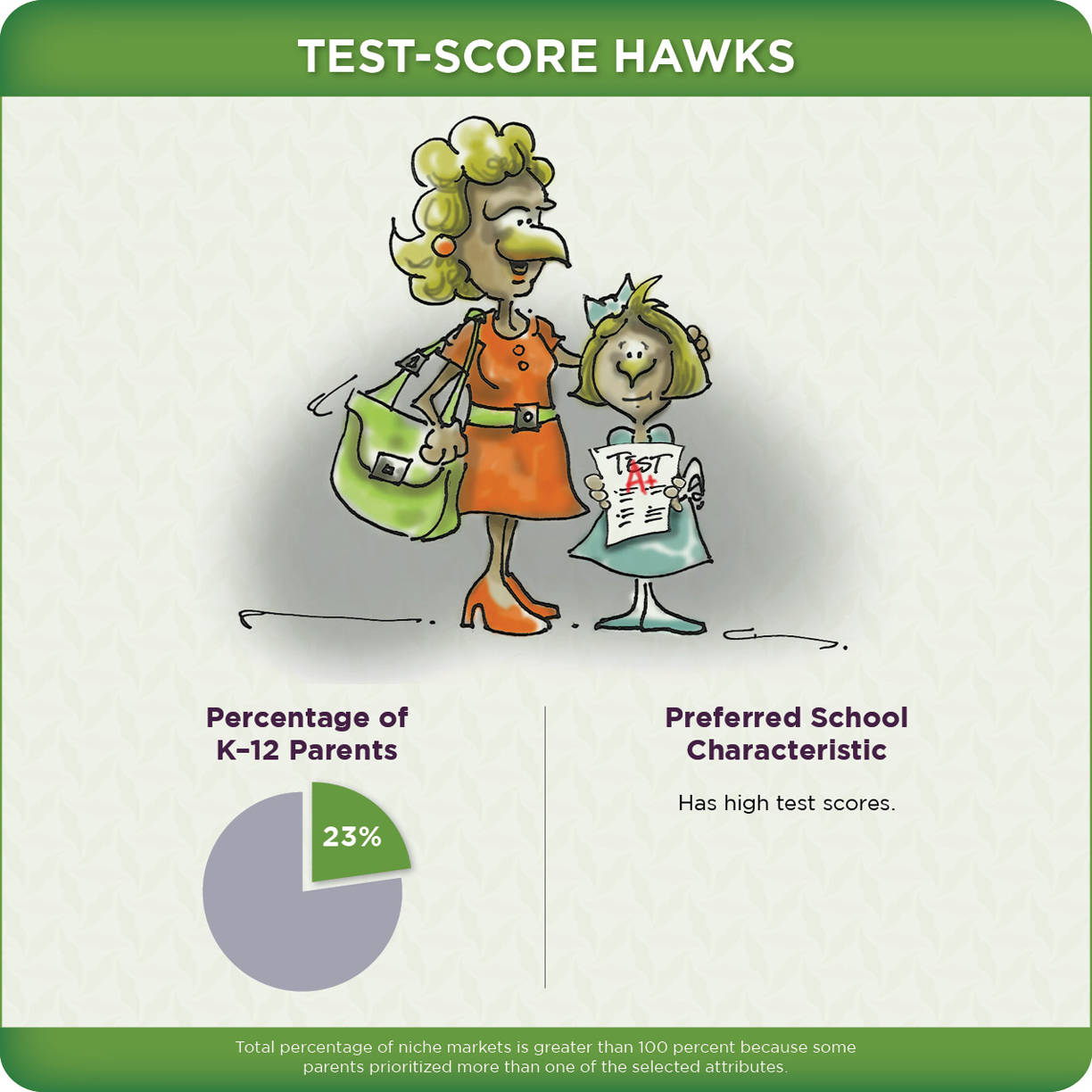
  • Test-Score Hawks (23 percent) look for a school that “has high test scores.” Such parents are more likely to have academically gifted children who put more effort into school. They are also more likely to set high expectations for their children, push them to excel, and expect them to earn graduate degrees. Test-Score Hawks are also more apt to report that their child has changed schools because, as parents, they were dissatisfied with the school or its teachers.
  • Multiculturalists (22 percent) laud the student goal: “learns how to work with people from diverse backgrounds.” They are more likely to be African American, to self-identify as liberal, and to live in an urban area.
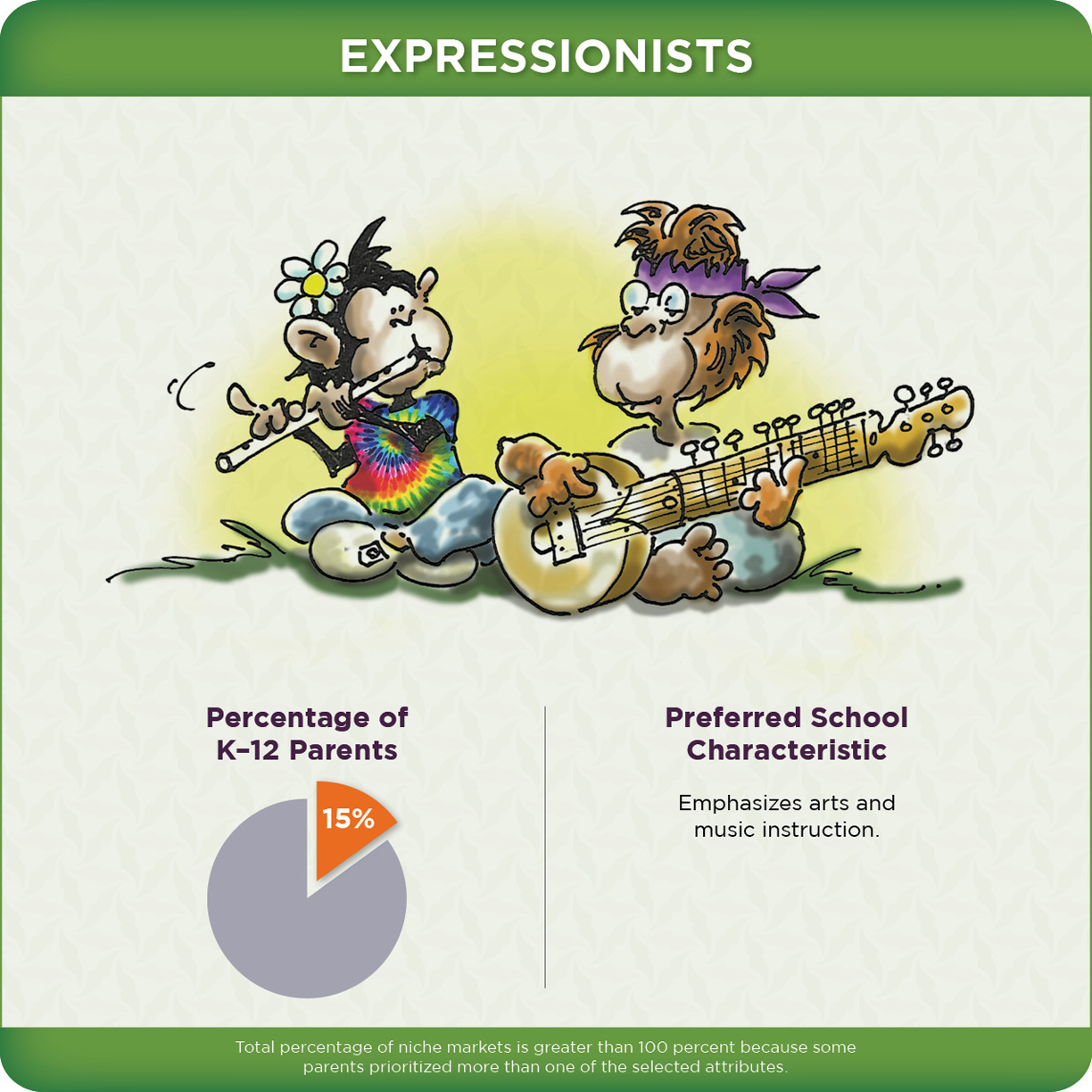
  • Expressionists (15 percent) want a school that “emphasizes arts and music instruction.” They are more likely to be parents of girls and to identify as liberal; they are less likely to be Christian. (In fact, they are three times more likely to self-identify as atheists.)
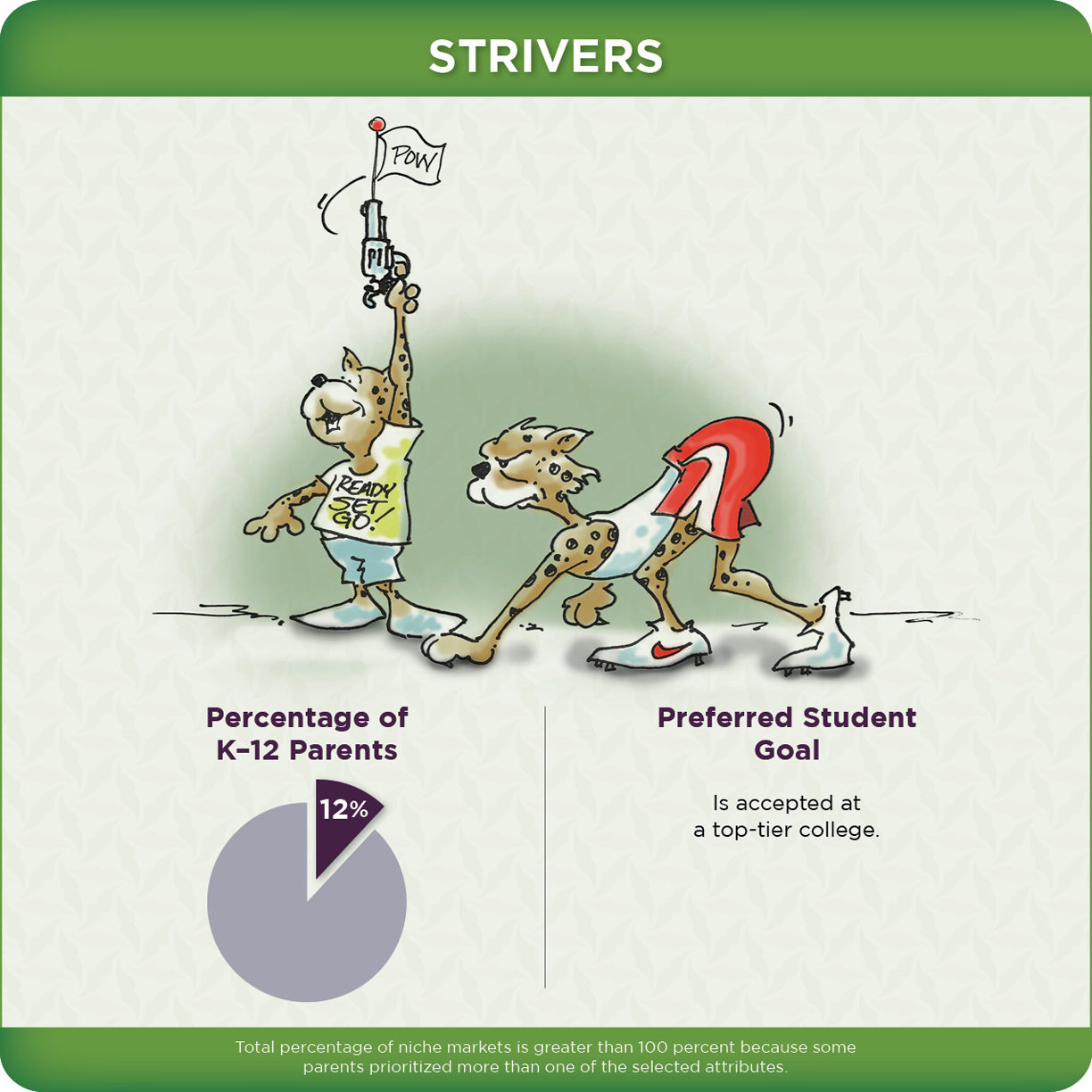
  • Strivers (12 percent) assign importance to their child being “accepted at a top-tier college.” Strivers are far more likely to be African American and Hispanic. They are also more apt to be Catholic. But they do not differ from the total population in terms of their own educational attainment.
     

What Parents Want: Education Preferences and Trade-Offs uses market-research techniques to determine what school characteristics and student goals are most important to parents.


What type of parent are you? Click here to take our quiz and find out!


Infographic

Pragmatists Jeffersonians Test Score Hawks Multiculturalists Expressionists Strivers
view

Teachers, race, and effectiveness

Chester E. Finn, Jr.
5.7.2014
Flypaper

Among the many problems facing American K–12 education, we don’t have enough highly effective, minority, or male teachers.

Two recent reports from the Center for American Progress (CAP) underscore the first and second of these three shortfalls. As for gender, you can take a look at the NCES data—or just take my word that there are more than three female teachers in U.S. public schools for every male teacher.

If you had to choose, would you rather have your child taught by a highly effective teacher or one who shares his or her race and/or gender?

Of course you’d prefer all of the above, but you may have to face the reality that not many families can have it. I’m reminded of the timeworn conundrum presented to impatient, parsimonious, quality-minded customers by any number of prospective vendors and contractors: “Yes, we can do it better, faster, or cheaper—but we cannot do all three at once. Pick no more than two.”

In a perfect world, you might want your child to be taught by someone who “looks like” him or her and is also highly effective in the classroom. But effective teachers of any race are hard to come by. There just aren’t enough of them, especially in schools serving poor kids. And the pay isn’t good enough to lure huge numbers of others away from more lucrative opportunities. For decades now, American public education has invested its ever-growing budgets in more teachers rather better ones. This is in marked contrast to the staffing practices of most countries that surpass our performance on PISA, TIMSS, and kindred measures. They’ve reached for quality rather than quantity—and for the most part, they have larger classes taught by abler and better-educated instructors (yet who also have more time during the day for lesson planning and such).

Any number of policy changes would gradually move us in that direction, too, but the political obstacles are huge and the timeline would inevitably be long.

Meanwhile, CAP analysts (and many others) are obsessing over the distribution of the too-few quality teachers that we already have and, most recently, over the ethnicity of those standing in front of our children’s classrooms. (Far less attention is paid to the gender discrepancy.)

The numbers themselves are not in dispute. As CAP’s Ulrich Boser writes, “Today, students of color make up almost half of the public-school population. But teachers of color are just 18 percent of the teaching profession.”

What is at issue is the severity of this problem and the extent to which policymakers and ed-reformers should focus time, energy, and resources on solving it versus the innumerable other challenges that plague our K–12 system. And finding teachers who are both effective and minority is doubly difficult.

It’s a fact. Not enough minority individuals complete college with a solid undergraduate education—due in no small part to failings of the K–12 system as well as institutional weaknesses at the postsecondary level—and those that do have their pick of an amplitude of good (and well-paid) jobs in myriad fields.

Let’s recognize up front that any solutions to the shortage of quality teachers, especially from minority groups, are bound to be very slow, relatively expensive, and in competition with other acute education needs (e.g., strengthening the knowledge and skill sets of the teachers we already have, giving kids more quality options, making more adroit uses of technology, extending learning time, and getting better leaders into schools).

As for the seriousness of this problem, any such discussion must begin by asking after the exact nature of the issue. If I don’t care whether my child’s teacher is right- or left-handed, tall or short, green-eyed or brown-eyed, or dressed in slacks versus skirts, why do I care about her (or his) race?

Several answers are possible. Parents may be looking for suitable role models for their child and believe that this is best done by someone who “looks like” their child. They may be strong partisans of ethnic solidarity and want their children to be educated in that sort of environment. They might believe that their child will be better treated by someone of similar background (or they might fear the reverse, that their child will be discriminated against by an instructor with a different background).

Keep in mind, too, that some parents crave the opposite: forms of unfamiliarity and diversity in children’s schooling experience that will better prepare them for adult success in a multiracial society, where they are apt to spend much their time in the company of people who do not look like them.

That parent (and student) preferences and priorities differ is one of the powerful arguments for school diversity and choice. Whether schools (or individual classrooms) should be organized and staffed primarily according to race is, however, a tricky issue both legally and morally, particularly in the public sector, where such moves can easily turn (or appear) discriminatory and end up violating sundry civil-rights statutes and constitutional prohibitions.

It’s one thing for parents voluntarily to seek out a school—public or private—that is relatively homogeneous, perhaps because it is located in a uniracial neighborhood or has an academic or language focus that is particularly appealing to families of a particular background. But it’s quite another thing for public officials to say, “This is a school for children of Hispanic origin and will be staffed by persons of Hispanic origin.” Shades of Jim Crow and the pre-Brown, pre–Civil Rights Act era!

As for academic achievement (which I take to be the foremost goal of U.S. education policy in the twenty-first century), although there’s been a vast amount of assertion that children learn more from teachers who “look like” them and understand their culture, there’s not much robust research undergirding such assertions.

The best of it has been done by Stanford economist Thomas Dee, who did indeed find achievement benefits in the early grades for children taught by teachers of their own race. This was true for both white and black pupils, though for black youngsters the benefits were strongest in disadvantaged and predominantly black schools. (Dee speculated that this might be due to the fact that white teachers found in such schools are apt to be the less-effective kind.)

But Dee’s caveats are also important to consider: the risk of possible harm to pupils in the same classroom who do not share the teacher’s demographics; the heightened risk of resegregation of schools or classrooms, with resulting damage to social relations and civil harmony (not to mention the legal issues that may arise); and the blunt fact that practically nothing is really known “about why the racial match between students and teachers seems to matter.” If that were better understood, he conjectures, we might be able to devise “improvements in training that could make teachers equally effective for all students, regardless of race.”

Which brings us back to the teacher-effectiveness challenge, surely a higher priority than the minority-teacher drought. But while we may be able to imagine rising to that challenge, we can’t begin to imagine how many advocacy groups and analysts such an accomplishment would put out of business, if only because they’d rather deal with hot-button issues like racial balance than with the long, painful slog toward better teachers in every classroom.

view

Will students recover from credit recovery?

The Education Gadfly
5.7.2014
Blog

In a new Education Next article, Sarah Carr examines the burgeoning online credit-recovery industry. She expresses concern regarding the speed with which the education system is embracing online credit recovery, with “so little known about the efficacy” of these programs—a reasonable concern in our view. While online, competency-based learning holds great promise, credit recovery smacks of perverse incentives. Schools want to boost their graduation rates; students want to get their diplomas; and for-profit providers want to get paid. Put it together and there’s nobody left to maintain academic standards—save, perhaps (and ironically), the NCAA.

Indiana’s school-voucher program serves almost 20,000 kids. One-third of the state’s private schools participate in the program, and they are reportedly reaching capacity. Policymakers and advocates are now turning to the question of school supply—how to make it possible for participating schools to expand their facilities and/or encourage the many private schools on the sidelines to jump into the game (check out our report School Choice Regulations: Red Tape or Red Herring? to learn more about what exactly deters private schools from doing so). The full study should be released in May.

As expected, New York City Mayor Bill de Blasio and the United Federation of Teachers reached a labor agreement. The union had gone without a contract since 2009 (the New York Times contends that union leaders chose to wait for the new mayor in the hopes that he would give away “more in raises than was prudent”—which, the paper contends, he did not). Interestingly, the contract deal includes a “buyout” clause for unemployed teachers, by which the city will pay unemployed teachers to quit instead of remaining in the so-called “absent teacher reserve.” On this one, we generally agree with our friends at the National Council on Teacher Quality: It’s a better agreement than you might expect, given de Blasio’s politics and proclivities. 

Mis-NAEP-ery

5.7.2014
Resource

Michelle and Brickman are concerned about the rapid growth of online credit-recovery programs, New York City’s new teacher labor agreement, and the fact that Indiana’s voucher-participating private schools are quickly filling up. Amber gets down to the (gloomy) facts with the 2013 12th Grade NAEP numbers.

Amber's Research Minute

The Nation's Report Card Grade 12: Reading and Mathematics 2012 by National Center for Education Statistics, (Washington, D.C.: National Assessment of Educational Progress, May 2014).

view

What (ed-reformer) parents want

8.29.2013
Video

What (ed-reformer) parents want. Read What Parents Want: Education Preferences and Trade-offs and take the quiz to see if you fall into one of our parent categories.

view

The Nation's Report Card, Grade 12: Reading and Mathematics 2013

Brandon L. Wright
5.7.2014
Blog

Today brought the eagerly awaited release of the 2013 NAEP results for 12th grade math and reading, which include scores for the nation as a whole as well as eleven pilot states. (NAEP has not traditionally reported state-level data for 12th grade.) There’s no report visible at this time, but the data can be found on a workable online database. Frankly, the results are depressing. In both math and reading, scores remained unchanged from their dismal 2009 levels. That means a mere 26 percent of students are proficient in math, and a slightly-better-but-still-bleak 38 percent are proficient in reading—two percentage points lower than in 1992. Moreover, those scoring below basic levels in math and reading are 35 percent and 25 percent, respectively. Worse yet, achievement gaps between ethnic groups didn’t narrow. To cheer you up just a bit, however, four of the eleven pilot states saw gains in math scores, and two saw reading gains. Of course, that means the others didn’t. Bottom line: whatever good recent reforms may be doing in the earlier grades, they’re not yet paying off at the end of high school—especially for African American and Latino students. And that, obviously, is just for the kids who even make it to the end.

National Center for Education Statistics, The Nation's Report Card Grade 12: Reading and Mathematics 2012 (Washington, D.C.: National Assessment of Educational Progress, May 2014).

view

Preventable Failure: Improvements in Long-Term Outcomes when High Schools Focused on the Ninth Grade Year

5.7.2014
Blog

New research from the Consortium on Chicago School Research provides a relatively easy to-do list for district leaders who want to see more students progress toward graduation. Melissa Roderick and company use real-time data to identify and monitor pupil performance at one intervention point: the ninth-grade transition. By looking at the on-track rate for ninth graders—a student is “on track” when he has enough credits to move to tenth grade and has no more than one F per semester in a core course—researchers found that between 2007 and 2013, the on-track rate rose 25 percentage points—from 57 to 82 percent. (That’s nearly 7,000 additional students who finish ninth grade and move onto tenth grade.) On-track rates improved for students across race and gender lines, too: African American males benefited the most, with an on-track rate increase from 43 percent to 71 percent. In public schools that showed large on-track increases as early as 2008 or 2009, the graduation rate three years later increased by at least eight percentage points. One school saw its graduation-rate increase by twenty percentage points. Chicago Public Schools school administrators and teachers monitored student performance and identified students at risk of falling behind the on-track rate for ninth graders. School leaders were flexible in how they used the data to intervene with students at risk of falling behind (but researchers don’t specify how school leaders intervened with students). Three cheers for research that shows significant results and provides education leaders with strategies that can help students stay on track in the ninth grade and beyond. But knowing exactly how school leaders used this data could help other districts benefit, too.

Melissa Roderick, Thomas Kelley-Kemple, David W. Johnson, and Nicole O. Beechum, Preventable Failure: Improvements in Long-Term Outcomes when High Schools Focused on the Ninth Grade Year (Chicago: University of Chicago Consortium on Chicago School Research, April 2014).

view

Sector Switchers: Why Catholic Schools Convert to Charters and What Happens Next

5.7.2014
Blog

Although they’ve long been a favorite of working-class parents in search of safe, structured, morally solid environments, inner-city Catholic schools have struggled with finances and enrollment numbers for decades. A new report from the Friedman Foundation, authored by Michael McShane and Andrew Kelly, explores the ways in which the advent of charter schools may provide a Lazarus moment to urban parochial schools through conversion—but also could ultimately weaken the Catholic schools that remain by narrowing the choice marketplace. In recent years, archdioceses have “spun off” some of their schools into charters, since they could no longer financially support their full portfolio of schools. Conversion allowed the schools to operate without charging tuition and for the selected schools—typically with wraparound religious services—to continue to serve their student body. In the studied schools in D.C., Miami, and Indianapolis, switching sectors reversed dwindling enrollment and meaningfully increased the percentage of minority students at the schools—indicating to the authors that there are a greater number of people who want to choose a Catholic school than can pay for one, even considering current voucher programs. It also stabilized the archdiocese’s finances, as they could charge operators rent and therefore had more money for the fewer students in their remaining schools. However, while many of the charter schools had the same staff and base student body as their Catholic incarnations, many leaders felt that conversion—even with the proffered wraparound services—removed the soul of Catholic education. Further, switching also raises questions about the true goals of school-choice policy: if it is to maximize the diversity of approaches to education, switching actually works against that goal, since it crowds out remaining Catholic schools. The authors suggest that improving current voucher programs offers the best potential for preserving Catholic education—archdiocese leaders in Indianapolis, who chose to close schools prior to the introduction of Indiana’s voucher program, believe they wouldn’t have converted had the generously funded voucher program been in existence—but the voucher amounts must be hefty enough to provide adequate support to keep the schools alive. After all, while Catholic schools can work miracles educationally, they can’t work miracles with money.

Michael Q. McShane and Andrew P. Kelly, Sector Switchers: Why Catholic Schools Convert to Charters and What Happens Next (Washington, D.C.: The Friedman Foundation for Educational Choice, April 2014).

Fordham Logo

© 2026 The Thomas B. Fordham Institute
Privacy Policy
Usage Agreement

National

P.O. Box 110
Burke, VA 22009

202.223.5452

[email protected]

Ohio

P.O. Box 82291
Columbus, OH 43202

614.223.1580

[email protected]

Sponsorship

130 West Second Street, Suite 410
Dayton, Ohio 45402

937.227.3368

[email protected]