

School Turnarounds: The Essential Role of Districts
SIG isn’t the only option
SIG isn’t the only option

 The federal School Improvement Grants (SIG) program—created in 2002 and ramped up in 2009 thanks to ARRA dollars—has enjoyed celebrity status in the education-reform conversation over the past few months. (See here, here, and here for examples of recent research.) This book by Heather Zavadsky (known for her deep dives into urban-district effectiveness) offers a fresh perspective on this widely discussed topic. The upshot: School-based turnarounds require significant district involvement to be effective; the culture, funding, size, and collective-bargaining agreement of the district directly affect the changes that can be effected at the school level—and vary dramatically among districts. Zavasdsky profiles the turnaround efforts of five urban school districts, showcasing how each uses its economy of scale to execute school-improvement programs effectively. For example, Boston created a teacher-residency program (a reform unavailable to single-school turnaround efforts), thus enlarging its human-capital pipeline. And Garden Grove implemented a large-scale data system, tracking student progress quarterly. Many actionable ideas and engaging anecdotes dot this text. District leaders—particularly those of large urban locales—looking to bolster low-performing schools would be wise to have a look.
Heather Zavadsky, School Turnarounds: The Essential Role of Districts (Cambridge, MA: Harvard Education Press, 2012).
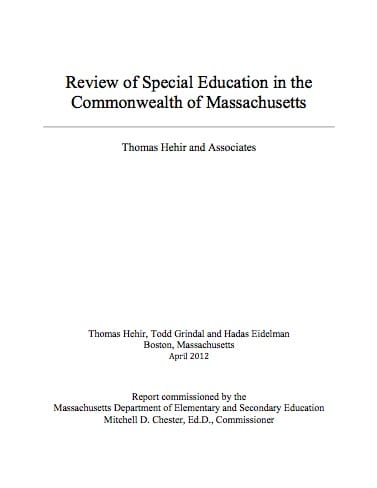 This study by Harvard researchers Tom Hehir and colleagues cracks the lid on special education in Massachusetts—which holds the distinction (perhaps dubious) of the second-highest identification rate in the U.S, with more than 17 percent of students eligible for special education services. Analysts examined both demographic and test-score data at the district, school, and student levels in roughly 300 Bay State districts and offer gobs of interesting findings—each well presented and nicely summarized. For example: Categories with the most subjective diagnoses (specific learning disabilities and communication or other health impairments) are by far the most prevalent (and are likely overdiagnosed). What’s more, low-income students are more frequently identified as having these “high incidence” disabilities than wealthier youngsters. This is particularly true for low-income pupils in high-income districts. More blacks and Latinos than whites are eligible for special-education services, but these differences mostly disappear when analysts control for socioeconomic status and other demographic characteristics. Student achievement for the Bay State’s special-needs population is better than the national NAEP average for such kids, though much of this effect can likely be attributed to MA’s high identification rates—meaning students with less severe disabilities are classified as students with disabilities. But the report mostly ignores the financial consequences of its findings, aside from the obligatory budgets-are-tight statements. Special education has long enjoyed near sacrosanct status among education-policy researchers—with few focusing on its efficacy and cost efficiency. At least some empirical attention to the cost of special-education services would have strengthened this otherwise succinct and useful contribution. To wit: The recommendations suggest new technological interventions to mainstream students with disabilities better into gen-ed classrooms (via text-to-voice technology on tablet computers, for example) without a peep about costs.
Thomas Hehir, Todd Grindal, and Hadas Eidelman, Review of Special Education in the Commonwealth of Massachusetts (Boston, MA: Thomas Hehir and Associates, April 2012).
 This latest missive from Brookings’s Brown Center on Education Policy hits hard from paragraph one: It questions the priorities of education policymakers and offers sharp, actionable recommendations for how to realign them. According to authors Matt Chingos and Russ Whitehurst, “There is strong evidence that the choice of instructional materials has large effects on student learning—effects that rival in size those that are associated with differences in teacher effectiveness.” But few focus adequately on strengthening and evaluating instructional materials, instead dispensing far too much energy on the “context” of education (including governance arrangements, collective-bargaining agreements, and teacher-evaluation systems). This omission is even more onerous in the Common Core era: Without rigorous instructional materials linked to those new standards, they will not likely lead to noteworthy student improvement. To remedy this, Chingos and Whitehurst offer sound recommendations geared to various stakeholders: First, state education agencies should collect and report data on their districts’ instructional materials. To make this happen, national foundations should provide seed funding, the National Center for Education Statistics should offer guidance, and the Data Quality Campaign should act as watchdog. Second, the National Governors Association and the Council for Chief State School Officers—both highly invested in seeing the Common Core succeed—should collect data on best CCSS-aligned instructional materials. Kudos to the Brown Center for once again airing a contrarian—and spot-on—concern. Even Kate Walsh agrees.
Matthew M. Chingos and Grover J. “Russ” Whitehurst, Choosing Blindly: Instructional Materials, Teacher Effectiveness, and the Common Core (Washington, D.C.: Brown Center on Education Policy at the Brookings Institution, April 2012).

Mike and Adam talk space shuttles, vouchers, and how districts can make the most of tight budgets on this week’s podcast, while Amber explains what special ed looks like in the Bay State.
Review of Special Education in the Commonwealth of Massachusetts - Download the PDF

READ "How School Districts Can Stretch the School Dollar"
Despite some signs of economic recovery, school districts nationwide continue to struggle mightily. Nobody expects economic growth—or education spending—to rebound to 2008 levels over the next five years, and the long-term outlook isn't much brighter.
In short, the "new normal" of tougher budget times is here to stay for American K-12 education. So how can local officials cope?
In my new policy brief, I argue that the current crunch may actually present an opportunity to increase the efficiency and productivity of our education system if decision makers keep a few things in mind:
First and foremost, solving our budget crisis shouldn't come at the expense of children. Nor can if come from teachers' sacrifice alone. Depressing teachers' salaries forever isn't a recipe for recruiting bright young people into education—or retaining the excellent teachers we have. Finally, quick fixes aren't a good answer; we need fundamental changes that enhance productivity.
So how can school districts dramatically increase productivity and stretch the school dollar?
One, we should aim for a leaner, more productive, better paid workforce. Let's ask classroom teachers to take on additional responsibility in return for greater pay, eliminate some ancillary positions, and redesign our approach to special education.
Two, we should pay for productivity. A redesigned compensation system would include a more aggressive salary schedule, more pay for more work and better results, and prioritization of salaries over benefits.
Three, we must integrate technology thoughtfully. Online and "blended" school models are coming to K-12 education. They can be catalysts for greater pupil engagement, individualization, and achievement and, if organized right, they can also be opportunities for cost-cutting.
Many districts continue to face budget challenges of historic proportions. Rather than slashing budgets in ways that erode schooling, let's rethink who we hire, what they do, how we pay them, and how to incorporate technology—that's where the big payoff is.
A venerable maxim of successful organizational management declares that an executive's authority should be commensurate with his or her responsibility. In plain English, if you are held to account for producing certain results, you need to be in charge of the essential means of production.
 There's a serious imbalance between a principal's accountability and authority. Photo by Kat. |
In American public education today, however, that equation is sorely unbalanced. A school principal in 2012 is accountable for student achievement, for discipline, for curriculum and instruction, and for leading (and supervising) the staff team, not to mention attracting students, satisfying parents, and collaborating with innumerable other agencies and organizations.
Yet that same principal controls only a tiny part of his school's budget, has scant say over who teaches there, practically no authority when it comes to calendar or schedule, and minimal leverage over the curriculum itself. Instead of deploying all available school assets in ways that would do the most good for the most kids, the principal is required to follow dozens or hundreds of rules, program requirements, spending procedures, discipline codes, contract clauses, and regulations emanating from at least three levels of government—none of which strives to coordinate with any of the others.
In short, we give our school heads the responsibility of CEO's but the authority of middle-level bureaucrats.
That cannot work well and most of the time does not, save for the occasional superhero principal who must act like a maverick—breaking or ignoring most of the rules—in order to cope with an inherently absurd imbalance.
To top it off, today's school principals get paid barely more than the senior teachers in their schools, though they typically work year-round versus the classic 180-day, nine-month teacher contract.
No wonder principals are retiring in droves. No wonder many of our ablest young educators—such as those emerging from the Teach for America program—shun the principal's office, at least in district-operated schools. (Many gravitate to the charter-school sector, where principals have far greater authority.) No wonder entrepreneurs, risk-takers, and change agents seldom last long as principals, or that many of those who do endure are people who can tolerate (or even welcome) middle-manager roles.
This situation grows worse with every passing year, as federal, state, and district programs multiply and become more rule-bound—by, for example, "special education" and "No Child Left Behind"; judges issue more rulings that bind the principals' hands; union contracts lengthen and become more restrictive; funding levels off; and teacher layoffs become unavoidable, resulting in even less discretionary money at the building level and, because of seniority and tenure rules, less say over who works there.
The underlying causes are threefold.
First, a dysfunctional and archaic governance structure for public education that pays homage to "local control" yet turns into bureaucratic management of dozens or hundreds of schools from burgeoning "central offices," rather than vesting any real control at the level closest to teachers, students, and parents. Setting policy for that system, typically, is an elected school board that itself has grown dysfunctional, particularly in urban America, as adult interest groups manipulate who serves on it. Atop all this sit state and federal agencies—multiple agencies at each level—as well as (in many states) county or regional administrative units.
Second, we've layered so many responsibilities on our schools that the teaching and learning of basic skills and essential knowledge have all but vanished under efforts to rectify injustice; foster diversity; provide multiple services to kids with varying needs; prevent drug abuse, adolescent pregnancy, and obesity; forge character; keep children off the streets; ensure physical fitness; and observe a near-infinity of special events, holidays, and interest-group enthusiasms.
Third, every time something goes wrong anywhere, a blizzard of new rules and procedures descends upon the school's obligations, lest that mishap recur anywhere else. Whether it's bullying or a playground accident, an unwanted intruder or a disgruntled parent, a kid who doesn't get into a particular course or a library book that offends someone, the checklists, regulations, and prohibitions multiply.
What's a principal to do? If his or her state (like Florida or California) has a universal class-size limit, he or she cannot even rearrange student and teacher assignments to make the best use of the school's instructional team. If a state tenure law or district union contract insists that, in a layoff situation, the newest teachers must be let go first, he or she will have no say over who ends up teaching in his or her school. (Never mind that the reduction in instructional force doesn't obviate the class size limit!) If a district policy (or court order) says no student can be suspended or expelled regardless of the offense, simply maintaining order within the school may prove impossible. (In the opposite case, a "zero tolerance" law may leave the principal with no discretion even for a first offender who didn't mean any harm. Remember those six-year-olds who brought TOY weapons for "show and tell"?)
This gigantic mismatch between responsibility and authority has no simple remedy. What's needed is a radical simplification, replacing rules with responsibility on the part of the people running our schools. If we don't give principals the authority to do their jobs, we are going to have few competent leaders for our schools, which means we're not going to have many effective schools or well-educated children tomorrow.
A slightly different version of this essay was originally published by TheAtlantic.com as part of its "America the Fixable" series.
Despite some signs of economic recovery, school districts nationwide continue to struggle mightily. The combination of a depressed property tax base and built-in cost escalators produces recurring gaps that demand budget cuts every year just to keep doing the same old thing… and the long-term outlook isn’t much brighter.
Make no mistake: The “new normal” of tougher budget times—as Secretary of Education Arne Duncan calls it—is here to stay for American K-12 education.
 Tight budgets should encourage districts to spend smartly and stretch funds, rather than harm education with shortsighted cuts. Photo by blognd |
While that presents plenty of hardships, it also offers local officials a golden opportunity to rethink the way we run schools and to boost productivity and efficiency, a point I make in my new policy brief, “How School Districts Can Stretch the School Dollar.”
How?
Let’s start with a few key principles to keep in mind when weighing cuts:
Solving our budget crisis shouldn’t come at the expense of children. We should do everything we can to protect students’ learning opportunities and boost their achievement.
Nor can it come from teachers’ sacrifice alone. Suppressing teacher salaries forever isn’t a recipe for recruiting bright young people into education—or retaining the excellent teachers we have now.
Quick fixes aren’t a good answer; we need fundamental changes that enhance productivity. The reforms—and investments—with the greatest payoff are those that will maximize student outcomes at lower cost. And since education is overwhelmingly a people business—and most of the system’s costs are in personnel—the most promising reforms are those that rethink our staffing model.
So how can school districts dramatically increase productivity and stretch the school dollar?
Aim for a leaner, more productive, better paid workforce.
In a people business like education, it’s next to impossible to cut costs without letting some people go. But the answer isn’t just to lay off teachers and let class sizes rise (though, in most grades and subjects, modest increases aren’t the end of the world). In the last two decades, school systems have hired all manner of instructional coaches, teachers’ aides, program administrators, support staff, counselors, psychiatrists, specialists, and so forth. Redefining these roles—and those of classroom teachers—provides great opportunities for increased productivity. None of this is easy, but districts should consider:
Pay for productivity. The best way to increase productivity is to ask fewer people to do more work in order to get better results. And they should be compensated fairly for it. Here’s how:
 To learn more, download the full policy brief, How Districts Can Stretch the School Dollar. |
Integrate technology thoughtfully. Online and “blended” school models—where students spend all or part of the day learning online—are coming to K-12 education. These can be catalysts for greater pupil engagement, individualization, and achievement. If organized right, they can also be opportunities for cost-cutting. Why couldn’t students learn foreign languages via Rosetta Stone, for example, instead of in a traditional classroom?
Rather than hope for revenue increases that are unlikely to materialize, smart leaders can turn the present budget crisis into an opportunity. Most of the school dollar goes toward instructional staff and the people who manage them. Rethinking whom we hire, what they do, how we pay them, and how to incorporate technology—that’s where the big payoff is. Local officials need to reconsider the core business of schooling—and get key stakeholders to buy into a new, more cost-effective, more productive vision. That’s no small thing. Are they up to the challenge?
As the Texas Board of Education weighs revisions to the state's math standards this week, it must also consider strong criticism from the business community and the media over the proposed changes. Fordham's new review of the draft math standards, by W. Stephen Wilson, adds another reason for the board to think twice before approving the changes. As Wilson writes,
While the proposed changes are an improvement on the status quo in the Lone Star State, they’re far from stellar—and pale in comparison with the CCSS alternative. By going it alone, Texas had hoped to do better than the Common Core. Unfortunately, it missed the mark. Now it’s high time for its Board of Education to recognize that going from lousy to ok just isn’t good enough.
A slightly different version of this analysis was originally published as a post on the Common Core Watch blog.
The Indianapolis Public Schools struck back this week, countering The Mind Trust’s plan for reforming education in Indy with a school reform report of its own. While it was sad to see the district defend its bureaucracy by blaming poverty and the media, it was a useful reminder that those who govern education can’t be trusted to reform education governance all on their own.
 Observers within and without the Hoosier State are closely watching Indiana’s ambitious attempt at tying teacher compensation to performance. While the research on merit pay tied to test scores is far from settled, Indiana’s willingness to innovate merits attention.
Two years after winning their shares of four billion dollars in Race to the Top money, the eleven lucky states (and D.C.) have spent only 14 percent of the loot. While it’s certainly preferable to blowing the cash with little to show for it, it’s also clear (and unfortunate) that states see this as more of a stroll than a sprint.
READ "How School Districts Can Stretch the School Dollar"
Despite some signs of economic recovery, school districts nationwide continue to struggle mightily. Nobody expects economic growth—or education spending—to rebound to 2008 levels over the next five years, and the long-term outlook isn't much brighter.
In short, the "new normal" of tougher budget times is here to stay for American K-12 education. So how can local officials cope?
In my new policy brief, I argue that the current crunch may actually present an opportunity to increase the efficiency and productivity of our education system if decision makers keep a few things in mind:
First and foremost, solving our budget crisis shouldn't come at the expense of children. Nor can if come from teachers' sacrifice alone. Depressing teachers' salaries forever isn't a recipe for recruiting bright young people into education—or retaining the excellent teachers we have. Finally, quick fixes aren't a good answer; we need fundamental changes that enhance productivity.
So how can school districts dramatically increase productivity and stretch the school dollar?
One, we should aim for a leaner, more productive, better paid workforce. Let's ask classroom teachers to take on additional responsibility in return for greater pay, eliminate some ancillary positions, and redesign our approach to special education.
Two, we should pay for productivity. A redesigned compensation system would include a more aggressive salary schedule, more pay for more work and better results, and prioritization of salaries over benefits.
Three, we must integrate technology thoughtfully. Online and "blended" school models are coming to K-12 education. They can be catalysts for greater pupil engagement, individualization, and achievement and, if organized right, they can also be opportunities for cost-cutting.
Many districts continue to face budget challenges of historic proportions. Rather than slashing budgets in ways that erode schooling, let's rethink who we hire, what they do, how we pay them, and how to incorporate technology—that's where the big payoff is.
READ "How School Districts Can Stretch the School Dollar"
Despite some signs of economic recovery, school districts nationwide continue to struggle mightily. Nobody expects economic growth—or education spending—to rebound to 2008 levels over the next five years, and the long-term outlook isn't much brighter.
In short, the "new normal" of tougher budget times is here to stay for American K-12 education. So how can local officials cope?
In my new policy brief, I argue that the current crunch may actually present an opportunity to increase the efficiency and productivity of our education system if decision makers keep a few things in mind:
First and foremost, solving our budget crisis shouldn't come at the expense of children. Nor can if come from teachers' sacrifice alone. Depressing teachers' salaries forever isn't a recipe for recruiting bright young people into education—or retaining the excellent teachers we have. Finally, quick fixes aren't a good answer; we need fundamental changes that enhance productivity.
So how can school districts dramatically increase productivity and stretch the school dollar?
One, we should aim for a leaner, more productive, better paid workforce. Let's ask classroom teachers to take on additional responsibility in return for greater pay, eliminate some ancillary positions, and redesign our approach to special education.
Two, we should pay for productivity. A redesigned compensation system would include a more aggressive salary schedule, more pay for more work and better results, and prioritization of salaries over benefits.
Three, we must integrate technology thoughtfully. Online and "blended" school models are coming to K-12 education. They can be catalysts for greater pupil engagement, individualization, and achievement and, if organized right, they can also be opportunities for cost-cutting.
Many districts continue to face budget challenges of historic proportions. Rather than slashing budgets in ways that erode schooling, let's rethink who we hire, what they do, how we pay them, and how to incorporate technology—that's where the big payoff is.
The federal School Improvement Grants (SIG) program—created in 2002 and ramped up in 2009 thanks to ARRA dollars—has enjoyed celebrity status in the education-reform conversation over the past few months. (See here, here, and here for examples of recent research.) This book by Heather Zavadsky (known for her deep dives into urban-district effectiveness) offers a fresh perspective on this widely discussed topic. The upshot: School-based turnarounds require significant district involvement to be effective; the culture, funding, size, and collective-bargaining agreement of the district directly affect the changes that can be effected at the school level—and vary dramatically among districts. Zavasdsky profiles the turnaround efforts of five urban school districts, showcasing how each uses its economy of scale to execute school-improvement programs effectively. For example, Boston created a teacher-residency program (a reform unavailable to single-school turnaround efforts), thus enlarging its human-capital pipeline. And Garden Grove implemented a large-scale data system, tracking student progress quarterly. Many actionable ideas and engaging anecdotes dot this text. District leaders—particularly those of large urban locales—looking to bolster low-performing schools would be wise to have a look.
Heather Zavadsky, School Turnarounds: The Essential Role of Districts (Cambridge, MA: Harvard Education Press, 2012).
This study by Harvard researchers Tom Hehir and colleagues cracks the lid on special education in Massachusetts—which holds the distinction (perhaps dubious) of the second-highest identification rate in the U.S, with more than 17 percent of students eligible for special education services. Analysts examined both demographic and test-score data at the district, school, and student levels in roughly 300 Bay State districts and offer gobs of interesting findings—each well presented and nicely summarized. For example: Categories with the most subjective diagnoses (specific learning disabilities and communication or other health impairments) are by far the most prevalent (and are likely overdiagnosed). What’s more, low-income students are more frequently identified as having these “high incidence” disabilities than wealthier youngsters. This is particularly true for low-income pupils in high-income districts. More blacks and Latinos than whites are eligible for special-education services, but these differences mostly disappear when analysts control for socioeconomic status and other demographic characteristics. Student achievement for the Bay State’s special-needs population is better than the national NAEP average for such kids, though much of this effect can likely be attributed to MA’s high identification rates—meaning students with less severe disabilities are classified as students with disabilities. But the report mostly ignores the financial consequences of its findings, aside from the obligatory budgets-are-tight statements. Special education has long enjoyed near sacrosanct status among education-policy researchers—with few focusing on its efficacy and cost efficiency. At least some empirical attention to the cost of special-education services would have strengthened this otherwise succinct and useful contribution. To wit: The recommendations suggest new technological interventions to mainstream students with disabilities better into gen-ed classrooms (via text-to-voice technology on tablet computers, for example) without a peep about costs.
Thomas Hehir, Todd Grindal, and Hadas Eidelman, Review of Special Education in the Commonwealth of Massachusetts (Boston, MA: Thomas Hehir and Associates, April 2012).
This latest missive from Brookings’s Brown Center on Education Policy hits hard from paragraph one: It questions the priorities of education policymakers and offers sharp, actionable recommendations for how to realign them. According to authors Matt Chingos and Russ Whitehurst, “There is strong evidence that the choice of instructional materials has large effects on student learning—effects that rival in size those that are associated with differences in teacher effectiveness.” But few focus adequately on strengthening and evaluating instructional materials, instead dispensing far too much energy on the “context” of education (including governance arrangements, collective-bargaining agreements, and teacher-evaluation systems). This omission is even more onerous in the Common Core era: Without rigorous instructional materials linked to those new standards, they will not likely lead to noteworthy student improvement. To remedy this, Chingos and Whitehurst offer sound recommendations geared to various stakeholders: First, state education agencies should collect and report data on their districts’ instructional materials. To make this happen, national foundations should provide seed funding, the National Center for Education Statistics should offer guidance, and the Data Quality Campaign should act as watchdog. Second, the National Governors Association and the Council for Chief State School Officers—both highly invested in seeing the Common Core succeed—should collect data on best CCSS-aligned instructional materials. Kudos to the Brown Center for once again airing a contrarian—and spot-on—concern. Even Kate Walsh agrees.
Matthew M. Chingos and Grover J. “Russ” Whitehurst, Choosing Blindly: Instructional Materials, Teacher Effectiveness, and the Common Core (Washington, D.C.: Brown Center on Education Policy at the Brookings Institution, April 2012).