Mobile Navigation

  • National
    • Policy
      • High Expectations
      • Quality Choices
      • Personalized Pathways
    • Research
    • Commentary
      • Gadfly Newsletter
      • Flypaper Blog
    • Events
    • Scholars Program
  • Ohio
    • Policy
      • Priorities
      • Media & Testimony
    • Research
    • Commentary
      • Ohio Education Gadfly Biweekly
      • Ohio Gadfly Daily
  • Charter Authorizing
    • Application
    • Sponsored Schools
    • Resources
  • About
    • Mission
    • Board
    • Staff
    • Career
Home
Home
Advancing Educational Excellence

Main Navigation

  • National
  • Ohio
  • Charter Authorizing
  • About

National Menu

  • Topics
    • Accountability & Testing
    • Advanced Education
    • Career & Technical Education
    • Charter Schools
    • Curriculum & Instruction
    • ESSA
    • Evidence-Based Learning
    • Facilities
    • Governance
    • Personalized Learning
    • Private School Choice
    • School Finance
    • Standards
    • Teachers & School Leaders
    • Think Again
  • Research
  • Commentary
    • Gadfly Newsletter
    • Flypaper Blog
    • Gadfly Podcast
  • Events
  • Scholars Program

The Education Gadfly Weekly

Sign Up to Receive Fordham Updates

We'll send you quality research, commentary, analysis, and news on the education issues you care about.
Thank you for signing up!
Please check your email to confirm the subscription.

Searching for Excellence: A Five-City, Cross-State Comparison of Charter School Quality

VOLUME 7, NUMBER 5
3.12.2013
3.12.2013

Searching for Excellence: A Five-City, Cross-State Comparison of Charter School Quality

VOLUME 7, NUMBER 5
view

Fordham weighs in on the Kasich education plan, the Common Core, and student mobility

Fordham’s gadflies have been buzzing over the past weeks, discussing Governor Kasich’s budget, Common Core, and Student Nomads. If you’ve missed any of these items, here’s your chance to catch up!

Aaron Churchill 3.12.2013
OhioBlog

Fordham weighs in on the Kasich education plan, the Common Core, and student mobility

Aaron Churchill
3.12.2013
Blog

The Opportunity Cost of Smaller Classes: A State-by-State Spending Analysis

Jeff Murray
3.12.2013
Blog

A school for scholars: Q & A with Chad Webb, Village Preparatory charter school

Ellen Belcher
3.12.2013
Blog

Education Governance for the Twenty-First Century: Overcoming the Structural Barriers to School Reform

Patrick McGuinn | Paul Manna
3.12.2013
Blog

Fordham weighs in on the Kasich education plan, the Common Core, and student mobility

Aaron Churchill
3.12.2013
Blog

The Opportunity Cost of Smaller Classes: A State-by-State Spending Analysis

Jeff Murray
3.12.2013
Blog
view

The Opportunity Cost of Smaller Classes: A State-by-State Spending Analysis

Jeff Murray 3.12.2013
Blog
view

A school for scholars: Q & A with Chad Webb, Village Preparatory charter school

Ellen Belcher 3.12.2013
Blog
view

Education Governance for the Twenty-First Century: Overcoming the Structural Barriers to School Reform

Patrick McGuinn, Paul Manna 3.12.2013
Blog
view

Fordham weighs in on the Kasich education plan, the Common Core, and student mobility

Aaron Churchill 3.12.2013
Blog
view

The Opportunity Cost of Smaller Classes: A State-by-State Spending Analysis

Jeff Murray 3.12.2013
Blog
view

Fordham weighs in on the Kasich education plan, the Common Core, and student mobility

Aaron Churchill
3.12.2013
Blog

Fordham’s gadflies have been buzzing over the past weeks, discussing Governor Kasich’s budget, Common Core, and Student Nomads. If you’ve missed any of these items, here’s your chance to catch up!

  • In a Columbus Dispatch editorial, Terry Ryan wrote in favor of the governor’s school funding plan. The plan, Ryan argues, is worthy of support because it “recognizes the fact that more and more of the state’s students attend schools other than their neighborhood district schools.” And by acknowledging this fact, Governor Kasich’s plan attempts to “target children and their schools as the locus of public funding, as opposed to funding just school district.” For more analysis of the governor’s funding plan, please see Steps in the Right Direction, a report conducted by esteemed school finance professor Dr. Paul Hill.
  • Emmy Partin was a guest on National Public Radio’s The Sound of Ideas, discussing Ohio’s impending transition to the Common Core State Standards in 2014-15. The conversation, which included representatives of the Ohio Department of Education, State Impact Ohio, Cleveland Teachers Union, and callers from the general public, spotlighted changes in classroom instruction, Ohio’s standardized exams, and graduation requirements that are and will occur under the new academic standards.
  • Fordham facilitated a community discussion around student mobility in Dayton and Cincinnati, the third and fourth in a series of such conversations about mobility. (See here for the recaps of the Columbus and Cleveland events.) The discussions, which included Dayton Public Schools’ superintendent Lori Ward and Cincinnati Public Schools’ Mary Ronan, explored ways that urban districts can reduce mobility in their schools and how community partnerships can reduce the negative impact of mobility on student achievement. For more coverage of these events, check out the coverage from the Cincinnati Enquirer and National Public Radio. 
view

The Opportunity Cost of Smaller Classes: A State-by-State Spending Analysis

Jeff Murray
3.12.2013
Blog

The Center on Reinventing Public Education has released a new study by Marguerite Roza and Monica Ouijdani that examines the cost of class size reduction – what it would cost per student to create smaller classes, and how those costs can add up significantly. And perhaps more importantly, the authors discuss whether the funding needed to create those smaller classes could be more effectively utilized elsewhere in the education system.

The Opportunity Cost of Smaller Classes: A State-by-State Spending Analysis begins with an attempt to downplay the rhetoric about “skyrocketing” class size and to determine just what the average class size is state by state. This is made difficult by the fact that the most-current class-size information nationwide hails from 2007-08. The authors suggest that this lack of current information is what allows anecdotal evidence of class size expansion nationwide to trump any sober analysis of the numbers.

Roza and Ouijdani, using both National Education Association (NEA) and National Center for Educational Statistics (NCES) data on student-teacher ratios (generally available through 2012), generated an estimate of average class size in all states where reliable information was available. Sadly, Ohio’s reported data from NEA and NCES in 2011-12 were not in agreement and so no estimate was able to be generated for the Buckeye State. But the results show, in general, that average class size across the United States (38 states and the District of Columbia were included in the study) has decreased since 2007-08.This downward trend has of course been aided by laws in various states and incentives initiated and perpetuated by the No Child Left Behind law, but has certainly come about with considerable expense.

So, assuming that class sizes have in reality been shrinking since 2008, the authors estimate the cost of raising class sizes. By increasing class sizes just two students over the known 2008 averages in each state, would yield an annual savings of up to $15.7 billion nationwide. The cost savings of this marginal increase in class size could be, in turn, deployed for other classroom uses. Pay-raises for great teachers or iPads, anyone?

SOURCE: Marguerite Roza and Monica Ouijandi, The Opportunity Cost of Smaller Classes: A State-by-State Spending Analysis (Seattle, WA: Center on Reinventing Public Education, 2012)

view

A school for scholars: Q & A with Chad Webb, Village Preparatory charter school

Ellen Belcher
3.12.2013
Blog

In both our role as researchers and as a charter school authorizer we have come to appreciate over-and-over again the critical importance of school leaders in making schools great. Yet, there is no harder job than running a successful school building for high-poverty students; nor a more important job. There are school leaders across the state and the nation who do it day-in and day-out, and too few get recognized for their great work. We are fortunate that some of these leaders work in schools that Fordham sponsors and it is our privilege to tell a little bit of their stories and the impact they are having on students in Ohio.

This Q&A with Chad Webb, the head of school for Village Preparatory School-Woodland Hill campus, is the fifth of our seven-part series on school leadership. (Please see our Q&A with Dr. Glenda Brown, Andy Boy, Dr. Judy Hennessey, and Hannah Powell Tuney.) Village Prep is part of the Breakthrough network of charter schools. Breakthrough operates the highest-performing charters in Cleveland—and, according to Stanford University’s Center for Research on Education Outcomes (CREDO), are some of the finest charter schools in the nation.

*  *  *  *

Chad Webb doesn’t think kindergarteners are too young to start thinking about college. At his Village Preparatory School-Woodland Hills Campus in Cleveland, each of the school’s six classrooms is named after a college, most after the teacher’s alma mater.

On Fridays, the school’s students in grades kindergarten through second forego their uniforms, wear their college tee-shirts and celebrate that week’s achievements by chanting their college’s cheer.

 The school is one of nine in the Breakthrough Schools charter network, which has a total enrollment of more than 2,000 K-8 students. The Cleveland charter management company hopes to have 20 schools in the city by 2020.

Village Prep shares a campus with a second Breakthrough School, the E Prep Middle School, and together the two are planning for 750 students by 2015.

Webb, 37, is an Urbana, Ohio, native and Ashland University graduate. He initially wanted to be a high school social studies teacher, but changed his mind and majored in elementary education. Most recently, Webb was in New Orleans where he was a principal and administrator working in schools that had been taken over because of poor performance by the state of Louisiana after Hurricane Katrina.

The following are edited excerpts from an interview with Webb.

Q: What kind of student were you?

A: I was average all the way through my career. But I was an average student who worked hard. I knew I wanted to be a teacher. I was very motivated, but I wasn’t stellar.

Q: You were in New Orleans before coming back to Ohio. What wooed you?

A: I wanted to be closer to family.

Q: How many students do you have?

A:  As of today, we have 171 scholars.  We call our students “scholars.” Our goal was 180. We have three kindergarten classes, one first grade and two second grades. Our goal is to have 90 scholars at each grade level.

Q: Does using the term “scholar” make a difference in how kids see themselves? How do parents relate to the term?

A: It’s a learning curve. Our children are not just students. We expect them to behave and do their homework like scholars. Our families have really embraced the concept. We explain the difference between a student and a scholar, and they really support us. College is our focus. We teach our children on Day 1 that they are going to go to college. That is our reach goal.

Q: How difficult was it to recruit students?

A: We are in a former K-8 Cleveland Metropolitan School District building that was closed for a year. There are five Cleveland schools less than a mile away from us. All are in “academic emergency” or “academic watch.” We did mailers, phone-a-thons, neighborhood canvassing. We attended park events and fairs. At first, enrollment was very slow. Then in mid-July, it really picked up. By Aug. 15, I had 95 percent of my scholars in place.

Q: Tell me about a conversation that you won’t forget that you had with a parent who was considering sending his or her child to your school.

A: We took the data from the surrounding schools and other area charters and had conversations with our families. We are a start-up, but we are part of a network in which the schools are rated “excellent” or on a trajectory to be rated “excellent.” We pointed out the data from the school their child attended and explained why we would be a better option. I would explain our educational model and our ratio of two teachers to every 30 scholars. When you share that with parents, they’re in a little bit of shock. It really excites families. They are in disbelief about how much we are providing the kids.

Q: How is having two teachers per classroom affordable?

A: Many of our students are two, three or four years behind academically. Eighty-four percent of my kindergartners did not even qualify as a pre-reader. That is why we have two teachers in every classroom. We need to do whatever it takes.

We are lucky to have been awarded a two-year $3.3 million U.S. Department of Education Teacher Incentive Fund grant. We also received a $3.5 million federal grant to open eight new Breakthrough Schools and expand three others. We have a fundraising arm to help offset our costs.

Q: You’re competing hard for students against Cleveland schools? How is that relationship working?

A: Under the Cleveland Plan for Transforming Schools, every single school is expected to be high-performing. We are no longer foes; we are friends. We’re doing whatever we can do to create a quality education.

Q: Your school applied for money from the recently passed Cleveland Public Schools levy. Cleveland is the first public school district in Ohio to offer a share of its property tax money to charter schools.

How much are you in line to get? What do you have to do to get it?

A: We have to commit to becoming part of the quality schools network to assure that nobody is working alone. I don’t have the exact number.

Q: How many teachers did you hire this year?

A: Twelve classroom teachers, a reading intervention teacher, two special education teachers, a music teacher, a computer teacher and a physical education teacher. So, 18 total.

Q: What kind of work did they participate in before the school doors opened in August?

A: Our teachers started July 15 when they reported for summer institute. We review our academic and behavioral taxonomies. Our teachers write all of their own curriculum. We took the Common Core standards, and standards from other states like Massachusetts, California and Indiana that have more rigorous standards, and we taught our teachers how to plan backwards.

Our teachers will make all of their own unit and lessons plans. It was a very intense four weeks of work before the kids came to school on Aug 8.

Q: Are your teachers’ salaries comparable to Cleveland’s?

A: I’m not exactly sure. Our starting salary is $39,140; it’s $35,000 for an associate teacher.

Q: What’s an associate teacher?

A: It’s considered their mentor year. It’s part of a career pathway.

Q: What is the length of your teachers’ contracts?

A: We are at-will employees. But we do a lot of coaching. My goal is to attract and retain quality.

Q: How long is the school day?

A: The doors open at 7:30, and classes go until 3:30. The teachers’ day is from 7:30 to 4:45, Monday through Thursday, and until 3:30 on Friday. We use that time after school to come together as a team. Professional development is built into our week.

Q: Did you get the number and quality of applications that you were hoping for?

A: Eventually I did. I did 80 on-site interviews and I hired 18 people. I have a stellar staff. We’re very fortunate to have Teach for America in Cleveland. I have four TFA teachers.

Q: You have been on the job just a few months. Is there anything you wish you would have done differently yet? Do you have advice for others running a start-up?

A: I think the cornerstone to our success is the quality of teachers I have. If you spend the amount of time needed to attract quality professionals, if you find out if they’re aligned to your mission, if you find out if they’re able to do the job, if you find out if they’re open to your feedback, you will be successful. Every single day we’re in our classes providing feedback. 

Q: But I’m asking what mistake that you think you’ve made?

A: You have to be cognizant of your budget. I’m in the black. You have to be constantly on top of your budget.

Q: What’s the most memorable thing that has happened so far this year?

A: I had a classroom that was struggling. It has two new teachers. We’ve been doing a lot of coaching and observation, giving a lot of feedback. The classroom has completely done a 180. All the work we’ve done is starting to make a difference.


view

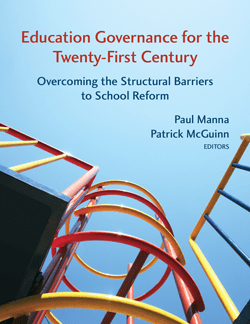
Education Governance for the Twenty-First Century: Overcoming the Structural Barriers to School Reform

Patrick McGuinn | Paul Manna
3.12.2013
Blog

America’s fragmented, decentralized, politicized, and bureaucratic system of education governance is a major impediment to school reform. In Education Governance for the Twenty-First Century: Overcoming the Structural Barriers to School Reform, a number of leading education scholars, analysts, and practitioners show that understanding the impact of specific policy changes in areas such as standards, testing, teachers, or school choice requires careful analysis of the broader governing arrangements that influence their content, implementation, and impact.

Education Governance for the Twenty-First Century comprehensively assesses the strengths and weaknesses of what remains of the old in education governance, scrutinizes how traditional governance forms are changing, and suggests how governing arrangements might be further altered to produce better educational outcomes for children.

Paul Manna, Patrick McGuinn, and their colleagues provide the analysis and alternatives that will inform attempts to adapt nineteenth and twentieth century governance structures to the new demands and opportunities of today.

* Copublished with the Brookings Institution and the Center for American Progress

view

Fordham weighs in on the Kasich education plan, the Common Core, and student mobility

Aaron Churchill
3.12.2013
Blog

Fordham’s gadflies have been buzzing over the past weeks, discussing Governor Kasich’s budget, Common Core, and Student Nomads. If you’ve missed any of these items, here’s your chance to catch up!

  • In a Columbus Dispatch editorial, Terry Ryan wrote in favor of the governor’s school funding plan. The plan, Ryan argues, is worthy of support because it “recognizes the fact that more and more of the state’s students attend schools other than their neighborhood district schools.” And by acknowledging this fact, Governor Kasich’s plan attempts to “target children and their schools as the locus of public funding, as opposed to funding just school district.” For more analysis of the governor’s funding plan, please see Steps in the Right Direction, a report conducted by esteemed school finance professor Dr. Paul Hill.
  • Emmy Partin was a guest on National Public Radio’s The Sound of Ideas, discussing Ohio’s impending transition to the Common Core State Standards in 2014-15. The conversation, which included representatives of the Ohio Department of Education, State Impact Ohio, Cleveland Teachers Union, and callers from the general public, spotlighted changes in classroom instruction, Ohio’s standardized exams, and graduation requirements that are and will occur under the new academic standards.
  • Fordham facilitated a community discussion around student mobility in Dayton and Cincinnati, the third and fourth in a series of such conversations about mobility. (See here for the recaps of the Columbus and Cleveland events.) The discussions, which included Dayton Public Schools’ superintendent Lori Ward and Cincinnati Public Schools’ Mary Ronan, explored ways that urban districts can reduce mobility in their schools and how community partnerships can reduce the negative impact of mobility on student achievement. For more coverage of these events, check out the coverage from the Cincinnati Enquirer and National Public Radio. 
view

The Opportunity Cost of Smaller Classes: A State-by-State Spending Analysis

Jeff Murray
3.12.2013
Blog

The Center on Reinventing Public Education has released a new study by Marguerite Roza and Monica Ouijdani that examines the cost of class size reduction – what it would cost per student to create smaller classes, and how those costs can add up significantly. And perhaps more importantly, the authors discuss whether the funding needed to create those smaller classes could be more effectively utilized elsewhere in the education system.

The Opportunity Cost of Smaller Classes: A State-by-State Spending Analysis begins with an attempt to downplay the rhetoric about “skyrocketing” class size and to determine just what the average class size is state by state. This is made difficult by the fact that the most-current class-size information nationwide hails from 2007-08. The authors suggest that this lack of current information is what allows anecdotal evidence of class size expansion nationwide to trump any sober analysis of the numbers.

Roza and Ouijdani, using both National Education Association (NEA) and National Center for Educational Statistics (NCES) data on student-teacher ratios (generally available through 2012), generated an estimate of average class size in all states where reliable information was available. Sadly, Ohio’s reported data from NEA and NCES in 2011-12 were not in agreement and so no estimate was able to be generated for the Buckeye State. But the results show, in general, that average class size across the United States (38 states and the District of Columbia were included in the study) has decreased since 2007-08.This downward trend has of course been aided by laws in various states and incentives initiated and perpetuated by the No Child Left Behind law, but has certainly come about with considerable expense.

So, assuming that class sizes have in reality been shrinking since 2008, the authors estimate the cost of raising class sizes. By increasing class sizes just two students over the known 2008 averages in each state, would yield an annual savings of up to $15.7 billion nationwide. The cost savings of this marginal increase in class size could be, in turn, deployed for other classroom uses. Pay-raises for great teachers or iPads, anyone?

SOURCE: Marguerite Roza and Monica Ouijandi, The Opportunity Cost of Smaller Classes: A State-by-State Spending Analysis (Seattle, WA: Center on Reinventing Public Education, 2012)

Fordham Logo

© 2026 The Thomas B. Fordham Institute
Privacy Policy
Usage Agreement

National

P.O. Box 110
Burke, VA 22009

202.223.5452

[email protected]

Ohio

P.O. Box 82291
Columbus, OH 43202

614.223.1580

[email protected]

Sponsorship

130 West Second Street, Suite 410
Dayton, Ohio 45402

937.227.3368

[email protected]