
Mobile Navigation

  • National
    • Policy
      • High Expectations
      • Quality Choices
      • Personalized Pathways
    • Research
    • Commentary
      • Gadfly Newsletter
      • Flypaper Blog
    • Events
    • Scholars Program
  • Ohio
    • Policy
      • Priorities
      • Media & Testimony
    • Research
    • Commentary
      • Ohio Education Gadfly Biweekly
      • Ohio Gadfly Daily
  • Charter Authorizing
    • Application
    • Sponsored Schools
    • Resources
  • About
    • Mission
    • Board
    • Staff
    • Career
Home
Home
Advancing Educational Excellence

Main Navigation

  • National
  • Ohio
  • Charter Authorizing
  • About

National Menu

  • Topics
    • Accountability & Testing
    • Advanced Education
    • Career & Technical Education
    • Charter Schools
    • Curriculum & Instruction
    • ESSA
    • Evidence-Based Learning
    • Facilities
    • Governance
    • Personalized Learning
    • Private School Choice
    • School Finance
    • Standards
    • Teachers & School Leaders
    • Think Again
  • Research
  • Commentary
    • Gadfly Newsletter
    • Flypaper Blog
    • Gadfly Podcast
  • Events
  • Scholars Program

The Education Gadfly Weekly

Sign Up to Receive Fordham Updates

We'll send you quality research, commentary, analysis, and news on the education issues you care about.
Thank you for signing up!
Please check your email to confirm the subscription.

A school for the gifted: Menlo Park Academy

VOLUME 7, NUMBER 10
5.28.2013
5.28.2013

A school for the gifted: Menlo Park Academy

VOLUME 7, NUMBER 10
view

Fordham on the airwaves and in print

The Common Core. Portfolio management. Superintendents’ views on education reform. If you’ve missed any of Fordham's recent research reports or events on these timely and relevant topics in Ohio education reform, read the notes below and click on the links!

5.28.2013
OhioBlog

Fordham on the airwaves and in print

5.28.2013
Blog

Liked but little used: Ohio’s rural districts and blended learning

Aaron Churchill
5.28.2013
Blog

Fordham on the airwaves and in print

5.28.2013
Blog
view

Liked but little used: Ohio’s rural districts and blended learning

Aaron Churchill 5.28.2013
Blog
view

Fordham on the airwaves and in print

5.28.2013
Blog
view

Fordham on the airwaves and in print

5.28.2013
Blog
  • Common Core: Fordham’s Emmy Partin hit the airwaves to discuss the Buckeye State’s transition to the Common Core standards in English language arts and math on All Sides with Ann Fisher on WOSU, Ohio’s National Public Radio station. Ida Lieszkovsky, a reporter for StateImpact Ohio and Kelly Kohls, president of the Ohio School Board Leadership Council joined Emmy to inform the public about the new learning standards and to debate their merits. To view the video of the event, please click here.
  • Good school governance: Fordham published Limitless: Education, the Reynoldsburg Way, a short report that profiles Reynoldsburg City School District, a Columbus-area school that serves around 6,000 students. In Limitless, Ellen Belcher, an award-winning journalist and formerly of the Dayton Daily News, interviews school leaders, teachers, and parents to describe how one Ohio district pushes innovation and empowers leaders—all to better meet kids’ needs while maintaining fiscal discipline. If you’re interested in an example of “portfolio management” done well, you’ll want to read this report, which can be downloaded here.
  • Superintendents’ views on education reform: The Buckeye State is in the midst of serious educational reform—from brand-new learning standards to a revamped accountability system to teacher evaluations partly based on students’ test scores. How do district superintendents, who are tasked with implementing these reforms, view them? With a hearty embrace? With a grimace and frown? To read the views and opinions of Ohio’s superintendents (344 out of 614 responded to our survey), please read the report Half Empty or Half Full, which can be downloaded here. The survey findings were the topic of an event in which Ohio’s policy leaders discussed the scope and pace of education reform. State Superintendent Richard Ross, State Senator Peggy Lehner, Kirk Hamilton, executive director for the Buckeye Association of School Administrators, and Steve Dackin, superintendent of Reynoldsburg City School District spoke at this event. We have posted a video of the event, which you can view here.
view

Liked but little used: Ohio’s rural districts and blended learning

Aaron Churchill
5.28.2013
Blog

Blended learning: It’s the talk of the town and perceived favorably, but it hasn’t found widespread use…yet. Fordham’s May 2013 publication Half Empty Half Full: Superintendents’ Views on Ohio’s Education Reform surveyed 344 of Ohio’s 614 district superintendents: 59 percent of superintendents thought that blended learning would lead to “fundamental improvement.” However, despite the vocal support for blended learning, few superintendents (a mere 5 percent) report that it has achieved “widespread” use in their school district. In fact, 31 percent of superintendents reported that blended learning was of “limited or no use” in their district.

Blended learning refers to an instructional model that mixes virtual education with traditional face-to-face instruction. The model can vary depending on what instructional model the teacher chooses to implement. (Heather Staker and Michael B. Horn, Classifying K-12 Blended Learning, identify four blended learning models.)  

Who are the most laggardly of the laggards in terms of using blended learning? It seems, as might be expected, that superintendents of rural districts are the most likely to report little to no use of blended learning. And, importantly, it’s not on account of attitudinal resistance to blended learning from these rural school leaders.

Chart 1 shows that rural superintendents view blended learning favorably—as favorably as their peers in larger, more urban districts. Sixty-one percent of rural superintendents view blended learning favorably, a percentage that mirrors that of urban (61 percent) and suburban superintendents (66 percent), and is considerably higher than small town superintendents (45 percent). 

Chart 1: Rural superintendents view blended learning favorably

Percentage of superintendents who consider blended learning as a “fundamental improvement” (rating it a 4 or 5 on a 5-point scale), by district typology
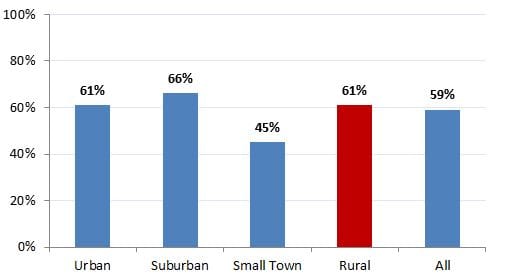
Source: Thomas B. Fordham Institute and FDR Group, Half Empty of Half Full? Note: Superintendent responses are sorted by the Ohio Department of Education’s district typologies (2007). Number of responses by typology: Urban = 64; Suburban = 84; Small Town = 47; Rural = 147. Total number of responses = 342. (Source and n-counts same for chart 2.)

When it comes to the actual use of blended learning, the story changes, as one begins to see differentiation in responses by district typology. More rural (and small town) superintendents report that blended learning is scarcely used in their district, compared to their peers in urban and suburban districts. Nearly two in five rural superintendents (37 percent) say that blended learning has limited or no use in their districts; meanwhile, 23 and 24 percent of urban and suburban superintendents, respectively, say that blended learning is rarely or never used. Chart 2 displays the use of blended learning by district typology.

Chart 2: Rural superintendents more likely to report no or little use of blended learning

Percentage of superintendents who report “limited or no use” of blended learning, by district typology

If Ohio’s superintendents are a bellwether for the state—perhaps even the nation—blended learning has a promising future. School leaders view blended learning favorably. However, they also report that it hasn’t taken hold in too many classrooms. This is especially the case for rural districts—and perhaps justifiably so. They may have neither the technological capacity nor know-how to implement blended learning. Nevertheless, rural districts ignore technological change at their own peril, and in fact many would seem to have the much to gain.

All this suggests that Ohio’s technological laggards can and must learn how to harness technology through blended learning. And, they could learn from blended learning’s “early adopters”—schools, like Reynoldsburg City Schools, who are leading the charge into blended learning. According to Reynoldsburg’s superintendent Steve Dackin, teachers at his district report that:

“Blended learning has transformed their approach to the classroom. It allows them to maximize their time and they can spend more time teaching. Teachers have said it’s a huge amount of work, but is our chance to customize the learning experience for every child.”

To read more about how a few schools are implementing blended learning see the following articles: “Mentor Public Schools Experiment with Blended Learning Classroom,” Mentor Patch; “Blended learning: Online and Face-to-Face,” The Canton Repository; “Purcell’s New Method of Teaching Math,” Cincinnati Enquirer. Online resources about blended learning include Public Impact’s recent publication A Better Blend: Digital Instruction + Great Teaching and the Clayton Christensen Institute website.


view

Fordham on the airwaves and in print

5.28.2013
Blog
  • Common Core: Fordham’s Emmy Partin hit the airwaves to discuss the Buckeye State’s transition to the Common Core standards in English language arts and math on All Sides with Ann Fisher on WOSU, Ohio’s National Public Radio station. Ida Lieszkovsky, a reporter for StateImpact Ohio and Kelly Kohls, president of the Ohio School Board Leadership Council joined Emmy to inform the public about the new learning standards and to debate their merits. To view the video of the event, please click here.
  • Good school governance: Fordham published Limitless: Education, the Reynoldsburg Way, a short report that profiles Reynoldsburg City School District, a Columbus-area school that serves around 6,000 students. In Limitless, Ellen Belcher, an award-winning journalist and formerly of the Dayton Daily News, interviews school leaders, teachers, and parents to describe how one Ohio district pushes innovation and empowers leaders—all to better meet kids’ needs while maintaining fiscal discipline. If you’re interested in an example of “portfolio management” done well, you’ll want to read this report, which can be downloaded here.
  • Superintendents’ views on education reform: The Buckeye State is in the midst of serious educational reform—from brand-new learning standards to a revamped accountability system to teacher evaluations partly based on students’ test scores. How do district superintendents, who are tasked with implementing these reforms, view them? With a hearty embrace? With a grimace and frown? To read the views and opinions of Ohio’s superintendents (344 out of 614 responded to our survey), please read the report Half Empty or Half Full, which can be downloaded here. The survey findings were the topic of an event in which Ohio’s policy leaders discussed the scope and pace of education reform. State Superintendent Richard Ross, State Senator Peggy Lehner, Kirk Hamilton, executive director for the Buckeye Association of School Administrators, and Steve Dackin, superintendent of Reynoldsburg City School District spoke at this event. We have posted a video of the event, which you can view here.
Fordham Logo

© 2026 The Thomas B. Fordham Institute
Privacy Policy
Usage Agreement

National

P.O. Box 110
Burke, VA 22009

202.223.5452

[email protected]

Ohio

P.O. Box 82291
Columbus, OH 43202

614.223.1580

[email protected]

Sponsorship

130 West Second Street, Suite 410
Dayton, Ohio 45402

937.227.3368

[email protected]
