Mobile Navigation

  • National
    • Policy
      • High Expectations
      • Quality Choices
      • Personalized Pathways
    • Research
    • Commentary
      • Gadfly Newsletter
      • Flypaper Blog
    • Events
    • Scholars Program
  • Ohio
    • Policy
      • Priorities
      • Media & Testimony
    • Research
    • Commentary
      • Ohio Education Gadfly Biweekly
      • Ohio Gadfly Daily
  • Charter Authorizing
    • Application
    • Sponsored Schools
    • Resources
  • About
    • Mission
    • Board
    • Staff
    • Career
Home
Home
Advancing Educational Excellence

Main Navigation

  • National
  • Ohio
  • Charter Authorizing
  • About

National Menu

  • Topics
    • Accountability & Testing
    • Advanced Education
    • Career & Technical Education
    • Charter Schools
    • Curriculum & Instruction
    • ESSA
    • Evidence-Based Learning
    • Facilities
    • Governance
    • Personalized Learning
    • Private School Choice
    • School Finance
    • Standards
    • Teachers & School Leaders
    • Think Again
  • Research
  • Commentary
    • Gadfly Newsletter
    • Flypaper Blog
    • Gadfly Podcast
  • Events
  • Scholars Program

The Education Gadfly Weekly

Sign Up to Receive Fordham Updates

We'll send you quality research, commentary, analysis, and news on the education issues you care about.
Thank you for signing up!
Please check your email to confirm the subscription.

The Education Gadfly Weekly: The votes are in, and 2024’s wisest wonk is…

Volume 24, Number 32
7.30.2024
7.30.2024

The Education Gadfly Weekly: The votes are in, and 2024’s wisest wonk is…

Volume 24, Number 32
view
Wonkathon
High Expectations

“Everything, everywhere, all at once” solutions to chronic absenteeism

Read the winning entry in Fordham’s 2024 Wonkathon, which asked contributors to answer this question: “How can policymakers and practitioners radically reduce chronic absenteeism—at least below pre-pandemic levels and preferably much further?”

Kelly James, Brad Bernatek 7.30.2024
NationalFlypaper

“Everything, everywhere, all at once” solutions to chronic absenteeism

Kelly James | Brad Bernatek
7.30.2024
Flypaper

To fix chronic absenteeism, we must ask why kids don’t want to go to school

Leslie Colwell
7.26.2024
Flypaper

Improving school attendance in Rhode Island

Jeremy Chiappetta | Krystafer Redden | Tom Giordano
7.29.2024
Flypaper

Modeling the impacts over time of education funding changes in Mississippi

Jeff Murray
8.8.2024
Flypaper

#932: Yes, AP exams are getting easier, with Checker Finn

8.6.2024
Podcast

Cheers and Jeers: August 8, 2024

The Education Gadfly
8.8.2024
Flypaper

What we're reading this week: August 8, 2024

The Education Gadfly
8.8.2024
Flypaper
view
Wonkathon

To fix chronic absenteeism, we must ask why kids don’t want to go to school

Leslie Colwell 7.26.2024
Flypaper
view
Wonkathon

Improving school attendance in Rhode Island

Jeremy Chiappetta, Krystafer Redden, Tom Giordano 7.29.2024
Flypaper
view
Mississippi map

Modeling the impacts over time of education funding changes in Mississippi

Jeff Murray 8.8.2024
Flypaper
view

#932: Yes, AP exams are getting easier, with Checker Finn

Chester E. Finn, Jr., Michael J. Petrilli, Amber M. Northern, Ph.D., David Griffith, Ph.D. 8.6.2024
Podcast
view
Fordham Gadfly image

Cheers and Jeers: August 8, 2024

The Education Gadfly 8.8.2024
Flypaper
view
Fordham Gadfly image

What we're reading this week: August 8, 2024

The Education Gadfly 8.8.2024
Flypaper
view
Wonkathon

“Everything, everywhere, all at once” solutions to chronic absenteeism

Kelly James | Brad Bernatek
7.30.2024
Flypaper

Editor’s note: This essay won first place in Fordham’s 2024 Wonkathon, which asked contributors to answer this question: “How can policymakers and practitioners radically reduce chronic absenteeism—at least below pre-pandemic levels and preferably much further?” Learn more.

The challenge of chronic absenteeism is incredibly complex. School, district, state, and other system leaders are taking steps to design more equitable solutions by naming and exploring the root causes of chronic absenteeism, engaging with those most proximate to the problem (including students, families and educators), and tailoring solutions to community, school, and family contexts. Still, this is not enough to solve the diverse and formidable issues keeping students from regularly attending school.

Dramatically reducing chronic absenteeism requires attention to “everything, everywhere, all at once” to understand and address the ecosystem of root causes identified by Attendance Works that include barriers to attendance, disengagement from school, aversion to school, and misconception about the impact of absences. We propose a three-pronged approach that includes re-engaging students, supporting families, and generating timely data. First, schools and districts need to re-engage students by addressing student engagement and sense of belonging in school. Second, schools and districts must support families by investing in programs, tools, and resources for asset-based family engagement. Finally, schools and districts need to generate timely data by integrating leading indicators of chronic absenteeism into data systems.

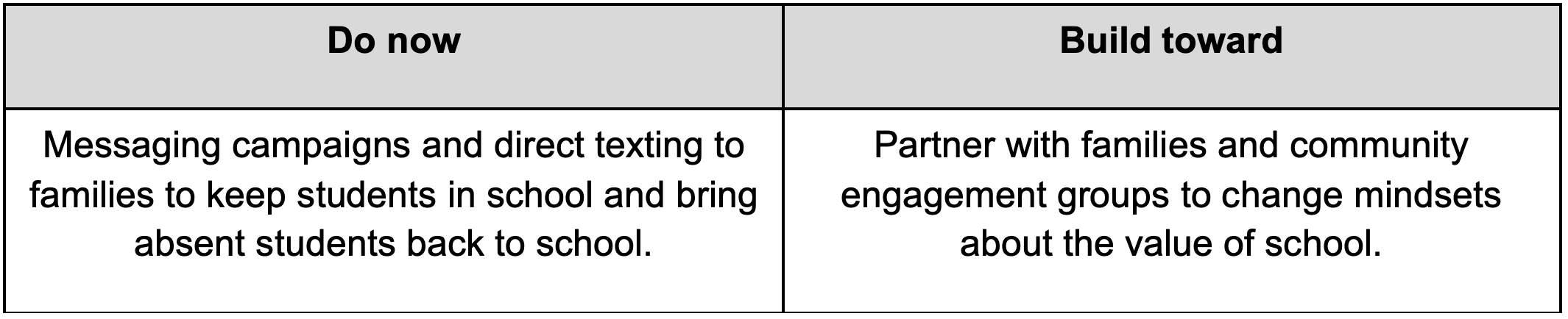
We need and want students in school now, but it will take time to accomplish the deeper changes that will bring students back and keep them in school. How do we develop “everything, everywhere, all at once” solutions without creating chaos in an already stretched system? Education Resource Strategies’ “Do Now, Build Toward” framework offers a strategy for addressing chronic absenteeism. At its heart, this approach consists of choosing a set of “doable starting points” for immediate implementation that are designed with “a longer-term vision in mind–a defined vision [that flows] through to clear strategies that are based on research and lessons learned from past experiences.”

1: Re-engaging students: Address student engagement and sense of belonging in school

1

Districts can build systems that listen to students to understand the barriers they face, particularly those related to instructional materials, sense of belonging, and learning conditions. Facilitating opportunities for schools and districts to collaborate with their communities can make schooling more relevant and engaging for students.

Research indicates that as students progress through school, they often become increasingly disengaged and bored. This disengagement is partly due to a lack of connection between the curriculum and their lived experiences, as well as a sense of not owning their learning process.[1] To counteract this, schools and districts are introducing culturally relevant curricula that reflect the diverse experiences of students and career-focused education that is directly related to life and work beyond school. Pedagogical approaches and school structures that center student voices also play a crucial role in boosting engagement. Listen to students and act on one student-defined solution to make school more relevant and interesting as districts implement culturally relevant curricula in the long term.

2: Supporting families: Invest in programs, tools, and resources for asset-based family engagement

2

Sustainable partnerships with families and community groups are vital to inform and re-educate them about the impacts of chronic absenteeism. Districts can consider a wide range of community and family engagement efforts, such as advocacy campaigns to change policies that exacerbate absenteeism, engaging community organizations to reinforce the importance of regular school attendance, and initiatives like libraries sharing information and healthcare organizations offering flexible hours for appointments.

Building stronger relationships with students and families takes considerable time and attention. In the short term, many schools and districts have implemented immediate solutions like messaging campaigns and direct texting to share positive messages, encourage attendance, and keep families informed about their children's attendance. This personalized attention helps address immediate attendance issues and lays the foundation for strong school-family partnerships.

Districts can support these short-term efforts by allocating resources to conduct effective family outreach. They can also provide technological solutions for easy communication in various languages. These efforts build toward deeper, long-term capacity-building for reciprocal relationships between families, schools, and communities, regaining trust necessary for sustained change.

3: Generating timely data: Integrate leading indicators of chronic absenteeism into data systems

3

Over the last decade, federal and state mandates have significantly improved attendance record keeping by states and districts, highlighting the growing issue of chronic absenteeism. Despite these advancements, gaps remain in early warning data systems, particularly in their ability to use collected data to implement effective solutions.

In the short term, districts can adopt practices around the proactive identification of at-risk students (e.g., after two absences). While many districts have early warning systems that track course grades, attendance, and behavior to identify at-risk students, these systems do not address the root causes of chronic absenteeism. Longer term, districts should expand their early warning systems to include elements such as students’ sense of belonging and the relevance of school to their lives.

4: “Everything, everywhere, all at once” solutions

We have identified several evidence-based efforts that are aligned with our proposed approach of “everything, everywhere, all at once” solutions that re-engage students, support families, and generate timely data:

  • Concentric Education Solutions (CES): School-based change that addresses organizational and leadership development, school culture and climate, student support services, and special education support. Research within Baltimore City Public Schools concluded that CES demonstrates “promising” evidence for improving student outcomes.

  • EveryDay Labs: School-based data collection and interventions to foster a supportive partnership between school districts and families to prevent absences. EveryDay Labs meets the “strong evidence base” criteria for ESSR funding, suggesting a strong and proven rate for alleviating chronic absenteeism.

  • Parent Teacher Home Visit Program: Identified as a best practice and as a national model for successful parent engagement by the Harvard Family Research Project.

In closing, chronic absenteeism is a critical challenge for our K–12 education system, and a complex problem to solve with root causes across multiple systems. However, based on research and the examples we highlight, we know that this “everything, everywhere, all at once” challenge can be met through opportunities for connecting and supporting an ecosystem of students, educators, families, community organizations, and policymakers, all focused on ensuring that barriers to attendance are lifted and students have what they need—in and out of school—to thrive. We can solve the problem of chronic absenteeism if we start now—designing solutions that cross a diverse set of root causes—and build toward a lasting and sustainable vision.


[1] Danks, A. (2019). Learning Ownership: A Framework to Enhance Educational Programs and Support Transference of Skills from K-12 to Postsecondary. Siegel Family Foundation.

view
Wonkathon

To fix chronic absenteeism, we must ask why kids don’t want to go to school

Leslie Colwell
7.26.2024
Flypaper

Editor’s note: This essay won second place in Fordham’s 2024 Wonkathon, which asked contributors to answer this question: “How can policymakers and practitioners radically reduce chronic absenteeism—at least below pre-pandemic levels and preferably much further?” Learn more.

America’s children are missing. The chronic absenteeism rate doubled from 15 percent in 2019 to a staggering 29.7 percent in 2022, meaning more than 14 million students are missing too much school. Absences have worsened across every demographic group and in every state with available data—small, large, urban, rural, everywhere.

The post-pandemic attendance crisis has been linked to a host of contributing factors—mental health issues and social safety net weaknesses that make it difficult for students to focus on schoolwork or even make it to school, smartphones and social media that make leaving the house unnecessary for young people, lax grading policies that reinforce school as optional.

Yet coverage of the crisis often fails to ask the most important question underpinning attendance numbers: why don’t kids want to go to school? Too often, it’s because their school experiences feel irrelevant, alienating, and disconnected from their personal interests. Educators, caregivers, and students continue to work within a century-old model of school design, pinned on uniformity and compliance, that doesn't reward innovation and leaves many learners behind.

How might attendance improve if the school day was something that students would genuinely hate to miss?

If we hope to rekindle disengaged students' joy of learning and dramatically reduce absenteeism, we must improve their day-to-day experience of school. This requires us to rethink traditional ideas about where, how, and with whom students learn. It will also require us to actually listen to students and design learning with their interests in mind.

Look no further than Salem Public Schools in Massachusetts for an instructive example of what this could look like. There, a pilot to improve student experiences at Collins Middle School cut chronic absenteeism in half, from 28 percent to 12 percent. The absenteeism rate among the pilot cohort continued to fall this year to less than 10 percent. Why? Because students don’t want to miss what’s offered at school.

In “studio” sessions, for example, students brainstorm and prototype solutions to real-world problems. Instead of spending every day inside the school building, students restore habitats on the Ipswich River, participate in exhibit design with the Peabody Essex Museum, and see cutting-edge robotics at UMass Lowell’s NERVE Center. Instead of interacting only with the same group of grade-level peers and teachers, students interview local business owners, visit lawmakers at the State House, and collaborate on civic action projects with Salem State University undergrads. Back in the classroom, learning centers on their experiences off campus.

In 2022, when Salem PS leaders saw the pandemic trends of low engagement, staggering learning loss and mental health challenges in their district, they asked the community how to better meet the needs of students. What did they learn? That only one-third of students enjoyed and wanted to be at school, and parents yearned for their children to have access to different modes of learning.

To reverse the trends, Salem PS launched the Middle School Learning Pilot for Collins eighth graders. In partnership with the WPS Institute, a nonprofit that works in education innovation, leadership at Salem PS—including superintendent Dr. Stephen Zrike and dean of innovation, Chelsea Banks—used the community’s feedback to co-design and pilot new learning experiences with buy-in from community members, staff, parents, and most importantly, students.

Salem developed a learning vision that aimed to make students feel connected, empowered, and growing through learning experiences that were personal, hands-on, and community-involved. By giving students more control over their schedules and the pace of their work, they helped students drive their own education and connect what they were learning to the real world.

Early on, the team identified that continuous learning would be crucial to the pilot’s success. WPS and Salem PS partnered with Transcend to understand how students experienced the pilot using the Leaps Student Voice Survey—a validated tool that measured the success of the pilot throughout and at the end of the year through the eyes of the students themselves. Banks and educators within the pilot convened regularly to look at the Leaps Survey data and discover areas to innovate or reinforce what was working.

Between September 2023 and April 2024, 27 percent more students agreed with the statement “Overall, most of the time I love school.” This fall, the district plans to scale the pilot to encompass all 8th graders in the district.

More than 100,000 responses to the Leaps Survey from students across the country show us that Salem is not an anomaly, and student perceptions of their learning experiences can serve as powerful leading indicators or “on-track” predictors of more traditional outcomes such as attendance, GPA, math test results and disciplinary incidents. In one analysis of 5,000 high school students, we found that when students report positive experiences in school, they are 25 percent less likely to be chronically absent than students who dislike their school experiences.

There are additional benefits to redesigning schools for greater student learning and happiness—perhaps it shouldn’t come as a surprise that greater family and teacher satisfaction follows. One hundred percent of families participating in Salem’s pilot said they would recommend the pilot to another family, and 100 percent of teachers agreed with the statement “Since joining the pilot, I feel I am more likely to continue teaching at CMS.”

Practitioners will lead the way in designing the learning environments where young people want to be, but advocates and policymakers can accelerate this work by investing in school design efforts, supporting the adoption of innovative school models, and facilitating knowledge-sharing among schools, districts, and CMOs that want to reimagine school for young people.

The answer to the question “How do we dramatically reduce absenteeism” is complex because it’s not a one-size-fits-all solution—it requires nothing short of reimagining schools as we have known and run them for generations. It is also deceptively simple, if we think about deeply listening to students as the first step to creating more relevant and rigorous learning experiences for them. The good news is that Salem’s community-based design pilot is just one case study for absenteeism reduction to learn from, with similar school transformation efforts underway across the country.


view
Wonkathon

Improving school attendance in Rhode Island

Jeremy Chiappetta | Krystafer Redden | Tom Giordano
7.29.2024
Flypaper

Editor’s note: This essay won third place in Fordham’s 2024 Wonkathon, which asked contributors to answer this question: “How can policymakers and practitioners radically reduce chronic absenteeism—at least below pre-pandemic levels and preferably much further?” Learn more.

School attendance is a critical factor influencing students’ academic success and long-term outcomes. In Rhode Island, chronic absenteeism has been identified as a significant barrier to educational achievement and high school graduation. In response, Governor McKee and state leaders launched the Learn365RI initiative and the AttendanceMattersRI program to address and improve school attendance. This essay explores the importance of school attendance, the strategies implemented through a collective impact approach across Rhode Island leaders to combat absenteeism, and the outcomes and future recommendations for sustaining this critical effort. Central to this effort has been Governor McKee and his office, the Rhode Island Department of Education, and the nonprofits The Partnership for Rhode Island and Always Learning Rhode Island.

The importance of school attendance

Regular school attendance is foundational for student success. Missing even a few days of school each month can severely impact a student’s academic performance and their likelihood of graduating high school. According to data from the Rhode Island Comprehensive Assessment System (RICAS) and the SAT results, there is about a 20-point gap in performance between students who attend school regularly and those who are chronically absent. This gap underscores the critical need to address absenteeism to ensure that all students reach their full potential.

The Learn365RI Initiative

In April 2023, Governor McKee launched the Learn365RI initiative, emphasizing the importance of improving attendance, reading, and math skills, and ensuring that students graduate high school with a clear plan for their future. The big idea is that learning does not just happen in school, but after school, on the weekends and on school-year and summer vacations; learning is a 365-day activity that we need to embrace and invest in. The AttendanceMattersRI campaign, a core component of Learn365RI, aims to tackle chronic absenteeism through a comprehensive, multi-faceted approach involving community engagement, public awareness, and data-driven strategies.

Strategies and milestones

The AttendanceMattersRI initiative has implemented several key strategies and achieved significant milestones over the past year:

  1. Public awareness campaigns: A series of op-eds and public opinion pieces by community leaders, including the Governor, the Commissioner of Education, the State Secretary of Commerce, mayors, and high school students, have highlighted the importance of school attendance. These articles aim to shift the public mindset and emphasize the value of regular attendance for the future of Rhode Island’s children and the state as a whole.
  2. Real-time data dashboards: The Rhode Island Department of Education has developed a set of nine public data dashboards that tracks chronic absenteeism at every school, updated daily. The only state education department in the country to publicly publish data on a daily basis, Rhode Island’s transparency allows for real-time monitoring and accountability, helping educators, parents, and policymakers to understand and address attendance issues promptly.
  3. Statewide attendance working group: Led by Commissioner of Education Angélica Infante Green, a diverse working group, including educators, administrators, students, community leaders, clergy, and business representatives has been convened to discuss attendance issues and propose effective strategies to combatting chronic absenteeism. This collaborative approach ensures that multiple perspectives are considered in developing policies and interventions.
  4. Direct support to schools: The Rhode Island Department of Education provides schools with robust internal dashboards, nudge tool reminders (parental text messages), backpack letters, direct mail, and state leaderboard competitions to encourage and support improved attendance.
  5. Attendance videos: The creation of over sixty videos featuring community leaders, influencers, and students themselves has been a critical part of the campaign. These videos aim to engage and motivate students and parents by conveying the importance of regular attendance in a relatable and compelling way.

Community and leadership engagement

Effective engagement of local leadership has been a cornerstone of the AttendanceMattersRI initiative. Schools alone cannot solve the attendance crisis; it requires the support and involvement of the entire community. Mayors, business leaders, church leaders, and medical professionals have all played vital roles in conveying the importance of school attendance and encouraging families to prioritize education.

Challenges and data dissonance

Despite the progress made, challenges remain. Data from various schools indicate that some schools have an inverse relationship between student beliefs about the importance of attendance and actual attendance rates. For instance, some schools with higher reported attendance rates often have lower student belief in the importance of attendance, suggesting a need for deeper analysis and targeted interventions to address underlying issues and misconceptions.

Outcomes and future recommendations

The initial outcomes of the AttendanceMattersRI initiative are promising, with improvements in awareness and some attendance metrics. Through 167 days of the 2023–2024 school year, Rhode Island schools reported nearly 300,000 fewer days absent than at the same point in time in the previous year and nearly every school in the state on-track to improve attendance rates and reduce chronic absenteeism rates. However, sustaining and building on this progress requires ongoing effort and innovation. Future recommendations include:

  1. Enhanced data analysis: Conducting more detailed analyses to understand the factors contributing to data dissonance and tailoring interventions to address specific needs and contexts within different schools and communities.
  2. Continued community engagement: Expanding the involvement of local leaders and community members to reinforce the importance of attendance and support families in overcoming barriers to regular school attendance.
  3. Strengthening support systems: Providing additional resources and support to schools, particularly those with high rates of chronic absenteeism, to implement effective attendance improvement strategies.
  4. Innovative communication strategies: Leveraging social media, local media, and other communication channels to reach a broader audience of parents and caregivers to sustain the momentum of the public awareness campaign.

Conclusion

Improving school attendance is essential for the academic success and future well-being of Rhode Island’s students. The Learn365RI and AttendanceMattersRI initiatives have made significant strides in addressing chronic absenteeism through a comprehensive, community-driven approach. Continued focus, innovation, and collaboration will be crucial in sustaining this progress and ensuring that all students have the opportunity to succeed academically and beyond. By prioritizing attendance and engaging the entire community, Rhode Island can create a culture that values education and sets its students on the path to success.

view
Mississippi map

Modeling the impacts over time of education funding changes in Mississippi

Jeff Murray
8.8.2024
Flypaper

The specific connection between increased school funding and student outcomes remains unclear—regardless of whether the added dollars are blanket or targeted—and the mechanisms at work remain elusive. Perhaps the historical record could shed some light on modern times. A new working paper offers a window into the past that might just show us the way for the future.

A quartet of researchers from the United States and Finland dig into data from Mississippi between 1940 and 2000, attempting to trace the impact of a school funding tweak implemented there in 1920. The so-called “equalization fund” was intended to provide more state dollars to districts whose expenses outpaced the combination of their base state revenue and their local tax revenue. Prior to 1920, districts with a majority-Black student population received higher funding than those with majority-White populations, largely because Black schools were fewer in number and geographically clustered, resulting in crowded buildings. Having more students meant receiving more money via the state’s base per capita formula. However, individual schools could be advantaged or disadvantaged as a result of allocation decisions made at the central office by White leaders who generally favored schools with more White students. That also meant that equalization funds ended up going to districts with a significant population of White students because, on paper, they received less from the state formula. Thus the unwritten rules of the Jim Crow South allowed almost-completely-separate and almost-completely-unequal school funding via every possible mechanism.

What changed when the equalization funds started flowing? The researchers fast-forward to 1940 and find that Mississippi schools were spending, on average, $5 per year per Black student versus $26 per White student (which translates to $107 versus $557 in today’s currency). For schools with a high concentration of Black students, this represents a decrease of about 4 to 6 cents for every percentage point increase in Black population share between 1920 and 1940.

They also zoom in to a subsample of school districts that did or did not receive equalization funding in 1940. Since there were instances of schools with a mix of Black and White students in both categories, they were able to create thirty-six district pairs for direct comparison. These districts were all relatively rural, with three-quarters of both their Black and their White students living on farms. Families were somewhat more disadvantaged relative to the broader population (for example, only 16 percent of Black families in the subsample owned their homes versus 24 percent in the larger group of districts). These districts included about 20 percent of all Black fourteen- to eighteen-year-olds from the larger group and roughly 9 percent of Whites.

Estimates indicate that higher levels of spending, where they occurred, had a positive effect on Black students’ educational attainment. Specifically, a $1 increase in annual instructional spending per Black student from the base average of $5 per year increased the fraction of fourteen- to sixteen-year-old Black students who completed at least sixth grade by around 1.5 percentage points (from a base of 45 percent) and increased mean completed years of schooling by around a tenth of a year (from a base of 5.28 years). Interestingly, the impact of increased marginal spending on White students was essentially null, but both outcome statistics were far higher for White students to begin with.

The researchers also go on to extrapolate these impacts over sixty years, using Census data to identify a sample of nearly 6,000 Black individuals who were between the ages of four and sixteen in Mississippi in 1940 and were still alive in 2000. Their analysis confirms that each dollar of additional instructional spending (as of 1940) was associated with a 0.09 year increase in completed education. This echoes the single-year estimate from 1940. Additionally, they find that higher school resources in 1940 were associated with significantly higher household and family income in 2000—an increase in $1 in school funding was associated with a 3 percent increase in income. This is a large effect relative to the size of the effect on completed schooling, suggesting that higher spending increased both the years of schooling of Black Mississippians and their returns per year of schooling. It’s worth noting that there were many other influences on the economic trajectory of all individuals between 1940 and 2000, including cycles of economic boom and bust, family migration, civil rights victories (along with unrealized goals), and numerous efforts to connect educational inputs and outcomes directly with a dedicated goal of fixing past injustices. Any or all could have influenced the economic outcomes of individuals in the study to greater or lesser degree, even if the researchers’ main point still stands.

The research team goes on to highlight the other side of the coin revealed by their initial analysis: what Black students who did not receive extra funding lost out on over the intervening years and how much better life might have been for them at the dawn of the twenty-first century if Black student funding in the state had equaled that of White students from 1940 onward. They (and others) discuss that long term analysis here.

Jim Crow–era Southern White leaders used every possible lever to keep Black people down and to raise up their own White sons and daughters. But data and analysis from recent years indicate that those sorry days are largely gone, although there is still work to be done. As my colleague Adam Tyner discusses in depth in his 2023 “Think Again” publication on school funding, research shows that, nationally, as of 2022, Black and Hispanic students were receiving $514 and $115 more per pupil, on average, than White students, respectively. “It is true, however, that funding gaps based on race/ethnicity are more common than those based on SES,” he writes. “Whereas Lee et al. find only a handful of states where total school-level funding is even slightly regressive, they identify more than twenty states where Black or Hispanic students are funded at lower levels than their White counterparts, although only a few of those differences are statistically significant.” One of those states is Texas, another place whose Black residents suffered under Jim Crow regimes for decades after the Civil War. “Although equity advocates shouldn’t exaggerate the problem,” Tyner concludes, “the persistence of racial disparities should prompt action in the places where they still exist.” This window on Mississippi’s past—especially the multi-decade impacts of a single school funding decision—provides a light by which to clearly see the consequences of inequity and gives us incentive to end those inequities wherever they may still exist once and for all.

SOURCE: David Card et. al, “School Equalization in the Shadow of Jim Crow: Causes and Consequences of Resource Disparity in Mississippi circa 1940,” National Bureau of Economic Research Working Papers (June 2024).

view

#932: Yes, AP exams are getting easier, with Checker Finn

8.6.2024
Podcast
 

On this week’s Education Gadfly Show podcast, Fordham’s Checker Finn joins Mike and David to discuss the changes in how the College Board is scoring Advanced Placement exams. Then, on the Research Minute, Amber reports on a meta-analysis examining the effectiveness of robot-assisted foreign language learning.

Recommended content:

  • “Are AP exams getting easier?” —Chester E. Finn, Jr.
  • “The Great Recalibration of AP exams” —John Moscatiello
  • “The College Board’s new method for raising AP scores” —John Moscatiello
  • Ali Derakhshan, Timothy Teo, Esmaeel Saeedy Robat, Mostafa Janebi Enayat, and Akbar A. Jahanbakhsh, “Robot-Assisted Language Learning: A Meta-Analysis,” Review of Educational Research (May 2024).

Feedback Welcome: Have ideas for improving our podcast? Send them to Stephanie Distler at [email protected].

view
Fordham Gadfly image

Cheers and Jeers: August 8, 2024

The Education Gadfly
8.8.2024
Flypaper

Cheers

  • Twenty-one-year-old Louie Leonardo’s decision to forego a traditional college education in favor of becoming an HVAC apprentice is indicative of a growing interest among young people in alternative pathways. —Wall Street Journal
  • A voucher-eligible Catholic school for boys will open in Cincinnati this month, reviving a building that has gone unused for more than thirty years. —Catholic News Agency

Jeers

  • In Massachusetts, “unions want to revoke a state test required for high-school graduation.” —Editorial Board, Wall Street Journal
  • School accountability, once a priority for Democrats and Republicans alike, has seemingly been abandoned by both parties. —Paul E. Peterson, Education Next
  • Critics of Massachusetts vocational schools argue that they should all be less selective, ignoring the fact that not every school has to or ought to serve every kind of student. — Boston Globe
view
Fordham Gadfly image

What we're reading this week: August 8, 2024

The Education Gadfly
8.8.2024
Flypaper
  • Students and colleagues of former public school teacher and current Governor Tim Walz speak highly of his skill and charm. Could he be just as popular as Vice President Harris’s running mate? —The Washington Post
  • “In troubling shift, English learners outpace peers in chronic absenteeism in California.” —The 74
  • Tim Walz’s work in education includes both time spent in the classroom and the passage of a slew of progressive education policies as governor. —Chalkbeat
  • Tim Walz’s history as a public school teacher may appeal to the rural and blue-collar voters Harris needs, though his individual education policy positions likely won’t have a prominent place in the campaign. —Education Week
Fordham Logo

© 2026 The Thomas B. Fordham Institute
Privacy Policy
Usage Agreement

National

P.O. Box 110
Burke, VA 22009

202.223.5452

[email protected]

Ohio

P.O. Box 82291
Columbus, OH 43202

614.223.1580

[email protected]

Sponsorship

130 West Second Street, Suite 410
Dayton, Ohio 45402

937.227.3368

[email protected]