
High Expectations
Is Common Core too hard for kindergarten?
There’s no such thing as too much, too soon in reading. Robert Pondiscio
There’s no such thing as too much, too soon in reading. Robert Pondiscio
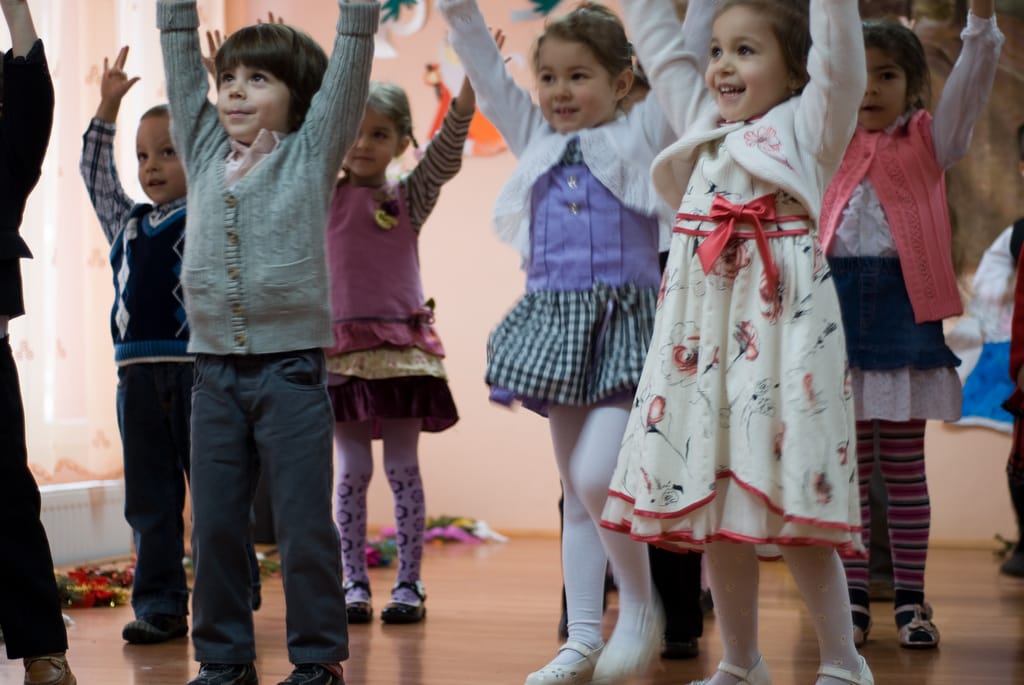
A report last month from a pair of advocacy organizations, the Alliance for Childhood and Defending the Early Years, argued that “there is a widespread belief that teaching children to read early will help them be better readers in the long-run,” but that there is “no scientific evidence that this is so.” The Washington Post and its Common Core-averse education blogger, Valerie Strauss, have been particularly aggressive in highlighting this report and running pieces from both parents and teachers arguing that “forcing some kids to read before they are ready could be harmful.”
The report, titled Reading in Kindergarten: Little to Gain and Much to Lose sounds an alarm over a perceived shift “from play-based, experiential approaches to more academic approaches” in early-childhood classrooms starting in the 1980s. “Under the Common Core State Standards (CCSS),” the authors claim, “the snowball has escalated into an avalanche which threatens to destroy appropriate and effective approaches to early education.”
The authors make much of the fact that no one involved with writing the standards was a K–3 teacher or early-childhood professional. The more important issue, however, isn’t who wrote it, but whether Common Core is beyond the abilities of five-year-olds or the expectations we should have for them. The short answer, I think, is “no.” But let’s look at some of the report’s specific complaints.
Expecting kindergarteners to read is “developmentally inappropriate.”
The much-used phrase “developmentally appropriate” (or inappropriate) is not as scientifically clear-cut as many suppose. There’s little evidence to suggest that a child’s readiness to learn occurs in the discrete, stair-step phases that Piaget theorized about long ago. As the respected cognitive psychologist Dan Willingham points out, “children's cognition is fairly variable day to day, even when the same child tries the same task.” When Common Core critics say, “This is developmentally inappropriate,” however, what they usually seem to mean is, “This is too hard.” “Stage theory” is not a useful guide for setting standards or planning lessons. For teachers, the question is seldom “Is this developmentally appropriate?” The far better question is, “What do I want kids to learn?” and “How can I present this in a way that makes sense to small children?”
Common Core is too hard for kindergarten.
There’s no reason to think that Common Core’s literacy benchmarks are too hard for kindergarten. According to the National Center for Education Statistics, two out of three kindergarteners already recognize the letters of the alphabet, both in upper and lower cases, when they enter kindergarten—and that’s one of the “foundational skills” expected under Common Core. (Parents would surely be alarmed if, by the end of kindergarten, their kids did not know their ABCs.) A similar number (61 percent) come into kindergarten with two or more Common Core “print concepts” under their cognitive belts, such as knowing that English text is read from left to right and from the end of one line to the beginning of the next. Most of the individual kindergarten reading standards say that small children should be able to demonstrate skills such as answering questions or retelling key details about a story “with prompting and support.” When you ask your child a question such as “What do you think will happen next?” while reading out loud from Goodnight Moon or Make Way for Ducklings, that’s offering “prompting and support.” There’s no suggestion in Common Core that children should meet these standards as independent readers during or at the end of kindergarten.
No research documents long-term gains from learning to read in kindergarten.
This is deeply misleading at best and arguably false. One longitudinal study published in 1985 followed four thousand students from kindergarten to twelfth grade. One-third of them had been taught to read in kindergarten; the rest were not. The kindergarten readers were stronger readers as high school seniors—a finding that “held up across districts and schools, as well as ethnic, gender and social class groups.” That study’s authors declared that “[a]ny school district with a policy that does not support kindergarten reading should be ready to present new and compelling reasons to explain why not.” To be clear, this was a correlational study—there were (for obvious reasons) no students randomly assigned to a control group and denied kindergarten literacy instruction. But the overwhelming weight of such correlational studies builds a compelling case in favor of early reading instruction.
Indeed, the strongest argument in favor of reading by the end of kindergarten and Common Core’s vision for early literacy is simply to ensure that children—especially the disadvantaged among them—don’t get sucked into the vortex of academic distress associated with early reading failure. Here the data are clear, unambiguous, and deeply sobering. Nearly 90 percent of struggling first graders are still struggling in fourth grade; three out of four struggling third-grade readers are still struggling in ninth grade; and one in six children who are not reading proficiently in third grade do not graduate from high school on time—a rate four times greater than for proficient readers.
Play-based kindergartens better prepare children to become fluent readers.
Nothing in Common Core—not one blessed thing—precludes schools and teachers from creating safe, warm, nurturing classrooms that are play-based, engaging, and cognitively enriching. If teachers are turning their kindergarten classrooms into joyless grinding mills and claiming they are forced to do so under Common Core (as the report’s authors allege), something has clearly gone wrong. Common Core demands no such thing, and research as well as good sense supports exposing children to early reading concepts through games and songs. The authors of Little to Gain would do early-childhood education a considerable service if instead they pushed aggressively for teacher education and professional development that enabled more teachers to meet Common Core benchmarks with the teaching techniques they favor, not demand that we “withdraw kindergarten standards from the Common Core so that they can be rethought along developmental lines.” There’s simply no reason to do so. Tim Shanahan of the University of Illinois at Chicago, who helped write the standards and chaired a federal review panel that examined the research undergirding them, noted emphatically that “[t]here are not now, and there never have been data showing any damage to kids from early language or literacy learning.”
Common Core sets unrealistic reading goals and uses inappropriate methods to accomplish them.
This is simply incorrect. The standards describe a range of skills that children are expected to demonstrate by the end of kindergarten. They are silent on the instructional methods that schools and teachers employ to meet those benchmarks. I had the opportunity to participate in a thoughtful, hour-long discussion of the report with Nancy Carlsson-Paige, one of the report’s authors, on KQED’s program Forum last month. But the star of the segment was Colleen Rau, a reading intervention specialist in the Oakland school district. While she shared some of Carlsson-Paige’s concerns around implementation pressures (mine too), she was quick to note that when she taught kindergarten eight years ago, “there was this same expectation around students learning all of their letters, sounds, and sight words and beginning to read early emergent text. That expectation,” she pointed out, “has been around far longer than Common Core.”
Children learn through playful, hands-on experiences with materials, the natural world, and engaging, caring adults.
Here the authors of the report come dangerously close to substituting philosophy for evidence and sound practice. We’ve all heard and read stories from friends and others about the kid who didn’t read until “something clicked” and she was off and running. As seductive as these anecdotes are, that is all they are—anecdotes. There’s no empirical support for the idea that reading develops naturally; “late bloomers” are rare. If the report’s message is that children should not be reading by the end of kindergarten, or that they will read when they’re darned good and ready, it’s perilously close to reckless. Most kids can already read simple texts by the end of kindergarten. And those who struggle early tend to continue to struggle—both in school and in life. The authors are absolutely correct that telling stories, reading from picture books, singing songs, reciting poems, activity centers, and imaginative play all help build literacy skills. That’s why none of those are discouraged by Common Core.
The Bottom Line
Of more than ninety specific Common Core kindergarten standards in literacy and math, the report takes issue with exactly one, which says that kindergarteners should be able to “[r]ead emergent-reader texts with purpose and understanding.” We’re not talking about six-year-olds reading Proust or Of Mice and Men. Keep in mind, too, that it’s the end of kindergarten that particular standard applies to. Common Core defines emergent-reader texts as “consisting of short sentences comprised of learned sight words and CVC [consonant vowel consonant] words.” Think “I am Sam and I am an ant,” not “To him who in the love of Nature holds communion with her visible forms.” There is nothing “developmentally inappropriate” about this standard, which many children—perhaps most—already meet. Our concern should be with those who don’t meet this standard, but can and should be put on a path to reading readiness before they fall forever behind.
In the final analysis, I share Carlsson-Paige’s concern about turning kindergarten into an academic pressure cooker. No one wants that; it is a recipe for disengagement and failure. But it’s simply incorrect to suggest that we can’t have both play-based kindergarten and language-rich kindergarten. It’s what the best kindergarten teachers have always done. Where Carlsson-Paige loses me, however, and where “Little to Gain” strikes me as not just wrong and misleading but nearly reckless, is in its suggestion that reading short “emergent text” sentences by the end of kindergarten is potentially harmful. This is clearly not the case.
The clear thrust of Common Core in kindergarten is to ensure that kids enter first grade ready for success—recognizing letters, understanding the sounds they represent, and knowing that words are collections of these letter-sized sounds. All of this is in the service of helping children understand how print represents language. That’s what kindergarten literacy looks like under Common Core. Given how early the trajectory is set, it should make us very, very nervous to suggest that kindergarten reading is too much, too soon.
photo credit: Remus Pereni via Flickr

Education reformers live in a world of data, accountability, policy, and percentiles. We are most comfortable debating ideas, writing papers, and talking to each other. But when it comes to telling powerful stories to inspire change, we have a lot to learn from one public school student in New York City.
Thirteen-year-old Vidal Chastanet was stopped and asked by Humans of New York photographer Brandon Stanton, “Who is the most influential person in your life?” With his answer—Nadia Lopez, principal at Mott Hall Bridges Academy (MHBA)—Vidal reached the hearts of millions of people.
“When we get in trouble, she doesn't suspend us. She calls us to her office and explains to us how society was built down around us. And she tells us that each time somebody fails out of school, a new jail cell gets built. And one time she made every student stand up, one at a time, and she told each one of us that we matter.”
Vidal’s answer went viral on Facebook, leading him to The Ellen DeGeneres Show and the White House last week. A fundraising campaign set up to help MHBA send students on a trip to Harvard over the summer raised $1.2 million.
Vidal’s story transcended mediums, inspired thousands, and raised millions because it went directly to people’s hearts. It is universal, human, and real.
At Education Cities, a national network of city-based organizations committed to improving public education, we challenge our network members, and ourselves, to reach for hearts, not just minds.
What should our members, and all those committed to expanding opportunity, learn from Vidal?
First, tap into shared beliefs.
Look at how Ms. Lopez justified the trip to Harvard. No “reform-speak” here. It’s not because she wanted all her students to go to college or succeed in a twenty-first-century economy (although both are surely true). It’s because she wanted “my scholars to know that there is not a single place they don’t belong.”
Don’t we all want the same for every child?
When reformers talk about ideas or policies that help more children have access to great schools, let’s root conversations in shared experiences and beliefs.
Second, trust the messenger.
There are few things more genuine than the honest words of a thirteen-year-old student, or a dedicated principal like Ms. Lopez. Why don’t we let them do more of the talking? Let’s support the voices of parents and children and stop doing all the pontificating ourselves.
And when they do speak up, parents and students can’t just be mouthpieces for our agendas. A national reporter who followed the parent trigger story in Adelanto, California recently told us that, when the effort first started, parents were great spokespeople—sincere, honest, candid. After time, they became “robots,” repeating talking point after talking point fed to them by organizations with something at stake.
The most effective messengers are educators, parents, and students. Let’s do more to elevate their voices without trying to control everything.
Third, let’s simplify our messages.
The next time you need to advocate for equitable funding for charter school students, take a cue from Stanton. On the fundraising page for the Harvard trip, he wrote: “Principal Lopez estimates that two-thirds of her budget every year goes toward her teachers' salaries, and what little remains goes towards the school's core programs.”
You know what is embedded in that statement? The fact that Ms. Lopez can’t control her budget. The fact that MHBA has to sacrifice enrichment activities for core programming. The fact that Ms. Lopez has to spend her time finding philanthropic funding to enhance the education of MHBA students.
Complex arguments, edu-jargon, and out-of-touch spokespeople are not the way to win hearts and minds. I am as guilty of falling into these traps as anyone else. But we need to remember that the fight to improve public education is not an academic debate, and we won’t be successful unless we can reach people’s hearts.
The overwhelming majority of us will never have the audience of Vidal or Humans of New York. But this story offers lessons for those of us seeking to reconnect with the human motivations behind our work.
Ethan Gray is the founder and CEO of Education Cities.

***
Correction: February 12, 2015
A previous version of this stated that the Broad Foundation was giving a $500,000 prize to charter organizations. That information came from the Los Angeles Times and is incorrect.
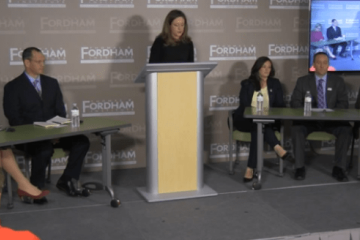
In 2010, former teacher, principal, and charter-school founder Doug Lemov authored Teach Like a Champion. The book offered a whole new perspective on teacher training—one that has yet to be embraced by ed schools. Since its release, thousands of teachers have adopted its framework as their own, becoming better teachers for it. Now Doug Lemov is back with a new edition: Teach Like a Champion 2.0 offers specific, concrete, and actionable techniques for teachers. But what’s so special about these techniques? And where are ed schools falling short? What does it take to teach like a champion in today’s school system?
Watch this conversation with Doug Lemov on his new book and a panel discussion on what it takes to prepare our teachers to teach like champions.
For those who march to the drumbeat of “college for all,” an updated report from the William T. Grant Foundation ought to give pause. Back in 1988, the “forgotten half” were American youth who didn’t attend college and “were struggling in ‘the passage to adulthood.’” Released in near-tandem with the president’s free-community-college plan, this report depicts an honest view of community college, from “notoriously low completion rates” (a mere 20 percent of those who attend community college attain a bachelor’s degree within eight years of graduating high school, and almost half earn no credential at all) to calling remedial education “a vague euphemism that doesn’t help students understand their situation, make informed choices, or learn about alternative programs.” The forgotten half of today are “youth who do not complete college and find themselves shut out of good jobs in the era of college for all.” While past generations with “some college” enjoyed increased earnings, a changing economy means that’s no longer true. “The most alarming finding is that many youth who took society’s advice to attend college, sacrificing time and often incurring debts, have nothing to show for their efforts in terms of credentials, employment, or earnings,” note the authors. They provide a commonsense policy solution: Colleges and high schools need to be frank with students on the costs, debts, time, and potential earnings of different education and career paths. The report also calls for better alignment between high school and college standards by pointing to the example of Florida, which administers a college remedial test to eleventh graders and thereby provides students and parents with a check-in on college readiness. None of this is easy, though, because it requires adults to tell teenagers, “I’m sorry, kid, but you’re just not college material.”
SOURCE: James Rosenbaum, Caitlin Ahearn, Kelly Becker, and Janet Rosenbaum, “The New Forgotten Half and Research Directions to Support Them,” the William T. Grant Foundation (January 2015).
Citing insurmountable data challenges, the authors of Great Schools’ most recent evaluation of the School Improvement Grant Program argue that policymakers are left “without a clear and unambiguous picture of whether this major investment in turning around the nation’s lowest-performing schools worked as intended.” The view may be opaque, but what we can see isn’t pretty.
According to the report, between the 2009–2010 and 2012–2013 school years, SIG grantees at the elementary and middle school levels saw a cumulative increase in proficiency of only a few percentage points in most grades and subjects relative to comparison groups—a disappointing result, considering some schools saw funding increases of as much as 58 percent per student under the program. And while SIG’s restart and closure models were used so infrequently that little can be said about their effectiveness, the report indicates that there were no statistically significant differences between the rates of improvement at transformation and turnaround schools, a finding that suggests that it doesn’t much matter which one-size-fits-all improvement models the federal government prescribes—implementation is what counts.
Unfortunately, SIG’s implementation was deeply troubled, as the authors of the report document through approximately fifty interviews with superintendents, program directors, principals, and teachers. Unsurprisingly, SIG grantees experienced difficulties with “the removal and recruitment of staff, community and union resistance to school changes or closures, the ability to secure and retain sufficient resources to launch and sustain the turnaround efforts, and conflicting demands from various stakeholders.” Additionally, governance was (as always!) a barrier to top-down reform, with incoherent state and district initiatives causing confusion and frustration that were compounded by the rushed timeline and abrupt increase and decrease in programmatic funding.
So, is the idea of school turnaround dead and buried? Not quite. Unmentioned in the report is the (criminally underreported) fact that, because state data systems were still being built during the planning phase of SIG, thirty-nine states used student achievement, rather than student growth, to identify eligible schools; this means that (much as with NCLB) the schools identified as “consistently low-performing” by SIG may not have been those most in need of reform. Moreover, this report was not able to look at student growth under SIG, so there might have been more progress than proficiency rates alone can indicate.
A more interesting report might have compared the results from these thirty-nine states to the eleven states that used student growth in the identification process. Until that report is written, however, defenders of “school improvement” will still have a (rather shaky) leg upon which to stand.
SOURCE: “School Improvement Grants: Progress Report from America’s Great City Schools,” Council of Great City School (February 2015).
Rural school districts are the oft-ignored middle child of our nation’s public schools, consistently snubbed in favor of their urban and suburban siblings. Through a survey of rural superintendents, this report by the Rural Opportunities Consortium of Idaho One sheds much-needed light on the most pressing issues rural educators face—primarily rooted in educators’ struggle to deliver effective, cost-efficient education to students who live in isolated communities. Small rural districts are underfunded. Science, English, and foreign language instructors are in short supply because rural districts lack the incentives to attract them, causing faculty to teach classes that exceed their qualifications. The report’s most interesting recommendation is to increase rural technological connectivity through the implementation of blended learning, a hybrid teaching method that combines digital learning with traditional classroom instruction. This reduces the need for a large, specialized instructional staff by providing live video lectures from teachers elsewhere. Such an initiative would improve the quality of rural education and save districts money. Yet as promising as this all sounds, funding is also an issue here—a concern that the report could have addressed in further detail. Implementing successful blended curricula will require massive up-front injections of capital for things like new tech gadgets, full-time IT personnel, and teacher training. Districts already pinching pennies cannot get their hands on necessary start-up funds without significant reforms to federal, state, and local funding policies. The report briefly addresses this with both an unrealistic recommendation to alter the Title I funding and a more meritorious one that smaller districts band together to compete for grants against larger districts. If the goal is to implement blended learning in the areas that could benefit from it most, it’s at least a start.
SOURCE: Lars D. Johnson, Ashley LiBetti Mitchel, and Andrew J. Rotherham, “Federal Education Policy in Rural America,” Rural Opportunities Consortium of Idaho (December 2014).