
High Expectations
The new ESEA, in a single table
The action is moving to the state level. It’s about time. Michael J. Petrilli
The action is moving to the state level. It’s about time. Michael J. Petrilli
As first reported by Alyson Klein at Education Week’s Politics K–12 blog, Capitol Hill staff reached an agreement last week on the much-belated reauthorization of the Elementary and Secondary Education Act. The conference committee is expected to meet today to give its assent (or, conceivably, to tweak the agreement further). Final language should be available soon after Thanksgiving, with votes in both chambers by mid-December. If all goes as planned, President Obama could sign a new ESEA into law before Christmas.
So what’s in the compromise? Here’s what I know, based on Education Week’s reporting and my conversations with Hill staffers. (There are plenty of details that remain elusive.) I’ll display it via a new version of my handy-dandy color-coded table. (Previous editions here, here, here, and here.)
The Staff Agreement Heading into Conference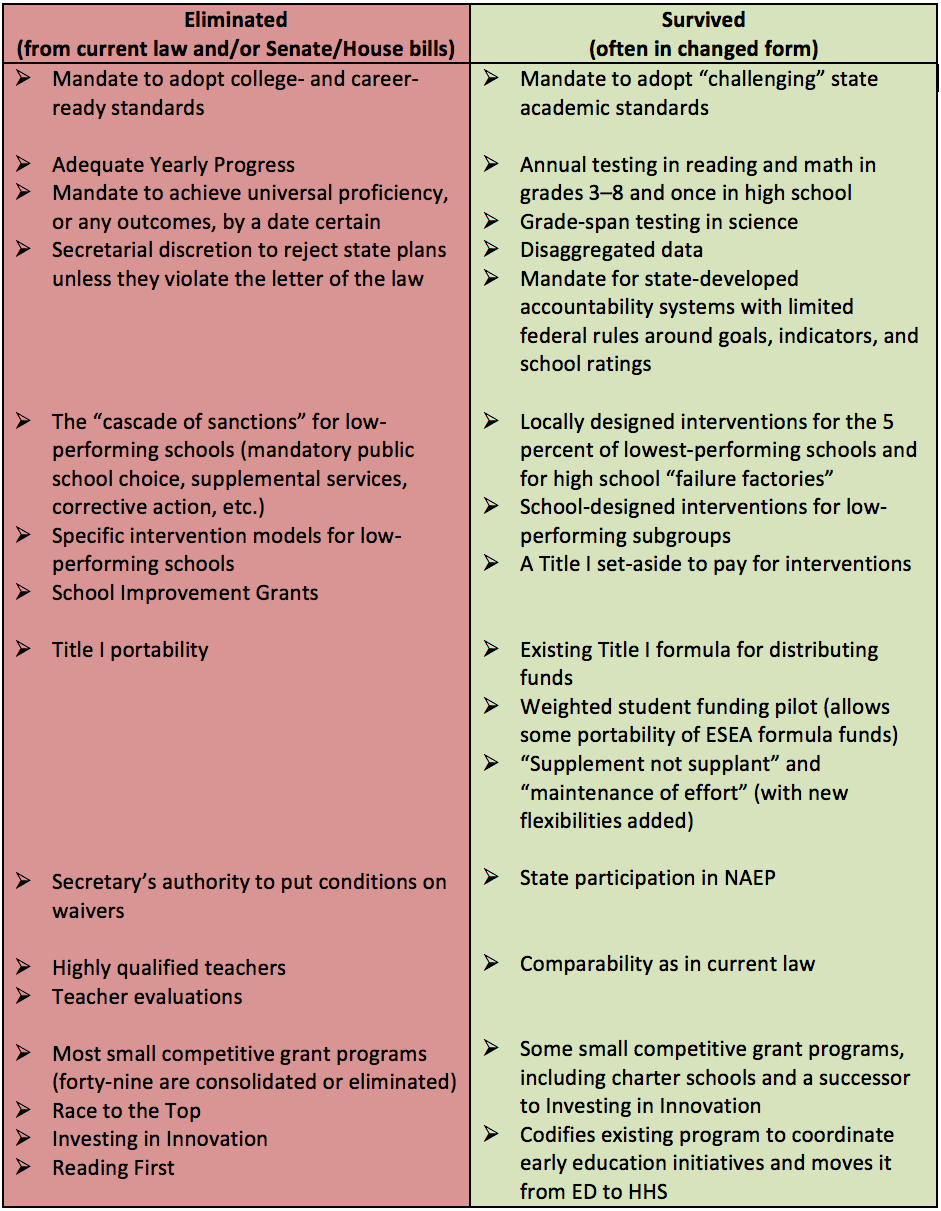
Note: Some of these provisions aren’t in current law—some were in the stimulus bill (like Race to the Top), some are in Secretary Duncan’s conditional waivers (like teacher evaluations), and some were in one of the bills passed in July (like Title I portability).
There you have it. Readers (and especially Hill staff): Tell me if you think I got anything wrong, and I’ll fix it. And advocates at the state level: Get ready. It’s looking extremely likely that by January, states will find themselves with a whole lot more discretion over their accountability systems, interventions in low-performing schools, teacher evaluations, and much else. The action is finally moving out of Washington. In my view, it’s about time. But as Uncle Ben told Spider-Man, “With great power comes great responsibility.” Let’s make sure the states exercise that responsibility sensibly.
dkfielding/iStock/Thinkstock

The Achilles’ heel of the West, I read not long ago, is that many people struggle to find spiritual meaning in our secular, affluent society. How can we compete with the messianic messages streaming from the Islamic State and other purveyors of dystopian religious fundamentalism?
It made me reflect on my own life. How do I find meaning? Largely from my role as a father, a role I cherish and for which I feel deep gratitude. But ever since I lost faith in the Roman Catholic Church of my upbringing—not long after I nearly succumbed to cancer at age eighteen—much of my life’s meaning has come from my view of myself as an education reformer.
I suspect that I am not alone. We are drawn as humans to heroic quests, and those of us in education reform like to believe that we are engaged in one. We’re not just trying to improve the institution known as the American school; we see ourselves as literally saving lives, rescuing the American Dream, writing the next chapter of the civil rights movement.
When people speak of Arne Duncan with tears in their eyes—explaining earnestly that he has always put kids first—it is because he epitomizes the virtuous self-image of the education reform movement. He has been our Sir Galahad. Now that he’s stepping down, he will always be revered by some as St. Arne.
This near-religious fervor gives the reform movement much of its energy and its moral standing, so it should not be dismissed lightly. To the degree that it helps us continue to strive—for better schools and better policies and better outcomes for kids— it is worthy of celebration.
But there’s a dark side too. Like most religious legends, this one only works well as a struggle between good and evil. So if reformers are on the side of the angels, at least in our own minds, who gets cast as the devil? The unions, which protect incompetent, abusive, or racist teachers? Miserly legislators, who refuse to appropriate the necessary dollars to lift all children up? Well-off parents, who hoard educational opportunities for their own progeny?
Not surprisingly, these groups don’t enjoy being vilified. Nor, in most cases, do they deserve it. They are engaged in their own struggles, see themselves fighting for their own sacred causes, and are busy looking for meaning in their own imperfect lives. They might not totally disagree with reformers about the changes needed in K–12 education, but when we turn them into Judas or Mephistopheles, opportunities for common ground evaporate.
But that’s not all. What if our education challenges aren’t mostly political or moral in nature, but fundamentally technocratic instead? What if our education system is chockablock with people who also want to do right by kids, who also want to close opportunity gaps and rekindle upward mobility, but are working within badly designed systems or with far-from-perfect information? “We know what works, we just need the political will to do it”: That’s the foundational creed of today’s reform movement. But what if the truth is closer to “We are just beginning to learn what works to help poor kids escape poverty, but we still don’t know how to do it at scale”? It doesn’t make for an inspirational slogan, but it might be a better guide to where policy and practice need to go. To his credit, Bill Gates embraced such a humble approach in his big speech a few weeks ago.
In other words, what if the reform movement needs more “science” and less “religion”? More openness to trial and error and a greater commitment to using evidence to guide our decisions?
Consider one example. We know that many students continue to struggle to read by the end of the third grade, and some show ever-weaker comprehension as they move through elementary school and beyond. Cognitive science indicates that the cause is a lack of content knowledge being taught in the early grades. So why aren’t schools beefing up their instruction in social studies and science, or inserting such content into their daily reading blocks? There’s no devil here as far as I can tell–nobody is against getting more science and social studies into schools. But how can we figure out what’s keeping schools from performing better, and then try to find ways to fix it?
Humility is required
It’s been a great joy to be part of the education reform movement for the past twenty years. It has allowed me to form bonds and friendships with many amazing, committed, and super-smart colleagues. I understand why so many young people today—fresh from service in Teach For America or still plugging away in “no excuses” charter schools—want to sign up and join the cause. On the whole, this is a wholesome and worthy path.
But if this is really to be about “the kids” and not just our own search for meaning, we need to be careful not to lapse into morality plays. We need to be particularly mindful not to malign our opponents. And we need to be humble enough to acknowledge the technical challenges in what we’re trying to achieve.
We should also remember that millions of American educators are finding meaning in their lives in a different way—through direct service to children. This is at least as praiseworthy as taking up a great political cause or policy quest, and almost certainly more so. (It certainly appears to be more in line with Pope Francis’s calls for us to take care of the less fortunate around us.)
It’s always been a good idea for us to check our egos at the door. Let’s check our halos there, too.
Editor’s Note: This article originally appeared in a slightly different form at the Hechinger Report.
supansa9/Thinkstock

Welders, as Marco Rubio recently reminded us, sometimes earn more than philosophers. But neither of them earn as much as students who receive degrees in STEM subjects. So perhaps the most encouraging bit of data to emerge from the ACT’s “The Condition of STEM 2015” report is this: Of the nearly two million high school graduates who took the ACT in 2015, 49 percent had an interest in STEM.
Interest, however, does not necessarily translate into aptitude. For the first time this year, ACT has added a new “STEM score” to their report—an acknowledgement of recent research indicating that college success in science, technology, engineering, and math classes requires a higher level of preparedness than ACT’s previous benchmarks in math and science alone seemed to predict.
Based on this enhanced measure, a paltry 20 percent of the 2015 ACT test takers were deemed ready for first-year STEM college courses. For reference, readiness is defined as either 1) a 50 percent chance of earning a B or higher or 2) a 75 percent chance of earning a C or higher in freshman courses like calculus, biology, chemistry, and physics. Among students who say that they are interested in STEM majors or careers, readiness jumps to 26 percent. (OK, "jumps" might be something of an overstatement.) And for those whose interests and activities, according to ACT’s “interest inventory,” indicate that STEM is for them, readiness climbs “all the way up” to 33 percent. None of which inspires confidence that the next Bill Gates or Steve Wozniak is acing freshman math as we speak (assuming they haven’t already dropped out and set up shop in the garage).
The report also surfaces a bit of a vicious circle: Nearly half of the class of 2015 might say they’re interested in STEM majors, but few plan to teach these subjects to tomorrow’s STEM-minded pupils. “Less than 1 percent of all ACT-tested graduates expressed an interest in teaching math or science,” the report notes. "Despite a larger number of ACT-tested and STEM-interested students this year, the number interested in teaching math and science was lower than in 2014.” Given their demonstrated lack of proficiency, this might not be all bad.
No word on how many want to become welders.
SOURCE: “The Condition of STEM 2015,” ACT, Inc. (2015).
A new Social Science Research study examines racial differences in how teachers perceive students’ overall literacy skills. It asks whether there are differences in these perceptions and to what extent they might be a reflection of a difference in actual abilities. In other words: Are teacher perceptions accurate?
The study uses data from the Early Childhood Longitudinal Study, specifically those students enrolled in first grade during spring 2000 who had literacy test scores from kindergarten and first grade (ECLS-K administers a literacy test). Teachers were also asked to evaluate students’ overall ability relative to other first-grade students on a scale that ranges from “far below average” to “far above average.” The analyst controls for a host of student, teacher, and classroom variables in the regression analysis, including parental income and education, teacher race, percentage of poor students in the school, and more.
The study finds that, per the average performers, teachers were mostly accurate in labeling them so; there are no statistically significant racial differences in teacher ratings here. But among lower performers, teachers tend to rate minorities (Asian, non-white Latino, and black students) more positively than their performance suggests, while low-performing white students were rated more negatively than their performance would warrant. More specifically, minorities are 4–6 percent less likely than their similarly performing white peers to be rated “far below average.” Among the higher performers, the reverse is true—meaning whites are rated more positively and minorities more negatively. Specifically, high-performing minority students are between seven and nine percentage points less likely to be rated far above average.
The author—also a sociologist—posits that increased awareness of equity issues may compel teachers to use “restraint” in using labels such as “far below average” when referring to low-achieving minority students. (Or, she says, teachers could be harder on white students who are low-performing if they tend to have higher expectations of white students in general.)
The race-based discrepancies on the high end are quite concerning at a time when all high-achievers, including minorities, tend to get overlooked as teachers focus on their struggling students. But there are implications to this mindset, one of which the author closes with: “If the cognitive abilities of high achieving minority students hold less value in teachers’ overall perceptions, they may also hold less value during decisions concerning academic placements, access to enrichment opportunities, and the distribution of resources and support.” Needless to say, that’s a very big problem.
SOURCE: Yasmiyn Irizarry, “Selling students short: Racial differences in teachers’ evaluations of high, average, and low performing students,” Social Science Research, Vol. 52 (July 2015).
All right, first things first: What do we mean when we use the phrase “Response to Intervention” (RtI)? Its utterly functional label—surely all interventions are designed to provoke a response—lends itself to a host of vague interpretations. Education Week has produced a useful overview of its growth and effects, and Fordham attempted the same in its 2011 exploration of trends in special education, but the general points are these: RtI emerged around the turn of the century as a way to identify kids with learning disabilities as early as possible, provide them with a series of gradually intensifying academic interventions, and monitor their progress throughout. Spurred in its expansion by the 2004 reauthorization of the Individuals with Disabilities Education Act (which permitted districts to use up to 15 percent of their Part B dollars on early intervention services), RtI supplanted IQ-focused “ability/achievement discrepancy” models of learning disability screenings, and it eventually came to be adopted as a general education framework. In the words of Alexa Posny, the DOE’s assistant secretary of special education and rehabilitative services, the approach “hasn’t changed special education. It has changed education and will continue to do so. It is where we need to head in the future.”
This extremely thorough study, published by MRDC in partnership with the Institute of Education Sciences, sets out to examine both the prevalence and effects of schools providing RtI interventions for students at risk of reading failure in elementary school. It differs from earlier assessments of RtI in a few critical respects. For one thing, it casts a broad net, measuring its results at the school level (rather than the district level) in thirteen states. It also compares two separate groups: One, an impact sample of 146 schools, was picked from those that had three or more years of experience in implementing RtI approaches for reading; the second was a reference sample comprising one hundred randomly selected schools from the same states. Finally, the study uses a regression discontinuity design to estimate impacts. What this means is that it focused on students just on either side of their respective reading grade levels, rather than students more broadly. As the authors put it, the study “does not assess whether the RtI framework as a whole is effective in improving student outcomes or whether reading interventions are effective for students well below grade-level standards.” It is up to others, then, to determine the impact of the method on the children who are furthest behind.
The results show that some 70 percent of districts in the thirteen states reported offering RtI services. No surprise there—the method has spread widely since the passage of No Child Left Behind and the 2004 IDEA update; the same figure was measured at 61 percent in 2010. Impact sample schools were more likely (97 percent versus 80 percent) to provide interventions like small group instruction for students somewhat below grade level at least three times per week; they were also more likely (67 percent versus 47 percent) to provide such interventions for students significantly below grade level at least five times per week. Schools in the impact sample were far more likely to conduct universal screening of students at least twice per year, and also to allocate extra staff to assist in reading instruction and data usage.
Most surprising by far are the results for RtI effectiveness. The study actually ascribes a negative effect to such interventions in the first grade—that is, for students either somewhat or significantly below grade-level reading, being engaged with RtI services like extra instructional time actually lowered their scores on assessments of both comprehensive reading and fluency decoding. Few could have anticipated such an outcome. Still, given the ubiquity of RtI and the acknowledged limitations of the study, more information is needed before drawing wider conclusions on the efficacy of the approach.
SOURCE: Rekha Balu et al., “Evaluation of Response to Intervention Practices for Elementary School Reading,” U.S. Department of Education, Institute of Education Sciences, National Center for Education Statistics (November 2015).
