
Education governance: Different schools of thought
Categorizing the many chefs in the school governance kitchen. Amber M. Northern, Ph.D., and Chester E. Finn, Jr.
Categorizing the many chefs in the school governance kitchen. Amber M. Northern, Ph.D., and Chester E. Finn, Jr.

Anyone who has spent serious time within the U.S. public education system would likely agree that there are too many chefs in the school governance kitchen. Not only that, some of them are terrible cooks. Which means that great governance is scarce, consensus is hard to achieve, and significant change is rare. Yet our education governance system, lamented and disparaged as it often is, is one of the least understood aspects of American K–12 schooling. So while it’s easy to agree that “bad” governance gets in the way of doing what’s best for kids, it’s harder to pinpoint just what exactly is so dysfunctional when it comes to running schools.
To shine a flashlight into this murk, we must first define the governance “system” that we’re talking about. Who exactly makes which kinds of education decisions? State or local? Who has the power? Is that power dispersed or centralized? To what degree can the wider public—not just insiders—participate in policymaking? These are some of the gnarly questions that characterize governance; but because they’re also humdrum and wonky, not many people bother trying to ask them.
Some of this apathy (or is it despair?) arises from the reality that the structures, rules, and institutions of American public education are indeed cumbersome and difficult to change. Issues like whether the state, district, or building leader decides how to dismiss an ineffective teacher often fall under the purview of the state constitution or education code. Ditto for how the state superintendent is selected. Even seemingly small matters, like altering when the local school board holds elections, can prove impervious to change.
Yet all is not lost. Fissures can be seen in the governance glacier. We’ve seen “cage-busting” leaders who know how to work in or around the system so that it functions better for kids (think of Paul Pastorek, Howard Fuller, Mike Feinberg, Wendy Kopp, Chris Barbic, Deborah Gist, Joel Klein, and others). We’ve even seen the structure itself remodeled in places that have shifted from uniformity to “portfolio” models, switched from board to mayoral control, created charter schools and statewide recovery districts, and handed school leaders more power while awarding “central offices” less.
So how to make sense out of a system with some cords that are binding and others that show some stretch? We turned to the University of Oregon’s Joanna Smith, who had previously co-authored a nifty study on education governance in California. Dr. Smith, aided by several talented graduate students, agreed to conduct a new study with two of Fordham’s own best analysts, Dara Zeehandelaar and David Griffith. The result is Schools of Thought: A Taxonomy of American Education Governance, released today.
Our dream team categorized state-level governance systems around three broad questions:
Answers to these questions yielded both big-picture findings and tantalizing factoids (at least in the eyes of us governance geeks).
Betcha didn’t know that (aside from Hawaii, with its single school district), North Carolina concentrates by far the most authority at the state level. Tar Heel state officials have the power to determine district boundaries and tax rates, mandate which textbooks may be used in classrooms, take over low-performing schools and districts, authorize new charter schools, and require that districts evaluate teachers annually, using a state-prescribed evaluation instrument. At the other end of the spectrum is Wyoming, which leaves most of this authority to its local districts.
We also learn that Florida has the most “consolidated” governance system, with authority overwhelmingly vested in a single state board and with a small number of very large school districts. Its foil is Alaska: The Last Frontier has the most distributed system of governance, with authority over higher education, CTE, and adult basic education parceled out to the Board of Regents, the Commission on Postsecondary Education, and the Department of Labor and Workforce Development. Additionally, it operates fifty-five districts to serve 131,000 students.
But we mainly hunted for similarities, not contrasts. To that end, the analysts fit similar states into eight categories—a taxonomy, if you will—based on their common characteristics. We named those categories after an octet of history’s most illustrious political thinkers and statesmen, people who have wrestled with governance questions over the centuries and whose central beliefs can be distinguished from one another: Jefferson, Hamilton, Lincoln, Locke, Burke, Madison, Andrew Jackson, and Plato.
Just as Jefferson distrusted the wisdom of a ruling class, the ten Jeffersonian states (including Alaska, Arizona, and California) vest much authority at the local level, distribute decision making among multiple institutions, and favor democratic participation. By contrast, the seven Hamiltonian states (including Pennsylvania, Maryland, and Delaware) feature governance systems that vest greater authority in the state than in local agencies, consolidate decision making within a small number of institutions, and limit public participation—consistent with the thinking of their namesake, who believed in a forceful, proactive central government. The Lincolnian states (Michigan, Nevada, and Tennessee among them) concentrate authority at the state level and within few institutions, yet also encourage public participation. In this, they mirror the preferences of our sixteenth president, who supported a strong central government that was also accountable to public opinion. (See the full report for more on the taxonomy.)
***
Burke remarked in 1792 that “the several species of government vie with each other in the absurdity of their constitutions, and the oppression which they make their subjects endure.” Those desiring to undo the absurdities of American public education governance are wise to begin with a clearer understanding not only of the arrangements they’re presently working within, but also of the remarkably different circumstances that have arisen in other jurisdictions. Our new report supplies such understanding.

Education policy is rarely a top issue in presidential campaigns. In the main, that's fine; most of the action takes place at the state and local levels. Still, last week's education policy summit hosted in New Hampshire by the education news website the Seventy Four and the American Federation for Children gave six of the seventy GOP presidential contenders the chance to burnish their K–12 credentials. (A second summit featuring Democratic candidates is slated for October in Iowa.)
To help the candidates hone their stump speeches, those of us at the Fordham Institute spent some time recently brainstorming campaign themes we'd like to see candidates from either party embrace. Here's what we came up with:
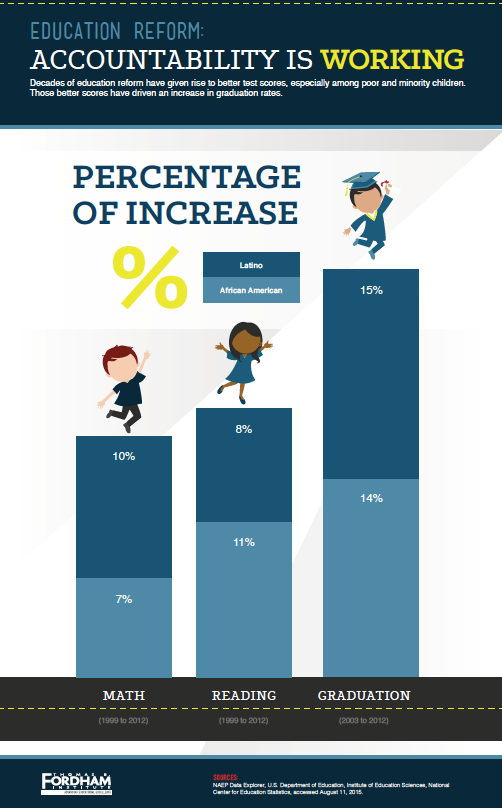
Education reform is working. It's by no means unanimous or uncontroversial, but Americans are generally supportive of the education reform agenda, broadly defined. An Education Next poll released last week shows solid (if softening) support for reform staples like charter schools, testing and accountability, merit pay for teachers, and tax credits to fund scholarships for low-income children. Voters even like higher standards—as long as you don't use the words "Common Core." And while there's no room for complacency, reform is working: Test scores are trending up, particularly in math. Graduation rates are too, especially for low-income kids of color.
Most likely to adopt this in her stump speech: Hillary Clinton. She has vocally supported charter schools since her husband's presidency. Democrats at the national level—including her former boss, President Obama—have largely supported the reform agenda for decades. By the time the general election rolls around, Clinton will want to remind centrist voters of her reform bona fides.
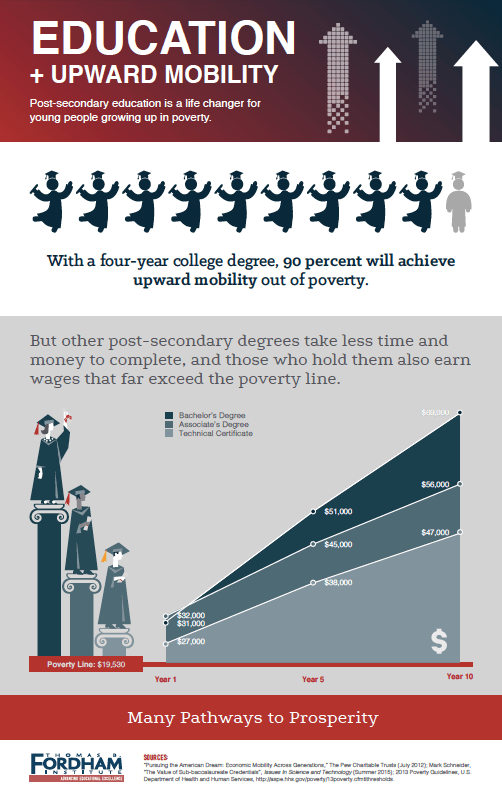
College isn't the only ticket to upward mobility. One of the great overreaches of the reform era is the "college-for-all" mantra that so many have preached for years. In the documentary Waiting for Superman, journalist Jonathan Alter memorably observed, "If you don't go to college, you're kinda screwed in America. And America's kinda screwed." This take is, well, screwy. Yes, there's a substantial wage premium associated with earning a college degree. But if the goal is upward mobility—and it should be—college is not the only route to the middle class. Many forms of postsecondary training and education are closely associated with higher wages, not just four-year college degrees.
Most likely to adopt this in his stump speech: John Kasich. The Ohio governor can brag about beefing up career and technical education during his tenure, including initiating such options in middle schools and allowing students to gain industry credentials while still in high school.
School choice is growing—and changing lives. Charter schools now educate nearly three million American children, with hundreds of thousands more on waiting lists. The Education Next poll shows support for charter schools slipping from a high of 54 percent last year to 51 percent now, but that's still nearly double the number of those who oppose them (27 percent). The reform rhetoric of rescuing low-income kids stuck in failing schools has clearly made an impact. Wonks debate whether choice "works" to spur improved outcomes, but parents seem to value choice as an end in itself.
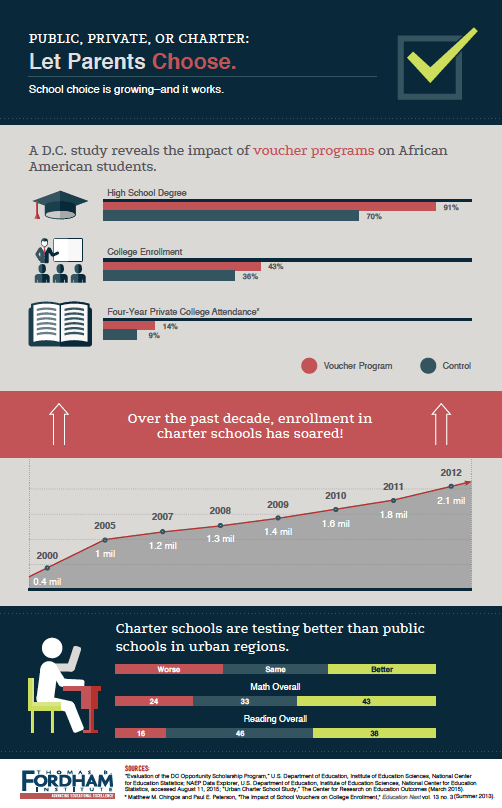
Most likely to adopt this in his stump speech: Jeb Bush. He already claims to have created the country's most ambitious school choice programs as Florida's governor. "This is America," he said of school choice at Wednesday's education summit. "Why wouldn't we think we could apply the same commonsense principles in everyday life and apply it to education?"
America's best and brightest need attention, too. When I taught fifth grade at low-performing public school in the South Bronx, I lamented one day to an assistant principal that the kids in my class who were at or above grade level were getting none of my attention. "Those kids aren't your problem," she replied tartly. The lesson stuck, and it stung: Most of our efforts in education today are aimed at getting stragglers to the starting line. Those already there are too often starved for attention. In a recent Wall Street Journal op-ed, my colleagues Chester Finn and Brandon Wright put it well: "If we cannot bring ourselves to push smart kids as far as they can go, we will watch and eventually weep as other countries surpass us in producing tomorrow's inventors, entrepreneurs, artists, and scientists."
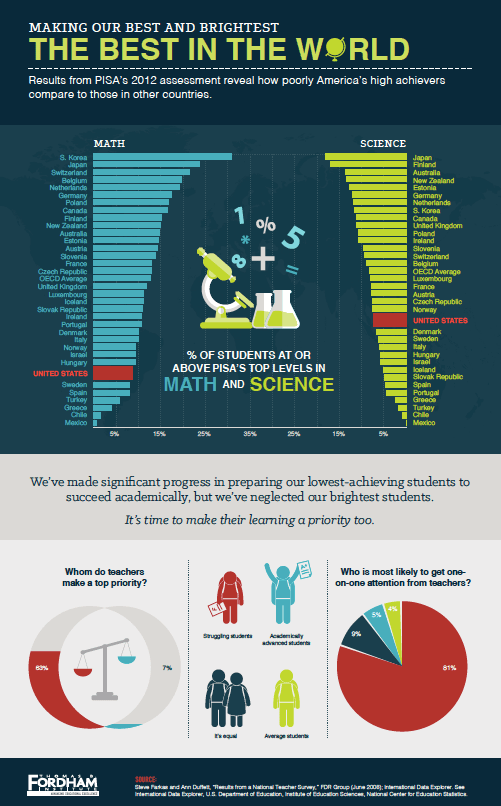
Most likely to adopt this in his stump speech: Ben Carson. If a poor kid who grew up to become a brain surgeon can't get America excited about gifted education, who can?
School discipline is under attack. Ask a teacher, "What's the biggest factor holding back student achievement in your school?" Don't be surprised if many, and perhaps even most, cite disruptive student behavior. Unfortunately, black students are three times more likely than white students to be suspended from school. That's led the Department of Education's Office of Civil Rights to demand racial parity in rates of punishment. The numbers don't lie, but this is a devilishly hard issue to manage successfully from thirty-five thousand feet. Schools need to be deeply reflective about discipline. But it's hard to imagine much good coming from schools becoming afraid to maintain basic order for fear of running afoul of the feds. Moreover, the Education Next poll asked the public about "disparate impact" in discipline too. Teachers hate it.
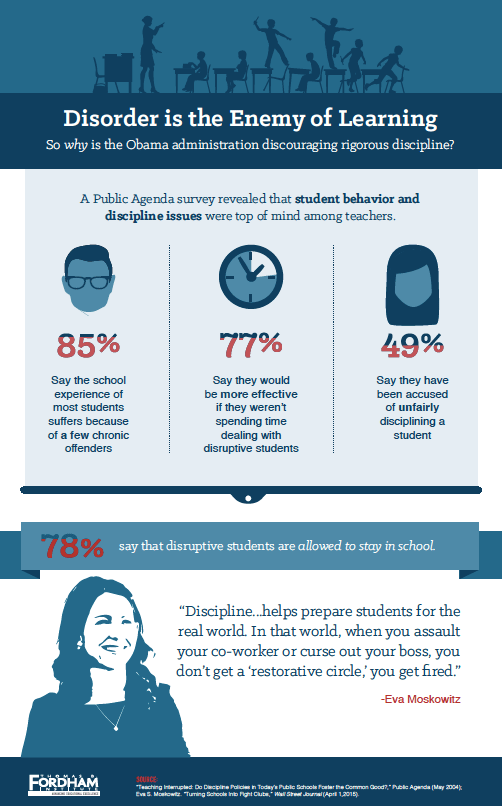
Most likely to adopt this in his stump speech: Scott Walker. The Wisconsin governor has tried to explain away his flip-flopping on Common Core as protecting local control of schools. Arguing that Common Core is federal overreach is a thin reed. This is a flaming arrow.
Bring back civic education. It's a pretty safe bet that Horace Mann, the father of public education, went to his grave never once having uttered the phrase "college- and career-ready." We've become used to thinking of education as almost entirely a private good. But there's an essential public dimension to education that has largely gone missing in the education reform era: preparation for informed participation in our democracy. Along with college and career, it's time to restore a third C as a coequal goal of education: citizenship.
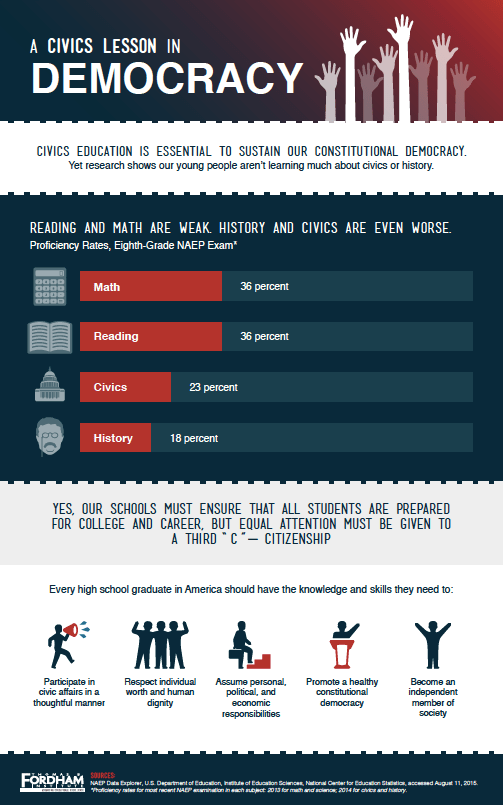
Most likely to adopt this in her stump speech: Carly Fiorina. “We are no longer educating citizens," she said at Wednesday's education summit. "I think it's a good idea if everyone has to take a citizenship test.”
Editor's note: This post originally appeared in a slightly different form at U.S. News & World Report.

The greatest failing of education reformers in the U.S. this past quarter century has been their neglect of governance and structure—widely regarded either as politically impractical to touch or as too boring to get anyone interested. Yet the very structures and governance of our K–12 system often prevent other badly needed changes from taking place, enduring, or succeeding.
Recent months, however, have seen some cracks in the governance glacier with a spate of new books, articles, and conferences on the topic—meaning this set of reform challenges is no longer taboo to discuss or to tackle.
In an earnest effort to advance this crucial conversation, the Thomas B. Fordham Institute—in partnership with the Center for American Progress and the Brookings Institution Press—is pleased to present Education Governance for the Twenty-First Century: Overcoming the Structural Barriers to School Reform, edited by Paul Manna of the College of William and Mary and Patrick McGuinn of Drew University.
This important volume should be on the desk or bedside of every serious education reformer and policymaker in the land.
Featuring chapters by education scholars, analysts, and battle-scarred practitioners, it closely examines our present structures, identifies their failings, and offers some penetrating ideas for how governance might be done differently.
All serious reform victories begin with battles over ideas. In that spirit, we urge you to spend some quality time with this book. Overhauling our dysfunctional education-governance arrangements is a key priority for us at Fordham—and will inevitably loom among the hottest and most consequential issues for all serious reformers in the years to come.
A new study by economists at the Center for Household Financial Stability disseminates research on family savings and debt and finds that the attainment of a college education does not appear to “protect” the wealth of all American families equally.
This is a descriptive study that examines the income and wealth of different families and the stability (or lack thereof) of each. Analysts use survey data from the 2013 edition of the Survey of Consumer Finances.
First, the researchers found that college-educated families—meaning those in which the head of the household has a four-year college degree—earn significantly higher incomes than those headed by someone without a college degree (no surprise there). The median income among all families headed by a college graduate is 2.4 times greater than the median income among families headed by a non-college-graduate.
Second, the median wealth (the value of real estate and other assets) of all families headed by college graduates declined by 24 percent between 2007 and 2013 as a result of the prolonged recession; the decline among families without college degrees was much higher at 48 percent.
Third, higher education appears to protect wealth during rocky economic times, but mostly just among white and Asian families. Specifically, over the long term (from 1992 to 2013) the median net worth of families differed quite a bit by race. The net worth of white families led by college graduates rose about 86 percent over the two decades, while the net worth of college-educated Asians rose 90 percent. Yet the median net worth of black families led by college graduates dropped nearly 56 percent; the comparable figure was 27 percent for Hispanic families.
Fourth, analysts examined the typical debt-to-income (DTI) ratio for families in 2007, right before the Great Recession. The median DTI ratios among college-educated Hispanic and black families were far higher than for Asians or whites. The typical DTI for a college-educated black family was 140 percentage points higher than the typical DTI ratio of a non-college-educated black family. The comparable figure for Hispanics is one hundred points, and for whites fifty-four points.
Finally, the housing boom between 2007 and 2013 went extra poorly for minority families. Declines in the average value of homes among college-educated Hispanics and blacks were 45 and 51 percent respectively; the decline in average home value was 25 percent among college-educated white families.
The researchers posit that wise financial choices play a bigger role than income fluctuations when it comes to wealth. Yet in their estimation, “higher education alone cannot level the playing field.” That’s sobering news for all of us.
SOURCE: William R. Emmons and Bryan J. Noeth, “Why Didn't Higher Education Protect Hispanic and Black Wealth?,” Federal Reserve Bank of St. Louis, Issue 12 (August 2015).
Here’s a line that deserves to be committed to memory by all who would seek to improve literacy outcomes for children. Maybe it should be tattooed onto our flesh:
“One striking fact is that the complex world of education—unlike defense, health care, or industrial production—does not rest on a strong research base. In no other field are personal experience and ideology so frequently relied on to make policy choices.”
That excellent observation, from a 1999 National Research Council paper, is quoted in this report from the Alliance for Excellent Education, The Next Chapter: Supporting Literacy Within ESEA. Author Mariana Haynes laments that literacy instruction in our schools “is not grounded in the science of reading development and learning.” Another “striking fact” is that the Alliance’s report itself overlooks a great, glaring chunk of that science itself in making an otherwise unimpeachable case for research-based reading instruction. Writing in the Core Knowledge Blog, Lisa Hansel rightly observed that the report ignores the need for building broad academic knowledge across the curriculum as a means of raising reading achievement. “Like almost all discussions of literacy, the focus is on literacy instruction and reading and writing skills,” Hansel lamented. “If only such skills were sufficient!”
Indeed. The Alliance’s report is essentially an extended call for the adoption of something called the Literacy Education for All, Results for a Nation (LEARN) Act, which encourages the use “research-based strategies” to teach reading and writing. “Under LEARN, schools would develop students’ reading and writing proficiency by providing high-quality classroom literacy instruction as well as a continuum of interventions and support for students with or at risk for reading failure,” Haynes writes. Elements of LEARN are included in the Senate version of the current reauthorization of ESEA, she adds.
The report notes that 60 percent of fourth and eighth graders struggle with reading in some manner, while nearly half of students of color and students from low-income families “enter fifth grade with skills below the basic level on NAEP.” I’ll leave it to others to tell whether LEARN is the right lever to pull to raise literacy rates, especially among low-SES kids. But any report or legislation that purports to promote practice rooted in science—not preference or ideology—is duty-bound to note the strong evidence from cognitive science that correlates broad background knowledge with reading achievement. The Alliance’s report does no favors by eliding the need for a curriculum rich in science, history, and the arts (not as a nice bonus, but a foundational component) to build language proficiency, or merely assuming it’s a given. The report’s focus on the “skill” of literacy misses the mark. Broadly speaking, reading comprehension is not a skill you teach, it’s a condition you create.
SOURCE: Mariana Haynes, “The Next Chapter: Supporting Literacy Within ESEA,” Alliance for Excellent Education (August 2015).
In most states, only math and reading teachers in grades 4–8 receive evaluations based on value-added test results. For all other teachers, it’s on to Plan B. To evaluate these teachers, many districts are using alternative measures of student growth, which include vendor assessments (commercial, non-state exams) and student learning objectives (SLOs, or teacher-designed goals for learning). But how are these alternative measures being administered? What are their pros and cons? The research on this issue is terribly thin, but a new study from the Institute of Education Sciences casts an intriguing ray of light. Through in-depth interviews, the researchers elicited information on how eight mid-Atlantic districts (unnamed) are implementing alternative measures.
Here are the study’s four key takeaways: First, educators considered vendor assessments (with results analyzed through a form of value-added modelling) to be a fairer and more rigorous evaluation method than SLOs. Second, both alternative measures yielded greater variation in teacher performance than observational methods alone. Third, implementing SLOs in a consistent and rigorous manner was extremely difficult. In fact, the authors write, “All types of stakeholders expressed concern about the potential for some teachers to ‘game the system’ by setting easily attainable goals.” Fourth, the implementation of these alternative measures took a great amount of time and came at a financial cost. The costs related to time should be of particular concern to states wrestling with worries about over-testing.
So do the benefits outweigh the disadvantages? The authors don’t render judgment, but they raise enough concerns to make this reader think that alternative measures (especially SLOs) may not be worth all the effort.
SOURCE: Moira McCullough et al., Alternative Student Growth Measures for Teacher Evaluation: Implementation Experiences of Early-Adopting Districts (Washington, D.C.: Institute of Education Science, July 2015).