

Presidential contenders: Steal this education speech!
Six big education themes for the 2016 campaign. Michael J. Petrilli
Six big education themes for the 2016 campaign. Michael J. Petrilli

Though it might be hard to believe, the first primary of the 2016 election season is still six months away. But the “ideas primary” is in full swing. Here’s what we hope to hear from candidates on both sides of the aisle. (Note to campaigns: These ideas and the related infographics are all open-source. Please steal them!)
Thank you for the opportunity to speak about the number-one domestic issue facing our country today: How to improve our schools so that every child has an opportunity to use their God-given talents to the max, contribute to society, and live the American Dream.
In a few minutes, I’m going to talk about what’s wrong with our education system. That’s appropriate, because bad schools continue to steal opportunities away from too many of our young people.
But before we get to that, how about some good news for a change? American schools, on the whole, are getting better. A lot better. Test scores are up—especially in math, and especially for our lowest-performing, low-income, and minority children. Graduation rates are at all-time highs. The college completion rate is inching upward. Things are heading in the right direction.

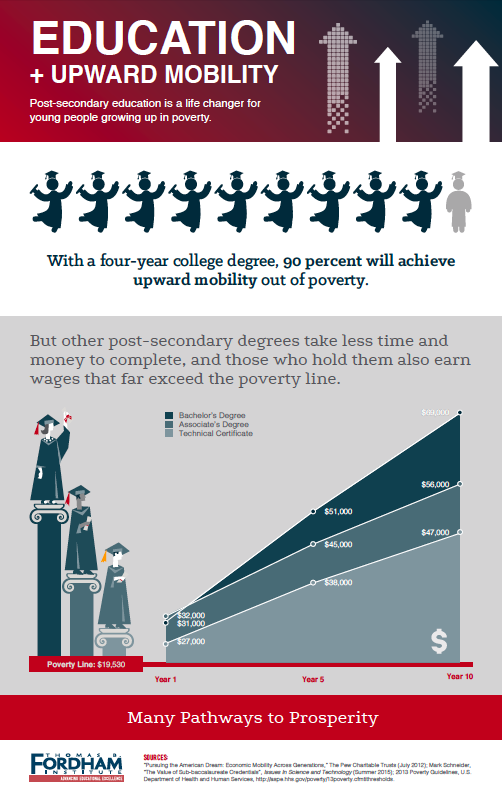
Why are things getting better? Because of two decades of education reform. Greater parental choice. An explosion of charter schools. More accountability for results. Higher standards. Better teaching.
To be clear, we have a long, long way to go. Progress has not been nearly fast or widespread enough.
But let’s acknowledge that progress is possible. The naysayers don’t think we can set things right, and they justify mediocrity by saying our schools are doing the best they can under the circumstances. We know better. We know we can do better. And our teachers and leaders deserve credit for the hard work that’s gotten us this far.
***
So we’ve made progress. But that has meant making changes and those changes haven’t always been popular. Real change never is. But more progress will mean more changes ahead. This is especially true when it comes to the education of our most disadvantaged children: those growing up in poverty, in single-parent homes, and in dangerous neighborhoods.
There’s been a lot of talk about whether the American Dream is still alive, and whether kids who grow up poor today still have a shot at making it. Many of us have our own American Dream story, of parents or grandparents or aunts or uncles who grew up poor, but worked hard in school and used a sound education to climb the ladder of opportunity.
Is that still possible today? Absolutely. But it’s tough. Good jobs now require high-level skills. And that almost always means some sort of education or training beyond high school.
Four-year college degrees are still best. For kids growing up in poverty, graduating from college is practically a guarantee that they will be free from it, and that their kids won’t know the hardship they did. Ninety percent of poor kids who graduate with a four-year college degree make it out of poverty.
That’s the good news. The bad news is that only about one poor kid in ten is making it to that degree. That’s not nearly enough. That’s why we can’t listen to the naysayers who want to stop making changes. We have to keep going, faster and smarter. We have to continue to raise expectations for our elementary and high schools so that many more kids are ready for college. And we have to continue to expand parental choice and grow the number of high-quality charter schools—the kind getting twice, three times, four times, five times the number of low-income students to and through college.
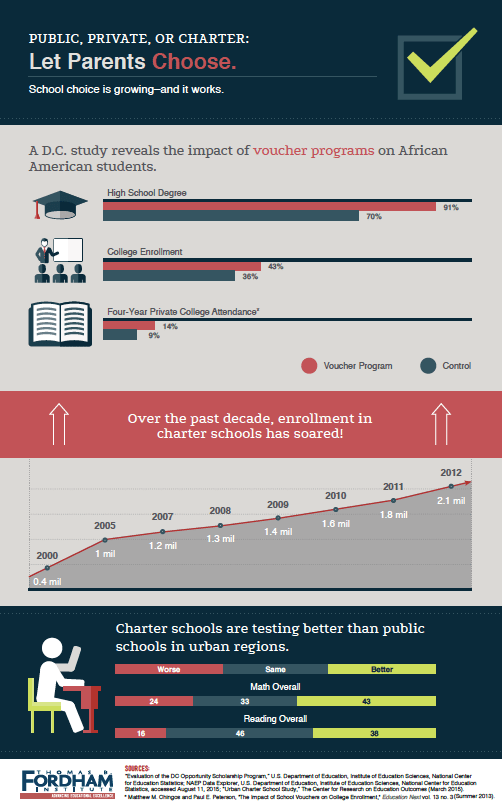
We also have to broaden our focus beyond the four-year college degree. Two-year technical degrees, and even one-year credentials, can also propel poor children into the middle class, especially if they choose the right field.
But expanding those options will also require changes, because too many places have given up on vocational education. High-quality career and technical education needs to be a viable option for many more kids, beginning in high school. It shouldn’t be forced on anyone, but it has to exist as an option for those who want it. Put teenagers on a path to meaningful credentials. Give them experience in a real workplace. Offer them apprenticeships. Find them great mentors and role models. Show them what it means to work.
So we must do more, a lot more, for our poorest and lowest-performing children. But they aren’t the only ones whose needs aren’t being met, and they shouldn’t be the only ones whose needs count.
All over this country, talented students don’t reach their potential because when they get to school, we tell them that they aren’t a priority. They can pass the standardized tests with their eyes closed, so we tell high-ability kids that their job is to sit still and stay quiet while the teacher focuses on low-achievers.
How is that fair? Everyone deserves to come to school and learn something new every day. Everyone deserves the chance to go as far and as fast as their ability allows. And yet our school system too often puts barriers in front of high-achievers. Rather than opening up programs and opportunities for gifted students, our schools shut them down.
This is most damaging for the life prospects of high-ability kids from poor families, who have perhaps the best shot at using a strong education to make it to the middle class. Yet in their schools especially we’ve eliminated the gifted programs, closing off their chance to excel. We’ve said to our young strivers, “You’re on your own.” That’s not right.

Something similar is going on when it comes to school discipline. Thankfully, our schools are safer and more orderly than ever. But that wasn’t always so. I can remember a time, not long ago, when many of our schools were wracked by constant fighting, disrespect for teachers, and general unruliness. But over the course of many years, most American schools reestablished discipline standards and found more effective ways of establishing positive school cultures. And students responded.
But now some want to walk away from all of that. They want to tie schools’ hands and make it harder to discipline disruptive students. They are worried that we are suspending and expelling too many kids. Some schools surely are, and that should be fixed. But just as “active policing” has made our cities dramatically safer, more vigorous discipline policies have done the same for our schools. Those gains are too valuable to walk away from. And the federal government should stop trying to make us forfeit them.

If our schools become less safe and less orderly, who will suffer? That’s easy: the vast majority of students who are behaving, working hard, and doing their best to learn. Especially the good kids in the toughest schools.
Let me finish with one last thought. I’ve saved the best for last.
We are here today participating in a wonderful American democratic tradition: running for president, meeting the voters, and debating the issues. And if there’s one thing our schools must accomplish, it’s to make sure that all of our young people are ready to participate fully in our democratic life. And yet that civic mission of the schools is often an afterthought. We are so focused on preparing students for college or career that we forget the third C: citizenship.
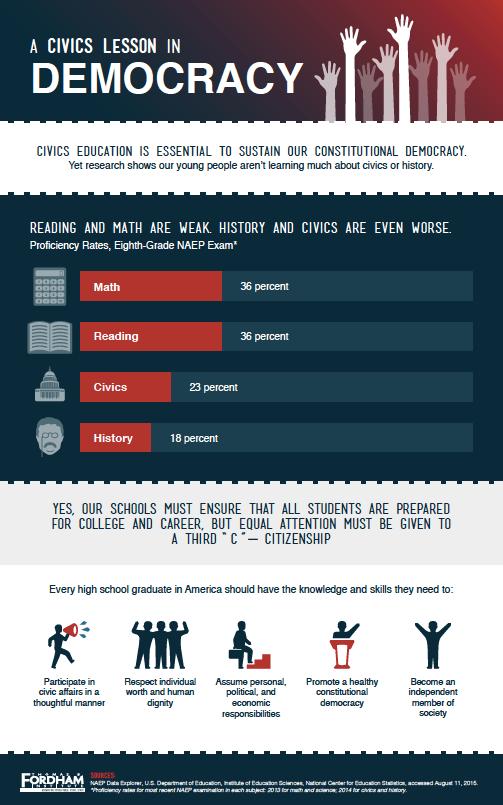
I promise you, I won’t forget. I will shine a light on those schools that are inspiring their students to learn and practice the habits of citizenship.
***
So let me recap. When it comes to education reform, we’re making progress. But we need to go faster. Nothing is more central to the cause of reviving the American Dream. And we need to go broader. Raising student achievement, boosting high school graduation and college completion rates, re-envisioning vocational education to equip our kids for twenty-first-century jobs—all of that matters immensely. But so does nurturing the talent of our most gifted students, ensuring an orderly place for all children to learn, and achieving the civic mission of our schools.
Let’s get to it. Let’s keep at it. Let’s not stop until this important work is done.

kathon_lanang/iStock/Thinkstock
The poll results that Education Next released yesterday carry mildly glum news for just about every education reformer in the land, as public support has diminished at least a bit for most initiatives on their agendas: merit pay, charter schools, vouchers, and tax credits, Common Core, and even ending teacher tenure. That dimming enthusiasm for change is apt to dominate coverage of the survey findings and the debates that follow.
Yet two other big-picture tendencies are also visible in these data, and it strikes me that they matter more over the long run than any one year’s blips around particular reform ideas.
First, when it comes to fundamental principles and practices regarding K–12 education, the American public is generally pretty sensible and steadfast. More on this below.
Second, when it comes to important basic facts regarding that very same K–12 education system, the American public is stunningly ignorant. This is especially true on the fiscal side. Poll respondents underestimated by half how much money is spent per pupil in their local schools. They’re off the mark regarding where the money comes from—estimating the federal portion to be far larger (and the state and local shares far smaller) than reality. They underestimate current (average) teacher pay by some $15,000. (Teachers participating in the survey were unsurprisingly closer to the truth on that question, although not on the others.) And people are all but clueless as to whether their district is or isn’t implementing the Common Core standards.
The public is also famously and enduringly off the mark regarding the academic performance of their local schools, still sipping the warm waters of Lake Wobegon and giving honors grades to “the public schools in your community,” even while conferring far lower marks on “the public schools in the nation as a whole.”
People’s sense of complacency about current school quality is, of course, a major source of their discomfort with radical changes in familiar school practices. (If it ain’t broke, etc.) Yet all the news about flat NAEP results and bleak PISA and TIMSS scores, to say nothing of the hand wringing over international competitiveness and waning social mobility, don’t seem to have penetrated very far into the public’s continued faith in their local schools. While they may not deserve As, Americans have long reasoned, they surely earn Bs or Cs; maybe they’re not great, but they’re not badly broken either.
About that large reality, I believe people are simply wrong. Yet they’re right about a good many other fundamentals. They support annual testing (even when federally required) and results-based accountability for schools. They’re mostly OK with multi-state standards for reading and math (although less so when the “Common Core” label is affixed.) They oppose “opting out” of tests. Overall, they remain bullish on charters, negative on teacher tenure, opposed to “agency fees” (whereby teachers are forced to pay the union to negotiate even if they decline to join the union themselves), and hostile to federal requirements that restrict schools’ ability to suspend disruptive students.
Another positive: People seem willing to alter their views when presented with relevant information. Otherwise-broad support for higher school spending, for example, narrows considerably when respondents are presented with accurate current spending levels.
This year’s survey also probed people’s views on curriculum, particularly focusing on what subjects should be “emphasized” in their local schools. The bottom line, as phrased by Education Next’s Paul Peterson, Martin West, and Michael Henderson, is that “everyone wants more emphasis on just about everything in school, except athletics, though the general public is especially eager for more emphasis on reading and math, while teachers see greater needs in history and the arts.”
That public hunger for reading and math brings me back to Common Core. Yes, those two words may constitute a tainted brand. Yet for all the yammering of politicians about federal meddling and overreach in the realm of academic standards, nearly as many Americans (41 percent) would have the federal government take the lead in “setting educational standards for what students should know” as would assign that role to the states (43 percent). It’s important to note that there’s far less support for Uncle Sam identifying failing schools or deciding what should be done with them. On this, the NCLB reauthorization lurching through Congress seems reasonably aligned with public opinion.
My own sense is that while Common Core—the brand—may continue to loom large in the GOP presidential primaries, it’s now more about politics and posturing than strong public feelings. Politicians aside, the Common Core debate has probably stabilized. Few states have actually bailed out. More of the public supports the standards than opposes them. Teachers are split, but probably more because of accountability anxieties than opposition to rigorous academic standards for kids.
The question going forward shouldn’t be, “What do you think of the standards?” It should be, “Has it all been worth it?” With new assessments finally in place almost everywhere (and the first results from them due in the very near future), we’re fast getting beyond the “Should we?” stage; soon, we’ll leave behind the painful early implementation of something ambitious and unfamiliar and transition fully into the real work of improving teaching and learning. "Early-adopter" states like Kentucky offer the hope that we’ll see progress in the years ahead. That progress might someday, just possibly, wean us off the Wobegon water, replacing it with the refreshing discovery that our local schools truly deserve an honors grade.

So-called “turnaround school districts,” inspired by Louisiana’s Recovery School District and its near-clone in Tennessee, have been gathering steam, with policymakers calling for them in Georgia, Pennsylvania, and other states scattered from coast to coast. But just how promising are these state-run districts as a strategy to bring about governance reform and school renewal? What lessons can we take away from those districts with the most experience? Can their most effective features be replicated in other states? Should they be? What are ideal conditions for success? And why has Michigan’s version of this reform struggled so?
This study examines the effect of market fluctuations on teacher quality. Using reading and math scores of students who took the Florida Comprehensive Assessment Test between the 2000–2001 and 2008–2009 school years, the authors construct valued-added scores for thirty-three thousand Florida teachers, then test to see if a number of business cycle indicators (such as unemployment and GDP) predict these scores.
Based on these data, they estimate that teachers who enter the profession during a recession are more effective at teaching math and English language arts than non-recession teachers (by 0.10 and 0.05 standard deviations, respectively). They arrive at slightly larger estimates for male and minority teachers and those entering the profession later in life.
According to the authors, increases in the supply of effective teachers, rather than decreases in demand or differences in attrition, account for the superior quality of teachers hired during recessions. Presumably, these increases are driven by a decline in the quality of alternative employment opportunities for these individuals, some or all of which reflects a decline in their expected earnings relative to those of teachers.
Following this line of reasoning, the study bears two implications: First, recessions are a great time for the government or others to hire effective teachers. Second, regardless of the business cycle, we might be able to attract better teachers to the profession if we made teaching more attractive relative to the alternatives by paying new teachers more—although this doesn’t mean that simply increasing the wages of the existing teacher workforce would lead to better performance.
SOURCE: Markus Nagler, Marc Piopiunik, and Martin R. West, “Weak Markets, Strong Teachers: Recession at Career Start and Teacher Effectiveness,” National Bureau of Economic Research, Working Paper 21393 (July 2015).
The New Teacher Project’s recent study indicating that billions of dollars are largely wasted on ineffective professional development has raised a question central to all of our reform efforts: How do we make teachers better?
This new brief from the RAND Corporation, representing the preliminary observations of their ongoing assessment of the Leading Educators Fellowship program, attacks that question from the angle of mentoring and teacher leadership. Leading Educators is a national nonprofit that selects and develops exceptional mid-career teachers, training them to act as guides for their less experienced peers and spearhead improvement efforts in their schools. Its specific aims are to inculcate leadership skills among participants in the two-year fellowship, boost the achievement of students taught by both fellows and their mentees, and increase teacher retention in high-need schools. The organization’s own characterization of the study asserts that the program has now graduated over three hundred fellows. That cohort has mentored approximately 2,500 teachers, affecting by extension some sixty-nine thousand students in New Orleans, Memphis, Kansas City, and Washington, D.C.
The report compared program participants (both fellows and mentee teachers) to people who had applied and been rejected, as well as other teachers deemed similar by dint of personal characteristics and instructional effectiveness from the year prior. Following three years of study in Louisiana and Missouri, RAND described the fellowship’s early results as “promising but mixed” in the realm of student achievement. For the fellows themselves, the only consistently measured impact was a bump in effectiveness for Louisiana math teachers—and even this discovery is inherently limited by its tiny sample size. Mentee teachers provided a more robust data set, as well as the most positive news: Math and social studies teachers in the Pelican State both raised student performance, though their colleagues in science and reading produced no such improvement. This sunny finding remains provisional, however, and the report notes that “while our results indicate that it is possible that mentees in Louisiana are benefiting from their exposure to the program, additional evidence is needed to confirm this pattern.”
The verdict is still out on teacher retention, however. The authors concede that they “failed to identify any consistent positive or negative effect of the program on participating mentee teachers.” Overall, these early findings provide only modest inklings of what the fellowship might accomplish, and given the vast numbers of students and teachers involved, RAND is correct in cautioning its readers against interpreting too much in the early goings. Mentoring holds great potential for fortifying the academic cultures of individual schools and establishing pipelines for leadership, but it remains one weapon in the battle to improve teacher quality.
SOURCE: Kata Mihaly, Benjamin Master, and Cate Yoon, “Examining the Early Impacts of the Leading Educators Fellowship on Student Achievement and Teacher Retention,” RAND Corporation (2015).
Hiring a teacher should be like buying a house. But according to a new report from Bellwether Education Partners, California treats the process like it’s purchasing a widget. And this is the wrong mindset when the state is experiencing a shortage in teachers—especially those trained to educate its diverse population of six million children.
The problem, it turns out, isn’t money. Thanks to a new funding formula, California schools will receive $3,000 more per student in the 2015–16 school year than in 2011–12, a 45 percent increase. Instead, the state lacks viable candidates and high-quality training programs. During the 2013–14 school year, for example, the state needed to hire twenty-one thousand teachers, yet it only awarded credentials to 14,810—a decrease of one-third from five years ago.
So where are all the teachers? Pursuing other professions now that the labor market has finally improved, the report surmises. Moreover, millennials aren’t hustling into teaching programs because they don’t rate the profession as prestigious or ambitious as other options, says Bellwether.
Teacher preparedness is equally problematic. California suffered a similar shortage in the 1990s and started hiring teachers with no experience by using emergency permits. Some worry that the state is headed in the same direction now. Yet even with today’s higher standards, only half of district employers report being satisfied or very satisfied with the preparedness of new teachers, suggesting that students are missing out on good instruction. The best teacher preparation programs have the same positive effect on outcomes as reducing a class’s size by 5–10 students. And that’s why it’s time for California to invest in teachers as though they are houses, not disposable widgets.
To recruit and train excellent teachers, the report recommends that three entities take responsibility: teacher training schools, districts, and state government.
“Teacher preparation programs must come down from the ivory tower and engage with the realities and needs of the districts in which their graduates work,” authors argue. This requires consistent discussion with local school districts about their needs. It also requires increasing selectivity and rigor while still maintaining flexibility to meet candidates’ needs, especially minorities from low-income groups. This is important if schools want their teachers to represent the demographics of their students. For example, the report says that Latino or Hispanic backgrounds make up more than half of California’s student population, but less than 20 percent of its teachers.
“Districts must take increasing responsibility for recruiting and developing their own future teachers, rather than leave it up to teacher preparation programs to provide the teachers they need,” the authors write. Teacher preparation doesn’t end when an undergrad receives a diploma; it should continue with professional development within schools. A teacher who stays with the district between twenty and thirty years is a $2 million investment.
Finally, the report encourages state policymakers to support diverse preparation pathways, leverage funds to support preparation programs, and continue to advertise a need for good teachers.
California needs hallways of learning, not replaceable instruments of instruction.
SOURCE: Sara Mead, Chad Aldeman, Carolyn Chuong, and Julie Obbard, “Rethinking Teacher Preparation,” Bellwether Education Partners (July 2015).