

Why has education policy produced such little improvement?
A former secretary of education on the gap between policy and practice. Rod Paige
A former secretary of education on the gap between policy and practice. Rod Paige


Editor's note: This editorial originally appeared in a slightly different form in the Austin American-Statesman.
At noon on Tuesday, January 13, the Texas Legislature convened its eighty-fourth legislative session. Like many previous legislative sessions, many hours of discussions will be devoted to improving Texas education. Like many previous legislative sessions, legislators will no doubt enact new state education policies aimed at improving Texas schools.
Despite massive new education policies from previous legislative sessions, and after decades of effort, tons of money, and volumes of educational punditry and political debate, we are left with relatively little to show for considerable effort. As we go forward with future education policies, it seems wise to pause and ask an important question. Why has so much previous education policy delivered such meager improvement?
Indisputably, that question has multiple answers. But one of the most critical answers is too often overlooked: Previous state education policy has been minimally integrated with education practice. Put another way, there has been, and there still is, a cavernous gap between education policy and education practice. In order for education policy to be an effective catalyst for improved school outcomes, it must influence education practice—and education practice is under the direct control of education practitioners. These practitioners have meager influence on education policy.
Previous state and federal education policy has ignored a cardinal truth: When schools improve, that improvement will be primarily due to the actions of people in the schools. Practically speaking, what this means is that teachers, principals, superintendents, and school board members are the major arbiters of school improvement, as they ultimately determine whether education policy has the desired efficacy or not.
Education policy, which consists of the laws, rules, and regulations enacted to govern the operation of our system of education, is primarily formulated in state settings and tends to be heavily influenced by the work of education think tanks, education lobby agencies, education advocacy organizations, and the practical realities of political expediency. Those who actually teach the children, manage the schools, and do the work of school boards are minimally represented in this process. This unfortunate truth creates a dual negative.
First, education policy created in this manner cannot benefit from the perspective of those who know the educational environment best. School reform policies constructed by policy elites, politicians, and others outside the school system are rarely based on sufficient understanding of the school environment and its unique cultural infrastructure to have the intended effect. Absent sufficient practitioner participation, policymakers’ understanding of schools is inevitably based on assumptions, theories, and notions about how education should be, which are seldom representative of real-world experiences in schools. More perilously, as outsiders, policymakers tend not to appreciate the complexity of teaching and learning in today’s schools. For education policy to be successful, it must be anchored in a realistic understanding of the school environment, and this cannot be achieved without authentic involvement and buy-in from those in the schools.
Secondly, and even more grievously, school professionals who are excluded from meaningful participation in the formation of education policy are likely to feel little ownership of the policy’s success. This leaves the policy void of meaningful practitioner advocacy. Further, education policy void of appropriate practitioner involvement fuels practitioners’ sense that the policy is being imposed upon them by those who not only do not fully understand the educational challenges, but also do not face any consequences for the success or failure of the policy. Some practitioners feel that their exclusion from the education policy development process demonstrates a fundamental indifference to the challenges that school personnel face, and even worse, an underlying disrespect for what they do and what they know.
Given the lack of meaningful practitioner participation, it seems unsurprising that educational practitioners greet so many policy changes with lackluster enthusiasm. To them, the issue is compliance, as opposed to improving student performance. The difference between responding to educational policy as a compliance issue vs. responding to it as an opportunity to improve student learning is not at all trivial. The level of advocacy within the school and school system is a major determinant of the quality of the results that will emanate from the reform policy.
This is not to understate or undervalue the importance of the work of policymakers. The vast majority of those involved in developing state and federal policy are not only sound thinkers with good intentions, but also experts in many aspects of the education policy landscape and committed to the task of education improvement. Clearly, their efforts are both needed and appreciated. But for policymakers’ goals to be accomplished, the gap between policymakers and practitioners must be significantly narrowed.
Undoubtedly, there are several ways to accomplish this goal. Two approaches come immediately to mind. Each has advantages and disadvantages. The first, an inclusion approach, involves broadening the participation of practitioners in policy formulation to enhance both the quality and quantity of dialogue between policymakers and practitioners. One might argue that teachers, principals, superintendents, and school board members already have advocacy organizations that participate in formulating educational policy. This is true, but with few exceptions, the influence of such organizations on education policymaking is minimal at best.
The disadvantage of this approach is that some such organizations have agendas that are not always aligned—and are sometimes even at odds—with the goal of authentic school improvement. Therefore, care in selecting participating groups is necessary. In fact, the effectiveness of this approach depends on state policymakers’ ability to involve organizations that are genuinely committed to improving the education system. Assuming sufficient awareness of this concern, increasing opportunities for such organizations to participate in educational policy development is a good thing.
The second approach is the empowerment approach highlighted by Richard Elmore and Milbrey W. McLaughlin in their seminal work, Steady Work: Policy, Practice, and the Reform of American Education. This approach involves shifting much of the responsibility for designing policy closer to those whose practice it concerns. Such policy would focus heavily on desired outcomes and on empowering practitioners with flexibility and variability in determining the inputs needed to achieve such outcomes. To be effective, however, this approach requires that there be adequate procedures for monitoring results and assuring accountability.
In summary, the current chasm between education policy and practitioners must be significantly narrowed if educational policy is to drive desired education reform. In the end, education policy is good only to the extent that it is implemented and operated with fidelity and policy implementation and operations are solidly under the control of education practitioners.
Rod Paige was the superintendent of the Houston Independent School District from 1994 to 2001 and the United States Secretary of Education from 2001 to 2005. He has served on the Thomas B. Fordham Institute’s Board of Trustees since 2005.
photo credit: cybrarian77 via Flickr
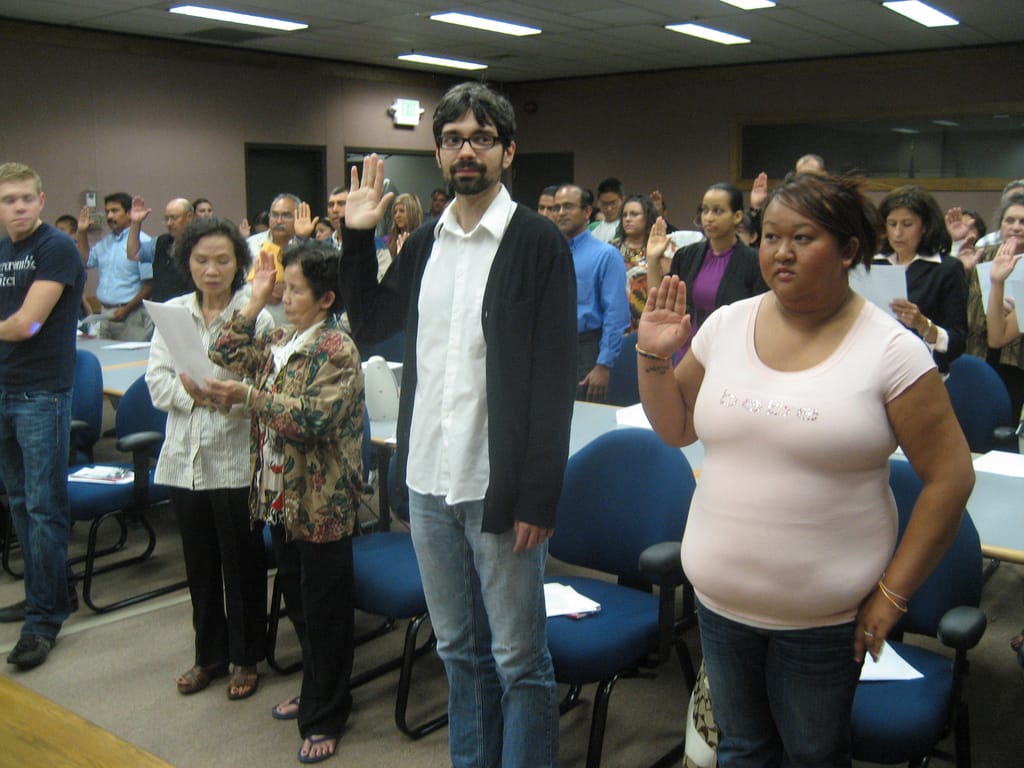
Arizona last week became the first state to make passing the U.S. Citizenship Test a high school graduation requirement. Governor Doug Ducey signed into law a bill mandating the test after the measure passed the state’s Republican-controlled House and Senate in a single day. And that’s really about all the deliberation that should be needed for other states to follow Arizona’s lead. It’s a no-brainer in more ways than one.
Here are some of the questions on the test:
These are among 100 basic questions on American government and history published by the U.S. Immigration and Naturalization service. It’s not particularly challenging stuff. Those seeking citizenship are asked up to ten of the questions; six correct is a passing score. Arizona students will need to get sixty of the hundred questions correct in order to graduate—the same ratio as immigrants to our country seeking citizenship.
It’s curious to note that the federal government—by law and tradition, and quite correctly—makes no curricular demands on its schools or knowledge demands on its native-born sons and daughters. But if you’re born elsewhere and wish to be naturalized, we do insist on a minimal baseline of factual knowledge before we confer upon you the title of citizen.
Here’s how hard the test is not: In 2010, the pass rate among those seeking naturalization was 97.5 percent according to a Xavier University study. Yet more than one in three native-born citizens fail when asked to show even that rock-bottom, basic level of civic knowledge. Raise the bar to seven out of ten for a passing and 50 percent fail. That’s an embarrassment, even humiliating. It’s also incongruous to make knowledge demands, however trivial, of one class of citizens but not another. Arizona, to its credit, is closing this gap.
Serious People in Education cluck at the citizenship test. It’s just trivial pursuit, they say. It’s no substitute for deep engagement in civics and citizenship. In an age where parents are rightly concerned about overtesting, do we really need yet another test to stress kids out? Perhaps not, but this one’s about as rigorous as the written test you took to get your learner’s permit at the Department of Motor Vehicles. If you graduate from a U.S. high school without being able to name one of your senators, any war fought in the 1900s, or the name of a single American Indian tribe, something has gone seriously wrong. Let’s not pretend otherwise.
To be sure, some questions on the citizenship test are trivia. No one should confuse the ability to cite obscure facts like the three authors of Federalist Papers or the precise number of amendments to the U.S. Constitution with a rigorous education in civics and history. But there is power in signaling an expectation, however modest, that there is a knowledge base common to all Americans and a baseline threshold below which no one should slip. It’s simply not a Herculean undertaking to familiarize yourself with a handful of elementary-school-level facts about the country whose schools have handed you a high school diploma.
Indeed a few years ago, a New Zealand-born elementary school teacher at a TeamCFA charter school in North Carolina was herself studying to take the citizenship test. She figured out that the answers to most of the hundred questions were in her school’s Core Knowledge curriculum. The solons of Arizona have basically mandated a fourth-grade education.
The simple—even simplistic—nature of the citizenship test isn’t a problem: It’s a benefit. Tired of the audacious “moonshot” goals we set for our schools? Me too. Overpromise and under-deliver enough and cynicism inevitably sets in. American education could sorely use a proof point that we can still get things done. Getting nearly all children to clear the low bar of the citizenship test is a worthy bid.
Our two goals— a deep engagement in public affairs and a minimal factual knowledge of civics and history—are not mutually exclusive. When I’m not at Fordham, I teach a seminar in civics and citizenship to twelfth graders at Democracy Prep, a New York City charter school that consciously (some might say aggressively) tries to inculcate a sense of civic duty and a spirit of activism. On January 30, every one of my students will take a short break from the current unit on examining police procedures and “broken windows” theory to take the citizenship test. It’s been a graduation requirement since the school was founded—and 60 percent isn’t the standard, but 83 percent. I’m not worried about it, and neither are my students. It’s not too hard. And it’s not too much to ask.
Without a doubt, we have bigger fish to fry in American education. Let’s start with the small fry. Kudos to Arizona for insisting all its children meet this barest minimum standard.
photo credit: Neven Mrgan via Flickr


The debate over annual testing has taken center stage as Congress considers reauthorization of the Elementary and Secondary Education Act (ESEA). Assessments provide critical information for parents and legislators on student progress, but when does annual testing become overtesting? And will it survive reauthorization? Watch Fordham's Mike Petrilli and AEI's Mike McShane discuss testing and accountability in the wake of the Senate hearing on the new ESEA.
A standard argument of those who downplay strong results among children in urban charters is that families who are motivated enough to exercise school choice are simply different, and their kids’ success is nearly preordained. This recent paper out of the National Bureau of Economic Research tests this assumption and studies the causal effect of takeover schools on student achievement in New Orleans’s Recovery School District (RSD). Specifically, it looks not at the impact of charter school admissions lotteries on the performance of kids who apply, but rather at the impact on the kids who don’t make a choice to apply—passive participants who are simply grandfathered into the newly constituted school. The sample includes eleven middle schools in the RSD that were slated for closure (called “legacy schools”) and subject to a full charter takeover, meaning they had all grades converted to a new school in a single academic year, typically in the same building. The comparison group is a group of same-grade students enrolled in schools that are not yet closed who, in the prior grade, went to a school that was similar to the one the legacy school students attended. Schools are “similar” if their performance scores are comparable to the legacy schools’. And students are matched based on race, sex, age, poverty, and other demographics. The “pre-takeover trajectories” of both groups of students are quite similar. They find that attending an RSD takeover charter substantially increases math and ELA scores (roughly .21 and .14 standard deviation, respectively, per year enrolled). Takeover effects are larger in seventh and eighth grade and in the first two years of takeover. The study was then replicated for a school in Boston where the authors also had lottery estimates, and the gains for grandfathered students were at least as large as the gains for those who got in via lottery. The analysts sum up the gist of the study quite well: Conventional wisdom says that “urban charter lottery applicants enjoy an usually large and therefore unrepresentative benefit from charter attendance because they’re highly motivated or uniquely primed to benefit from the education these schools offer. [Yet] Boston and RSD takeovers generate gains for their passively enrolled students that are broadly similar to, and sometimes even larger than the lottery estimates reported in [other research].” Very interesting. Charter takeovers of traditional schools are fraught with controversy, mostly among adults; this study says they are beneficial to kids.
SOURCE: Atila Abdulkadiro?lu, Joshua D. Angrist, Peter D. Hull, and Parag A. Pathak, "Charters Without Lotteries: Testing Takeovers in New Orleans and Boston," National Bureau of Economic Research, Working Paper 20792 (December 2014).
The massive 2014 protests in Albany led by the nonprofit Families for Excellent schools seemed, at the time, to strike like a bolt from the blue. Thousands of parents and students abruptly converged on the state capital in objection to New York City Mayor Bill de Blasio’s efforts to curtail charter expansion, drawing sympathetic press coverage and even gaining the support of Governor Andrew Cuomo. But according to the American Enterprise Institute’s prolific Andrew P. Kelly, the rally bore less resemblance to lightning than electricity. His new paper, examining parental engagement in education reform and touching on public demonstrations in New York, Louisiana, and California, reveals some of the ways in which unfocused energy can be harnessed and channeled into effective, disciplined movements. It’s a critical area of study because public schools, their school boards, and their districts are democratic entities responsive to a gamut of competing constituencies. Social agitators from the time of the abolitionists have all had to learn to convert their missionary zeal into a force capable of mobilizing public support, and the relatively young undertaking of education reform will be no different. Vital groups like Stand for Children and Parents United for Public Schools, often led by educated whites for the primary benefit of disadvantaged minorities, are especially vulnerable to being cast as Astroturf outsiders rather than grassroots activists. To combat this easy delegitimization, successful education reform advocacy organizations (ERAOs) enlist natural leaders among communities of parents and emphasize depth of commitment over a shallow breadth of membership rolls. As Kelly demonstrates, the “human touch” of parental networking—door-to-door canvassing, neighborly phone calls, and religious attendance at PTA meetings—is matchless both for enticing committed volunteers and imposing social costs on apathy. It’s good to see reform intellectuals espousing the dearly purchased lessons of community organizing (this must surely be the first AEI publication making favorable reference to the works of Saul Alinsky); it’s also fitting that the paper doesn’t attempt to answer all the tactical questions of how best to effect change with direct action. It can be left to future movement leaders to learn, for instance, whether it is best to work outside of schools or to cultivate the backing of cooperative teachers and officials. For now, let’s just be grateful for the message that education reform can’t be all sparks and no circuitry.
SOURCE: Andrew P. Kelly, “Turning lightning into electricity: Organizing Parents for Education Reform,” American Enterprise Institute (December 2014).
This new study from the Center for American Progress challenges the ubiquitous and frequently repeated statistic that the new-teacher attrition rate is 50 percent. Pulling from three NCES-sponsored surveys—the 2007–2008 and 2011–2012 Schools and Staffing Surveys and the Beginning Teacher Longitudinal Study—the authors instead found that 87 percent of new teachers remained in the profession for at least three years and almost 70 percent stayed for five years or more. Even teachers in high-poverty schools, a subgroup that has traditionally seen higher rates of turnover, were found to have retention rates comparable to their counterparts in low-poverty schools. The uptick in staying power for the teaching profession “may have started before the Great Recession began at the end of 2007 and continued because of it, or it may have started in response to it,” the authors note. Cause for further investigation is large local district-to-district variation, such as in North Carolina, where attrition rates can differ by as much as ten percent. Regardless of the lack of specific identifiers, this trend rectifies the reporting discrepancy between the outdated 50 percent figure and points to a positive trend for retaining highly trained, enthusiastic teachers. Moreover, as TNTP highlights, teachers who spend at least five years in the classroom tend to improve their instructional strategies and are more effective. The authors acknowledge the “narrow focus” of the study; and while we walk away with more questions worthy of investigation, we can, for the time being, revel in the promise of a committed teaching profession.
SOURCE: Robert Hanna & Kaitlin Pennington, “Despite Reports to the Contrary, New Teachers Are Staying in Their Jobs Longer,” Center for American Progress (January 8, 2015).