Mobile Navigation

  • National
    • Policy
      • High Expectations
      • Quality Choices
      • Personalized Pathways
    • Research
    • Commentary
      • Gadfly Newsletter
      • Flypaper Blog
    • Events
    • Scholars Program
  • Ohio
    • Policy
      • Priorities
      • Media & Testimony
    • Research
    • Commentary
      • Ohio Education Gadfly Biweekly
      • Ohio Gadfly Daily
  • Charter Authorizing
    • Application
    • Sponsored Schools
    • Resources
  • About
    • Mission
    • Board
    • Staff
    • Career
Home
Home
Advancing Educational Excellence

Main Navigation

  • National
  • Ohio
  • Charter Authorizing
  • About

National Menu

  • Topics
    • Accountability & Testing
    • Advanced Education
    • Career & Technical Education
    • Charter Schools
    • Curriculum & Instruction
    • ESSA
    • Evidence-Based Learning
    • Facilities
    • Governance
    • Personalized Learning
    • Private School Choice
    • School Finance
    • Standards
    • Teachers & School Leaders
    • Think Again
  • Research
  • Commentary
    • Gadfly Newsletter
    • Flypaper Blog
    • Gadfly Podcast
  • Events
  • Scholars Program

The Education Gadfly Weekly

Sign Up to Receive Fordham Updates

We'll send you quality research, commentary, analysis, and news on the education issues you care about.
Thank you for signing up!
Please check your email to confirm the subscription.

The Education Gadfly Weekly, Volume 14, Number 36: Restarting the Common Core debate

Volume 14, Number 36
9.3.2014
9.3.2014

The Education Gadfly Weekly, Volume 14, Number 36: Restarting the Common Core debate

Volume 14, Number 36
view
High Expectations

Restarting the Common Core debate

Over the past couple of years, a raucous debate has emerged over the Common Core, content standards in English and mathematics adopted by states nationwide. The debate has been marked by acrimony rather than analysis, but there is hope that both sides want a reset.

Michael J. Petrilli 9.3.2014
NationalBlog

Restarting the Common Core debate

Michael J. Petrilli
9.3.2014
Blog

The states versus Secretary Duncan

Brandon L. Wright
9.3.2014
Flypaper

Strings attached to NYC preschool dollars

The Education Gadfly
9.3.2014
Blog

Peace, love, and lawsuits

9.3.2014
Resource

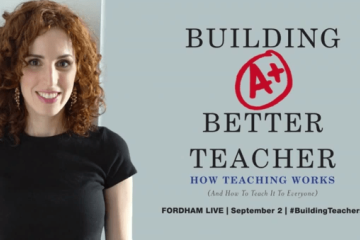
VIDEO: Building a Better Teacher: How Teaching Works (and How to Teach It to Everyone)

9.3.2014
Video

What Effective Schools Do

Robert Pondiscio
9.3.2014
Blog

Peer Effects in Early Childhood Education and Peer Effects in Urban Schools

Aaron Churchill
9.3.2014
Blog

The Condition of College & Career Readiness

Jessica Poiner
9.3.2014
Blog
view

The states versus Secretary Duncan

Brandon L. Wright 9.3.2014
Flypaper
view

Strings attached to NYC preschool dollars

The Education Gadfly 9.3.2014
Blog

Peace, love, and lawsuits

Michael J. Petrilli, Amber M. Northern, Ph.D. 9.3.2014
Resource
view

VIDEO: Building a Better Teacher: How Teaching Works (and How to Teach It to Everyone)

9.3.2014
Video
view

What Effective Schools Do

Robert Pondiscio 9.3.2014
Blog
view

Peer Effects in Early Childhood Education and Peer Effects in Urban Schools

Aaron Churchill 9.3.2014
Blog
view

The Condition of College & Career Readiness

Jessica Poiner 9.3.2014
Blog
view

Restarting the Common Core debate

Michael J. Petrilli
9.3.2014
Blog

photo credit: Flazingo.com

Over the past couple of years, a raucous debate has emerged over the Common Core, content standards in English and mathematics adopted by states nationwide. The debate has been marked by acrimony rather than analysis, but there is hope that both sides want a reset. We—one Core advocate, one opponent—want to assist by laying out the facts on which we think everyone should agree.

What are some signs of detente? Core architect David Coleman recently decried characterizations of Core opponents “as crazies or people who don’t tell the truth,” while strategists at firebrand Glenn Beck’s “We Will Not Conform” event called for ditching invective like “ObamaCore” or “communist plot.”

Now, the facts.

First, there is no evidence that most Core opponents or advocates are ill-intentioned. There’s no compelling reason to believe, for instance, that Bill Gates is funding Core advocacy for any reason other than that he thinks it is beneficial, or that opponents are motivated by anything other than concern that the standards are inadequate, or amount to dangerous national standardization.

Next, the Core was not created by Washington, but groups that saw crummy state standards and tests and agreed on the need to improve their quality. In particular, these organizations wanted to ensure that “proficient” meant the same thing in Mississippi as Massachusetts, and sought to reduce the huge proportion of people arriving at college or workplaces without the skills to succeed. Responding to this, the National Governors Association and Council of Chief State School Officers started discussing whether common, higher standards could be forged in the basic subjects of reading and math. With support from the Gates Foundation, they launched the effort that eventually became the Core. All this occurred, importantly, before Barack Obama was elected president.

However, federal involvement played an important role in the Core. Federal policy, beginning in 1994, pushed states to develop standards and tests in the first place, and No Child Left Behind, enacted in 2002, doubled down on these mandates, requiring states to disaggregate test results for numerous groups and sanction low-performing schools.

More directly, in 2010, the Obama administration held the first “Race to the Top” competition. To maximize their chances of winning part of $4 billion, states had to sign on to college- and career-ready standards adopted by “a majority of states,” a definition met only by the Core. The administration also supplied $350 million to develop Core-aligned tests.

Two years later, the administration announced that states could get waivers from key parts of No Child Left Behind. To qualify, they had to either adopt the Core, or have their standards certified as “college- and career-ready” by a state college system.

Core adoption was technically voluntary: States could refuse to seek Race to the Top money or waivers, and a few did. The allure of hundreds of millions of dollars and No Child Left Behind relief, though, were certainly powerful. Some Core advocates wanted federal incentives. The National Governors Association and the Council of Chief State School Officers called for them in their 2008 report “Benchmarking for Success,” and some supporters reportedly worked with the administration in formulating Race to the Top.

Another major concern is whether the Core prescribes, or is agnostic about, curriculum.

Any set standard puts a box around curriculum, and the crafters of the Core explicitly called for a number of “instructional shifts” in the classroom. In addition, what is on Core-aligned tests may, de facto, fill in some curriculum. This, though, is different from saying only one curriculum will do. Much of the frustration experienced by educators and parents appears to stem from poorly designed textbooks, not the standards themselves. With very limited exceptions, the Core does not prescribe specific readings.

What about data collection, teacher evaluation and other issues often thought synonymous with the Core? These are connected through Race to the Top and No Child Left Behind waivers, but the Core itself is just standards.

These are the facts. Hopefully, all can agree on them and focus on the issues with which we really need to grapple: Is there good reason to think common, rigorous state standards will improve outcomes? Does the Common Core fit that bill? What roles should Washington, states, districts and parents have in deciding what standards guide classroom instruction? We have different answers to these questions, but agree on at least one thing: We must stop fighting over basic facts, and respectfully tackle these crucial questions.


This article first ran in the Washington Times on Tuesday, September 2, 2014.

view

The states versus Secretary Duncan

Brandon L. Wright
9.3.2014
Flypaper

Last week, Louisiana Governor Bobby Jindal sued the U.S. Department of Education over the Common Core State Standards (CCSS), with a particular focus on the role that Race to the Top (RTTT) played in encouraging their adoption. And three days later, rumors arose that Oklahoma Governor Mary Fallin might haul that same agency into court for revoking its No Child Left Behind (NCLB) waiver. Together these two suits bring some of the most criticized recent federal education policies under legal scrutiny. But President Obama’s conditional waivers are much more vulnerable to legal challenge than is his Race to the Top initiative. Here’s why:

Jindal’s lawsuit claims that the federal government has used legislation to incentivize state adoption of the CCSS. The complaint asks the court to (1) declare that these actions violate the United States Constitution and a number of federal statutes and (2) enjoin the federal government from continuing. There are a number of lenses through which the court could view these actions.

Let’s first look at the constitutional claim, which has virtually no chance of success. Louisiana alleges that the feds’ standards push violates state sovereignty under the Tenth Amendment, which reads: “The powers not delegated to the United States by the Constitution, nor prohibited by it to the states, are reserved to the states respectively, or to the people.”

The federal Race to the Top program, the primary target of Jindal’s compliant, is an example of a grant-in-aid program, a form of federal-state cooperation in which the feds condition subsidies on certain state action. Such programs are very common, numbering 1,122 in 2011. Examples include tying federal highway money to a legal drinking age of twenty-one or conditioning state funding on certain protections for students with special needs.

The Supreme Court has repeatedly upheld the constitutionality of these kinds of programs, typically after determining whether they violate Article I, Section 8, Clause 1—also known as the Taxing and Spending Clause. To answer this question, the Court subjects the program to a five-prong test:

  1. The exercise of the spending power must be in pursuit of "the general welfare."
  2. The conditions of the funding must be stated unambiguously.
  3. The conditions must be related to the federal interest in particular national projects or programs.
  4. The conditions must not mandate unconstitutional state action (e.g., cruel and unusual punishment).
  5. The program must not be coercive (i.e., the states must actually have a choice of whether to participate).

RTTT very likely passes each test. The competition was created as part of the American Recovery and Reinvestment Act of 2009 (ARRA). RTTT was intended to improve American education, which very likely meets the test of “in the pursuit of the general welfare” and “related to the federal interest” under the banner of ARRA (prongs one and four). The conditions are stated quite clearly (prong two). And nothing in RTTT seems to mandate unconstitutional state action (prong four).

Prong five, whether the program is coercive, deserves special attention—even though it, too, shouldn’t pose a problem to RTTT. The Court has clearly stated that for a program to violate this prong, states must effectively not have a choice in whether to participate. The most recent example of such coercion was the Affordable Care Act. The government tried to tie state compliance to all of that state’s Medicaid funding—over 10 percent of most states’ annual revenue. RTTT, in stark contrast, was optional, as evidenced by the fact that four states didn’t apply at all. Its $4 billion is a pittance of the education system’s $600 billion annual budget.

The statutory question is a bit trickier. The General Education Provisions Act of 1965 (GEPA) and the Department of Education Organization Act of 1979 (DEOA) share a common provision that states that the Department of Education cannot “exercise any direction, supervision, or control over the curriculum [or] program of instruction . . . of any educational institution, school, or school system.”

The feds will likely argue that standards are neither curricula nor programs of instruction. Fordham would agree, holding that standards “should define what students should know and be able to do by the end of each grade.” Local leaders then select or develop curricula, which includes “selecting the programs, setting the scope and sequence, and determining the instructional strategies that teachers will use to help students meet the expectations.” Moreover, different locales may utilize different programs of instruction, such as Direct Instruction or Success for All, neither of which the standards mandate.

Plus, RTTT is a competitive grant program. States don’t have to apply. And over the years, Congress has authorized and appropriated funds for discretionary grant programs in other curricular areas, such as STEM education and American history. In doing so, the legislature indicated that these funding mechanisms did not direct or control curricula or programs of instruction. Indeed, the myriad curricular choices districts make between and even within schools should offer de facto proof that the feds are not directing, supervising, or controlling instruction.

The Department of Education can also point to clear Congressional authorization for its design of the Race to the Top program. The applicable portion of the ARRA (the statutory basis for RTTT) says that the Secretary may base RTTT grants on state application information “and other such criteria as the Secretary determines appropriate.” This is a pretty broad grant of power. When a statute gives an agency “the authority to speak with the force of law,” and it “explicitly ‘left a gap for the agency to fill,’ the reviewing court shall not overturn an agency’s interpretation unless it is ‘arbitrary, capricious, or manifestly contrary to the statute.” This is known as Chevron Deference—a particularly high bar for legal challenges.

Making matters worse for Jindal, this level of deference might also apply to the question of whether standards count as curriculum. Neither GEPA nor DEOA defines “curriculum” or “program of instruction,” so even through this lens the Department of Education’s stance that standards are something different may hold.

In sum, Jindal’s statutory case depends on an unlikely series of favorable decisions. To win, a judge would probably have to hold that (1) standards are synonymous with curricula and (2) the Department of Education isn’t entitled to deference. Neither is likely.

What about the Sooner State?

By contrast, Governor Mary Fallin and Oklahoma’s potential case is much stronger. Last week, the Department of Education announced that it would revoke the state’s NCLB waiver, citing Oklahoma’s failure to adopt college- and career-ready standards, and subjecting the state once again to the law's graduated annual yearly progress penalties.

NCLB has had a waiver provision since its inception in 2001. Critically, however, the statute says nothing about whether the Secretary of Education can impose conditions on states in return for the flexibility provided by waivers. The question, then, is whether the agency has the constitutional authority to act unilaterally where an authorizing statute is completely silent. Much like Jindal’s case, this brings up the five-prong federal grant-in-aid program constitutional test and Chevron Deference; but unlike the Bayou State’s slim shot at success, Oklahoma might enter the courthouse with a strong hand.

Refer above to the five-prong constitutional test for whether a federal grant-in-aid program violates the federal government’s Spending Power. The problem lies in the second prong. “If Congress desires to condition the States’ receipt of federal funds, it ‘must do so unambiguously . . . enabl[ing] the States to exercise their choice knowingly, cognizant of the consequences of their participation’” (Dole citing Pennhurst). NCLB says nothing about conditions in its waiver provision, not even hinting at Secretary discretion (as, e.g., ARRA does). Nor is there any mention of “college- and career-ready standards” in the statute. As such, Oklahoma would seem to have a legitimate argument that the Department of Education’s conditional waivers violate the Tenth Amendment.

It’s also quite possible that a court would find that the Department of Education exceeded its congressionally delegated statutory authority. Congress’s silence on the agency’s waiver authority is once again the problem. The Secretary’s ability to condition these as he sees fit would be a vital part of NCLB’s waiver provision. Unfortunately for Mr. Duncan, Congress doesn’t use vague terms to grant agencies the power to fundamentally alter statutes—“it does not, one might say, hide elephants in mouseholes.” Yet by setting conditions that Duncan chooses unilaterally, NCLB waivers have the potential to alter NCLB significantly. As two Harvard Law School professors state in a 2013 Columbia Law Review article, “For those states that qualify for the waiver, it creates a new regime.” In short, Duncan may have overreached his authority here.

To be sure, the Sooner State’s case is not a slam dunk. The Congressional Research Service, citing “the novelty of the question,” says that it’s “unclear how a reviewing court would rule on such an issue.” Nevertheless, the case against conditional NCLB waivers is much stronger than the case against Race to the Top. If both Louisiana and Oklahoma move ahead with legal action, we might expect a split decision.


view

Strings attached to NYC preschool dollars

The Education Gadfly
9.3.2014
Blog

New York City Mayor Bill de Blasio’s offer to subsidize full-day pre-K programs came with a number of strings attached, and many religious organizations are refusing to play along. The city is tying funding to, among other things, regulations on after-meal prayer, displays of religious symbols, and references to religious texts. Many faith-based preschools would, of course, benefit from some extra cash. But perhaps mindful of a certain sacred text’s condemnation of money as the “root of all sorts of evil,” some are advising caution.

Driven by high rates of youth unemployment and the Internet, vocational education may finally be poised for a revolution. Two big changes are eliminating the biggest culprits of stagnation—low status and a lack of innovation. Nineteen-year-old auto mechanics, for example, can out-earn not only college-graduate peers but the median pay of all U.S. workers. And competency-based education MOOCs are allowing prospective laborers to learn skills at their convenience and in whatever order or manner works best for their careers.

Richard Kahlenberg and Halley Potter, in a New York Times op-ed over the weekend, argued that socioeconomic diversity should be one of the cornerstones on which charter schools are built. Unfortunately, they’re only half right. Sure, we ought to support and encourage socioeconomically diverse charter schools. But defining charter schools by one or two specific characteristics misses the point. Different families have different priorities—and the entire basis of school choice is to give families different choices. The version envisioned by Kahlenberg and Potter should be but one—but only one—among many.

RESEARCH ROUNDUP

A paper from the National Bureau of Economic Research shows solid improvement in academic outcomes for low-SES kids participating in "Pathways to Education,” a program that offers tutoring, mentoring, counseling, and other services to at-risk students entering high school. A second NBER paper reinforces previous research findings showing that cognitive gains from Head Start fade out once kids hit elementary school—but finds evidence that gains persist through first grade for some Spanish speakers. And an analysis of 2013 NAEP scores compiled by Attendance Works shows that eighth graders in Washington, D.C., who missed zero days of school in the month before testing scored higher than those who missed three or more days—fourteen points in reading; twelve in math. The differences were even bigger among fourth graders.

Peace, love, and lawsuits

9.3.2014
Resource

Mike and Alyssa discuss a Kumbaya moment in the Common Core debate, weigh the wisdom of governors suing Arne Duncan, and confirm that charter schools ought to be about choice. Amber schools us on the evolution of teacher evaluations.

Amber's Research Minute

“Teacher Evaluations in an Era of Rapid Change: From 'Unsatisfactory' to 'Needs Improvement',” by Chad Aldeman and Carolyn Chuong, Bellwether Education Partners (August 2014).

view

VIDEO: Building a Better Teacher: How Teaching Works (and How to Teach It to Everyone)

9.3.2014
Video

Elizabeth Green’s new book, Building a Better Teacher: How Teaching Works (and How to Teach It to Everyone), takes a look at the science and art of being and building a great teacher. But policy questions abound: Can teacher-preparation programs churn out the number of effective new teachers our schools need every year? Should it be harder to become a teacher? Is the real issue “teacher quality” or “quality teaching”? And if the latter, what can governors and other policymakers do about it?

This is a conversation and discussion with Green on her new book and on what makes a great teacher—and great teaching.

view

What Effective Schools Do

Robert Pondiscio
9.3.2014
Blog

This much-discussed study, published in the current edition of Education Next, finds that “oversubscribed charter schools” in Boston produce strong test-score gains but “do not improve students’ fluid cognitive skills.” Put another way, the study shows high-performing charters are getting great results improving “crystallized knowledge”—but fluid skills, not so much. Crystallized knowledge is prior knowledge—vocabulary, math facts, and bits of mental furniture. Fluid intelligence, in contrast, is your ability to think, reason, and solve problems. The two combine into overall cognitive ability. West and his colleagues report that “effective schools help their students achieve at higher levels than expected based on their fluid cognitive skills.” Bravo, charters. But wait. What does it mean if these putatively high-performing schools aren’t moving the needle on fluid skills? Jay P. Greene describes the finding as “potentially unsettling” and notes that, “if fluid skills really matter, ed reform is in a serious pickle” because reform efforts “appear to be increasingly emphasizing (and measuring) crystallized knowledge to the exclusion of fluid skills.” Enter University of Virginia cognitive scientist Dan Willingham, who says the results are “fascinating, but they are also easy to misinterpret.” Researchers have long had a hard time finding evidence that fluid intelligence is malleable. It may simply be hard to improve, he notes. “So it’s inaccurate to interpret these results as showing that charters are making kids good at scoring well on math tests, but they haven’t really taught them math because they haven’t improved their cognitive skill,” Willingham writes. West and his co-authors conclude in their Ed Next piece, “This is a perfect time for cognitive psychologists, educators, and perhaps even game- and software developers to join forces in rapid-cycle experimentation to explore whether and how schools can broadly and permanently raise students’ fluid cognitive skills.” Maybe. Maybe not. Remember cognitive performance is a product of both fluid and crystallized intelligence. The difference is that we know crystallized intelligence is improvable, while fluid intelligence might not be. If these important findings end up translated by schools as, “raise fluid intelligence,” the result could be like Aesop’s fable about the dog with a bone who sees a dog with a bigger bone reflected in the water: if we drop one for the other, we may lose both.

SOURCE: Martin R. West, et al., “What Effective Schools Do,” Education Next Vol. 14, No. 4 (Fall 2014).

view

Peer Effects in Early Childhood Education and Peer Effects in Urban Schools

Aaron Churchill
9.3.2014
Blog

Two new studies add to the growing body of peer effects research that confirms what seems self-evident: learning alongside motivated, smart students enhances student outcomes. The first examines the peer effect on pre-K students diagnosed with a disability. Researchers measured student achievement among 670 students, roughly half with an IEP, in eighty-three classrooms in one Midwestern state, using teacher ratings of students’ language ability gains between the fall and spring of a single school year. IEP students appear apt to languish, language-wise, if enrolled in a low-skilled classroom; they do better when mainstreamed into heterogeneous settings. The second study uses Philadelphia public-schools data on nearly 35,000 elementary-school students who took the Stanford 9 exams during the mid- to late 1990s. The analyst employs a few different empirical strategies to untangle the true peer effect from other confounding factors. The main finding: elementary-school students in this urban district gained significantly when learning in a classroom with high-achieving peers, compared to similar students in an average classroom. The converse also applies. Students lost ground when placed in classrooms of lower average achievement. Interestingly, achievement also significantly increased in classrooms with more girls, even if the girls weren’t higher achieving. Predictably, achievement sank in classrooms containing more children with behavioral problems. As the proverb goes, iron sharpens iron—the research indicates that children stand to benefit when learning with suitable peers. Yet, as Daniel Willingham points out, it’s unclear whether enough well-mannered, high-aptitude students exist for all their peers who might benefit from sitting alongside them in class. Hence, designing optimal classrooms within the constraints of a school’s student body remains something of an engineering problem and a moral dilemma.

SOURCES: Laura M. Justice, et al., “Peer Effects in Early Childhood Education: Testing the Assumptions of Special-Education Inclusion,” Psychological Science (2014): 1-8; Michael A. Gottfried, “Peer Effects in Urban Schools: Assessing the Impact of Classroom Composition on Student Achievement,” Education Policy 28 (2014): 607-647.

view

The Condition of College & Career Readiness

Jessica Poiner
9.3.2014
Blog

Approximately 1.85 million students—or 57 percent of the U.S. high school class of 2014— took the ACT in 2014. That’s an 18 percent uptick since 2010, despite the overall number of graduates decreasing by 3 percent. Twelve states boast a 100 percent participation rate; yet all of them, predictably, have composite scores below the national average of 21. The highest marks belong to states in which just 20–30 percent of graduates took the ACT: Massachusetts (composite score of 24.3), New Hampshire, and Connecticut (each with scores of 24.2). Diversity is also up. The proportion of test takers who are Hispanic has increased since 2010, while the percentage of white students sitting for the ACT has dropped. College readiness, as measured by the ACT, remains stagnant, and achievement gaps persist. Students who meet at least three out of four of the ACT’s subject-specific college-readiness benchmarks are deemed to have a good shot at success freshman year. In 2013, 53 percent of white students met the math benchmark, compared to a mere 14 percent of African American students and 29 percent Hispanic students. This year, numbers are down one percentage point for both white and Hispanic pupils, while African American kids still register a paltry 14 percent. The numbers are nearly identical for reading, with no more than a one-point change in any of the three groups. Worse yet, the report notes that a significant number of test-takers who say they plan to go to college fail to actually do so. In 2013, for example, only four-fifths of these students followed through on their pledge. In short, aside from higher numbers of students sitting for the ACT, there’s little to be happy about here.

SOURCE: The Condition of College & Career Readiness 2014 National (ACT, August 2014). 

Fordham Logo

© 2026 The Thomas B. Fordham Institute
Privacy Policy
Usage Agreement

National

P.O. Box 110
Burke, VA 22009

202.223.5452

[email protected]

Ohio

P.O. Box 82291
Columbus, OH 43202

614.223.1580

[email protected]

Sponsorship

130 West Second Street, Suite 410
Dayton, Ohio 45402

937.227.3368

[email protected]