Mobile Navigation

  • National
    • Policy
      • High Expectations
      • Quality Choices
      • Personalized Pathways
    • Research
    • Commentary
      • Gadfly Newsletter
      • Flypaper Blog
    • Events
    • Scholars Program
  • Ohio
    • Policy
      • Priorities
      • Media & Testimony
    • Research
    • Commentary
      • Ohio Education Gadfly Biweekly
      • Ohio Gadfly Daily
  • Charter Authorizing
    • Application
    • Sponsored Schools
    • Resources
  • About
    • Mission
    • Board
    • Staff
    • Career
Home
Home
Advancing Educational Excellence

Main Navigation

  • National
  • Ohio
  • Charter Authorizing
  • About

National Menu

  • Topics
    • Accountability & Testing
    • Advanced Education
    • Career & Technical Education
    • Charter Schools
    • Curriculum & Instruction
    • ESSA
    • Evidence-Based Learning
    • Facilities
    • Governance
    • Personalized Learning
    • Private School Choice
    • School Finance
    • Standards
    • Teachers & School Leaders
    • Think Again
  • Research
  • Commentary
    • Gadfly Newsletter
    • Flypaper Blog
    • Gadfly Podcast
  • Events
  • Scholars Program

The Education Gadfly Weekly

Sign Up to Receive Fordham Updates

We'll send you quality research, commentary, analysis, and news on the education issues you care about.
Thank you for signing up!
Please check your email to confirm the subscription.

The Education Gadfly Weekly, Volume 14, Number 30: ESEA does not give Arne Duncan ‘mandate authority’

Volume 14, Number 30
4.21.2014
4.21.2014

The Education Gadfly Weekly, Volume 14, Number 30: ESEA does not give Arne Duncan ‘mandate authority’

Volume 14, Number 30
view
High Expectations

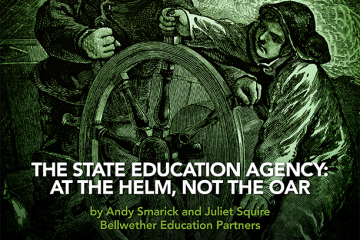
The State Education Agency: At the Helm, Not the Oar

In recent years, policymakers and reform advocates have viewed State Education Agencies (SEAs) as the lead organizations for implementing sweeping reforms and initiatives in K–12 education—everything from Race to the Top grants and federal waivers to teacher-evaluation systems and online schools.

Juliet Squire 4.21.2014
NationalReport

The State Education Agency: At the Helm, Not the Oar

4.21.2014
Report

ESEA does not give Arne Duncan ‘mandate authority’

Michael J. Petrilli
7.23.2014
Blog

We’ll miss you, Michael Gove

Chester E. Finn, Jr.
7.23.2014
Flypaper

Upward mobility

The Education Gadfly
7.23.2014
Blog

Glenn Beck ain't got nothin' on this podcast

7.23.2014
Resource

Do high flyers maintain their altitude?

Janie Scull
9.20.2011
Flypaper

Making School Choice Work

Amber M. Northern, Ph.D.
7.23.2014
Blog

Teachers versus the Public: What Americans Think about Schools and How to Fix Them

Marie Dandie
7.23.2014
Blog

The Productivity of Public Charter Schools

Amber M. Northern, Ph.D.
7.23.2014
Blog
view

ESEA does not give Arne Duncan ‘mandate authority’

Michael J. Petrilli 7.23.2014
Blog
view

We’ll miss you, Michael Gove

Chester E. Finn, Jr. 7.23.2014
Flypaper
view

Upward mobility

The Education Gadfly 7.23.2014
Blog

Glenn Beck ain't got nothin' on this podcast

Michael J. Petrilli, Marc Porter Magee, Amber M. Northern, Ph.D., Pamela Tatz 7.23.2014
Resource
view

Do high flyers maintain their altitude?

Janie Scull 9.20.2011
Flypaper
view

Making School Choice Work

Amber M. Northern, Ph.D. 7.23.2014
Blog
view

Teachers versus the Public: What Americans Think about Schools and How to Fix Them

Marie Dandie 7.23.2014
Blog
view

The Productivity of Public Charter Schools

Amber M. Northern, Ph.D. 7.23.2014
Blog
view

The State Education Agency: At the Helm, Not the Oar

4.21.2014
Report

In recent years, policymakers and reform advocates have viewed State Education Agencies (SEAs) as the lead organizations for implementing sweeping reforms and initiatives in K–12 education—everything from Race to the Top grants and federal waivers to teacher-evaluation systems and online schools. But SEAs were not built—nor are they really competent—to drive such reforms, argue Andy Smarick and Juliet Squire in The State Education Agency: At the Helm, Not the Oar. And despite the best efforts of talented, energetic leaders, SEAs will never be able to deliver the reform results that their states need. This paper from the Thomas B. Fordham Institute suggests a new governance approach, organized around the “4 Cs”:

Control: Return SEAs to their core functions of channeling federal and state dollars to districts; adopting statewide standards and assessments; creating and maintaining data systems; and monitoring compliance with applicable laws.

Contract: Contract with other organizations that are better equipped to accomplish education work, while ensuring that performance agreements with those organizations delineate outcomes and consequences for poor performance.

Cleave: Leave tasks that are well outside SEAs’ core competencies—such as charter-school authorizing and generating educational innovation—to other government entities or nongovernmental organizations.

Create: Encourage state leaders, both inside and outside government, to create new entities to take on much-needed reform work. 

Watch a presentation and discussion of the report event live on April 24 at 10:00 a.m. EDT:

State Education Agencies: The Smaller the Better?

____________

If you have questions about the book, please email Andy Smarick.

view

ESEA does not give Arne Duncan ‘mandate authority’

Michael J. Petrilli
7.23.2014
Blog

Yesterday’s big news (regarding ObamaCare’s subsidies in states with federal exchanges) is that the judiciary actually expects the executive branch to pay attention to the clear language of laws passed by the legislature. (Update: At least, the D.C. Circuit does.) That this lesson in Civics 101 is news at all tells you something about the disrespect the Obama administration has shown to our Constitutional system. Congress may be semi-paralyzed, but the White House and the federal agencies still aren’t allowed to write the laws themselves.

Yet that’s exactly what Arne Duncan and his Department of Education continue to do when it comes to their interpretation of the waiver authority in the Elementary and Secondary Education Act (ESEA). He has the right to offer greater flexibility to the states when it comes to the law’s “adequate yearly progress” measures and other parts of its accountability system. What he has no constitutional right to do is dream up new mandates out of thin air and make flexibility contingent upon their embrace by supplicant states.

Let’s follow the example of the D.C. Circuit and examine the clear language of the applicable law. Section 9401 of ESEA plainly states that “the Secretary may waive any statutory or regulatory requirement of this Act” (with some noted exceptions). It says that states should describe, in their waiver requests, “How the waiving of…requirements will increase the quality of instruction for students and improve the academic achievement of students.” But it grants no authority for the Secretary to place conditions on those waivers.

Yet the Department’s waiver policy says that, in order to receive waivers, states “must submit a request that addresses each of the following four principles, consistent with the definitions and timelines described later in this document, to increase the quality of instruction for students and improve student academic achievement in the State and its [districts].” Note the sleight of hand. The law expects states to explain how waivers would “increase the quality of instruction” and “improve academic achievement.” The Department requires adherence to its preferred “principles” as the only routes to such improvement.

Further, the Department forces states to pledge allegiance to “each” (meaning all) of the four principles—even when these are not germane to the specific flexibility being requested.

What are these principles?

  1. College- and Career-Ready Expectations for All Students
  2. State-Developed Differentiated Recognition, Accountability, and Support
  3. Supporting Effective Instruction and Leadership (i.e., teacher and principal evaluation)
  4. Reducing Duplication and Unnecessary Burden

All fine-sounding principles, even laudable, but try to find a place in ESEA where Congress declared that a state’s waiver would hinge on its embracing all of them—and satisfying the Secretary that it will indeed implement them all.

As a result of the all-or-nothing system dreamed up on the seventh floor at 400 Maryland Avenue, states that wanted flexibility on accountability (number two) had to abide by the Department’s new rules on teacher evaluations (number three). And so forth. Where’s the legal rationale for that?

To be sure, numbers two and four are legitimate exercises in flexibility, because they relate directly to ESEA’s accountability and reporting requirements. But numbers one and three have no basis in the law at all.

Let’s home in, in particular, on the teacher-evaluation requirement, as that’s the one that’s tripped up several states, including California, Washington, and, until recently, Illinois. ESEA says not one word about evaluating teachers. (Go ahead, search it yourself.) Some have argued that the legal basis for this mandate can be found in section 1111(a)(8), the so-called “equitable teacher distribution” requirement, which asks states to submit plans to the Secretary that describe “steps that the State educational agency will take to ensure that poor and minority children are not taught at higher rates than other children by inexperienced, unqualified, or out-of-field teachers, and the measures that the State educational agency will use to evaluate and publicly report the progress of the State educational agency with respect to such steps.”

Read that language again. Do you see any indication that Congress intended this as a requirement that states “develop, adopt, pilot, and implement, with the involvement of teachers and principals, teacher and principal evaluation and support systems,” as Duncan now mandates? There are legitimate policy reasons to look at teacher “effectiveness,” as opposed to the credentials mentioned by the law (such as experience or qualifications). But they aren’t contemplated by the law itself. They are simply not in the law. (This is the case for the “college- and career-ready standards” requirement, too.)

In fact, the Department’s brand-new policy guidance on the “equitable-distribution” requirement hearkens back to the “inputs” that are mentioned by the law (teacher qualifications and such), rather than asking states to use the results of their teacher-evaluation systems to determine whether they in fact have an inequitable distribution of effective teachers. It’s hard to imagine that this was the preferred approach of the policy types. But—speculating here—maybe the General Counsel wouldn’t go along with a mandate on teacher distribution that didn’t match the letter of the law itself. That’s precisely what Bellwether analyst (and former Obama administration official) Chad Aldeman surmised, telling Education Week’s Alyson Klein that they didn’t have a choice, that the new guidance is “using the same language and tools that NCLB allowed. Which is 12-year-old language.”

Then why didn’t those lawyers speak up three years ago when Secretary Duncan rolled out the NCLB waivers in the first place? Whatever its possible merits, he and his team, not Congress, created the teacher-evaluation mandate. And it was attached to waiver requests that have nothing to do with teacher policy, such as those related to school accountability systems. Maybe I could be convinced that the Secretary has the authority to require teacher-evaluation systems for states that wanted out of the law’s “highly qualified teachers” mandate. But those that wanted out of AYP?

What we need today is a state (perhaps Washington?) willing to argue in federal court that its waiver was been denied (or rescinded) for reasons not allowed under the law. I am confident that some of the courts, at least, will ask Duncan to point to the “plain language” of ESEA that gives him the authority to mandate statewide teacher-evaluation systems, particularly for states that want waivers on school accountability. Just as with ObamaCare and the question of whether the federal government is a “state,” the administration won’t have a good answer.

A version of this article originally appeared on the Flypaper blog.

view

We’ll miss you, Michael Gove

Chester E. Finn, Jr.
7.23.2014
Flypaper

Recent revelations suggest that David Cameron’s unexpected move to replace reform-minded education minister Michael Gove (who’s been popular with British conservatives) with Ms. Nicky Morgan might have been triggered by more than crass preelection maneuvering to placate teachers and women.

Gove’s earnestly pursued and widely touted “academies” initiative, which allows district-operated public schools to convert to charter-like status and be managed by outside groups, has led to a major scandal in Birmingham, where a handful of such schools were taken over by fundamentalist Muslims.

Because all academies are, in principle, accountable to the secretary of state for education rather than to local authorities, Gove was ultimately responsible for the decisions that led to this situation, which has been carefully documented by inspectors from Ofsted, England’s independent school-reviewing body.

This is not to say that academy status produced this problem. As a close review by Peter Clarke makes clear, the local Birmingham authorities had turned a blind eye to it for ages. Indeed, one can fairly argue that coming under the secretary of state’s authority is what finally surfaced the problem and empowered the government to intervene, which it has now done.

With some 3,500 such schools now operating in England and enrolling more than one in four of all school kids in the country, it was unrealistic to expect Gove and his small staff to know much about what was happening in them. Still, that’s how this enormously important element of England’s school-choice and school-autonomy policies is structured. And the Birmingham scandal reveals a major weakness, even as it also illustrates how a change in governance-and-accountability structures can pave the way to overdue changes in school operations.

Still, this saga includes a cautionary tale regarding charter school authorizing, particularly when done on a large scale, and will inevitably be used by school-choice foes in the U.S. as evidence in support of their scary predictions that chartering will lead to madrasas and such. One can reasonably wonder how close was the scrutiny that Gove’s team gave to these Birmingham schools and the folks who wanted to take charge of them before conferring academy status upon them.

Moving Gove out (and into a sort of intra-party role as “chief whip” in the Commons) was thus a way for the prime minister to contain the fallout from this lamentable situation. With a general election set to occur sometime before May 2015, it was also a good time to remove this thorn in the side of England’s teachers and teacher unions (and the rest of what Gove, channeling Bill Bennett, called the education “blob”) and to replace him with a woman.

Having said all that, let me say that Michael Gove’s overall record as education minister these past four years has been brilliant and brave as well as boisterous. A fan who writes for the Telegraph offers a better account of his accomplishments than I could supply. Click on that link and check out the nine “bullets” that he lists.

Radical as Gove has been in the British context, in reality, much of what he has sought to accomplish follows logically from its antecedents during Tony Blair’s time, particularly the initiatives devised and led by Sir Michael Barber, some of which you can read about in his own excellent book, Instruction to Deliver: Fighting to Transform Britain’s Public Services. And it’s no real stretch to find their precedents in the Thatcher years. Indeed, macro-education policy in England has followed a reasonably steady—and radical—course for three decades, regardless of which team was in charge in Whitehall.

The path on which Gove and his predecessors placed English education resembles the path taken by sundry U.S. education reformers—most definitely including Arne Duncan as well as Bill Bennett, Lamar Alexander, and Jeb Bush. Me, too. It consists of high standards, rigorous tests with transparent results (including the kind that make it easy to compare schools’ performance), school-level autonomy, quality choices, meaty Core Knowledge–style curricula, forceful interventions into failing schools, and sweeping deregulation.

I’ve envied British education reformers from time to time because they don’t have nearly so many layers (or branches!) of government to work through or so many veto points in the system. It’s better to think of primary and secondary education in England as analogous to that of a large U.S. state—the total pupil population of 7 million may be compared with California’s 6 million—and of the governance system as akin to that of a state capitol. (When it comes to K–12 education, the “United Kingdom” contains four separate systems, because Wales, Scotland, and Northern Ireland run their own. Gove and his predecessors were in direct charge only of England’s.)

As a result of this more centralized control through a parliamentary-style government, reformers in London have been able to make decisions that reverberate rather quickly throughout the land. This has led, for instance, to the staggering rise in the number of academies, particularly at the secondary level.

Gove is a zealous reformer whom I like and respect. If you listen to his keynote address to Jeb Bush’s big annual education conference last year, you might be as impressed as I am.

Zealousness is much preferable to lethargy, and I hope the Birmingham glitch doesn’t slow the pace of education reform in England. Gove’s policies wouldn’t have been undertaken had the prime minister not agreed with them, and for at least the next ten months, Cameron will remain in that role. After the general election, much could be up for grabs, though history suggests that the basic path probably won’t change much. Meanwhile, even Gove’s devoted fans must acknowledge that the Birmingham episode—akin to the proliferation of mediocre schools that we witnessed when Texas, Ohio, Arizona, and other states strove to get as many charters up and running as fast as possible—does illustrate some of the hazards that accompany haste in the implementation of a promising reform. Yet his critics—and those who reject the charter concept on this side of the Atlantic—also need to recognize that traditional “local control” wasn’t doing anything to clean up the mess in Birmingham.

A version of this article originally appeared in the National Review Online.

view

Upward mobility

The Education Gadfly
7.23.2014
Blog

In this weekend’s Wall Street Journal, Tamar Jacoby wrote about a recent high school graduate working at becoming a construction contractor—not as a last resort but as a deliberate career choice. Via his story and those of others seeking out quality career and technical education, Jacoby made the case for improving postsecondary options other than four-year degrees. She names three requirements of paths toward upward mobility—entry ramps at the ground level, training that leads to a job, and alignment to economic needs—and argues that as a nation, we should begin by showing more respect for practical training.

An analysis by WBEZ found that Chicago’s school-choice arrangement results in a system that sorts students into separate high schools based on their achievement levels. This leaves education leaders with a tough choice. On one hand, evidence suggests that low achievers benefit from having high achievers in their classrooms (at least if the differences aren’t too great), and under a system in which high achievers are placed in a school of their own, low achievers will lose out on these peer effects. But on the other hand, the same peer effects also lead these high achievers—most of whom are low income, in Chicago at least—to miss out on challenging instruction that could push them to go far. It is abundantly clear that high-performing, low-income students have been getting the short end of the stick for some time, including the belief that they ought to serve as a resource to low-achieving peers—an expectation that is seldom placed on well-off peers.

In an op-ed in the Columbus Dispatch, Fordham’s Jessica Poiner addresses the recent lawsuit brought by School Choice Ohio against Cincinnati Public Schools and Springfield City Schools, in response to their shameful circumvention of public-records laws in order to prevent families from knowing about their school-choice options. She writes that rather than fearing the healthy competition that school choice engenders, school districts ought to embrace it. Competition advances academic outcomes, for it is one mechanism that drives public schools to improve. What’s more, it’s the American way.

Glenn Beck ain't got nothin' on this podcast

7.23.2014
Resource

Mike and 50CAN’s Marc Porter Magee take on career and technical education, sorting by student achievement, and charter schools’ noncognitive effects. Amber reports on charters’ productivity.

Amber's Research Minute

The Productivity of Public Charter Schools by Patrick J. Wolf, et al., (Fayetteville, AR: School Choice Demonstration Project, University of Arkansas, July 2014).

Mike Petrilli:             Hello, this is your host Mike Petrilli at the Thomas B. Fordham Institute here at the Education Gadfly Show and online at edexcellence.net. And now please join me welcoming my co-host, the Glenn Beck of education policy, Marc Porter Magee!

Marc Magee:             Thank you, thank you.

Mike Petrilli:             I'm just kidding about the Glenn Beck part, I don't know that you have a whole lot in common with him other than that you are an excellent communicator, you understand social media, you understand the current populist movement in America today...

Marc Magee:             Go on, go on Mike. And it's my first time on the podcast.

Mike Petrilli:             That too, that too. And I mention Glenn Beck because today, or this week, or sometime around now, he is doing his "We will not conform" event about the common core where he is telling all these people, "Conform by coming to a movie theater and paying money" that I assume is going into  his pocket, "Buy my book," which is going into his pocket, and "Rally against the common core." You got to love the guy's gall.

Marc Magee:             Yeah, it's a good gig, I guess.

Mike Petrilli:             It's a good gig. Well, hey Marc, so you're wife, of course, Kathleen Porter Magee, who has been on the show many, many times, this is your first time, and you run a group called 50CAN. Though right now it should really be called, what, 9CAN?

Marc Magee:             7CAN? [crosstalk 01:33] Maybe 9CAN in the future. When we were starting, we started out in two states, Rhode Island and Minnesota, and John Sackler, one of our board members, used to joke that we should be called 2CAN, so we actually had a little toucan made up as our mock logo.

Mike Petrilli:             And we thought it was hilarious a couple years ago in our April Fool's Day Gadfly when we decided he would move to Canada and be called CanCAN.

Marc Magee:             That was a good one.

Mike Petrilli:             That's a good one!

Marc Magee:             One of my favorites is going to South Dakota and we'd be called SodaCAN.

Mike Petrilli:             We kill us! We kill us!

Marc Magee:             Have a little fun with the names.

Mike Petrilli:             Alright, so the thing to know about 50CAN is you are helping to start up the state based education reform organizations to push for things like, what? Accountability, high quality charter schools, teacher effectiveness policies, et cetera...

Marc Magee:             All those things and more.

Mike Petrilli:             And you have become an expert on advocacy in education reform and in fact you're doing some courses very soon that people can participate in!

Marc Magee:             They can! So we took everything that we are learning, across all of our different state campaigns, and organized it into a 3 hour workshop, so you can come and get up to speed on all of the different theories and practices of advocacy, and we are doing this with our friends and partners over at EdFuel. So they're running 2 2 day workshops, July 29th and 30th, and then later, August 6th and 7th. And I know you're going to be joining them as well, so we'd love to have people come out. If you go to the EdFuel website, which is EdFuel.org, they can sign up, and join us, and I believe there's even networking and drinks, so it's going to be fun.

Mike Petrilli:             Let me ask you a serious question.

Marc Magee:             Yes.

Mike Petrilli:             What if you get a mole there at this thing?

Marc Magee:             That is a serious question. So I would say-

Mike Petrilli:             Do we have some kind of now, I don't know, we need some spies in the education reform movement or do some counter intelligence to make sure that we're protected here!

Marc Magee:             When we were doing, we sort of tested this workshop out, we went and performed it for our friends over at grade schools last week, and I was joking at the beginning, "This is a little bit like a magician who's walking through all their tricks." But I think actually we're way too secretive in the advocacy world, and the benefits of bringing more people in and showing them how they could advocate too, far outstrip anything we get from keeping this things close to our vest.

Mike Petrilli:             Well that's good since this podcast will be on the internet! And everybody can have access to it. OK, let's get started, Marc, Pamela, let's play, "Pardon the Gadfly!"

Pamela Tatz:             In this weekend's Wall Street Journal, Tamar Jacoby told the stories of students who sought out quality career and technical education and argued that the nation needs to show respect for practical training. Has the education reform movement been antagonistic to career and technical education?

Mike Petrilli:             Yes? Marc? What do you think?

Marc Magee:             I have a nuanced view on this, which is that I think, if we're trying to push a one size fits all model, where we're saying everyone needs to go to college and therefore all of our schools are going to be structured that way, then that violates the principle of choice. But so does the way we used to do it, where we're tracking kids into programs that closed off the opportunities for college. So I think there's a way to find our way to students really being able to follow what they're interested in, parents having genuine choices for their kids, and that is the way we're going to get to a point where technical education will be embraced and not seen as some kind of second class track.

Mike Petrilli:             Alright, so you're saying the key is the system can't make the choice for the student, it really has to be the student, and the parent, making that choice. Now we're talking about the, once kids are, say, 14, 15 years old, and the challenge is, even for career and technical education, or for a college prep kind of high school, you've got have pretty high level skills in reading, math, writing... that's what we're learning. And what happens to those kids who aren't even anywhere close to having those basic skills for even those kinds of programs, that's a big challenge in education reform. But Marc, don't you think we have been overly obsessed with college prep high schools? I can't think of any high profile charter school chains that are explicitly focused on career and technical education. All of the big name ones that get a ton of funding and a ton of attention are college prep.

Marc Magee:             Yeah, I think that's true in terms of what we as a reform community are holding up as the models we want people to pay attention to. But on the ground, I think you're seeing local reformers doing a lot more in this direction. So one of the earliest portfolio models that we were involved in was in Connecticut under Superintendent Adamowski. One of the first things he did was actually create a nursing academy high school. And a lot of other themed approaches to schools that were different than just, "Oh, you want a choice, here's this one high performing college bound model."

Mike Petrilli:             Very good. Topic number 2.

Pamela Tatz:             An analysis done by WBEZ found that Chicago's school choice system sorts students into separate high schools based on their achievement levels. Is this unintended consequence cause for concern?

Mike Petrilli:             I'm not even sure it's unintended, right? And I'm not sure it should be cause for concern! Here's, again on this same topic here, is this about tracking or is it about trying to make sure that there are good choices out there for lots of different kids. Right now I think the kids that get hosed by our system more than anybody else are low income kids who are high achieving. And they are asked to go into these big urban comprehensive high schools and just sit there and not get challenged. And this, having more selective schools, or some schools where they can be around other kids that are high achieving, it actually means they get to be challenged like the affluent high achieving kids in the suburbs.

Marc Magee:             Yeah, I do think it's really unfair the way we frame up these questions sometimes, where we seem to make the case that the high performing kids in low performing cities need to be sacrificing for everyone else. We really never ask that question of suburban kids. I think, to your question, is it unintended, if we're putting testing provisions on high schools then that probably is going to result in some sorting. I think maybe we were surprised to the degree of sorting. I think in the  story they talk about 96% of the top scoring kids ended up in six of these high schools. And I do think as education reform becomes bigger, and takes on a larger role in designing systems, these questions of what happens to the whole system as these reforms kick in, is a real one. Because I think we can all agree that we should not hold back high performing kids, but if the result is that we end up with a few high schools where all of the low performing kids are pooled, then we've got an even bigger problem.

Mike Petrilli:             I guess, Marc, but I guess that's why we need to be honest about this, and admit that there are trade offs, and an earlier generation of reformers were all about de-tracking, there's that word again, and we understand why, that it didn't feel right for the system to be making those choices, and we also knew that a lot of kids were tracked into what were very much dead end tracks, that weren't going anywhere. So, it's good that we have tried to get rid of those dead end tracks and make sure that even the kids on the... even the lowest performing kids, the schools are expected to get them to some basic literacy and numeracy that's going to help them be successful in their life.

                                    All good! But we have to wrestle with the fact that there is such a thing as pure effects, basically everybody does better if they're around high achieving kids. It helps the low achievers but it also helps the high achievers, and this is one of these things where there are only so many in these systems, high achievers to go around, so you do have to start to make some choices. And you say, "Well, is it more important to give high achievers challenge by putting them around other high achievers, or to maybe help bring up the performance of low achievers by exposing them to the high achievers?" It's kind of sacrificing the high achievers. These are really tough moral questions. I feel like we tends to paper over those issues in education reform with a lot of happy talk  like, "Everybody can get exactly what we need." These are the kinds of questions... and at the very least let's be open about the choices we face.

Marc Magee:             Yes, it's a very economic view. I feel like that's the tough hard trade offs that we often don't confront. We can't just snap our fingers and make it all go away.

Mike Petrilli:             Well, I get the equity push, that feels wrong to say that, "Well, we're going to preference the high achievers." And particularly if you're in a system where the high achievers are also the most affluent, or the... But we're usually now talking about urban systems, where basically, almost everybody's poor, right? And the affluent high achievers, their parents by and large have left the cities and moved to the suburbs or gone to private schools. They have found a way to ensure that their kids are in environments where they're around other high achieving kids. That's our system, I'm doing it with my own kids, there you have it, right? So I just think sometimes the equity advocates, they just lose the forest for the trees. What they don't see is their advocacy for equity is actually hurting a class of low income kids.

Marc Magee:             Yeah. And I think we would all feel better about providing these high achievers with these exclusive opportunities if we were doing a better job of making progress in the rest... This goes on if we didn't see low performers getting concentrated into a couple of neighborhood schools that are getting left behind.

Mike Petrilli:             Alright, Pamela, topic number 3!

Pamela Tatz:             A UCLA and Rand survey finds evidence suggesting that attending a high performance charter school reduces the rates of high risk health behaviors among low income teenagers. Do you think this is evidence of charter effectiveness or skimming?

Marc Magee:             One of the things I thought was really interesting about this story is I've thought for a while that while we often point to test scores to say charter schools are doing better with kids, when you go and visit these high performing charter schools, you see them going way beyond just what it would take to get the test scores right and engaging the parents, engaging the communities, really changing life courses and behavior. So it's great to see us widening our view to see that there actually are bigger impacts than just test scores.

Mike Petrilli:             Yeah, and it was interesting. Specifically what they looked at were risky behaviors, like having unprotected sex, or binge drinking and the charter school kids were self reporting to do those things less frequently. They're self reports, in these schools they were not randomly assigned to these schools, so we really can't look at causation. And it's an interesting questions. You say, "Are these kids engaging in fewer risky behaviors because something they've learned at their charter school, or is it that kids who engage in less risky behaviors to begin with were the ones that were interested in these charter schools?" In other words, is this some indication that, aha, these schools, these kids, even though they may be poor, they may be eligible for free lunch, they might be in some way more advantaged than the other kids. Their families might be more intact or functional or whatever, and that's showing up in the data.

Marc Magee:             Yeah. We've started to... that's the perennial question we've had even with test scores is selection bias.

Mike Petrilli:             Selection bias.

Marc Magee:             And we've largely started to solve that question with more sophisticated studies, more experimental studies, tracking kids over time. I'd love to see us start to fold in these larger questions about outcome variables, and answer, "Is it really changing... giving kids so much more than just the basic knowledge?"

Mike Petrilli:             Absolutely, and the studies that have been out there that are quite rigorous, there have been a few looking at charter schools and at voucher schools, and what they tend to show is that the long term outcomes far outpace what you'd expect just from the relatively small improvements in test scores. In other words, the charter schools and the voucher schools do better on test scores, but they do way better on some of these other long term outcomes, and that might be the non cognitive stuff, the character stuff, all this other stuff that we talk about.

Mike Petrilli:             Absolutely. So we do this survey that couple months ago we put out, and we asked parents, what do they care most about in long term effects of a school? Setting their kids up for a job came in fourth, number one was character, number two was leadership. So, I think we'll go much further in really understanding how to give parents the education they want for their kids, if we can speak to these values issues.

Mike Petrilli:             Absolutely. Alright, excellent Marc! Well played! That's all the time we've got for Pardon the Gadfly, now it's time for everyone's favorite, Amber's Research Minute! Amber, welcome back to the show!

Amber Northern:      Thank you Mike!

Mike Petrilli:             Amber, before the whole common core thing, I'm just curious, did you like Glenn Beck?

Amber Northern:      I did. I kind of liked him, and now he's just gotten too... I guess I didn't realize he was extreme and didn't really look at data too much, I don't know. I just feel like I've had a change of opinion about him, and I really liked him, so I feel like I'm now leery of him. Because of this whole issue, it's raised my suspicions about him and how much he really looks into issues instead of just relying on the rhetoric.

Mike Petrilli:             Yeah, it's interesting, my mom, of course, is very angry at Fox News for being so anti common core all the time, thank you Mom, and I think it has raised some questions for her about some of the other Fox News reporting. Starts to think about maybe on these other issues that we don't follow as closely, are they being unfair on some of those things?

Amber Northern:      Right.

Mike Petrilli:             Not that this doesn't happen on the liberal side of the aisle either, Marc.

Amber Northern:      That's right, that's right.

Mike Petrilli:             Alright, so Amber, what you got for us this week?

Amber Northern:      We have a new report out from the University of Arkansas that compares the productivity of public charter schools and traditional schools, both in terms of their cost effectiveness and return on investment, or ROI.  For the cost effectiveness analysis, they consider how many test score points students gain on the NAPE 2010-2011, for each thousand dollars invested in their public education in the charter compared to traditional sector. You got that?

Mike Petrilli:             Yes, sort of.

Amber Northern:      Key finding, for every thousand dollars invested, charter students earned a weighted average of an additional 17 points in math and 16 additional points in reading on NAPE compared to traditional district students, controlling for student characteristics such as poverty and special ed status. This translates into charters nationwide being 40% more cost effective, according to their calculations. And then a little bit about the return on investment, that calculates ROI by converting the learning gains over time by students in charter and traditional sectors into an estimate of the economic returns over a lifetime. This is Eric Hanushek's stuff, OK? In comparing those returns to the revenue amounts invested in their education. Key finding... I know, it's a...

Marc Magee:             Should we high five now?

Amber Northern:      Using Eric Hanushek's estimates on lifetime earnings and productivity, we find that public charter schools delivered a 3% increase in lifetime economic gains, was the terminology they wanted to use, they didn't want to just say salary for a bunch of different reasons. For a student who attends a charter for one year, they look at how long if you're in a charter one year, six years, however years, a 19% increase for students who attend half of their K12 education. So bottom line, this obviously looks pretty good for the charter sector but they end with a discussion that I think makes a lot of sense, which is, "Does a higher productivity rest on the fact that charters get less funding to begin with? And they're therefore more disciplined in how they use these dollars, and if they were funded equally, which is what a lot of folks have been wanting, would we actually see these same productivity patterns?

Mike Petrilli:             Right, that nationally, at least, it looks like the charters are pretty similar to traditional public schools, in terms of test score gains, but they are 30% cheaper. Right?

Amber Northern:      Right.

Mike Petrilli:             So the point is not so much that they out perform traditional public schools, they do maybe by a little bit, but really where this all is coming from is they're much less expensive.

Amber Northern:      Right, per dollar.

Mike Petrilli:             They're getting a lot less money. And so what... I saw Bruce Baker from Rutger's got something up online about this, I haven't had a chance to look at it closely yet, what are people going to say? Are they going to just question the...

Amber Northern:      Yeah, so Bruce is going to say it's because they have... it's going to be a difference of the sped kids, and it's going to be a difference in the disadvantaged kids, but they spend a lot of time at the front end of the report saying, "guess what? The charters tend to reflect the demographics of the area," and so these charters are actually serving more disadvantaged kids. So that doesn't hold water.

Mike Petrilli:             Alright, let me push back on one thing, though. So let's say we know that there's other traditional public schools that tend to be low spending schools. Let's say rural schools, tend to spend less than other schools, and you control for demographics and all of that, and even though they spend less, the results look pretty similar to other similar schools in the state, right? You could make the same argument for them, and it may be simply that because spending doesn't matter.

Amber Northern:      Could be.

Mike Petrilli:             Right. So we just don't know.

Marc Magee:             When you have it, you spend it. Sometimes you spend it on things that actually help kids, and sometimes you don’t.

Mike Petrilli:             Right. So maybe the answer here, Marc, I know, I've a great idea for you for advocacy. You should go out and advocate a 30% cut for all traditional public schools.

Marc Magee:             We just want kids to do better. And the efficiency argument is great, but hopefully we're figuring out a way, we got so many gains we need to make. If we're going to put any extra dollars into the system, how do we learn from this so that it actually gets results?

Mike Petrilli:             Very nicely said.

Marc Magee:             What do you think, Amber, are you convinced? Is this important? Certainly people like Marc are going to use it for advocacy.

Amber Northern:      Yeah, I think it's important, but you're right, at the end of the day, we care about the gains. The money matters, it's important to look at this stuff. But I don't know, it's hard to parse, because you can roll out a study that says that really shows that money matters, and you can roll out a study that says that it doesn't. So I think this is still in dispute, this whole question.

Mike Petrilli:             You know, one thing that is cool is they're basically combining their previous analysis on charter spending and the credo results in terms of achievement, and you put that together, and a few cities really do pop out as doing something very well. Like D.C...

Amber Northern:      D.C.

Mike Petrilli:             They spent a ton of money, but compared to the D.C. Public Schools, they spend less and they get a really strong results. Few other states that have a strong showing. Our home state of Ohio looking pretty mediocre as they have on other measures. But again the lesson we looked at this in the Walkathon, Marc, is that some states are doing the charter thing much better than others. That's an issue about policy, authorizing, spending, it's also an issue about...

Amber Northern:      Operators.

Mike Petrilli:             Being able to do operate... recruiting great people. So this is where we inside the reform movement need to keep learning, is saying, "What do we keep doing to get those laggard states and cities to look a lot more like the D.C.s, or the Tennessees, or the Rhode Islands, and less like...

Marc Magee:             Rhode Island! [crosstalk 19:44] Little Rhodie, always overlooked!

Mike Petrilli:             Little Rhodie! I did that for you, Marc.

Marc Magee:             Thank you.

Mike Petrilli:             And less like the Ohios, and the Texases of the movement.

Amber Northern:      Good summary.

Mike Petrilli:             Excellent. Alright, well, that is all the time we've got for this week! Until next week...

Marc Magee:             Hi, I'm Marc Porter Magee.

Mike Petrilli:             Almost a little bit early there, Marc, a little too...

Amber Northern:      Jumping the gun.

Mike Petrilli:             Too fast on the draw. Marc Porter Magee, thank you for joining us! I'm Mike Petrilli at the Thomas B. Fordham Institute's Education Gadfly Show, signing off.


view

Do high flyers maintain their altitude?

Janie Scull
9.20.2011
Flypaper

If America is to remain internationally competitive, we need to maximize the potential of our top students. Over the last decade, however, federal and state education-accountability systems?particularly in the wake of the No Child Left Behind Act (NCLB) of 2001?have placed primary emphasis on moving low-performing students toward proficiency. The sanctions stemming from these systems have cast greater attention on schools that fail to attain proficiency for most students?a necessary and noble endeavor. But they have also fueled concerns that the academic needs of high-performing learners, who in many states are largely unaffected by accountability systems, have been neglected.

In order to maximize the potential of our above-average and top students, we first need to know who those students are, and where and when they're most likely to falter. But to date, few research studies have examined the progress of individual high achievers over time.

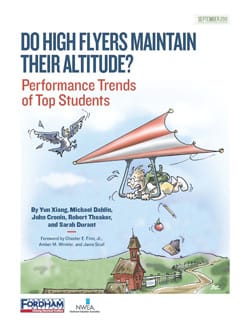
Today, Fordham took a leap in that direction with the release of a groundbreaking study, Do High Flyers Maintain Their Altitude? Performance Trends of Top Students, the first ever to examine the achievement of high-performing students over time at the individual level. It poses?and seeks to answer?this straightforward question: Do students who outscore their peers on standardized achievement tests remain at the top of the pack year after year? Put differently, how many ?high flyers? maintain their ?altitude? over time? How many fall back toward Earth as they make their way through school, losing the academic edge they once enjoyed?

Over the next few days, we'll delve into the report's main findings and host a forum for expert guests to react here on Flypaper. If you just can't wait to find out more, you can download a copy of Do High Flyers Maintain Their Altitude? Performance Trends of Top Students here, or visit the report data gallery, hosted by the Kingsbury Center at the Northwest Evaluation Association, here.

?Janie Scull

view

Making School Choice Work

Amber M. Northern, Ph.D.
7.23.2014
Blog

In this report, the Center for Reinventing Public Education surveys 4,000 parents and interviews civic leaders in eight choice-rich cities—Baltimore, Cleveland, Denver, Detroit, Indianapolis, New Orleans, Philadelphia, and Washington, D.C.—to help determine how to improve existing choice systems, regardless of whether parents choose a charter or district school. Three key findings emerge. First, the majority of parents are actively choosing a school for their children, though parents also report considering just one or two schools. Perhaps this is because the options were not there; indeed, roughly half report that if their current school was not available, there were no other schools that would satisfy them. Second, parents cite a number of barriers to choosing schools, including inadequate information, transportation, and a lack of quality options. Not understanding which schools their child was eligible to attend was the barrier most often cited. These challenges are not confined to the charter or district sector. Third, responsibility for schools falls to multiple parties, including school districts, charter school authorizers, and state agencies, which weakens accountability and makes it hard for leaders to address the challenges facing parents. Having too many cooks in the kitchen makes it difficult for parents to navigate information. For instance, Phoenix has twenty-eight school districts responsible for overseeing public education and Houston has nineteen—meaning that charter operators hoping to coordinate on enrollment timelines would have to negotiate separate agreements with the entire bunch. The report recommends a more transparent, accountable, and fair system, meaning state and city leaders may need to change laws to ensure that districts and charter authorizers oversee schools responsibly and that families do not face large barriers to choice. Formal governance changes may be necessary to address the challenges to making school choice work for all families.

SOURCE: Michael DeArmond, Ashley Jochim, and Robin Lake, Making School Choice Work (Seattle, WA: Center for Reinventing Public Education, July 2014).

view

Teachers versus the Public: What Americans Think about Schools and How to Fix Them

Marie Dandie
7.23.2014
Blog

When it comes to what constitutes a superb education in America, the general public and teachers have vastly different views, say Peterson, Henderson, and West in this book, a compilation of research reported originally in Education Next. Surveys fielded by over 5,000 teachers and members of the general public (2007–13) conclude that, overall, teachers and the public disagree most on issues pertaining to tenure, pensions, union efficacy, charter schools, school vouchers, and standardized testing. The authors also found that when a member of the general public was informed that their local school district’s national ranking was low, the teacher-public divide deepened. While teacher opinion doesn’t change when given new information, the public grew eager to support universal school vouchers, charter schools, and parent-trigger laws. The book meticulously underscores the striking way in which education is viewed through the scattered, often fluctuating lenses of the general public and solid stance of teachers. In the end, the authors conclude that in education, the public and teachers are more divided than Democrats and Republicans, young and old, rich and poor, and white and disadvantaged minorities. As a teacher—and one who does not consider herself to be “versus the public”—I agree that bridging the divide is key.

SOURCE: Paul E. Peterson, Michael Henderson, and Martin R. West, Teachers versus the Public: What Americans Think about Schools and How to Fix Them (Washington, D.C.: Brookings Institution Press, April 2014).

view

The Productivity of Public Charter Schools

Amber M. Northern, Ph.D.
7.23.2014
Blog

This new report from the University of Arkansas compares the productivity of public charter schools and district schools, both in terms of cost effectiveness and return on investment (ROI). For the cost-effectiveness analysis, the authors consider how many test-score points students gain on the 2010–11 NAEP for each $1,000 invested; to measure ROI, the authors used, among other data, student-achievement results from CREDO’s national charter school study (that matched students via a “virtual twin” methodology). The key finding: For every $1,000 invested, charter students earned a weighted average of an additional seventeen points in math and sixteen additional points in reading on NAEP, compared to traditional district students, controlling for student characteristics such as poverty and special-education status. This translates into charters nationwide being 40 percent more cost effective. The researchers calculate ROI by converting the learning gains over time by students in charter and traditional sectors into an estimate of the economic returns over a lifetime and comparing those returns to the revenue amount invested in their education. Using Eric Hanushek’s existing estimates on lifetime earnings and productivity, they find that public charter schools delivered a 3 percent increase in lifetime economic gains for a student who attends a charter for one year and a 19 percent increase for a student who attends a charter school for half of their K–12 education. It is likely that the higher productivity rests on the fact that charters receive less funding and are thus more disciplined in using those funds. If they were funded equally to the district sector, would they continue to be more productive?

SOURCE: Patrick J. Wolf, et al., The Productivity of Public Charter Schools (Fayetteville, AR: School Choice Demonstration Project, University of Arkansas, July 2014).

Fordham Logo

© 2026 The Thomas B. Fordham Institute
Privacy Policy
Usage Agreement

National

P.O. Box 110
Burke, VA 22009

202.223.5452

[email protected]

Ohio

P.O. Box 82291
Columbus, OH 43202

614.223.1580

[email protected]

Sponsorship

130 West Second Street, Suite 410
Dayton, Ohio 45402

937.227.3368

[email protected]