Mobile Navigation

  • National
    • Policy
      • High Expectations
      • Quality Choices
      • Personalized Pathways
    • Research
    • Commentary
      • Gadfly Newsletter
      • Flypaper Blog
    • Events
    • Scholars Program
  • Ohio
    • Policy
      • Priorities
      • Media & Testimony
    • Research
    • Commentary
      • Ohio Education Gadfly Biweekly
      • Ohio Gadfly Daily
  • Charter Authorizing
    • Application
    • Sponsored Schools
    • Resources
  • About
    • Mission
    • Board
    • Staff
    • Career
Home
Home
Advancing Educational Excellence

Main Navigation

  • National
  • Ohio
  • Charter Authorizing
  • About

National Menu

  • Topics
    • Accountability & Testing
    • Advanced Education
    • Career & Technical Education
    • Charter Schools
    • Curriculum & Instruction
    • ESSA
    • Evidence-Based Learning
    • Facilities
    • Governance
    • Personalized Learning
    • Private School Choice
    • School Finance
    • Standards
    • Teachers & School Leaders
    • Think Again
  • Research
  • Commentary
    • Gadfly Newsletter
    • Flypaper Blog
    • Gadfly Podcast
  • Events
  • Scholars Program

The Education Gadfly Weekly

Sign Up to Receive Fordham Updates

We'll send you quality research, commentary, analysis, and news on the education issues you care about.
Thank you for signing up!
Please check your email to confirm the subscription.

The Education Gadfly Weekly: States should embed civic content into statewide reading assessments

Volume 23, Number 21
5.25.2023
5.25.2023

The Education Gadfly Weekly: States should embed civic content into statewide reading assessments

Volume 23, Number 21
view
High Expectations

School systems’ essential quest for coherence

Every leader of a state or school system gets asked the question, “How do all of the things we are doing fit together?” It’s a question about “coherence”—the Holy Grail of education, says Freitag. And for the last two years, she has worked with leaders of four offices in one state with the goal of finding more of it. Here’s what she learned.

Emily Freitag 5.25.2023
NationalFlypaper

School systems’ essential quest for coherence

Emily Freitag
5.25.2023
Flypaper

The CLT is a growing, classical alternative to the ACT and SAT: An interview with its co-founder

Daniel Buck
5.25.2023
Flypaper

States should embed civic content into statewide reading assessments

Ross Wiener
5.25.2023
Flypaper

Another nail in the “money doesn’t matter” coffin

Adam Tyner, Ph.D.
5.25.2023
Flypaper

Dire straits: Taking stock of and addressing pandemic-related learning loss

Victoria McDougald
5.25.2023
Flypaper

#871: The severity of pandemic learning loss, with Tom Kane

5.24.2023
Podcast

Cheers and Jeers: May 25, 2023

The Education Gadfly
5.25.2023
Flypaper

What we're reading this week: May 25, 2023

The Education Gadfly
5.25.2023
Flypaper
view

The CLT is a growing, classical alternative to the ACT and SAT: An interview with its co-founder

Daniel Buck 5.25.2023
Flypaper
view

States should embed civic content into statewide reading assessments

Ross Wiener 5.25.2023
Flypaper
view

Another nail in the “money doesn’t matter” coffin

Adam Tyner, Ph.D. 5.25.2023
Flypaper
view

Dire straits: Taking stock of and addressing pandemic-related learning loss

Victoria McDougald 5.25.2023
Flypaper
view

#871: The severity of pandemic learning loss, with Tom Kane

Tom Kane, Michael J. Petrilli, Amber M. Northern, Ph.D. 5.24.2023
Podcast
view

Cheers and Jeers: May 25, 2023

The Education Gadfly 5.25.2023
Flypaper
view

What we're reading this week: May 25, 2023

The Education Gadfly 5.25.2023
Flypaper
view

School systems’ essential quest for coherence

Emily Freitag
5.25.2023
Flypaper

Every leader of a state or school system I know regularly gets asked the question, “How do all of the things we are doing fit together?”

Coherence is the Holy Grail of education. We long for a coherent student experience, a coherent instructional program, a coherent message. The draw of coherence is strong because examples of incoherence are everywhere. We see incoherence when students are asked to do totally different things in math class and math intervention block, in the mixed messages that teachers get from their curriculum and assessments about what to teach, in the similar—but different—versions of school plans principals need to complete, and in the way different departments use different language.

Education comes by some of this incoherence honestly. Authority over education is diffused by design; there is no center to play air-traffic control. Legislation at different levels doesn’t work from the same framework, let alone glossary. Various funding streams have requirements that pull in different directions. Myriad instructional products have different approaches and structures.

But some of education’s incoherence is accidental friction—the product of rapid decisions, people creating different pieces of the puzzle without a shared understanding of the bigger picture, or missing key perspectives in design.

For the last two years, I had the honor of working with leaders of four offices in one state department of education with the goal of driving more coherence. Based on stakeholder feedback, which consistently lifted confusion about how work connected as a problem during ESSER planning meetings, the offices responsible for school improvement, student support, special education, and teaching, learning, and assessment came together with the hope that “if the state agency can clarify and connect work better, the state will be able to support school systems and schools more effectively, leading to a stronger experience for educators and more impact learning for students.”

I am in awe of how invested the team was in seeing it through during the complex years of Covid-19 recovery. This winter, after two years of hard work, the state released an updated framework for a multi-tiered system of support. All four teams see their work reflected in this shared framework, and each team is ready to use the framework as they support schools across the state. They also released a shared glossary that all four teams will use to guide their tools and guidance.

The work has not reached schools yet. There is more to do to build capacity across teams and to sustain the routines necessary to bring the framework to life, but getting to the place of conceptual alignment was significant progress—and the first step toward making a meaningful difference that will be felt by districts, teachers, and educators across the state. The team is also now excited to bring other teams in the department into the work.

Facilitating the first phase of this quest involved helping the teams:

  • Carve out and protect time to get to know the work that other offices are doing enough to connect dots.

  • Get close to schools to experience the impact of mixed signals.

  • Build relationships and trust to help team members make decisions within commitment to the whole, not just each part.

  • Develop a process to negotiate and litigate language: What words will we use? What words won’t we use? Do we all understand those words to mean the same thing?

  • Build the habit of bringing early-stage documents and process recommendations for feedback and alignment review with other processes before hitting “release.”

This project inspired me and changed my thinking in some big ways. As we took stock of the way state initiatives intersected at the school level, I was thunderstruck by how much time and brain space is wasted by different programs getting layered on top of each other and how easily guidance pulls educators in different directions, leaving them confused about what to do. I saw more clearly the steep cost of incoherence for kids. It was especially vivid in reading, as educators try to juggle a bonkers combination of curricula with different parts, screeners with different schemas, various progress monitoring tools, and multiple intervention programs. I have rarely been described as a patient person, but this project grew my commitment to measure twice and cut once and weigh deeply the cost of adding “another thing.”

Supporting coherence will never be urgent. Incoherence causes paper cuts, not broken legs. But paper cuts hurt. This project showed me that strengthening coherence is a major undertaking not only because it is complex, people-centered work, but because it is rarely done. But I learned from this experience that the juice is worth the squeeze. Educators and leaders should be frustrated by everything that unnecessarily makes a hard job harder. Driving stronger coherence can save time and precious energy, give everyone involved a stronger sense of shared purpose, and empower educators to make instruction work for kids.

We are all either fueling coherence or incoherence. What can be done?

  • Educators can strengthen coherence for students by thinking about the costs of switching between different instructional materials as a factor in decision making.

  • School leaders can strengthen coherence for their teams by making connections between initiatives and by sharing clear feedback about incoherence in the systems they experience.

  • System and state leaders can get all team leaders in a room and ask them to regularly norm on how work connects. They can support time and focus on getting to a unified framework and shared glossary and charge one team or person with reviewing all new guidance and processes to make sure the language is clear and consistent.

  • Media can shine a light on the costs of incoherence and bring caution to any coverage of initiatives that create a “new thing.”

For my part, I will do much more to look for connections and the way I support leaders.

Editor’s note: This was first published in an email newsletter from Emily Freitag in her role as CEO of Instruction Partners.

view

The CLT is a growing, classical alternative to the ACT and SAT: An interview with its co-founder

Daniel Buck
5.25.2023
Flypaper

Last week, Florida Governor Ron DeSantis signed legislation that allowed high schoolers to use the Classic Learning Test (CLT)—a classical alternative to the SAT and ACT—to qualify for the state’s Bright Futures scholarship. Already accepted at over 200 colleges, this legislation is the CLT’s biggest boost yet. It signals the exam’s ability to become a formidable competitor in the standardized testing space.

In a recent piece for the Wall Street Journal, Jeremy Wayne Tate, the CLT’s co-founder and president, and Cornel West write, “The richest ideas of what it means to be human are those that have stood the test of time.” Tate sees the assessment as a means to incorporate even more of the “virtues of the classics” in our school system. I had a chance to sit down and discuss classical education, the CLT, and more with him.

Sometimes it’s easiest to define by comparison. So rather than begin with “what is the CLT?” I want to ask instead: How does the CLT differ from the ACT or SAT?

The primary difference between the CLT and the ACT/SAT is source material. Source material meaning the content that is put on the test. The source material that is used on the ACT/SAT is primarily drawn from the modern age and includes thinkers from a more progressive perspective. In contrast, CLT source matter goes back thousands of years to Plato and Aristotle and includes the most influential thinkers that have driven the development of thought and culture.

You often suggest that tests are more than a mere evaluative tool. They teach. What exactly does the CLT teach that the SAT or ACT don’t?

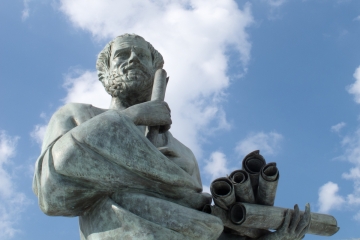
Yes, what is put in front of students on the most important test of their academic careers carries tremendous weight. It conveys to students what is and isn’t important. The greatest thinkers in history have been deeply concerned with questions of human existence and history: What is a good life? What is virtue? How does how I live affect how happy I am? Philosophers and theologians have written on these questions for millennia. However, the SAT/ACT neglect the great philosophical and theological traditions, which in turn leads to further neglect in the classroom. Imagine if every teacher/parent/school district knew they were likely to encounter Aristotle on the most important test? What would the impact be for what is taught in the classroom?

Can you tell readers a bit about the conception of the CLT? How did the idea come about? And if spreading a classical vision of education is your goal, why a test?

I was inspired to make a change in the standardized testing space from my time teaching and college counseling at a Catholic school. The Dominican Sisters who lead the school tried to add a philosophy course, but almost no students signed up to take it. When I questioned students on why they didn’t want to take this course, they told me, “It is not a weighted AP course and I’ll never be tested on it.” The College Board and current standardized tests had tremendous power even over private schools. If we wanted to change curriculum, we had to start at the test.

A very practical question that I’ve had through my friendship with you and the CLT more generally: How was the test made? Who wrote the thing? Who decides on the passages? How are the questions crafted?

Thanks for asking about our CLT development process. From the days when I was the only CLT employee, the test has been the heart of the company. The first test was designed and constructed by a very manual process. I was coordinating closely with the person who selected passages, and that person authored most of the questions, bringing in math expertise and editorial review as needed. For security reasons, we created brand new material for every exam. After five years of overseeing the internal development of thousands of items tied to hundreds of passages, we now draw on the strongest questions to create assessments of perfectly balanced difficulty.

Moving onto the inevitable politics of this all, Ron DeSantis recently introduced legislation to encourage the adoption of the CLT across Florida’s schools and colleges. It’s not hard to imagine a Brian Kemp and other conservative governors following suit, with Democratic governors like Gavin Newsom performatively rejecting it. What’s to keep the CLT from being the conservative test and the SAT from being the liberal test, further dividing our education system along political lines?

I think it depends on what you mean by progressive and conservative. There is no question that the CLT is conservative in the sense that it values the intellectual tradition that gave birth to America. However, many aspects of a classical education, many of what are considered the “useless arts” (poetry, theater, philosophy), have often been preserved by folks on the left. I believe that both sides of the political system have their own love/hate with the classical tradition. Conservatives tend to love that classical education values tradition and the great books of the Western canon, but as exemplified by Marco Rubio, republicans have often failed to value disciplines such as philosophy or classical literature. We make the case that the wisdom of the past should be paid forward, neither neglected by conservatives nor censored by progressives.

I want to talk about classical education more generally. In an interview with the New York Times, you defined it as teaching students to love what is good and not love what is not good. Often, classical education is only discussed as it pertains to curriculum—more Aristotle, less Diary of a Wimpy Kid. I want to know what it looks like in the classroom. What makes instruction, not just book lists or dress codes, classical?

I always say, walking into a classical school classroom and seeing the students who are being formed by this type of education is the best argument for why we need these ideas, texts, and methods in the classroom. The truth is that students are far more intelligent than we give them credit for. If a student is given a novel that was written two years ago, they know that it will be irrelevant in another two years. Whereas, when a student is given a text that has been passed down for millennia—The Iliad or The Odyssey—they know it is something to be treasured and taken seriously.

The classical classroom carries a pedagogy of wonder. Students receive more than a lecture on Nicomachean Ethics—as if it were another “informational text.” They are invited to Socratic discussions of the layers of meaning that have formed a foundation for millennia of thought about right and wrong. In a classical classroom, you are unlikely to find a plethora of secondary source curriculum or textbooks. Instead, you’ll find students reading from primary sources treated with a sense of the sacred by teachers who were themselves deeply moved by the same texts. These methods and curriculums are humanizing and dignifying, and keep students engaged in a lifetime love for learning.

What’s next for the CLT and the classical education movement more generally?

The classical education movement has reached Malcom Gladwell’s tipping point, where it is now known nationally as the leading alternative to mainstream education. When we launched seven years ago, we had to explain the concept of “classical education” to almost everyone we met. Today, most people have some connection to classical education via best-selling books, dozens of conferences, and thousands of schools and homeschool co-ops. The CLT’s aim from day one was to provide a key piece of infrastructure to support the growth of classical education. As the barriers to parental rights fall in state after state, the role of the CLT only increases in importance. We will be the test for families looking for something better for their children.


view

States should embed civic content into statewide reading assessments

Ross Wiener
5.25.2023
Flypaper

Editor’s note: This was first published by The 74.

The recent dismal civics and history results from the Nation’s Report Card put American democracy at risk. Eighth-graders recorded their lowest scores ever in U.S. history and the first decline in civics scores. The decreases were most dramatic for lower-performing students. Just under half of eighth-graders report taking a class primarily focused on civics, and fewer than one-third have a teacher whose primary responsibility is teaching civics. School accountability policies that emphasize reading and math scores have led to less time spent on other essential subjects.

To counter this unproductive narrowing of the curriculum, states should embed civic content into statewide reading assessments. This simple change would incentivize more attention to civic learning while making reading tests more engaging, equitable and accurate.

Just 6 percent of American middle schoolers can read an excerpt from Martin Luther King Jr.’s “I Have a Dream” speech and identify two ideas from the Constitution or Declaration of Independence that King might have been referring to. This is a symptom of the atrophy in the civic mission of schools that represents a grave danger to American democracy. Only 30 percent of millennials think a democratic government is essential, compared with 70 percent of Americans born before World War II. Most millennials say that if Russia invaded the United States, they would not fight to defend our country. These data are a wake-up call that the nation needs to recommit public schools to their foundational purpose: preparing young Americans for citizenship.

Including civic content on every grade’s reading test is low-hanging fruit because it encourages engagement with meaningful issues while signaling to teachers the importance of covering social studies content—all of which improves literacy instruction. While phonics (knowing letter sounds) and decoding (putting together sounds to make words) are essential foundational skills, they are not sufficient for proficient reading. Students also need background knowledge to make sense of what they are seeing on the page. Research shows that when students are given a text about a topic they are familiar with, they perform better on reading tests. Conversely, students perform more poorly when confronted with texts on topics they’ve never learned about, even if they have strong reading skills. 

Louisiana is piloting assessments that put this idea into practice, with promising results. Some texts in the state’s innovative reading test draw directly from books students have read, with additional passages extending into related topics. Designing tests around what students are expected to be taught makes sense and dovetails state expectations for learning, classroom curricula, and reading comprehension assessments.

When students are familiar with the topics being tested, they stay more engaged and do better. Early research reveals that achievement gaps are somewhat smaller on Louisiana’s pilot tests, partly because the opportunity gap is being narrowed by creating more equitable opportunities for students to demonstrate their reading skills. Tests that use random texts privilege students who have more world knowledge from outside of school. Louisiana’s innovative test design encourages teachers to focus on the topics the state wants students to learn and more accurately assesses their reading skills.

Embedding civic content in reading tests would make teachers’ jobs easier and support better student learning outcomes. Every state already has adopted civics standards, and almost all state English language arts standards include expectations for reading and writing in science and social studies. But only Louisiana has prioritized content from its standards in innovative reading/language arts assessments. Every state could make similar progress by making small shifts in the direction it gives to its testing contractor.

Including a focus on civic learning in reading tests is a simple solution that can be implemented by state education commissioners and testing directors without changing any laws or regulations. That said, this shift should be done with key stakeholders through an open and inclusive process. Leading with public engagement and input creates the opportunity to share the rationale and build trust with educators, parents, and policy leaders, minimizing the risk that this becomes a polarizing idea. Parents are likely to support the change because they want tests of what’s being taught in class much more than generic standardized tests.

In 2012, Supreme Court Justice Sandra Day O’Connor said, “the only reason we have public school education in America is because in the early days of the country, our leaders thought we had to teach our young generation about citizenship...that obligation never ends. If we don’t take every generation of young people and make sure they understand that they are an essential part of government, we won’t survive.”

Democracy is being tested in real life. Reading tests can signal the importance of civic learning and lead to more time and attention to this vital content. State education commissioners should make this a first step to reinvigorate public education’s mission as a bulwark of democracy.

view

Another nail in the “money doesn’t matter” coffin

Adam Tyner, Ph.D.
5.25.2023
Flypaper

In recent years, the debate on the impact of financial resources in education has been petering out. Studies showing that more money for schools has had a discernable effect on student academic outcomes, particularly for students from lower-income families, keep accumulating. As this finding has become clearer, Stanford scholars Danielle Handel and Eric Hanushek return to the fray with a chapter highlighting the variation in effects of school spending to be published in the forthcoming volume of the Handbook of the Economics of Education. Hanushek is, of course, the scholar most associated with skepticism about the effects of increased school spending. Hanushek’s and Handel’s new meta-analysis engages the growing—and increasingly sophisticated—school finance literature and offers an interpretation of its results.

In the paper, they identify forty-three of these new, stronger studies of the impacts of schools spending and standardize their inputs and outputs to compare the effects of a 10 percent increase in spending on test scores and high school graduation rates. This standardization process reveals patterns that are obscured when comparing studies with different scales, but most importantly it enables their meta-analysis methodology for examining these studies in aggregate.

Upon examining the standardized results, the authors find generally positive effects of spending increases on both test scores and high school graduation. Out of the sixteen U.S.-based studies with test scores as the outcome, fourteen showed a positive effect of more spending, with nine being statistically significant. For high school graduation, all eighteen studies showed positive effects, with fourteen being statistically significant. Importantly—and in contrast with the older, methodologically-weaker literature on this topic—the authors did not find any negative and statistically significant results of increased spending.

However, the effects of spending on student outcomes varied greatly across the studies, and some showed no effect. Handel and Hanushek say that this suggests that factors other than simply increasing school spending are at play.

To explore that point further, they go on to examine specific inputs that money may be used for. Unlike their findings related to school spending, they found positive, negative, and many statistically insignificant results for class size and no positive effects at all for increased teacher education. Conversely, they found positive effects for teacher experience and small positive effects for performance pay programs for teachers.

The authors interpret these results to conclude that spending more money isn’t enough to guarantee better results; what matters is how money is spent, not how much. Yet the implicit assumption that the estimates of the effects of school spending increases should be highly similar across very different contexts is questionable: Most researchers would consider finding many “statistically significant” positive effects and no such negative effects to be strong evidence of a real effect of spending. This is particularly true when the studies in question are of the strongest class of research design.

Although their interpretation of the results focuses on the varying magnitude of spending impacts, they unfortunately neglect to analyze a well-known heterogeneity of impacts in school spending. Previous research has shown that increased spending typically has the greatest impact when targeted to students from low-income families. For example, one paper cited by Handel and Hanushek finds no statistically significant impact of funding when looking at the overall results (i.e., including all students), but also finds higher test scores and graduation rates for students from less affluent backgrounds. Although the authors acknowledge this difference in effects for various student populations in their review of the literature, it seems like a missed opportunity that they do not themselves conduct this type of analysis.

By finding overwhelming positive effects from increased school funding on student outcomes, this new meta-analysis helps validate that America’s historical school funding gaps exacerbated educational inequities. Now that school funding has risen dramatically and been largely equalized—or even made progressive—we face a new set of challenges. Of obvious importance is how to prioritize school spending, especially as pandemic-era infusions dissipate in coming years. Handel and Hanushek show convincingly that some inputs, such as marginal reductions in class size, are almost certainly not worth their (in this case, tremendous) cost. And even if the “money doesn’t matter” coffin now has more than enough nails, a larger question will live long into the future: How much progressivity is necessary to make up for historical shortfalls and to ensure that students from all backgrounds fulfill their potential?

SOURCE: Danielle V. Handel and Eric A. Hanushek, “U.S. School Finance: Resources and Outcomes,” Handbook of the Economics of Education, Volume 7, forthcoming November 2023.

view

Dire straits: Taking stock of and addressing pandemic-related learning loss

Victoria McDougald
5.25.2023
Flypaper

As the school year winds down, and with the World Health Organization officially declaring the emergency phase of the Covid-19 pandemic over earlier this month, many students, parents, and educators are feeling optimistic and ready to put the difficult, darkest days of the pandemic behind us. One recent poll conducted by the Pew Research Center found that a majority of U.S. parents of K–12 students say they are now “extremely” or “very satisfied” with the quality of education their children are receiving, reflecting a marked rebound from the major dip in satisfaction with schools documented during the pandemic.

But as eager as we are to close the pandemic’s awful chapter in our collective lives, it’s a good time to take stock of the true extent to which the pandemic upended public education over the past three years. New research from the Education Recovery Scorecard Project, a collaboration with researchers from the Center for Education Policy Research at Harvard University and Stanford University’s Educational Opportunity Project, does just that, providing a comprehensive—and very bleak—picture of just how dramatically the pandemic affected student learning across the nation.

The team of researchers reviewed a slew of test scores, public health data, the duration of school closures, voting records and patterns of social activity, employment data, and survey data on family activities and mental health during the pandemic from nearly 8,000 communities in forty states and Washington, D.C. (representing roughly 80 percent of the public K–8 students in the country).

They found that the educational harm to students due to the pandemic is widespread and alarming, but in the hardest-hit districts and communities, it has been nothing short of devastating.

As the researchers summarized in a recent New York Times opinion piece, “Math, reading, and history scores from the past three years show that students learned far less during the pandemic than was typical in previous years. By the spring of 2022, according to our calculations, the average student was half a year behind in math and a third of a year behind in reading.” What’s more, “The pandemic exacerbated economic and racial educational inequality.... By 2022, the typical student in the poorest districts had lost three-quarters of a year in math, more than double the decline of students in the richest districts. The declines in reading scores were half as large as in math and were similarly much larger in poor districts than rich districts.” Heartbreakingly, in some of the hardest-hit communities, such as New Haven, Connecticut; Richmond, Virginia; and St. Louis, Missouri, students fell behind by over a year and a half in math.

So what contributed to these trends, and are they reversable?

The researchers found that test scores declined more in districts where schools were closed longer, and that “the extent to which schools were closed appears to have affected all students in a community equally, regardless of income or race.” In short, where children lived during the pandemic mattered hugely, and they found more variation between districts than within them.

But they also found that the educational impacts of the pandemic were due to out-of-school factors, as well; local conditions and disruptions had large impacts. Specifically, “test scores declined more in places where the Covid death rate was high, in communities where adults reported feeling more depression and anxiety during the pandemic and where daily routines of children and families were most significantly restricted. In combination, these factors put enormous strain on parents, teachers and kids—making it unlikely that adults could help kids focus on school.” Researchers also found that test score declines were smaller in communities with higher voting rates and Census response rates.

Given that most parents believe their child is at or above grade level in math and reading, and say they’re confident that their child’s school is well-preparing him or her for success in college, this latest research is a sobering, but much-needed, reality check for parents, educators, and policymakers, underscoring the urgent need to accelerate our national learning recovery efforts.

To catch students up, the researchers argue, schools can’t just return to business as usual. They stress, “In the hardest-hit communities...schools would have had to teach 150 percent of a typical year’s worth of material for three years in a row just to catch up. It is magical thinking to expect they will make this happen without a major increase in instructional time.” While federal relief money runs out in 2024, efforts might include widespread summer learning opportunities, expanded instructional time in the coming school years, more and better tutoring programs, more mental health supports for students, and new ways of engaging parents. 

There is so much at stake. As the researchers conclude, “If we fail to replace what our children lost, we—not the coronavirus—will be responsible for the most inequitable and longest-lasting legacy of the pandemic. But if we succeed, that broader and more responsive system of learning can be our gift to America’s schoolchildren.”

view

#871: The severity of pandemic learning loss, with Tom Kane

5.24.2023
Podcast
On this week’s Education Gadfly Show podcast, Tom Kane of Harvard University joins Mike Petrilli to discuss his findings from The Education Recovery Scorecard Project. Then, on the Research Minute, Amber discusses a New York City study that investigates how external principal hires and internal principal promotions affect various measures of school quality.

On this week’s Education Gadfly Show podcast, Tom Kane of Harvard University joins Mike Petrilli to discuss his findings from The Education Recovery Scorecard Project. Then, on the Research Minute, Amber discusses a New York City study that investigates how external principal hires and internal principal promotions affect various measures of school quality.

Recommended content:

  • “Parents don’t understand how far behind their kids are in school” —Tom Kane and Sean Reardon
  • “Pandemic learning loss: The role remote education played” —New York Times
  • “American schools would rather not tell parents just how badly behind their children are after the pandemic” —Fortune
  • The study that Amber reviewed on the Research Minute: Marcus Winters et al., The Impact of Principal Attrition and Replacement on Indicators of School Quality, Education Finance & Policy (2023)

Feedback Welcome:

Have ideas for improving our podcast? Send them to Jeanette Luna at [email protected].

view

Cheers and Jeers: May 25, 2023

The Education Gadfly
5.25.2023
Flypaper

Cheers

  • New CDC data show an overall decline in adolescent mental health emergencies. —Education Week
  • Black Americans are experiencing better employment rates, and many have moved into higher-paying, more stable, and more skill-based jobs. —The Wall Street Journal
  • Indiana’s new Career Scholarship Accounts help students participate in a wider range of internships and apprenticeships. —Chalkbeat
  • The National Assessment Governing Board will ask Congress to push the next administration of the National Assessment of Educational Progress from 2026 to 2027, which would ensure that the test doesn’t happen during an election year. —K-12 Dive
  • Montana has become the 46th charter school state. —Montana Free Press

Jeers

  • Some parents are paying to get their teens published in questionable “peer-reviewed” publications to beef up their college applications. —ProPublica
  • Since the pandemic, there’s been a rise in  “school avoidance”—students’ refusal to attend or remain at school. —USA Today
view

What we're reading this week: May 25, 2023

The Education Gadfly
5.25.2023
Flypaper
  • “Why teacher evaluation reforms flopped.” —Matthew Yglesias
  • The Educational Testing Service and the Carnegie Foundation for the Advancement of Teaching are collaborating on new tests they say will promote students’ learning at their own pace and decrease the need for traditional “seat time.” —The 74
  • If released, the complete data set from the National Assessment of Educational Progress may offer a “gold mine” that could help researchers identify student misconceptions and the impact of various factors on student achievement. —Mark Schneider and John Whitmer —
  • A timely forum on Ron DeSantis and the education culture wars. —Education Next
Fordham Logo

© 2026 The Thomas B. Fordham Institute
Privacy Policy
Usage Agreement

National

P.O. Box 110
Burke, VA 22009

202.223.5452

[email protected]

Ohio

P.O. Box 82291
Columbus, OH 43202

614.223.1580

[email protected]

Sponsorship

130 West Second Street, Suite 410
Dayton, Ohio 45402

937.227.3368

[email protected]