Mobile Navigation

  • National
    • Policy
      • High Expectations
      • Quality Choices
      • Personalized Pathways
    • Research
    • Commentary
      • Gadfly Newsletter
      • Flypaper Blog
    • Events
    • Scholars Program
  • Ohio
    • Policy
      • Priorities
      • Media & Testimony
    • Research
    • Commentary
      • Ohio Education Gadfly Biweekly
      • Ohio Gadfly Daily
  • Charter Authorizing
    • Application
    • Sponsored Schools
    • Resources
  • About
    • Mission
    • Board
    • Staff
    • Career
Home
Home
Advancing Educational Excellence

Main Navigation

  • National
  • Ohio
  • Charter Authorizing
  • About

National Menu

  • Topics
    • Accountability & Testing
    • Advanced Education
    • Career & Technical Education
    • Charter Schools
    • Curriculum & Instruction
    • ESSA
    • Evidence-Based Learning
    • Facilities
    • Governance
    • Personalized Learning
    • Private School Choice
    • School Finance
    • Standards
    • Teachers & School Leaders
    • Think Again
  • Research
  • Commentary
    • Gadfly Newsletter
    • Flypaper Blog
    • Gadfly Podcast
  • Events
  • Scholars Program

The Education Gadfly Weekly

Sign Up to Receive Fordham Updates

We'll send you quality research, commentary, analysis, and news on the education issues you care about.
Thank you for signing up!
Please check your email to confirm the subscription.

The Education Gadfly Weekly: Some Republicans want Miguel Cardona gone. They might come to regret it.

Volume 22, Number 3
1.20.2022
1.20.2022

The Education Gadfly Weekly: Some Republicans want Miguel Cardona gone. They might come to regret it.

Volume 22, Number 3
view
High Expectations

Some Republicans want Miguel Cardona gone. They might come to regret it.

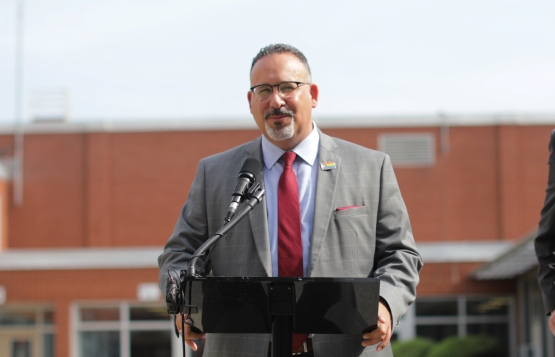
A letter seeking federal law enforcement intervention into threats aimed at school board members has caused a hullabaloo one year into U.S. Secretary of Education Miguel Cardona’s otherwise unremarkable tenure. Though his role in soliciting the letter is unclear, some Congressional Republicans would love nothing more than to see him become the fall guy. They would do well to consider how their thirst for blood might cut both ways.

Dale Chu 1.20.2022
NationalFlypaper

Some Republicans want Miguel Cardona gone. They might come to regret it.

Dale Chu
1.20.2022
Flypaper

On teaching courage

Jennifer Frey
1.20.2022
Flypaper

The case for starting NAEP in kindergarten

Michael J. Petrilli
1.20.2022
Flypaper

Searching for the root of educational inequities in parent-child interactions

Amber M. Northern, Ph.D.
1.20.2022
Flypaper

Classic texts’ continuing value in a more partisan world

Nathaniel Grossman
1.20.2022
Flypaper

Education Gadfly Show #803: John Bailey on Omicron and schools

1.19.2022
Podcast

Cheers and Jeers: January 20, 2022

The Education Gadfly
1.20.2022
Flypaper

What we're reading this week: January 20, 2022

The Education Gadfly
1.20.2022
Flypaper
view

On teaching courage

Jennifer Frey 1.20.2022
Flypaper
view

The case for starting NAEP in kindergarten

Michael J. Petrilli 1.20.2022
Flypaper
view

Searching for the root of educational inequities in parent-child interactions

Amber M. Northern, Ph.D. 1.20.2022
Flypaper
view

Classic texts’ continuing value in a more partisan world

Nathaniel Grossman 1.20.2022
Flypaper
view

Education Gadfly Show #803: John Bailey on Omicron and schools

Michael J. Petrilli, John Bailey, Amber M. Northern, Ph.D., David Griffith, Ph.D. 1.19.2022
Podcast
view

Cheers and Jeers: January 20, 2022

The Education Gadfly 1.20.2022
Flypaper
view

What we're reading this week: January 20, 2022

The Education Gadfly 1.20.2022
Flypaper
view

Some Republicans want Miguel Cardona gone. They might come to regret it.

Dale Chu
1.20.2022
Flypaper

In the latest twist to an ongoing saga that began last September, U.S. Secretary of Education Miguel Cardona came under fire last week for his alleged role in soliciting a six-page letter sent from the National School Boards Association (NSBA) to President Biden. In this letter, the NSBA sought federal law enforcement intervention to threats aimed at school board members across the country. In emails obtained by the watchdog group Parents Defending Education, an NSBA board member wrote that the interim executive director at the time told officers that the letter sent to Biden was “from a request by Secretary Cordona” [sic].

For his part, Cardona quickly denied orchestrating the letter, but it has done little to tamp down the furor. Forty-one House Republicans have since called for Cardona’s head, and twenty-two Senate Republicans wrote a letter to him demanding answers. The hullabaloo comes a year into Cardona’s otherwise unremarkable tenure, during which he’s earned praise from educators, but low marks from parent groups. (The irony is not lost that his predecessor had the exact opposite to contend with.) It should come as no surprise, then, that the name calling and finger pointing trace back to parents taking offense at being labeled “domestic terrorists” in NSBA’s letter, and the perception of having the DOJ and FBI sicced upon them.

Absent a congressional hearing, revealing media leak, or crackerjack investigative journalism, the question of Cardona’s involvement cannot be definitively answered. Although Congressional Republicans would love nothing more than to see him become the fall guy, they would do well to consider how their thirst for blood might cut both ways. Biden could use this dust-up to his advantage, as conservative pundit Jonah Goldberg has observed, if he fired Cardona and publicly repudiated any sub rosa involvement (e.g., “This is not how we do business in my administration”), in effect creating a Sister Souljah moment. Realistically though, it’s hard to see the president throwing any of his friends or allies under the bus, given his track record of passing on other such opportunities, most recently in Chicago, to say nothing of how nothing seems to be going right for him these days. If anything, the White House might have asked Cardona to solicit the letter, which would make it difficult for Biden to disown a scheme of his own staff’s making.

What’s worrying, if not surprising, about the GOP’s eagerness to defenestrate Cardona is how it memory-holes the tireless, behind-the-scenes advocacy that got him installed over a number of less desirable (to Republicans) candidates in the first place. It’s worth remembering that the former head of the nation’s largest teachers union almost became education secretary. Although that didn’t happen, Cardona’s deputy is as establishment as they come when it comes to opposing the flavors of reform typically favored by conservatives. Which is to say, in the extremely unlikely event that Republicans get their way, there’s little reason to believe that whoever follows would be an improvement in their eyes. In fact, chances are that such a person would be more overtly sympathetic to the teachers unions and their distaste for all things reform-related.

To be fair, the effort to tie Cardona to NSBA’s ill-advised missive is not entirely of the right’s doing. In some respects, he brought this upon himself by initially taking parents for granted during the school reopening process, an oversight demonstrated by the absence of parent leaders from last year’s National Safe School Reopening Summit, which Cardona hosted. This omission didn’t go unnoticed, providing fodder for opponents and helping to fuel the narrative that the Biden administration has been ginning up a “war on parents.” In this sense, the pillorying of Cardona can be seen as the latest in a larger attempt to swing Republicans to victory in this fall’s midterms.

Taken together with last November’s gubernatorial contest in Virginia, Republicans have seen how well school debates can be weaponized, and they view the NSBA/Cardona brouhaha as another opportunity to keep banging the drum. Lost in the overcaffeinated fracas is any granularity or nuance. When it comes to the NSBA letter and the DOJ’s response in particular, this means that an informed and good-faith debate about whether threats against school boards require any form of federal government action is completely out of the question.

Following two years of interrupted and intermittent schooling, the anger and frustration being directed at Cardona is understandable, if not somewhat misplaced. These feelings have been amplified by a growing sense that he and his team have prioritized teacher well-being over student recovery. However, without more conclusive evidence that the fix was in on this—in which case, a serious discussion on repercussions is worth having—Republicans should spend less time attacking Cardona and more time pursuing a serious agenda that responsibly addresses the many hurdles our students and families still face.

view

On teaching courage

Jennifer Frey
1.20.2022
Flypaper

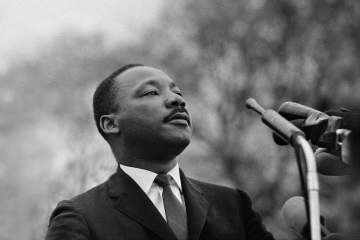
In recent days, American students have been learning about Martin Luther King Jr. and his leadership in the American civil rights movement. Here in the deep South where I live, my children have been taught about the Jim Crow laws and the various forms of racial terrorism that afflicted Black Americans in the previous century: from lynchings and race riots, to the murder of Emmitt Till and the bombing of 16th Street Baptist Church. One of the reasons that King’s activism in particular had so much power is that, in the face of hatred and violence, King led a movement that was explicitly non-violent, rooted in ideals of justice, charity, and human dignity.

King was well aware that he was putting himself in danger. Once he was designated the leader of the Montgomery bus boycott, the FBI opened a file on him, his house was firebombed, his family’s lives threatened, his fellow boycotters physically attacked, and he was imprisoned, and yet he remained resolute that his movement for justice and equality must be based in love rather than hate. He preached to his fellow boycotters that “we must love our white brothers, no matter what they do to us.” King always knew that his enemies wanted him dead or behind bars, but he refused to back down, as he knew his cause was greater than himself and worth all that he could give to it. And it did, sadly, eventually cost him his life.

While we have many debates about how best to teach America’s history of racial discrimination and violence, there is widespread agreement about the necessity of teaching the civil rights movement as part of state curriculum standards, and widespread recognition of King and other leaders in his movement as great Americans. Teaching this period of American history is one of many opportunities for students to receive lessons in the virtues that animated and sustained these historical social justice movements, and yet all too often this opportunity is not taken, because teachers and students lack the conceptual framework to present the material through a virtue lens. But we cannot really understand King’s life (and so many other activists) without recognizing and making explicit his courage and how it was essential to his pursuit of justice and equality.

So what, then, is courage? Courage is a virtue, a stable disposition that regulates the emotion of fear so that one feels the right amount of fear in a given situation. Fear is a felt, urgent desire to withdraw from something that appears to be bad, harmful, or threatening to one’s life or safety. Courage is a mean between two extremes: rashness or lack of fear in a dangerous situation on the one hand, and cowardly excess of fear in such a situation on the other. It is not good to be rash; some things are dangerous and ought to be avoided. But we can also fear in excess, which makes us unable to face danger when it is necessary. Students need to be taught that fear is a natural and normal emotion, but that they can and must exercise control over their fears in order to attain their goals and realize their vision of what is good.

Courage is often presented in dramatic fashion, but it is also a mundane, everyday virtue that is key to student success. Students need to overcome shyness and become capable of speaking their mind to others. They need to learn to take certain risks in the classroom, including the risk of giving the wrong answer or being proven wrong by a peer. They need to develop a strong sense of what risks are worth taking in certain situations and why. They need the rich vocabulary of courage in order to connect their everyday fears and risks at school with their own success and well-being. In particular, they need to see the connection between courage and the attainment of their goals and the preservation of their values.

It is not enough to tell students that courage is good, because courage isn’t simply about knowledge, but about our feelings, perceptions, imagination, and actions. To develop courage, our students must have more than a conceptual framework for understanding it; they need concrete opportunities to grow in courage in the school environment. Therefore, educators need to think about how to integrate courage lessons into their entire curriculum and how they can name, acknowledge, and encourage acts of courage in their classroom, regardless of what is being taught. What does it mean to read, think, imagine, deliberate, and act with courage? What acts of courage can students recognize around them in the school and in their own lives, and even in their own various forms of study? How can teachers model courage for their students?

Students should develop imaginations that are full of courageous characters, as this shapes what they themselves will aspire to become. This can be achieved in English language arts, through plays, novels, creative writing, and in history and social studies where they learn of historical profiles in courage, from Harriet Tubman to the heroes of Flight 93. Students can also be inspired not just by stories of courage, but by people in their everyday lives that exemplify this virtue in their jobs—from firefighters and police officers, to politicians and artists.

Courage is key to student success and essential to human flourishing. It is the virtue that regulates our fears so that we can pursue and preserve what we value and most deeply desire. For Martin Luther King Jr. and his fellow civil rights activists, what they wanted was justice and equality, and their courage is what enabled them to do what was necessary to bring about these goods. Let us teach our students to recognize courage and to understand the depth of its value in human life, but let us also teach them and empower them to be courageous themselves.

view

The case for starting NAEP in kindergarten

Michael J. Petrilli
1.20.2022
Flypaper

Way back in the late 1960s, when federal officials and eminent psychologists were first designing the National Assessment of Educational Progress, they probably never contemplated testing students younger than nine. After all, the technology for mass testing at the time—bubble sheets and No. 2 pencils—only worked if students could read the instructions and the questions, hold a pencil, and fill in their answers. Yes, there have been early-childhood assessments available for decades, instruments like the Peabody Picture Vocabulary Test, but they require teachers to sit down one-on-one with students while students sound out words, identify numbers, and demonstrate other skills in person. Using those sorts of tests for a nationally representative examination system would have been logistically complex, prohibitively expensive, and politically untenable.

Furthermore, in those days, most young children were not enrolled in school. Public education didn’t start until 1st grade in most places. It wasn’t until the 1970s, when most U.S. states offered grants to help school districts start kindergarten programs, that attending school at age five became commonplace (see “What Happened When Kindergarten Went Universal?”, research, Spring 2010). And while preschools existed, only 28 percent of four-year-olds attended them, and their focus was almost entirely on exploration, socialization, and play. With school not starting in earnest until age six or so, testing at age nine made sense.

But how times have changed. Forty-one states now require districts to offer kindergarten, and half of them mandate that students attend. Nationwide, 85 percent of five-year-olds are enrolled in pre-K or kindergarten, with 77 percent in full-day programs. Furthermore, the vast majority of America’s four-year-olds are in some kind of formal preschool program—68 percent, at last count. While there is still vigorous debate about what children should be doing in preschool, there is also a broadly shared expectation that students spend at least part of their time learning pre-literacy and pre-numeracy skills, so they can hit the ground running in kindergarten.

The other big change, of course, is technology. The choice is no longer between cheap bubble tests and expensive, one-to-one batteries. Modern assessments, given over Chromebooks, iPads, and other devices, can accurately assess student skills and understanding even before students can decode words on a page. Questions can be read aloud and speech-recognition software can record students’ verbal responses, which artificial intelligence can comprehend. Animated graphics and engaging videos can make the whole experience feel more like a game than a test.

This is why commercial test providers Curriculum Associates and NWEA have done what the NAEP designers may not have considered: created standardized tests for students as young as five. Banish from your head images of kindergarteners filling in bubble sheets. Instead, imagine kids playing an interactive game, much as they would on an educational app or website, during short testing sessions with plenty of “brain breaks.” The i-Ready and MAP Growth fall kindergarten assessments may look like games, but they also work to gather data that thousands of school districts use to identify student needs, spot trends, and target instruction.

Now that almost all NAEP exams are given on devices, too, there’s little reason to think that officials couldn’t design and offer a kindergarten exam as well.
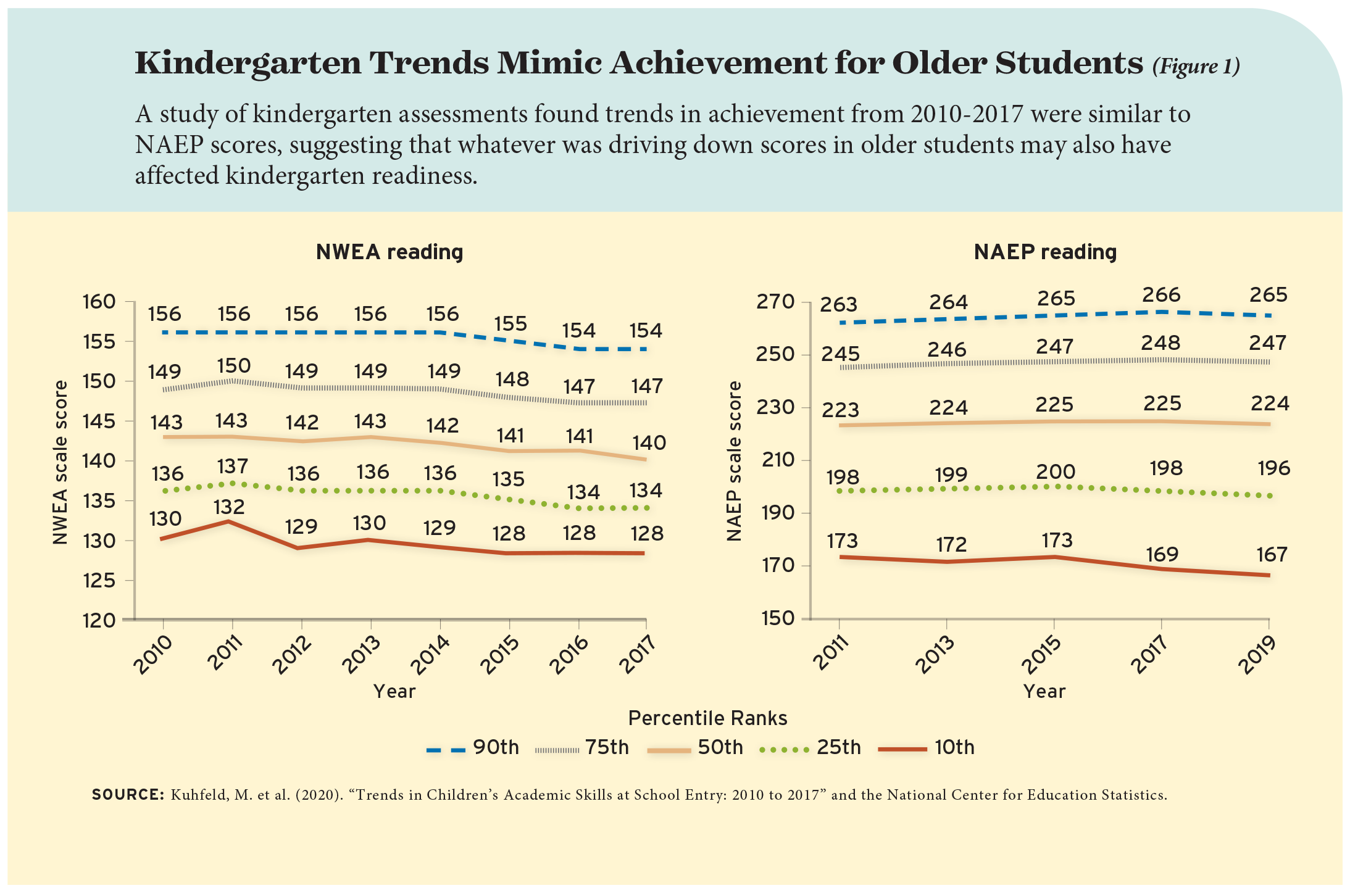
1

Source: Education Next

Assessing early elementary

The rationale for testing academic skills in the early elementary grades is powerful. Consider the federal law behind NAEP, which defines its purpose as “to provide, in a timely manner, a fair and accurate measurement of student academic achievement and reporting of trends in such achievement in reading, mathematics, and other subject matter.” In its current form, NAEP leaves an enormous gap in our knowledge about what’s going on in schools. Most kids in this country are starting their education at age three or four, yet we don’t test them until age nine or until the 4th grade (using either the Long-Term Trend Assessment administered every four years or the newer “main NAEP” tests given every other year). That’s a long time for policymakers and researchers to be left in the dark about what’s going on and what students may or may not be learning.

Grades K–3 are arguably the most critical years of a child’s education, given what we know about the importance of early-childhood development and early elementary-school experiences. This is when children are building the foundational skills they’ll need in the years ahead. One report found that kids who don’t read on grade level by third grade are four times more likely to drop out of high school later on. Why do we wait until after the most important instructional and developmental years to find out how students are faring?

Gaining access to valid and reliable kindergarten data would give us a much better chance at solving some of the mysteries that have stumped the field in recent years, especially about the trends we’ve seen in past decades. Those trends show big gains on NAEP for most students from the late 1990s until about 2010 or so, followed by a plateau and then a more recent, pre-pandemic decline in the achievement of the lowest-scoring students. Since we only have scores from the fourth, eighth, and twelfth grades, most of the conversation naturally focuses on what might be happening in schools that accounts for the trends. But if we had kindergarten data, we might learn that it’s what’s happening before kids ever get to elementary school that is responsible for what we are seeing. What if kindergarten readiness has changed over time, and that’s what’s causing the ups and downs in pupil achievement? We might also gain valuable information about the foundational instruction that young students are receiving in kindergarten from the teacher surveys that go along with the tests. These surveys can tell us, for example, what young students are learning, which instructional materials schools are using, and whether teaching methods are well aligned with the science of reading.

Even the test scores alone would be a huge contribution to our understanding. To get a glimpse of what we might see, consider a recent study by a quartet of scholars (see Figure 1). Using NWEA’s fall kindergarten MAP Growth assessment results from thousands of schools, weighted to represent the national population, they found a similar pattern to the one we see in NAEP data for older children: from 2010 to 2014, scores were mostly flat, followed by a significant decline through 2017 (when their time series ended).

This is intriguing but also frustrating, since we don’t have data from before 2010—NWEA wasn’t testing enough kindergartners back then—or for more recent years. But it indicates that whatever was driving down scores for older students, starting in the mid-2010s, might also have been reducing kindergarten readiness. And it also indicates how much more we could gain from the current NAEP administration with kindergarten data. Testing students in kindergarten could also give the public and policymakers a better understanding of how much students are learning in grades K–4, by establishing a baseline against which growth can be measured.

A worthy challenge

To be sure, the wizards who oversee the NAEP would have to figure out a number of technical and design challenges. For example, should the test focus on kindergarten readiness, and therefore be given in the fall? Or should officials focus on a spring assessment, to align with tests for the fourth, eighth, and twelfth grades? How will they make sure that all test takers have access to similar devices and connectivity, so the testing conditions are the same from school to school? What if some kindergarteners are more familiar with technology than others? And when it comes to literacy, should the assessment focus solely on fluency, or the skill of sounding out words and making sense of them, or should it also focus on comprehension, even if students aren’t actually reading yet themselves? How will NAEP’s sampling work given that kindergarten, while ubiquitous, is not universal?

Even with modern technologies, kindergarten assessments aren’t quite as valid and reliable as those for older students. At least that’s the case for i-Ready Assessment and MAP Growth, partly because their vertical scales start at grade K and there’s always more statistical noise at the bottom and the top of such scales. Officials would need to figure out how to make a kindergarten NAEP as trustworthy as its other assessments.

And then there are the financial and political headwinds. As it stands, NAEP doesn’t have enough money to implement all of the assessments officials would like to give. So if we were to add kindergarten testing, Congress would either have to provide more money, or tests in other subject areas or grade levels would need to be cut.

None of these challenges should be insurmountable. If NAEP were being designed today from scratch, it’s hard to imagine that kindergarten assessments would not be included in the package. We’ve been operating in the dark around early childhood long enough. It’s time to turn on the lights.

Editor’s note: This was first published by Education Next.

view

Searching for the root of educational inequities in parent-child interactions

Amber M. Northern, Ph.D.
1.20.2022
Flypaper

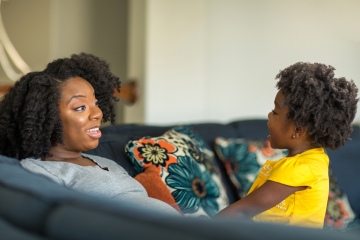
Research (as well as common sense and folk wisdom) has shown that “parental investments” are critical to the healthy development of young children. However, studies also show that such investments—including time spent with children and other non-financial inputs—differ substantially by socioeconomic status (SES). A recent NBER paper explores how parental beliefs about child development, including the parents’ own role in it, could impact socioeconomic inequalities and whether those beliefs can be changed in hopes of narrowing that gap.

A trio of researchers from the University of Chicago begin by showing dramatic differences in parental beliefs across SES, with higher-SES parents more likely to believe that their investments impact child development (with “investments” here defined as high-quality parent-child interactions). They then carry out two field experiments focused on low-SES families to see if their beliefs are malleable and, if so, whether those revised beliefs improve their investments in their child and, subsequently, their child’s outcomes.

The first experiment involved newborns: The researchers partnered with ten pediatric clinics in the Chicago metro area that all reached traditionally medically underserved, underinsured, or uninsured populations. They worked with parents during their first well-child visit, three to five days after birth. A total of 475 parent-child dyads met the study’s SES and health eligibility criteria and were randomized into treatment and control groups. Treatment group parents watched four videos (ten minutes each) when they arrived at the clinic for additional well-child visits at one, two, four, and six months. The videos provided information on the role of parents in the early stages of child development, on brain malleability, on babies’ capabilities, and on how parents can leverage this knowledge in their daily routines with their baby, specifically around what language-rich interactions look like. The control group either watched four videos about safety tips for babies or did not watch videos.

The second experiment was a more intensive, home-visit program and, like the other experiment, emphasized language-rich interactions. The researchers recruited parents of twenty-four- to thirty-month old children in medical clinics, grocery stores, daycare facilities, and public transportation venues around Chicago. A total of ninety-one dyads met the SES and health criteria and again were randomized into treatment and control groups. The treatment group received two home visits each month for six months; the twelve visits were an hour each and followed a curriculum designed to foster both cognitive and social-emotional development by improving parental beliefs. The curriculum started with a video that covered a specific area of child development (such as linguistic interaction, incorporation of math into an everyday routine, or how to encourage your child), followed by a home visitor-led activity with the parent or caregiver to demonstrate how to put the concept into practice. The control group received a nutrition intervention with packets of information reviewed with the parents and caregivers during the home visits, which took place every six weeks over six months.

In both experiments, they collected extensive data about parental beliefs—such as whether they agree with a statement like “Children zero to two years old can learn just as many words from educational TV as they can from their parents”—data on children’s skill levels, and the quality of parent-child interactions. The latter was measured using audio recordings of all the sounds produced by and around the child (captured by a sound-recording T-shirt worn by the child) during a series of eight-hour recording days. Recordings were processed using speech recognition software to separate language from noise, sentences from words, etc., and to gauge the linguistic quality of those sounds.

Both experiments had an impact on parents’ beliefs and child outcomes, but the less-intensive version did not last; improvements faded by twelve to eighteen months. The more intensive home visits positively impacted parent-child interactions, vocabulary, math skills, and social-emotional skills, lasting the full timeline of the experiment, i.e., 3.5 years later. The researchers supplemented their results with data from a related study and found that a 1.0 standard deviation (SD) increase in parental knowledge and beliefs when the child is between thirteen and sixteen months is associated with a 0.8 to 1.2 SD increase in language skills later—up to three years and four months old. Their estimates suggest that parent beliefs alone can explain up to 18.7 percent of the variation in child language skills at this early age.

Everyone knows that there are multiple deep drivers of inequality that prevent many kids from getting a fair start in life. These daunting challenges can discourage even our best efforts. Thankfully, this study points to one potential pathway to lessen one particular mechanism of said inequality. Yet we don’t have data tracking these children into school. Will the improvements from the more intensive version of the experiment fade over the long term? It would help to know that answer before engaging in what appears to be intensive but promising parent empowerment work.

SOURCE: John A. List, Julie Pernaudet, and Dana Suskind, “It All Starts with Beliefs: Addressing the Roots of Educational Inequities by Shifting Parental Beliefs,” NBER WorkingPaper #29394 (October 2021).

view

Classic texts’ continuing value in a more partisan world

Nathaniel Grossman
1.20.2022
Flypaper

“This is a book about my liberal education,” begins Roosevelt Montás’s book, Rescuing Socrates. Through four lengthy chapters, he details “the way in which liberal education has altered and enriched the trajectory of my life.” The book—which effortlessly swings between Montás’s own story and his meditations on the Western scholarly tradition—defies easy categorization. It is part memoir, part history of ideas, and part undergrad course syllabus.

Liberal education, by which students develop competencies in multiple humanistic disciplines such as literature, art, history, and philosophy, is the ideal education for the virtuous citizen in Montás’s view. Its central feature is “its concern with the condition of human freedom and self-determination.” As distinguished from professional and technical educations, it “looks to the meaning of human life beyond the requirements of subsistence—instead of asking how to make a living, liberal education asks what living is for.” And it often incorporates classic texts into its curricula.

The last component is familiar to Montás, who is a senior lecturer at Columbia University’s Center for American Studies, and previously was director of that institution’s Center for the Core Curriculum. A long-lived and much-lauded type of Great Books program, Columbia’s core curriculum takes first year undergrads on a journey of literary and philosophical masterworks from antiquity to the present day. Their authors—St. Augustine, Plato, Aristotle, Freud, Nietzsche, Gandhi—fill the pages of Montás’s book.

As the author readily admits, this mode of education has fallen out of favor in recent decades. In her review of the same book, Naomi Shaefer Riley notes that “today’s most fortunate students are rarely getting an actual liberal arts education,” and when they do, “they spend a lot of time protesting its bias and its irrelevance.” Derided as too old, too white, too male, too Western, texts such as The Republic and The Iliad are being abandoned by American educators. “Be like Odysseus and embrace the long haul to liberation (and then take the Odyssey out of your curriculum because it’s trash),” a teacher tweeted in June. A high school teacher responded, “Very proud to say we got the Odyssey removed from the curriculum this year!”

It is not surprising that Montás discovers Plato exactly there: in the trash. Passing by a pile of garbage left on the street corner one winter night in the late ‘80s, a teenaged Montás notices a stack of hardback books. One is a copy of Plato’s dialogues. He rescues the book from the heap (providing the inspiration for the book’s title) and takes a giant leap forward on his academic journey, one that eventually leads him through the ivy gates.

It is a fascinating journey, one both intellectual and geographical. Born into poverty in the Dominican Republic, Montás made his way to New York City with his older brother just before his twelfth birthday. His mother had emigrated years before to establish a life for her family. His father, a would-be Marxist revolutionary, left the family early on to return to the Dominican Republic. Unfamiliar with American culture and speaking almost no English, Montás struggled to find his place in his new homeland. Unprepared for winter, he shivered in a leather jacket, not knowing the value of down-filled coats. His assimilation began with his discovery of Plato.

Like the classical canon itself, assimilation is increasingly viewed as a relic of a past, less-enlightened age. The commandments of identity politics tell us not only to respect our cultural differences, but also to exalt them. Nowhere is this tenet as faithfully observed as in academe. “The idea that there can be an American culture that everyone joins seems to be anathema to some academic thinkers,” acclaimed education thinker E.D. Hirsh told the Wall Street Journal in an interview last year.

“A liberal education can only take place when those notions [of identity] are held lightly and seen through,” Montás tells us. His initiation into the classics is not coercive or “problematic,” to borrow a term du jour. Instead, Montás discovered that, “As a young person trying to understand what it meant to be who I was and to be where I was, I found Plato a genuine affirmation of my identity.” This identity is not limited to race, ethnicity, or immigration status, “but something more fundamental.” The Platonic dialogues, in which the philosopher Socrates fearlessly pursues truth, beauty, and goodness through conversations with the citizenry of Athens, “pointed toward what felt like the most worthwhile way of living for me.” The reader infers that Montás has rescued Socrates and the ancient teacher has returned the favor.

Moral relativism is another progressive ideal that Montás rebukes. The purpose of education is not only the intellectual development of the student, but also the moral cultivation of the citizen. “Liberal education is not possible without a recognition that inquiry into the life of virtue—that is, into the best and most excellent life for a human to live—is not a futile endeavor but, in fact, leads to a deeper self-understanding and, in this sense, a fuller life.” The polymath scholar John McWhorter, who also taught a one of Columbia’s core curriculum courses, noted that doing so “made a better person out of me, as well as the dozens of students I ushered through it.” Yet educators have dumped this moral cultivation, much like the volume of Plato that Montás discovered in the trash. This dereliction of duty begins in our compulsory K–12 schools. A fly on the wall in any American elementary classroom would hear more about self-esteem than about virtue.

Montás’s convincingly makes the argument that the classics enrich any life pursuit. By doing so, his story should appeal to anyone who cares about education. There is something here to illuminate and inspire, for both curricular traditionalists and progressive educators, for both pragmatic business majors and idealistic scholars of philosophy. At the very least, it will motivate the reader to think twice before tossing away that dusty volume of The Odyssey.

view

Education Gadfly Show #803: John Bailey on Omicron and schools

1.19.2022
Podcast
 

On this week’s Education Gadfly Show podcast (listen on Apple Podcasts and Spotify), John Bailey, nonresident senior fellow at the American Enterprise Institute, joins Mike Petrilli and David Griffith to discuss Omicron’s impact on schools and whether the virus will soon be endemic. Then, on the Research Minute, Amber Northern examines a study about the most in-demand college majors.

Recommended content:

  • John Bailey’s daily Covid-19 policy updates on Substack and his March 2021 review of public health research on schools for AEI, “Is it safe to reopen schools? An extensive review of the research.”
  • The study that Amber reviewed on the Research Minute: Steven W. Hemelt et. al., “College Majors and Skills: Evidence from the Universe of Online Jobs Ads,” NBER Working Paper #29605 (December 2021).

Feedback welcome!

Have ideas or feedback on our podcast? Send them to our podcast producer Pedro Enamorado at [email protected].

view

Cheers and Jeers: January 20, 2022

The Education Gadfly
1.20.2022
Flypaper

Cheers

  • Harrison Bader of the St. Louis Cardinals baseball team volunteered to substitute for a class to help with teacher shortages. —Belleville News-Democrat
  • Learning loss is leading to changes in school calendars, including starting earlier and ending later. —The 74
  • New York City Mayor Eric Adams has a chance to leave a strong education legacy by lowering barriers to charter school expansion. —Wall Street Journal

Jeers

  • Progressives have refused to admit that school closings were a historic and foreseeable blunder. That’s how they lost the public’s trust. —Jonathan Chait
  • “Nearly half of all school and district leaders (44 percent) say they are receiving more threats of violence by students now than they did in the fall of 2019.” —Education Week
view

What we're reading this week: January 20, 2022

The Education Gadfly
1.20.2022
Flypaper
  • Partisan overtones in the National School Boards Association’s letter to President Biden has led many members to withdraw or refuse to renew their membership. —Washington Post
  • “The empty pageantry of education research.” —Rick Hess and Mike Goldstein
  • In his first year, Secretary Cardona has managed to improve relations between the U.S. Department of Education and districts, but critics feel he didn’t prioritize students and reopening enough. —The 74
  • “The volatile debate over how to teach about America’s racist past is wreaking havoc on states’ processes for deciding what students will learn about history and social studies.” —Education Week
Fordham Logo

© 2026 The Thomas B. Fordham Institute
Privacy Policy
Usage Agreement

National

P.O. Box 110
Burke, VA 22009

202.223.5452

[email protected]

Ohio

P.O. Box 82291
Columbus, OH 43202

614.223.1580

[email protected]

Sponsorship

130 West Second Street, Suite 410
Dayton, Ohio 45402

937.227.3368

[email protected]